Understanding Case Volume Evaluation in Residency
Case volume evaluation is one of the most important—and most misunderstood—components of residency training. For surgical and procedure-heavy specialties, your total surgical volume and procedure numbers directly influence your clinical confidence, board eligibility, and competitiveness for fellowship and jobs. Yet, not all case numbers are created equal, and not all programs provide the same quality of operative exposure.
This guide breaks down how to critically assess residency case volume, what numbers actually mean, how accrediting bodies track them, and how you can strategically use this information when choosing programs and shaping your own training.
We’ll focus on surgical and procedural specialties (general surgery, orthopedic surgery, neurosurgery, OB/GYN, ENT, urology, interventional radiology, cardiology with cath lab time, GI with endoscopy volume, anesthesia, EM procedures, etc.), but the principles are broadly applicable.
1. What “Case Volume” Really Means
1.1 Definitions and Key Concepts
When programs or residents talk about “case volume,” they may be referring to different things. It’s critical to clarify:
- Total cases: The sheer number of cases a resident participates in, usually logged over the course of residency.
- Primary surgeon vs. assistant:
- Primary surgeon / operator: You are performing the core components of the procedure.
- Assistant: You are helping, retracting, closing, or doing a portion, but not leading.
- Index cases: Key, representative operations or procedures that define competency in a specialty (e.g., laparoscopic cholecystectomy in general surgery, total joint arthroplasty in orthopedics).
- Breadth vs. depth:
- Breadth: The range of different procedures you see.
- Depth: How many times you repeat the same type of procedure.
- Autonomy: Not captured by raw numbers alone; refers to how independently you operate under supervision.
When you evaluate case volume, you must look beyond a single number. A residency that advertises “2,000+ cases” could still leave you underprepared if:
- Most of those are extremely minor procedures.
- You primarily functioned as an assistant rather than the primary operator.
- Your exposure to core index cases or subspecialty areas was thin.
1.2 Why Case Volume Matters
For surgical and procedural training, repetition is how you build skill. Benefits of robust case volume include:
- Skill acquisition: Fine motor skills and decision-making sharpen with repeated practice.
- Pattern recognition: You develop an intuitive sense of variation, complications, and normal vs abnormal.
- Confidence and readiness: High case volume associates with greater comfort managing complex patients and complications.
- Board certification and accreditation: Many boards have minimum procedure numbers or case categories required to sit for exams.
- Fellowship and job applications: Recruiters and fellowship directors often ask about operative logs or expected surgical volume.
However, more isn’t always better. A very high case volume in a chaotic, poorly supervised setting may lead to:
- Burnout
- Inconsistent teaching
- Shortcuts in documentation and reflection
- Gaps in non‑technical skills (teamwork, communication, patient counseling)
The balance between quantity, quality, and supervision is key.
2. How Accreditation and Boards Track Case Volume
2.1 Logging Systems (e.g., ACGME Case Log System)
For ACGME-accredited programs in the United States, most surgical and procedural specialties use an official case log system:
- Residents log:
- Type of case (by CPT or defined category)
- Role (primary, assistant, teaching assistant)
- Patient age group (adult, pediatric, etc.)
- Setting (inpatient, outpatient, emergency)
- Program directors and clinical competency committees (CCCs) review logs regularly.
- Aggregated data are compared to national benchmarks and minimums.
Even if you’re not in the U.S., most structured residency systems have some version of:
- Minimum exposure requirements
- Recommended case targets
- Formal or informal logging
2.2 Minimums, Benchmarks, and Why They’re Not the Whole Story
Most specialties define minimum case numbers across categories—for example (illustrative, not exact):
- General surgery: Minimum numbers of hernia repairs, cholecystectomies, colorectal cases, endoscopies, etc.
- OB/GYN: Vaginal deliveries, C‑sections, hysterectomies, operative laparoscopies.
- Orthopedics: Trauma cases, arthroplasties, spine, hand, pediatric orthopedics.
- Anesthesiology: Neuraxial anesthesia, peripheral nerve blocks, OB, pediatric, cardiac cases.
- EM: Airway procedures, central lines, chest tubes, procedural sedation, ultrasound exams.
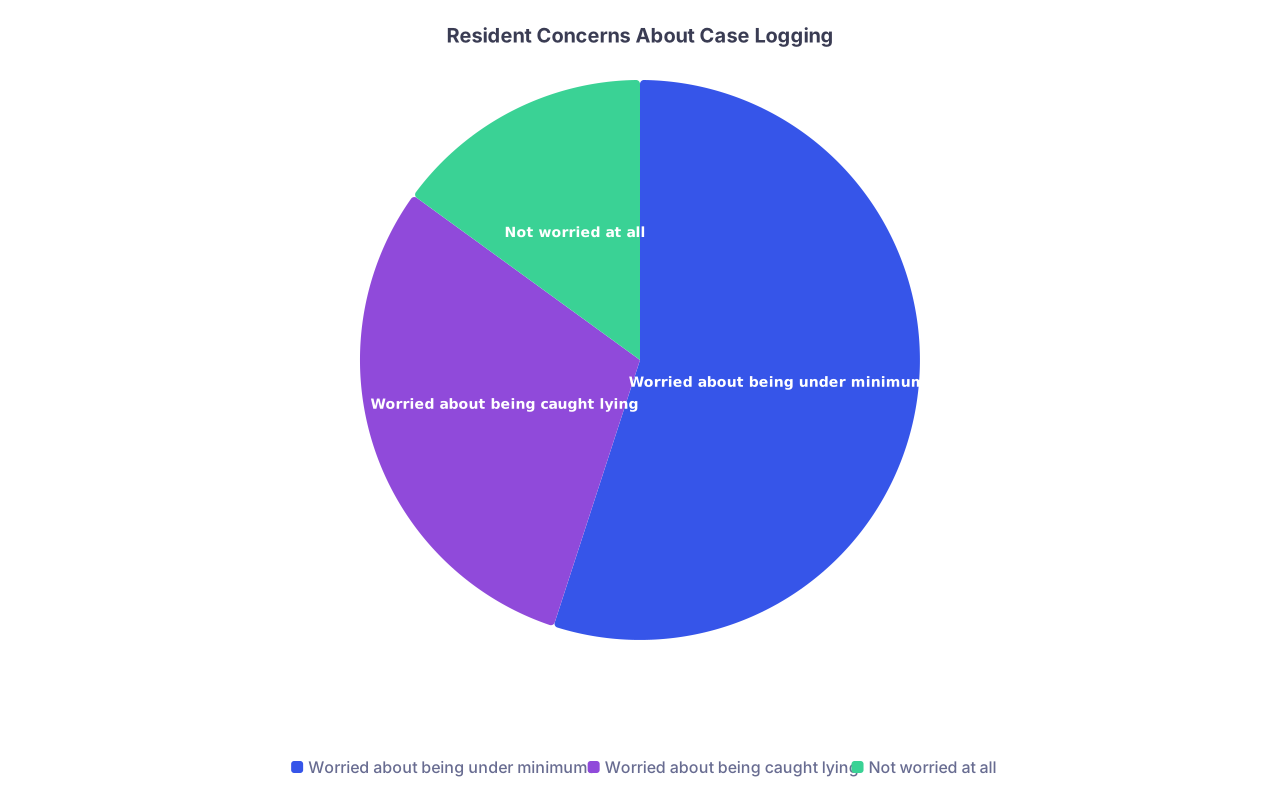
These required procedure numbers are usually set to represent a floor, not a target for excellence. Being just at the minimum:
- Typically means you’re “eligible,” not necessarily confident.
- May signal that your exposure was limited in certain key areas.
When evaluating programs, ask:
- Where do your graduates fall relative to national medians?
- Are we barely clearing minimums, or consistently exceeding them?
- Are there any categories where residents regularly struggle to meet requirements?
3. How to Evaluate Surgical Volume and Procedure Numbers in Programs
3.1 Where to Find Case Volume Information
Sources of information include:
- Program websites:
- Some list average case numbers for graduating residents (e.g., “Residents graduate with ~1,200 major cases”).
- Often mention signature strengths: “High trauma volume,” “Busy transplant service,” “Largest OB service in the region.”
- ACGME or accrediting body data:
- Public reports sometimes show case volume trends or citations related to inadequate exposure.
- Program information sessions / open houses:
- Ask directly about procedure numbers and distribution.
- Interviews and second looks:
- Talk to current residents—especially chiefs—about their own case logs.
- GME reports or outcome data:
- Some institutions publish annual summaries of resident experience, including average surgical volume.
3.2 Questions to Ask Residents and Faculty
When you meet people from the program, go deeper than “Is your case volume good?” Consider specific, targeted questions:
About overall case volume
- “What is the average total case volume of recent graduates in your specialty?”
- “How do your graduates’ procedure numbers compare with national medians?”
- “Are there particular areas where volume is exceptionally high or relatively low?”
About distribution and progression
- “How quickly do juniors get into the OR/procedure suite?”
- “Do PGY-1s and PGY-2s get hands-on experience or mostly assist?”
- “By PGY-4 or PGY-5, are chiefs truly leading major cases routinely?”
About core and index cases
- “Are there any index cases or categories where residents struggle to meet minimums?”
- “How are rare or complex cases distributed among residents?”
About autonomy and supervision
- “Who typically does the main portions of a major case: fellow, senior resident, or attending?”
- “How is autonomy balanced with patient safety here?”
- “Do you feel like you’re ready to practice independently by graduation?”
About documentation, feedback, and quality
- “How often do attendings formally review your case log?”
- “Does the program intervene if someone is low in a particular category?”
Use these to get beyond marketing language and understand actual practice.
3.3 Interpreting “High Volume” Claims
Programs often brand themselves as “high volume.” Assess what that practically means.
Red flags:
- “High volume” mentioned, but no numbers or examples provided.
- Residents describe:
- Very long hours
- Lots of scut work
- Minimal time actually performing key portions of procedures.
- Significant reliance on mid-levels (APPs) that may limit resident hands-on experience in the OR or procedure rooms.
Promising signs:
- Clear, concrete data: “Our graduating residents average ~1,800 major cases with X in category A, Y in category B…”
- Residents describe:
- Early and increasing operative responsibility.
- Direct feedback on technique.
- A culture of teaching in the OR, not just throughput.

4. Balancing Volume with Autonomy, Complexity, and Education
4.1 Case Volume vs. Case Complexity
Two residents might each report 1,500 cases, yet their training experiences could be radically different.
Consider:
- Complexity mix:
- Resident A: Mostly straightforward elective cases (hernia repairs, bread-and-butter arthroscopies, routine deliveries).
- Resident B: High exposure to trauma, oncologic resections, complex revisions, and re-operations.
- Pace of cases:
- High case numbers achieved by doing many quick, low-complexity procedures may impress on paper but provide limited decision-making challenges.
- Preoperative and postoperative involvement:
- A resident deeply involved in pre-op workup and post-op care for complex patients learns far more than one who just “drops in” to do a procedure.
Ask:
- “Do residents get sufficient exposure to complex trauma / oncologic / revision / high-risk cases?”
- “How are case assignments balanced across complexity levels at each PGY?”
4.2 Autonomy: Who Actually Operates?
Autonomy is where case volume evaluation becomes truly nuanced.
Consider these scenarios:
- Fellow-heavy environment:
- If many fellows share the same operative pool (trauma, vascular, transplant, cardiothoracic), they may claim the most complex and index cases.
- Residents may have solid numbers but limited experience as true primary operator on key procedures.
- Resident-driven OR:
- Residents are the primary operators, with attendings guiding and assisting.
- Senior residents may act as teaching assistants, elevating both their own and juniors’ skills.
You should probe:
- “Is this a fellow-heavy program? How are cases divided between fellows and residents?”
- “As a senior, will I be the default primary operator on major cases, or second in line after fellows?”
4.3 Education vs. Service: Is Volume Educational or Just Work?
High volume can sometimes reflect a high service load more than strong education. Warning signs include:
- Residents spending much of the day:
- Managing floor calls and admissions.
- Doing paperwork/transfers.
- Covering multiple services with minimal OR or procedural presence.
- OR days where:
- Attendings prioritize speed and efficiency.
- Limited intraoperative teaching (“Just keep up” mentality).
- Residents do limited portions of the case to “save time.”
Prefer programs where:
- Service tasks are structured to protect operative and procedural time.
- There is explicit recognition of competing priorities—and a plan to safeguard training needs.
- Attendings are recruited, promoted, and rewarded in part for education, not just productivity.
4.4 Objective and Subjective Markers of Good Volume
Objective markers:
- Graduates consistently clear board-required case minimums with a comfortable margin.
- Average case numbers are above national medians without extreme outliers.
- No recent accreditation citations for inadequate clinical exposure.
Subjective markers:
- Seniors feel confident to practice independently without extra “transition” training.
- Graduates match into strong fellowships (when desired) with no concern about technical readiness.
- Alumni feedback (shared informally or via program surveys) consistently praises operative experience.
5. Strategically Using Case Volume Data as an Applicant and Resident
5.1 Weighing Case Volume Against Other Program Factors
Case volume is essential, but it’s one piece of a broader picture. When choosing a program, integrate it with:
- Culture and wellness:
- Extremely high surgical volume plus a toxic culture can be unsustainable.
- Research and academic support:
- Some highly academic programs may have slightly lower volume but excel in research and mentorship.
- Fellowship aspirations:
- Certain subspecialties may favor:
- Broad, high-volume general experience, or
- Highly specialized exposure at a quaternary center.
- Certain subspecialties may favor:
- Location and personal factors:
- Burnout risk is higher if you’re chronically unhappy outside work.
Think of case volume as necessary but not sufficient: you must have enough, but once past a certain threshold, marginal gains may matter less than quality, guidance, and career alignment.
5.2 Practical Example: Comparing Two Hypothetical Surgery Programs
Imagine two general surgery programs:
- Program X:
- Graduates average 1,300 major cases.
- High trauma volume, large community catchment area.
- Limited subspecialty services; complex oncologic and hepatobiliary cases often referred elsewhere.
- No fellows—residents are primary on almost everything.
- Program Y:
- Graduates average 1,700 major cases.
- Large academic center, transplant, HPB, oncologic surgery, thoracic, vascular, etc.
- Multiple fellows in each subspecialty.
- Residents often assist on the most complex cases; primary on intermediate-level cases.
Which is “better” depends on your goals:
- If you want to be a community general surgeon with broad hands-on experience and high autonomy, Program X may be ideal.
- If you’re targeting a complex surgical fellowship, Program Y’s exposure to advanced subspecialties, research, and academic environment may outweigh reduced autonomy in the rarest cases.
The key lesson: use case volume evaluation in context, not as a simple ranking metric.
5.3 As a Resident: Managing and Maximizing Your Own Case Volume
Once you’re in a program, you still have considerable influence on your case volume and mix.
Practical tips:
Log cases consistently and accurately
- Get in the habit of logging cases daily or weekly.
- Make sure your role (primary vs assistant) is recorded correctly.
- Periodically review your totals by category with a mentor or program director.
Identify gaps early
- Are you low on:
- Specific categories (e.g., endoscopy, trauma laparotomies, OB emergencies)?
- Certain age groups (pediatrics, geriatrics)?
- If so, proactively request rotations or elective time to fill these gaps.
- Are you low on:
Volunteer strategically
- When there’s a “call for help” for a case, offer to scrub in—especially in underrepresented categories.
- Off-service and elective rotations: choose those that supplement, not duplicate, your core experience.
Communicate with attendings
- Let attendings know where you are in your learning curve:
- “I’m trying to solidify my skills in [procedure]. Could I take the lead on the next one, with your guidance?”
- Many faculty are happy to structure a case around your educational needs if you articulate them.
- Let attendings know where you are in your learning curve:
Monitor for over-service
- If your schedule is dominated by non-educational service tasks to the detriment of procedural experience, talk with your chief or program leadership.
- Well-run programs want to know when training needs aren’t being met and will often adjust workflows.

6. Special Considerations by Specialty and Setting
6.1 General Surgery and Surgical Subspecialties
For general surgery, ortho, neurosurgery, ENT, urology, plastics, etc.:
- Pay close attention to:
- Index procedure numbers (e.g., colectomies, hernia repairs, arthroplasties).
- Endoscopy exposure (for general surgery).
- Trauma vs elective mix.
- Laparoscopic vs open vs robotic experience.
- Community vs academic:
- Community programs often offer higher autonomy and bread-and-butter case volume.
- Academic centers offer exposure to rare, complex cases and research.
6.2 OB/GYN
- Evaluate:
- Number of vaginal deliveries, C‑sections, operative deliveries.
- Volume of benign gynecologic surgery and oncologic exposure.
- Minimally invasive surgery exposure (laparoscopy, hysteroscopy, robotics).
- Consider the presence of maternal-fetal medicine and gyn onc fellows and how they share cases with residents.
6.3 Anesthesiology and Emergency Medicine
For anesthesia:
- Assess:
- Proportion of cases by subspecialty (OB, peds, neuro, cardiac).
- Volume of neuraxial blocks and peripheral nerve blocks.
- Exposure to high-acuity ICUs and advanced airway management.
For EM:
- Focus less on “cases” and more on specific procedure numbers:
- Intubations, central lines, chest tubes, reductions, laceration repairs, ultrasound-guided procedures.
- Critically ill resuscitations (codes, sepsis, trauma activations).
- Trauma center level and overall ED acuity shape procedural exposure.
6.4 Internal Medicine and Non-Surgical Specialties
Even in non-surgical fields, procedure exposure matters:
- Internal Medicine:
- Paracenteses, thoracenteses, lumbar punctures, bone marrow biopsies, central lines.
- Cardiology fellowships:
- Cath lab time, echocardiography interpretation volumes.
- GI fellowships:
- Endoscopy numbers (EGD, colonoscopy, advanced procedures).
Here, case volume evaluation often focuses on:
- Adequate procedural exposure for competency.
- Sufficient interpretive volumes (e.g., ECGs, echos, imaging studies).
FAQs: Case Volume Evaluation for Residency
1. What is a “good” case volume number for residency?
There is no single “good” number; it depends on the specialty, program structure, and national benchmarks. As a rule of thumb:
- You should clearly exceed board-required minimums.
- Your total procedure numbers should be in line with or above national medians for your specialty. What matters most is not just volume, but your role, autonomy, and exposure to key index cases.
2. Should I always choose the program with the highest surgical volume?
Not necessarily. Extremely high surgical volume can come with:
- Limited teaching and rushed cases.
- Heavy service demands and burnout.
- Less individual attention or mentorship. You’re better served by a program with solid volume plus strong teaching, supportive culture, and alignment with your career goals, rather than raw numbers alone.
3. How can I tell if fellows will take away cases from residents?
Ask current residents directly:
- “How often do fellows take key cases that residents might otherwise do?”
- “Do fellows add to or detract from your learning?” Look for:
- Transparent policies about case allocation.
- Resident testimonials that they still feel they get excellent operative exposure despite fellows.
4. I’m already in residency and worried my procedure numbers are low. What should I do?
Act early:
- Review your case log with your program director or mentor.
- Identify specific categories where you’re low.
- Request targeted rotations, electives, or additional shifts in those areas.
- Volunteer for underrepresented cases and communicate your needs to attendings. Programs are responsible for helping residents meet case requirements, but you must advocate for yourself and provide data from your logs.
Case volume evaluation is both a science and an art. Understanding how to interpret surgical volume and procedure numbers—in context of autonomy, complexity, and educational quality—will help you choose the right program and shape the best possible training experience for your career.