Understanding Case Volume in Urology Residency
For an MD graduate residency applicant in urology, the concept of case volume—how many procedures you perform and what types—plays a major role in both how you evaluate programs and how program directors evaluate you. In a highly procedural field like urology, your surgical volume and procedure numbers directly influence your technical skill development, confidence in the OR, and readiness for independent practice or fellowship.
As an MD graduate from an allopathic medical school, you are already familiar with ACGME case log requirements in general. In urology, however, the stakes are uniquely high: the specialty is small, the learning curve is steep, and exposure can be highly variable across programs. Thoughtful case volume evaluation helps you avoid underexposure, identify robust training environments, and communicate convincingly during the urology match.
This article will walk you through:
- What “good” case volume looks like for urology
- Which procedures and subfields you should track
- How to evaluate residency programs beyond just raw numbers
- How to use case volume data strategically in your urology residency application and interviews
Why Case Volume Matters in Urology
1. Skill Acquisition in a Procedural Specialty
Urology is fundamentally a procedural discipline. Across residency, you must progress from observer to assistant to primary surgeon on:
- Endoscopic procedures (e.g., TURP, TURBT, ureteroscopy, stone procedures)
- Open and laparoscopic surgeries
- Robotic urologic oncology and reconstructive procedures
- Office-based procedures (e.g., cystoscopy, vasectomy, prostate biopsy)
The more surgical volume you experience—especially with graduated autonomy—the more comfortable, efficient, and safe you become. Repetition reinforces:
- Hand–eye coordination
- Instrument handling and ergonomics
- Efficient OR workflow and communication
- Intraoperative decision-making and complication management
2. Breadth vs. Depth of Experience
Sheer procedure numbers are not enough. You need both breadth of exposure (across urologic subspecialties) and depth of experience (enough repetitions within each domain to achieve competency). A program that logs thousands of repetitive low-complexity cases but offers little oncologic, reconstructive, female pelvic, pediatric, or andrology exposure may leave important gaps in your education.
Balanced training should roughly cover:
- General adult urology
- Endourology and stone disease
- Oncology (prostate, kidney, bladder, testis, upper tract)
- Reconstructive urology / male GU reconstruction
- Female pelvic medicine and reconstructive surgery (FPMRS)
- Pediatric urology
- Andrology / infertility
- Minimally invasive and robotic surgery
3. Impact on Fellowship and Career Options
Program directors in fellowships and hiring groups know that a resident’s residency case volume is a strong proxy for:
- Operative skill and independence
- Clinical judgment in complex cases
- Comfort with rare or technically demanding procedures
For instance:
- An applicant to a fellowship in endourology is expected to show high stone surgery and endourologic volume.
- A future community urologist should have robust general, oncology, endoscopy, and office-based procedure numbers.
During fellowship or job interviews, you may be explicitly asked:
“How many robotic prostatectomies have you performed as primary surgeon?”
“What is your ureteroscopy and percutaneous nephrolithotomy case volume?”
Planning ahead ensures your training aligns with your goals.
Key Case Volume Benchmarks in Urology
While exact minimums change over time and by accrediting body, several practical benchmarks and patterns are useful. As an MD graduate focused on the allopathic medical school match for urology, you should understand both the formal requirements and the real-world standards of well-regarded programs.
1. ACGME-Related Framework (Conceptual)
The ACGME (and specialty boards) set minimum case expectations to ensure residents gain adequate exposure. These are typically broken down into:
- Index or key indicator cases (e.g., radical prostatectomy, partial nephrectomy, TURBT, TURP, ureteroscopy)
- Category minimums (endoscopy, oncology, reconstructive, pediatric, etc.)
While you may not have the exact numeric thresholds at your fingertips, think about each category:
- Are there clear targets for each major disease category?
- Does the program meet or exceed these regularly and comfortably?
- Are residents scrambling near graduation to fill deficits?
A healthy program will describe residents exceeding minimums with ease, not barely meeting them.
2. Real-World Target Ranges (Illustrative)
The following illustrative ranges reflect what many urology educators consider reasonably robust for graduating residents at strong programs. These are not official requirements but provide orientation when you evaluate programs and ask questions.
Total logged urologic procedures by graduation:
Often in the 800–1,200+ range across all categories, with many residents exceeding 1,000 cases.Endoscopic and stone procedures:
- Flexible and rigid ureteroscopy with laser lithotripsy: 150–250+ combined
- Cystoscopy and minor endoscopic procedures: often hundreds over training
- TURP/TURBT and other endoscopic resections: 75–150+ combined
Major oncologic procedures (as surgeon or first assistant with graduated autonomy):
- Radical prostatectomy (open/robotic): 40–80+
- Partial or radical nephrectomy (open/robotic): 30–60+
- Radical/partial cystectomy and urinary diversion: 15–30+
These may include a significant portion done as console surgeon in robotic cases by senior years.
Reconstructive and FPMRS:
- Urethroplasty, ureteral reconstruction, complex fistula repairs, etc.: 10–30+
- Sling procedures and pelvic organ prolapse repairs: 20–40+
Pediatric urology cases:
- Hypospadias, orchiopexy, ureteral reimplantation, pyeloplasty, etc.: 40–60+ total
Volume may vary depending on whether pediatric exposure is internal or via external rotation.
- Hypospadias, orchiopexy, ureteral reimplantation, pyeloplasty, etc.: 40–60+ total
Office-based procedures:
- Vasectomies, prostate biopsies, intravesical therapies, minor procedures: hundreds, important for mastering outpatient practice.
Again, these numbers are ballpark. What matters more is relative strength, diversity, and progressive responsibility in each domain.
How to Critically Evaluate Case Volume When Choosing a Urology Program
Evaluating MD graduate residency options in urology requires more than glancing at a single case log number. You should unpack how cases are distributed, who gets to do them, and how equitably they’re shared.

1. Questions to Ask on Interview Day
When meeting residents and faculty, ask targeted, open-ended questions about urology residency case volume:
Global volume and distribution
- “Approximately how many cases do residents graduate with?”
- “Are there any subspecialty areas where residents consistently feel underexposed?”
- “How are cases distributed among residents—are there ever conflicts about who gets to operate?”
Progressive autonomy
- “When do residents typically start as primary surgeon on routine cases?”
- “By PGY-4 and PGY-5, are you the main operating surgeon on robotic and complex open cases?”
- “Do juniors ever just hold the camera for years, or are they actively operating under supervision?”
Robotic and minimally invasive exposure
- “How many robotic cases do seniors average per year?”
- “Are residents first assist only, or do they routinely get console time?”
- “Are there dual consoles or structured curricula to train residents in robotic surgery?”
Subspecialty balance
- “How is pediatric urology exposure structured? Internal vs. external rotation?”
- “Is there dedicated time on reconstructive urology, FPMRS, and andrology services?”
- “Do any fellowships at your institution compete with residents for cases?”
2. Interpreting Program-Provided Numbers
Programs may show you:
- Aggregate procedure numbers for recent graduating classes
- Average case logs per PGY level
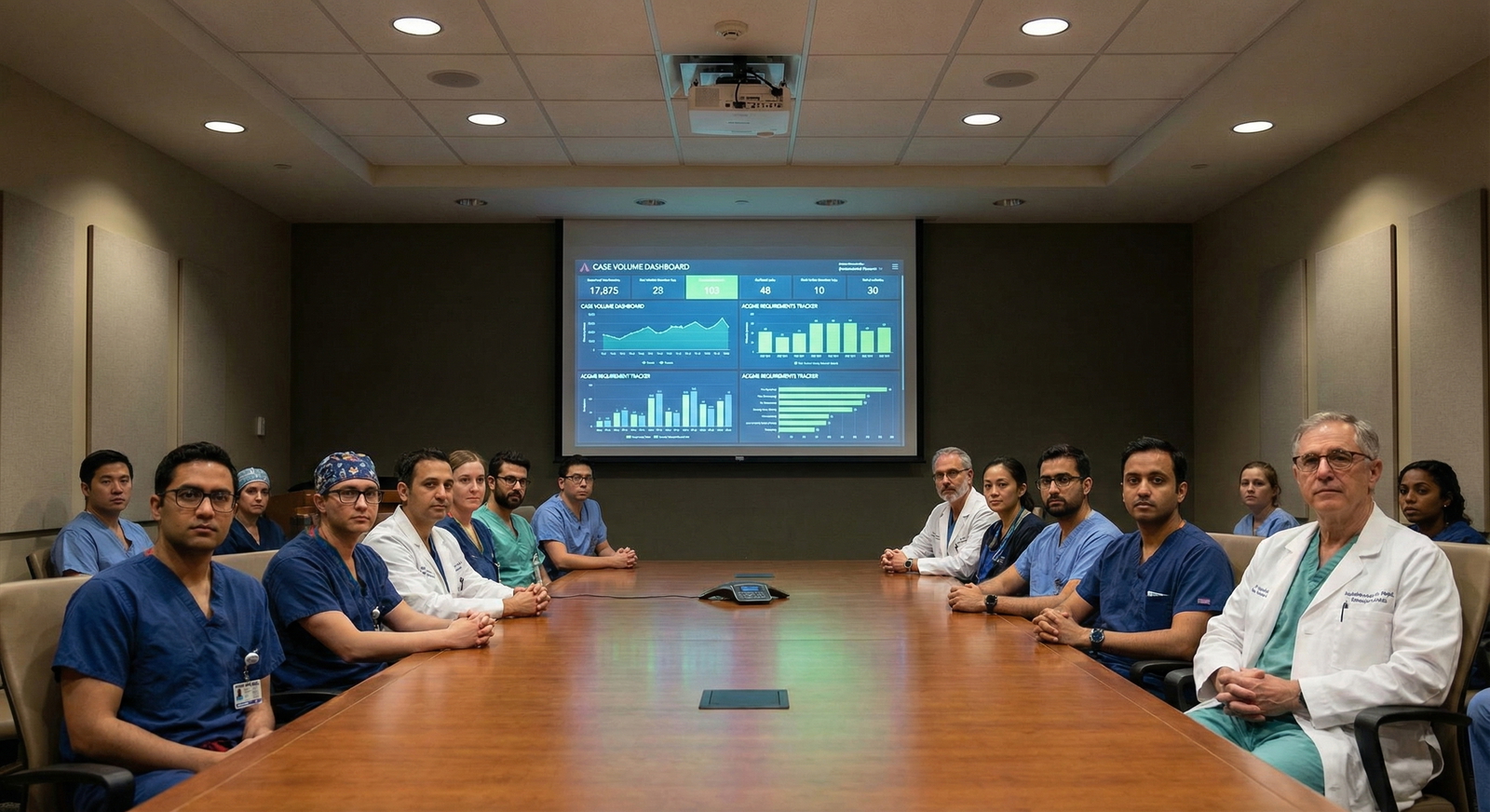
- Distribution charts (e.g., endoscopy vs major open vs robotic vs pediatrics)
When you review these, look for:
- Consistency across years. Does every graduating resident achieve similar robust volume, or are there wide swings?
- Balanced exposure. A program with 400 robotic prostatectomies a year but very limited reconstructive or pediatric exposure may require you to seek additional experience elsewhere if your interests are broader.
- No red-flag deficits. If a program admits they barely meet minimums in pediatric or reconstructive numbers, probe how they address this.
3. Case Volume vs. Service Load
High volume is not inherently good if it comes at the expense of education. Red flags:
- Residents describe large numbers of “scut-heavy” cases where they are present but not meaningfully involved in decision-making or operating.
- A single resident is pulled in multiple directions, leading to superficial exposure instead of in-depth participation.
- A service relies heavily on advanced practice providers (APPs) or fellows for core cases, leaving limited OR opportunity for residents.
A better pattern is:
- Reasonable but busy operative days with residents functioning as key members of the team
- Systems that protect educational cases from being usurped by fellows or staff
- Transparent, rotation-based assignment of operative responsibilities
Case Volume by Subspecialty: What MD Graduates Should Watch For
Every urology program has a unique profile. As an MD graduate aiming for the urology match, you should identify your own interests and ensure a program can support them—while still guaranteeing a strong generalist foundation.
1. Endourology and Stone Disease
Endourology is a core bread-and-butter component of urology practice. For residency case volume in this domain, look for:
- Robust numbers in:
- Ureteroscopy (flexible and rigid) with laser lithotripsy
- Percutaneous nephrolithotomy (PCNL)
- Shock wave lithotripsy (where applicable)
- Structured skills training in:
- Guidewire handling
- Flexible scope manipulation
- Laser safety and technique
Ask residents:
- “Do you feel confident managing complex stone cases independently?”
- “How many ureteroscopies and PCNLs do seniors typically log?”
High procedure numbers in this area are a strong indicator of a program’s ability to prepare you for community or endourology practice.
2. Urologic Oncology
Urologic oncology is central to most urologists’ careers. Consider:
- Robotic radical prostatectomy and partial nephrectomy: key index cases for robotic skills
- Radical cystectomy with urinary diversion: measures exposure to major pelvic surgery and perioperative complexity
- Upper tract urothelial carcinoma and complex renal masses: reflect breadth
Evaluate:
- Are oncology cases concentrated among a few senior residents or equitably shared?
- How much console time do graduating residents have, and on which procedures?
- Do oncology-focused fellows limit or enhance resident experience?
A strong oncology volume supports both general practice and subspecialty ambitions.
3. Reconstructive Urology and FPMRS
Reconstruction is technically demanding and often underemphasized in lower-volume programs. You should pay attention to:
- Urethral reconstruction, ureteral reimplantation, complex fistula repairs
- Male incontinence and prosthetics (e.g., artificial urinary sphincters, slings)
- Female pelvic organ prolapse repairs and incontinence surgeries
Ask:
- “How many urethroplasties or complex reconstructive cases does each resident typically log?”
- “Is there a dedicated reconstructive service or fellowship, and how does that affect residents?”
Even if you don’t plan to be a reconstructive subspecialist, comfortable management of strictures, incontinence, and fistulas will be critical in practice.
4. Pediatric Urology
Pediatric exposure is often variable. A solid foundation should include:
- Undescended testis surgery (orchiopexy)
- Hypospadias repair
- Pediatric nephrectomy, pyeloplasty, ureteral reimplantation
- Evaluation of congenital anomalies and vesicoureteral reflux
Probe:
- “Is pediatric urology on-site, or do residents rotate at a children’s hospital?”
- “Are there minimum pediatric case numbers that residents reliably meet?”
- “Do all residents achieve sufficient operative time, or is it limited to a subset?”
Even if you do not plan a pediatric fellowship, basic pediatric competence is expected of a comprehensive urologist, especially in smaller communities.
5. Andrology and Office-Based Procedures
Andrology and office urology shape much of a typical community practice. Look for:
- Vasectomy and vasectomy reversal exposure
- Varicocelectomy, penile prosthesis, and other sexual medicine procedures
- High volume of:
- Office cystoscopy
- Prostate biopsy (TRUS or MRI-targeted)
- Minor procedures (e.g., intravesical instillations, catheter interventions)
Ask:
- “By graduation, do residents feel fully comfortable running an outpatient clinic solo?”
- “How many prostate biopsies, vasectomies, and office cystoscopies do they perform?”
High outpatient procedure numbers are an excellent indicator of real-world readiness.
Strategically Using Case Volume in Your Urology Match Journey
Understanding case volume isn’t just for program selection—it’s also part of how you present yourself as a serious, informed applicant in the urology match.
1. During Away Rotations and Sub-Internships
As an MD graduate from an allopathic medical school, your sub-internships are crucial:
Track your own exposure:
- Keep informal notes on procedures you observe, assist with, or perform portions of.
- Reflect on how you improved over a 4-week block (e.g., from camera holder to performing key steps in TURP).
Ask thoughtful questions:
- “How does this institution ensure residents gain enough console experience?”
- “What does a typical case log for a graduating resident look like here?”
Demonstrating that you understand case volume and its impact on training sets you apart as a mature applicant.
2. Addressing Case Volume in Personal Statements and Interviews
You can subtly integrate your awareness of case volume:
In your personal statement, you might highlight:
- How early exposure to OR time in medical school confirmed your interest in a procedure-heavy field.
- Your commitment to seeking a residency with balanced, robust surgical volume.
In interviews, when asked what you’re looking for in a program:
- Mention that you value both high surgical volume and structured progressive autonomy.
- Emphasize your interest in broad exposure, from endourology to oncology to outpatient urology.
This frames you as someone who thinks about training outcomes, not just name recognition.
3. Red Flags and Trade-Offs
Be cautious when you hear:
- “We’re extremely busy—residents are constantly in the OR—but sometimes it’s hard to find time for teaching.”
- “We have fellows in nearly every subspecialty, and they usually handle the complex cases.”
- “Our case volume fluctuates a lot year to year depending on faculty turnover.”
Some trade-offs are acceptable, especially in smaller programs, but you should be convinced that:
- You will graduate competent in all core domains, not just one or two
- You will have documented case logs that support your future job or fellowship applications
- Graduating residents consistently feel confident rather than undertrained in key areas
Practical Checklist for Evaluating Urology Case Volume as an MD Graduate
When you compare programs, use a simple checklist to keep your impressions organized:
1. Overall Surgical Volume
- Do average graduating residents exceed ~800–1,000 cases?
- Are residents busy in the OR most days, without being overwhelmed by service work?
2. Balance Across Subspecialties
- Adequate endourology and stone procedures (URS, PCNL, etc.)
- Strong oncologic exposure (robotic/open prostatectomy, nephrectomy, cystectomy)
- Meaningful reconstructive/FPMRS opportunities
- Consistent pediatric volume with clear learning objectives
- High outpatient/office procedure numbers
3. Progressive Autonomy
- PGY-2/3: Regular assistant roles, performing portions of key cases
- PGY-4/5: Frequent primary surgeon roles, including console time for robotic cases
- Residents report feeling prepared to operate independently by graduation
4. Equity and Culture
- Case distribution appears fair among residents and between classes
- Fellows and APPs support education rather than displacing residents from key cases
- Faculty explicitly prioritize resident learning in the OR
5. Outcomes
- Graduates match into fellowships of interest or secure desirable jobs
- Alumni feedback: “I felt technically well-prepared for practice”
Organizing your observations with this framework will help you make a rational, data-informed ranking list.
FAQs: Case Volume Evaluation for MD Graduates in Urology
1. How much total case volume should I aim for in a urology residency?
Aim to graduate from a urology residency with at least 800–1,000+ logged procedures, recognizing that many strong programs exceed this. What matters most is a balanced distribution across endourology, oncology, reconstructive, pediatrics, and office-based procedures, with clear evidence of progressive autonomy. During interviews, ask about typical totals for recent graduates and whether they regularly surpass ACGME minimums.
2. Is high case volume always better than lower volume?
Not necessarily. Extremely high volume can be a double-edged sword if it comes with:
- Poor supervision or limited teaching
- Minimal resident autonomy (always assisting, rarely operating)
- Little time for reflection, reading, or research
A moderate-to-high volume program that emphasizes structured teaching, graded responsibility, and case diversity is often better than a “mega-volume” program where residents mostly retract and close.
3. How do I compare case volume between different programs in the urology match?
Compare programs on several dimensions:
- Total cases per graduate
- Distribution across subspecialties (endourology, oncology, reconstructive, pediatric, andrology)
- Robotic and minimally invasive experience
- Autonomy level by PGY year
- Graduate outcomes (fellowships, jobs, perceived preparedness)
Take notes during each interview day, then review side by side before creating your rank list. If possible, talk to recent alumni to validate what you heard on interview day.
4. What if I’m interested in a niche area like reconstructive or andrology—do I still need broad general case volume?
Yes. Even if you plan a niche career, you should complete residency as a well-rounded urologist. Fellowship directors expect strong general case exposure plus additional depth in your chosen field. When evaluating programs, confirm that you’ll meet robust general urology numbers and also have enough reconstructive, FPMRS, or andrology cases to be competitive for fellowship and to feel comfortable with complex cases later in practice.
Thoughtful case volume evaluation is one of the most powerful tools you have as an MD graduate navigating the allopathic medical school match in urology. By focusing on numbers, balance, autonomy, and outcomes—not just prestige—you set yourself up for a residency that truly prepares you for the full spectrum of urologic practice.