
The myth that programs either care about Step 2 CK or class rank—but not both—is wrong. They absolutely use both. But not in the way most students think.
Here’s the real answer: Step 2 CK is your fast filter and risk flag; class rank (or quartile/decile) is your context and tie‑breaker. When the committee is making actual decisions—who gets an interview, who moves up or down the rank list—Step 2 usually talks first, but class rank often has the final say.
Let’s break down how this actually plays out when people are sitting in a conference room building a rank list.
1. What Step 2 CK Really Means to Programs Now
Step 2 CK is no longer “just a clinical shelf exam.” For many programs, it’s the only standardized metric left with any real spread.
Here’s what I’ve seen repeatedly:
- Step 2 CK is used as:
- A hard screen (below X doesn’t get an interview)
- A risk predictor (will you pass boards on first try?)
- A competitiveness signal (high scorers look safer and more autonomous early on)
Programs don’t all use the same number, but they do use numbers. Rough, realistic bands:
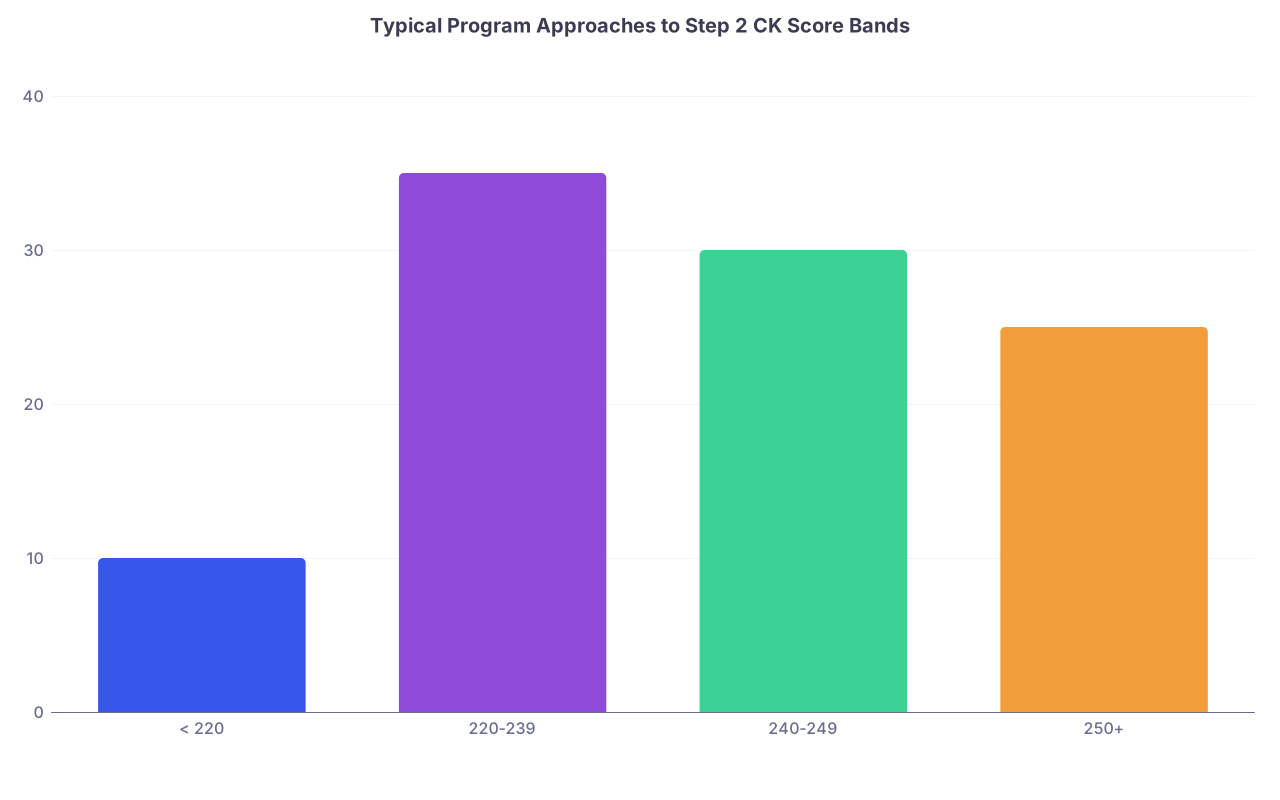
| Category | Value |
|---|---|
| < 220 | 10 |
| 220-239 | 35 |
| 240-249 | 30 |
| 250+ | 25 |
Interpretation pattern I’ve seen in actual committee rooms:
- Below ~220:
“Is something wrong here?” → Application gets scrutinized, often rejected unless strong explanation or offsetting strengths (home student, incredible letters, unique background, etc.). - 220–239:
“Solid but not eye‑catching.” → Fine for many IM, peds, FM, psych programs; borderline for more competitive specialties without other strengths. - 240–249:
“Comfort zone.” → Most mid‑to‑strong programs feel comfortable; this is often “no worries” territory. - 250+:
“This person can test.” → Extra points for competitive specialties and top‑tier academic programs, if the rest of the app isn’t weak.
But here’s the key: Step 2 CK often gets you in the door or keeps you out of the pile. It rarely gets you from rank 35 to rank 5 by itself. Once you’re “above the line,” programs start caring a lot more about your overall performance and class rank.
2. What Class Rank Actually Tells Programs
Class rank (or quartile/decile) is how programs calibrate your performance against your peers at your school. It’s how they answer: “In a normal environment with normal expectations, how did this person actually do?”
Programs look at:
- Exact rank (top 10%, top 25%, etc.)
- Quartile or decile
- AOA or similar honors societies
- MSPE language like “outstanding,” “excellent,” “very good,” “good”
- Number of honors vs high passes vs passes on clerkships
Class rank matters because:
It predicts how you deal with:
- Clinical workload
- Feedback
- Multi‑tasking while tired
It reveals consistency:
A single big test is one thing. Two years of clerkships with multiple evaluators is another.It lets programs compare you to other students from your same curriculum.
A 242 from a school where everyone scores high on shelves is different from a 242 where scores are more spread out.
Programs use class rank differently depending on the applicant:
- For high Step 2, low rank:
“Strong test taker, but middling day‑to‑day.” Risk of professionalism, work ethic, or clinical judgment issues. - For moderate Step 2, high rank:
“Not a superstar on standardized tests, but very solid overall.” Often preferred over the opposite pattern.
And yes, some PDs have said flat out in meetings: “I’d rather have the top 10% student with a 240 than the bottom half with a 255.”
3. How They Actually Weigh Them Side‑by‑Side
When an application is on the screen, they aren’t saying “Step 2 is 40%, rank is 30%…” Real life is more like: “Are there any red flags?” and “Is this person above our comfort threshold?”
For most core specialties (IM, peds, FM, psych, OB/GYN, general surgery), the rough hierarchy when screening and ranking looks like this:
| Factor | Screening (Invite) | Ranking (Final List) |
|---|---|---|
| Step 2 CK score | High | Medium |
| Class rank / MSPE | Medium | High |
| Letters & narrative comments | Medium | Very High |
| Fit, interview, professionalism | Low–Medium | Extremely High |
Translation:
To get an interview:
- Step 2 CK has more power. It’s easy to sort and filter.
- Class rank is used mainly to upgrade borderline scores or downgrade suspiciously high scores.
To get ranked highly:
- Class rank and MSPE language jump in importance.
- Step 2 tends to matter only if:
- It’s very low (risk of board failure)
- It’s exceptionally high and they’re splitting hairs between two otherwise similar candidates
Common Real‑World Scenarios
High Step 2, lower class rank
- Example: Step 2 255, 3rd quartile.
- Conversation: “Great test score. Why middle of the class? Any flags in the MSPE? Shelf failures? Professional concerns?”
- Outcome:
- Strong letters, neutral MSPE → probably fine, ranked reasonably.
- Concerns in MSPE → that 255 won’t save you.
Moderate Step 2, top tier rank
- Example: Step 2 238, top 10%, honors in most core clerkships.
- Conversation: “They clearly work hard, good clinical reviews, should be safe for boards.”
- Outcome:
- Often ranked ahead of the 255/3rd quartile applicant, especially in fields that value team function and reliability.
Strong Step 2, average rank, competitive specialty (derm, ortho, ENT)
- Example: Step 2 255, 2nd quartile, few honors.
- These specialties are score‑sensitive but also prestige‑sensitive:
- At very top programs: your class rank will hurt if your peers all have top 10% and AOA.
- At mid‑tier: they might happily take you if letters and research look strong.
Late Step 2 score at time of application
- If Step 2 is pending:
- Some programs will not interview without it (surgery, anesthesiology, EM in many places).
- Others will screen off Step 1/clinical record and then re‑evaluate once Step 2 appears.
- Once it’s in, it can bump you up or down, but class rank usually doesn’t move.
- If Step 2 is pending:
4. Specialty‑Specific Patterns
Different specialties weigh Step 2 vs rank slightly differently.
Internal Medicine, Pediatrics, Family Med, Psych
- Step 2: Used mainly to ensure you’re likely to pass boards.
- Class rank: Big deal, especially for academic IM and peds.
- What they’ll say in meetings:
- “We don’t need 260s, we need people who will show up, function well, and pass boards.”
General Surgery, OB/GYN, Emergency Medicine
- Step 2: Critical threshold metric; many use explicit cutoffs.
- Class rank: Important, but second to “will this person survive our workload and pass ABS/ABOG/ABEM?”
- That said: shaky class rank with a high score often gets a “concern” label.
Highly competitive specialties (Derm, Ortho, ENT, Plastics, Rad Onc, some Radiology/Anesthesia programs)
- Step 2: High expectations; score gaps are very real.
- Class rank: AOA/top decile very strongly preferred.
- In real committee rooms:
- “This candidate is only top half at their school. Everyone else we’re ranking is top 25% or better.”
- That sentence kills applications more than any single Step 2 number, once you’re already in the competitive score range.
5. How This Should Change Your Strategy
Let me be blunt: chasing a sky‑high Step 2 at the expense of clerkship performance is a bad trade.
Here’s what to do with this information.
If you still haven’t taken Step 2 CK
Your floor matters more than your ceiling.
Avoid bombing it. Aim for “comfortably safe” for your specialty.But don’t tank your rotations to chase 10 extra points.
Honors in medicine/surgery with a 242 will often beat high pass with a 252 in real decisions.Use your actual risk profile:
- Strong preclinical and shelf history → you can aim higher while maintaining clinical performance.
- Struggled on shelves → focus on steady, safe rather than heroics. You can’t afford a low score.
If you already have your Step 2 score
Ask yourself: “What story does my Step 2 + class rank combo tell?”
Use that to shape your application narrative:
High Step 2, mid rank:
- Emphasize growth, maturity, and how you improved as you hit clinical years.
- Get concrete, behavior‑based letters from attendings who can say “excellent team member, reliable, great with patients.”
Moderate Step 2, high rank:
- Lean on consistency, work ethic, and multi‑source excellence (clerkships, research, leadership).
- Make it very obvious you’re the person everyone liked working with.
Lower Step 2, lower rank:
- You need:
- Clear explanation if there were life events/health issues.
- Strong, specific letters that say “this person is better than their numbers.”
- Realistic program list and specialty selection.
- You need:
6. Visual: How Programs Move You Through Decisions
Here’s a simple way to picture it:

| Step | Description |
|---|---|
| Step 1 | Application Received |
| Step 2 | Reject or hold |
| Step 3 | Review MSPE and class rank |
| Step 4 | Invite to interview |
| Step 5 | Interview and letters reviewed |
| Step 6 | Use class rank and Step 2 as tie breaker |
| Step 7 | Place at natural spot on rank list |
| Step 8 | Step 2 above cutoff |
| Step 9 | Rank concerns? |
| Step 10 | Borderline between others? |
That diamond marked “Borderline between others?”—that’s where the Step 2 vs class rank debate actually happens out loud.
7. Practical Takeaways by Scenario
Let’s make it concrete.
Step 2 250+, 1st quartile:
- You’re numerically golden for most specialties and programs.
- Focus your energy on: interviews, letters, and not sounding arrogant.
Step 2 240–249, 1st–2nd quartile:
- This is the sweet spot.
- Many PDs prefer you over a 260 with weaker rank because you look balanced.
Step 2 230–239, top quartile:
- You’ll be very competitive for primary care, IM, peds, psych, OB/GYN at a wide range of programs, including academic.
- For the most competitive fields: lean on research, mentorship, and institutional connections.
Step 2 < 230, 3rd–4th quartile:
- You must be strategic:
- Talk honestly with mentors.
- Apply broadly.
- Emphasize clinical strengths and growth.
- Choose specialties and programs where holistic review is real, not just a brochure phrase.
- You must be strategic:
FAQ (exactly 7 questions)
1. If I have a high Step 2 CK but I’m in the middle of my class, will programs care about my class rank?
Yes. They absolutely look at class rank/MSPE even if your Step 2 is strong. Many will view you as a good test taker but question your consistency or day‑to‑day performance. Strong letters and clean MSPE language can reassure them, but the rank won’t be ignored.
2. Can a great class rank make up for a mediocre Step 2 CK score?
Often, yes—up to a point. For many IM, peds, FM, and psych programs, top‑quartile performance and strong clinical comments can outweigh a mid‑230s Step 2. Where it fails is when your score dips into a range that makes them worry about board failure risk; then no rank fully “cancels” that concern, it just softens it.
3. Do programs have fixed weightings like 50% Step 2, 50% rank?
No. Real committees don’t work like a spreadsheet. Step 2 is mostly a threshold and risk tool, especially early. Rank and narrative comments matter more later, when they’re deciding how high to place you relative to other interviewees with similar scores.
4. How do osteopathic schools without traditional class rank factor in?
Programs use proxies: COMLEX/USMLE scores, number of honors, MSPE language, and sometimes internal quartiles or descriptors the school provides. If there’s no hard rank, they lean more heavily on narrative comments and pattern of performance across clerkships.
5. If my school doesn’t give AOA or formal rank, am I at a disadvantage?
Not necessarily. Programs adjust expectations by school. They’ve usually seen many previous applicants from your institution and know how to interpret your MSPE language and clerkship evaluations. You just lose the quick shorthand of “top 10%,” so your letters and MSPE wording become even more important.
6. Will a strong Step 2 CK score late in the season move me up a rank list?
Sometimes. If your initial file was borderline and your new Step 2 score removes concern about test performance, you might get a small bump. If you were already clearly in or clearly out category‑wise, a new score doesn’t usually trigger major re‑ranking unless it’s drastically better or worse than expected.
7. Which should I prioritize more during third year: Step 2 studying or clerkship performance for rank?
Prioritize clerkship performance enough to avoid tanking evaluations—it’s much harder to recover a weak MSPE than a slightly lower Step 2. That said, don’t ignore Step 2 prep. Aim for solid shelves and build Step 2 knowledge gradually, then take a focused dedicated period where you push the score without sacrificing professionalism or patient care.
Bottom line: Programs use Step 2 CK to decide if you’re safe to interview and train; they use class rank and the MSPE to decide if they actually want to work with you. Once you’re past the Step 2 cutoff, your day‑to‑day performance and standing in your class usually matter more than squeezing out another 5–10 points on a multiple‑choice test.