
Is a Single Step 2 CK Score Enough to Switch into a Competitive Field?
Can one big Step 2 CK score erase two years of mediocre evaluations and a lukewarm CV and magically drop you into dermatology, plastics, or ortho?
Let me be blunt: programs love that fantasy almost as much as students do. Because it lets everyone pretend this process is more objective and “fair” than it actually is.
The myth: crush Step 2 CK and you can “switch into” any competitive specialty.
The reality: Step 2 CK is a lever. Not a teleportation device.
Let’s dissect what a single score actually can—and cannot—do for you if you’re trying to pivot late into a competitive field.
What Programs Actually Use Step 2 CK For
Programs are not reading your score in a vacuum. They use Step 2 CK for three main things:
- Screening
- Risk control
- Tie-breaking
Notice what’s missing: “overhaul your whole application trajectory.”
With Step 1 now pass/fail, many competitive specialties shifted their filter to Step 2 CK. They need some quick numeric tool to chop a thousand applications to a few hundred. Step 2 CK became the sacrificial lamb.
So you have two key thresholds in play:
- A floor: below this, you’re an automatic “no” almost everywhere
- A band: inside this, they’ll actually look at you
- A bonus tier: way above average helps—but only after you clear the other hurdles
Here’s a rough feel for where Step 2 CK sits for typical matched applicants in competitive fields (not perfect, but directionally accurate):
| Specialty | Common Matched Range* |
|---|---|
| Dermatology | ~250–265+ |
| Plastic Surgery | ~250–265+ |
| Orthopedic Surg | ~245–260 |
| ENT (OTO-HNS) | ~245–260 |
| Radiology (DX) | ~240–255 |
| Anesthesiology | ~235–250 |
*Ranges are approximate bands from recent NRMP Charting Outcomes + program reports; there’s variation, but this is the ballpark.
Now here’s the part students do not like hearing: once you’re inside that typical range, the marginal benefit of each extra 5–10 points is real but smaller than you think. Programs don’t rank 250 > 255 > 260 like a leaderboard. After a point, it’s “good enough; let’s see the rest of the file.”
To visualize how much of the “decision power” Step 2 CK really holds in your file, think of it as one chunky—but not dominant—piece of the puzzle:
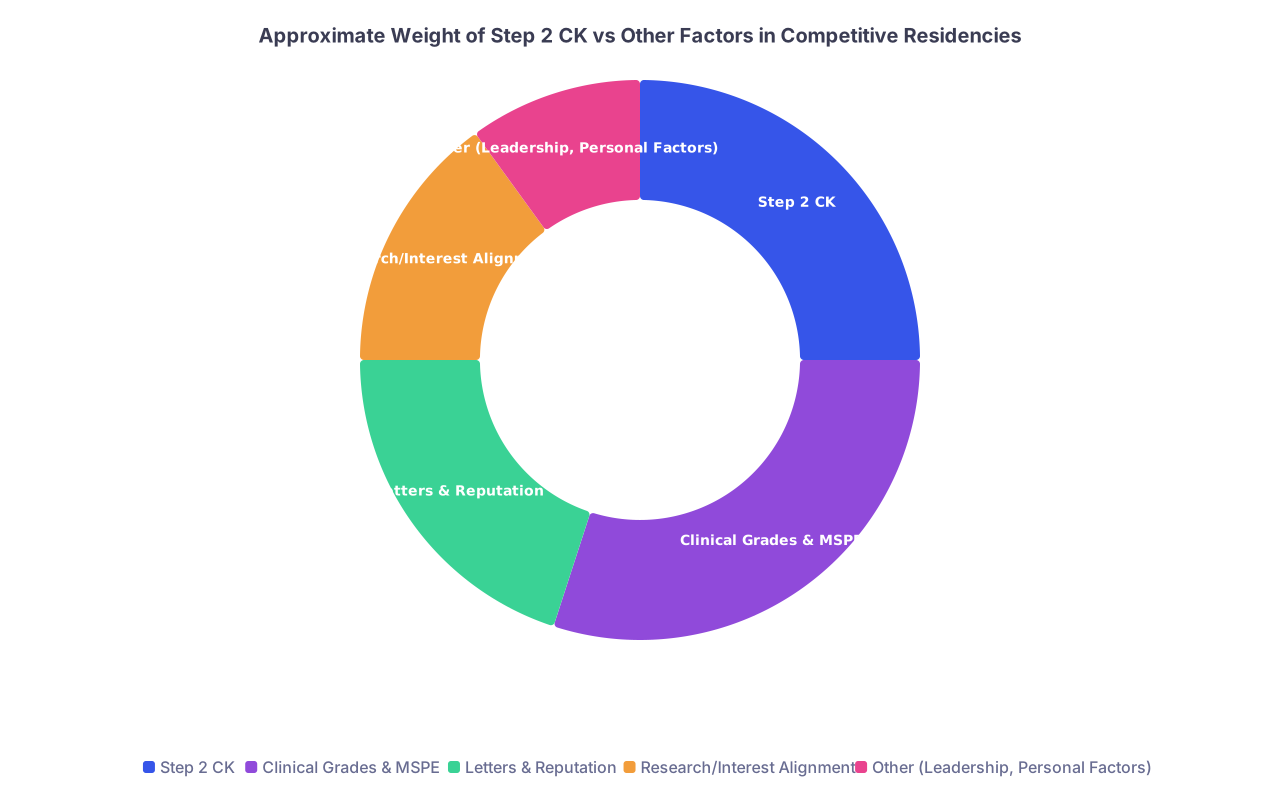
| Category | Value |
|---|---|
| Step 2 CK | 25 |
| Clinical Grades & MSPE | 30 |
| Letters & Reputation | 20 |
| Research/Interest Alignment | 15 |
| Other (Leadership, Personal Factors) | 10 |
Is that exact? No. But it’s closer to the truth than the “Step 2 is everything now” narrative floating around class GroupMe chats.
When a Big Step 2 CK Score Can Change Your Trajectory
Now to the actual question: can a single Step 2 CK score help you switch late into a competitive field?
Sometimes yes. But only under certain conditions.
Scenario 1: The Borderline Candidate Who Becomes Viable
You’re a rising M4. You’ve been flirting with internal medicine, but halfway through M3 you decide you actually want radiology. Your profile:
- Step 1: barely pass
- Early clerkship grades: mostly passes, one high pass, no honors
- Limited research, none in radiology (yet)
Then you study like a maniac and drop a 255 on Step 2 CK.
What changed?
- Before: lots of rads programs would auto-screen you out based on weak early metrics
- After: your Step 2 puts you inside the typical range for matched rads applicants; you clear more filters
You didn’t become a superstar. But you moved from “probably invisible” to “maybe worth a look,” especially at mid-tier and some academic programs desperate for evidence you can handle complex cognitive work.
If you then stack:
- A couple of strong away rotations in radiology
- One or two decent letters from radiologists who actually know you
- A short but real radiology project or case report
Now that Step 2 score is doing what it’s supposed to do: reassuring programs that your earlier stumbles were not your ceiling.
Does that magically convert to derm or plastics? Probably not. But for radiology, anesthesiology, maybe even ENT at the right place with the right story? Now you’re in the conversation.
Scenario 2: The “Quietly Good” Student Who Gets Noticed
You’re at a mid-tier MD or DO school without a home program in the field you want. Your application:
- Step 1: pass on first try, nothing special
- Clinical grades: solid, some honors, strong comments
- Active student, some research but not in the competitive specialty
- School is not a known feeder to that field
You hit a 260 on Step 2 CK.
Now your score does something important: it cuts through institutional bias a bit.
Programs that normally favor students from a handful of “name” schools may actually pause on your file because a 260+ is hard to ignore. They’re not suddenly ignoring school prestige—but you’re no longer dismissed as “generic mid-tier.”
I’ve seen this happen: a student from a non-famous school with a killer Step 2 and strong letters matched into ENT at a good program. The score didn’t do it alone. But it got people to read his letters with a different lens: “Oh, this person is probably quite sharp; maybe we should take this praise more seriously.”
So yes, in this kind of case, a single score can expand the field from “only low- to mid-tier programs” to “legitimate shot at a few high-tier places.”
When a Great Step 2 CK Score Is Not Enough
Here’s where the myth completely breaks: students who think Step 2 CK is a reset button that erases structural weaknesses.
No Specialty-Specific Commitment? Programs Notice.
Competitive fields are allergic to dabblers. You can’t wander through M3 wanting family medicine, decide in August of M4 that you “actually love derm,” drop a 255, and expect serious programs to take you on faith.
They’re asking:
- Where’s your track record of interest?
- Why aren’t there derm electives, away rotations, or at least something adjacent?
- Why are your letters all from internal medicine and OB?
A 260 with zero tangible track record in the specialty screams “late pivot” or “I just want a chill, high-paying lifestyle specialty.” Programs have seen that movie. They don’t like the ending.
Weak Clinical Performance Is a Major Red Flag
Another problem: Step 2 CK is still one test, on one day, in a standardized bubble. Clinical grades and MSPE comments tell programs how you function in messy reality.
If your clerkship record shows:
- Multiple low passes or fails
- Remediation of rotations
- Consistent negative comments (unreliable, unprofessional, poor teamwork)
Then a 260 on Step 2 doesn’t cancel that out. It just proves you can answer multiple-choice questions.
Programs in procedural, team-heavy fields (surgery, ortho, EM) value “can I trust you in the OR or on night float?” more than “can you crush a shelf-esque exam?” They’ll happily rank the 243 candidate with glowing evaluations over the 262 candidate who annoyed half their attendings.
The Late Switch: How Late Is Too Late?
Let’s talk timing, because this is where people really misjudge what a score can do.
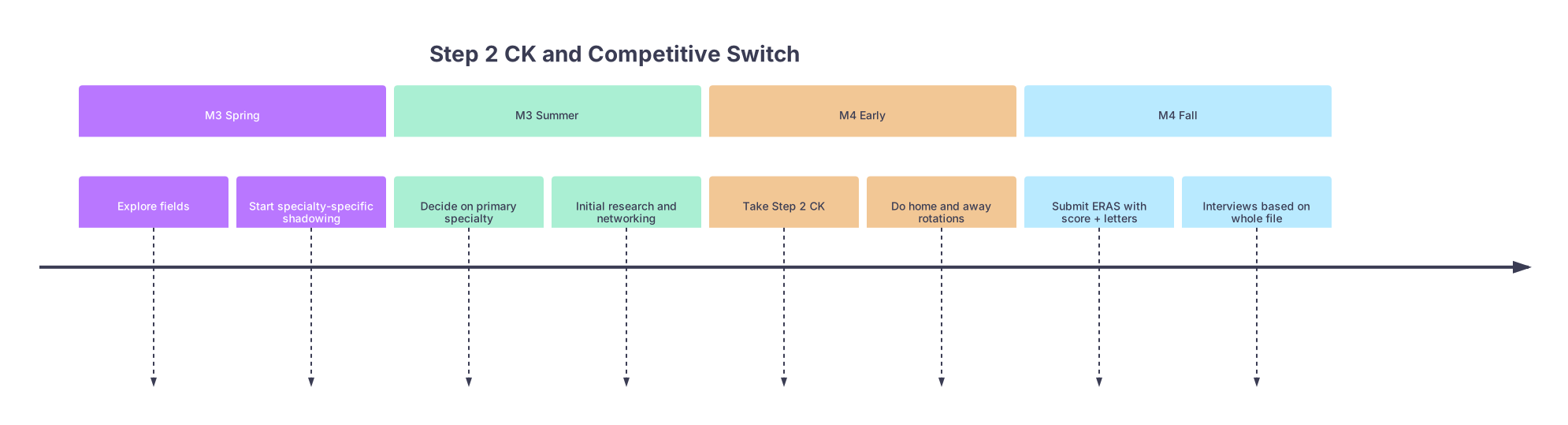
If you’re taking Step 2 CK:
Early M4 (June–July): A high score arrives in time to shape perceptions, influence which aways you land, and show up on ERAS. This can support a real switch, if you simultaneously hustle to align rotations and letters.
Late M4 (September+), after ERAS submission: Too late. That score is now more about staying off SOAP and less about switching into competitive fields. The ship has mostly sailed.
People love the fantasy: “I’ll apply broad IM as backup and also throw in some derm apps. If I crush Step 2 in October, maybe they’ll notice me.” They will not. By then interview invites are largely out, and committees are not reopening stacks of applications because your self-reported score went from “pending” to “260.”
The Specialty-Switch Matrix: Where a Single Score Matters Most
Let’s be specific. For a late-ish switch (M3–early M4), a big Step 2 CK score has different leverage depending on where you’re coming from and where you’re going.
| Target Field | From IM/Peds/FM | From Gen Surg/OB/EM | From Undecided/No Clear Path |
|---|---|---|---|
| Dermatology | Low–Moderate | Low–Moderate | Low |
| Plastic Surgery | Very Low | Low–Moderate | Very Low |
| Orthopedics | Very Low | Moderate | Very Low |
| ENT | Low–Moderate | Moderate | Low |
| Radiology | Moderate–High | Moderate–High | Moderate |
| Anesthesia | Moderate–High | Moderate–High | Moderate |
Translation:
- Derm, plastics, ortho, ENT: a huge Step 2 CK is table stakes, not a golden ticket. You still need early commitment, aligned letters, and usually research.
- Radiology and anesthesiology: these are the most realistically “switchable” competitive fields where a big Step 2 can truly move you from long-shot to viable—if other pieces aren’t terrible.
Step 2 CK as a “Redemption Arc” – How Real Is It?
Here’s the part that is slightly hopeful.
Program directors are not blind to the fact that people mature late. Some students coast early, then wake up. Others have legitimate crises during preclinicals or early M3, then stabilize.
If your narrative looks like:
- Mediocre or even weak early performance
- Strong upward trend in clerkships
- Clear, focused effort in the new field (research, rotation, mentorship)
- Then a very strong Step 2 CK
That’s a coherent story. PDs are more willing to buy that than you think—especially in fields that care a lot about long-term cognitive load (rads, anesthesia, some IM subspecialty pipelines).
To them, your Step 2 is not “the thing that gets you derm.” It’s “evidence the recent version of you is legit, not a fluke.”
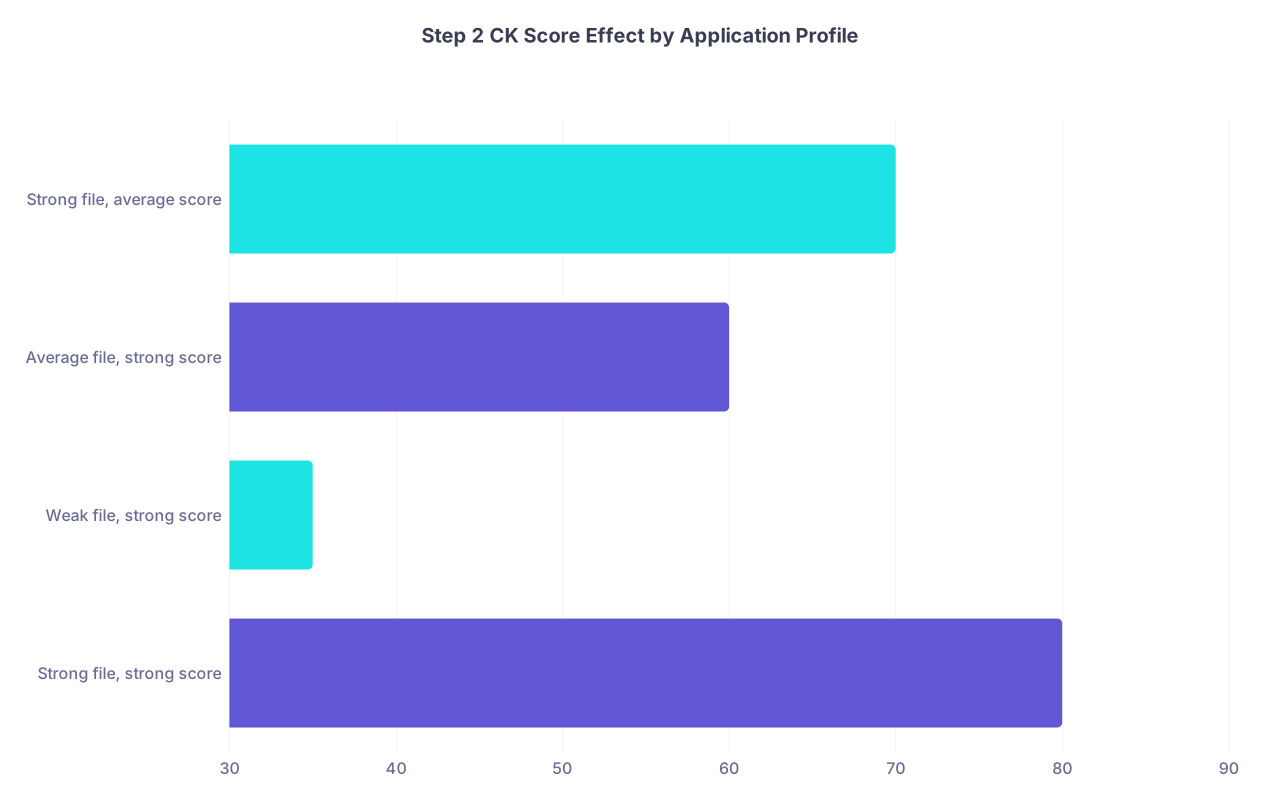
| Category | Value |
|---|---|
| Strong file, strong score | 80 |
| Weak file, strong score | 35 |
| Average file, strong score | 60 |
| Strong file, average score | 70 |
Think of that chart as “relative benefit” (not match chances). A strong score on a weak file helps, but it’s nowhere near as powerful as the same score on an already solid file.
What To Do If You’re Banking on Step 2 CK for a Switch
If you’re still reading, you’re probably in one of these groups:
- You’re hoping a big Step 2 lets you jump from a noncompetitive plan into a competitive specialty
- You already took Step 2 and did well, and you’re asking “is this enough to try?”
- Or you bombed Step 1 and are trying to salvage competitive options with Step 2
Three blunt pieces of advice.
First, decide if you’re chasing the field or the image. Some of you do not actually love dermatology; you love the lifestyle and the flex. Programs can smell that desperation. If you can’t articulate a convincing, specific reason you care about the specialty that predates your Step 2 fantasy, you’re already behind.
Second, build the rest of the signal, fast. That means at least:
- One home or away rotation in the target field, done before ERAS if possible
- At least one strong, specialty-specific letter
- Some kind of tangible scholarly or project work tied to that field
If Step 2 is the only part of your file that screams “I want this specialty,” you don’t actually look committed.
Third, be brutally honest about tiers. A 252 and zero relevant background is not dragging you into a top-5 ENT program. But it may open doors at smaller or newer programs, community-heavy programs, or geographically less popular places. If you’re serious about switching, you apply where your file is competitive, not where your ego wants to live.
The Bottom Line
A single strong Step 2 CK score:
- Can: get you past filters, counteract some earlier academic wobble, and make a late switch into some competitive fields (especially radiology and anesthesia) realistically possible—if your rotations, letters, and story all line up.
- Cannot: erase a non-existent track record in the specialty, compensate for consistently poor clinical performance or professionalism issues, or single-handedly drop you into derm/plastics/ortho from a cold start.
Use Step 2 CK as a lever, not a miracle cure. If you pair a great score with real specialty-specific work and honest self-assessment, it can absolutely change your ceiling. But if you treat it like a magic key, you’re going to be disappointed on Match Day.