

J-1 is not a “primary care visa.” That idea is lazy, wrong, and costing IMGs good opportunities.
Let me be blunt: a huge number of international medical graduates quietly filter out entire specialties or programs because “they only sponsor J-1 and I want something other than primary care.” I have watched smart applicants walk away from solid Internal Medicine programs thinking J-1 locks them into outpatient clinic life forever.
That’s fiction.
If you’re an IMG trying to choose between J-1 and H-1B, or deciding which programs to apply to, you need to understand what J-1 actually does, what it does not do, and where the primary-care myth came from.
Where the J-1 “Primary Care Only” Myth Comes From
The confusion is not random. It grows from three half-truths that people mash together into one bad conclusion.
J-1 has a two‑year home residency requirement (212(e))
After J-1 clinical training, you’re generally required to return to your home country for two years unless you get a waiver.The most common waiver route is the Conrad 30 program
Conrad 30 is run by U.S. states. They sponsor J-1 waivers for physicians who agree to work in medically underserved or shortage areas for three years.Many Conrad 30 slots are indeed used for primary care
States worry about family medicine, general internal medicine, general pediatrics. So yes, a large chunk of those waiver jobs are primary care.
People hear this at a pre‑match Zoom session, strip away all nuance, and repeat: “J‑1 is for primary care only.”
No. J‑1 is for graduate medical education and training in any ACGME‑accredited specialty or subspecialty that gets ECFMG sponsorship. The visa does not say “family medicine only” or “you must be a PCP forever.”
It just doesn’t.
What J‑1 Actually Covers: Way More Than Primary Care
Let’s separate myth from statute.
J‑1 for physicians is governed by 22 CFR 62.27. ECFMG is the main sponsor for clinical J-1 physicians. Their mandate is clear: sponsor graduate medical education and training programs that are:
- ACGME‑accredited residency and fellowship programs, or
- ACGME‑recognized subspecialty fellowships, or
- Occasionally, non‑standard training with special approvals
Nowhere does the law or ECFMG policy restrict you to primary care fields.
Look at the specialties where J‑1 physicians train every single year:
- Internal Medicine, Family Medicine, Pediatrics (sure, the classic three)
- But also: General Surgery, OB/GYN, Psychiatry, Emergency Medicine, Neurology, Anesthesiology, Pathology, Radiology
- And subspecialties: Cardiology, GI, Pulm/CCM, Endocrine, Hem/Onc, Nephrology, Rheumatology, Infectious Disease, Interventional Card, EP, Surgical subspecialties, etc.
You’ve seen these people. The J‑1 GI fellow. The J‑1 interventional cardiology attending at an academic hospital. They exist everywhere. If J‑1 were “primary care only,” these physicians wouldn’t be there.
Programs do sometimes favor J‑1 over H‑1B for practical reasons:
- J‑1 sponsorship is centralized via ECFMG and relatively standardized
- H‑1B requires the hospital’s lawyers, more fees, more paperwork, and wage obligations
- For many institutions, “we sponsor J‑1 only” is not about making you a primary care doctor; it’s about administrative workload
So if a university hospital anesthesia program says “J‑1 only,” it does not mean “we only train primary care doctors.” It means “we can’t be bothered with H‑1Bs.”
The Real Limitation: Post‑Training Plans, Not Residency Specialty
The part that does matter—and where primary care shows up again—is what happens after residency or fellowship.
J‑1 has a built‑in catch: the two‑year home residency requirement (HRR). To avoid going home for two years, you need a waiver. That’s where the system starts to subtly push you toward certain jobs.
Main waiver paths used by IMGs:
- State Conrad 30 (by far the most common)
- Federal programs: VA, HHS (clinical care), ARC, DRA, etc.
- Exceptional hardship or persecution waivers (rare, case-specific)
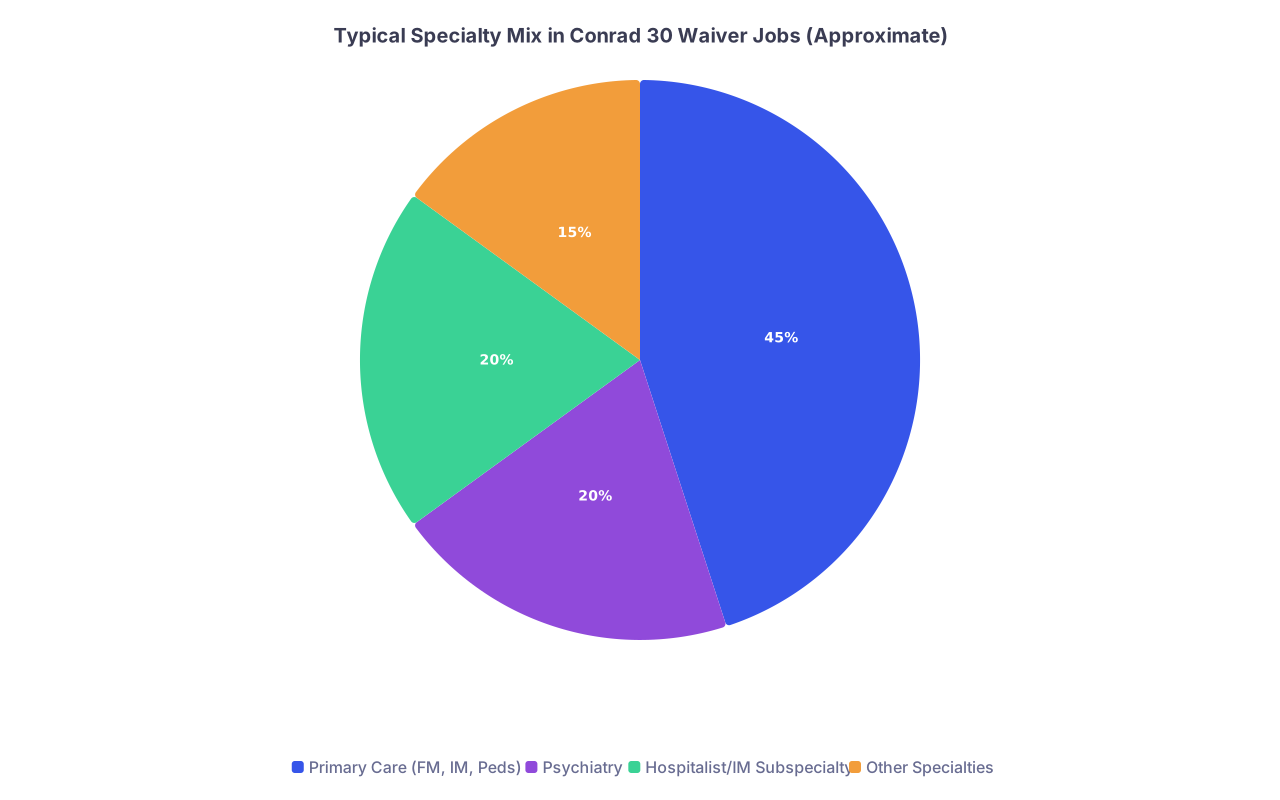
Most IMGs on J‑1 end up chasing state Conrad 30 positions first. And those positions are heavily skewed but not exclusive to primary care.
| Category | Value |
|---|---|
| Primary Care (FM, IM, Peds) | 45 |
| Psychiatry | 20 |
| Hospitalist/IM Subspecialty | 20 |
| Other Specialties | 15 |
This is not official nationwide data, but it roughly matches what you see if you read state Conrad 30 reports and job postings over the last decade. Most states prioritize:
- Family Medicine
- General Internal Medicine / outpatient clinics
- General Pediatrics
- Psychiatry
However—and this is the part people ignore—I’ve repeatedly seen Conrad 30 waivers granted for:
- Hospitalist positions (often counted as “primary care” by states)
- Hem/Onc, Endocrine, GI, Nephrology, Pulm/CCM in underserved regions
- General Surgery, OB/GYN, Emergency Medicine in rural areas
Is it harder in, say, Dermatology or Radiology? Yes. Some states basically never use Conrad slots there. But harder ≠ impossible, and it definitely does not mean “J‑1 is only for primary care.”
The visa isn’t the primary care problem. The waiver job market is.
Specialty by Specialty: How J‑1 Really Plays Out
Let’s talk reality for common IMG specialties.
Internal Medicine
This is where the myth bites hardest.
IMGs hear “IM on J‑1 = doomed to outpatient primary care.” Meanwhile:
- Many J‑1 residents in IM go into subspecialty fellowship (GI, Card, Pulm/CCM, etc.)
- After fellowship, they still get Conrad 30s as hospitalists or subspecialists in smaller cities or rural areas
- Some states explicitly list Hem/Onc, Cardiology, or Nephrology on their Conrad-eligible needs lists
Reality: J‑1 + IM lets you do:
- Hospitalist work (common)
- Traditional primary care (if you want)
- Subspecialty‑heavy jobs in shortage areas
No, you’re not restricted to a strip‑mall primary care clinic for life.
Family Medicine & Pediatrics
These really are “primary care‑heavy” even outside visa discussions. On J‑1, your waiver options are frankly pretty good:
- Almost every state wants FM and Peds
- Recruitment is aggressive in underserved areas
- J‑1 FM or Pediatrics often has more waiver options than an H‑1B Neurosurgery grad trying to stay in one metro suburb
Here, J‑1 essentially aligns with the workforce demand. So the primary-care label sticks, but not because J‑1 forced it—it’s because the specialties themselves are built around first-contact care.
Psychiatry
Underappreciated in the IMG rumor mill.
States are desperate for psychiatrists. I’ve seen:
- Conrad 30 slots specifically reserved for Psychiatry
- Urban and rural psych jobs get approved
- Academic appointments combined with underserved clinical care
If you’re an IMG interested in Psychiatry, J‑1 is not a trap. It can be an asset, because your waiver odds are often better than more saturated subspecialties.
Surgical Fields & Competitive Subspecialties
Here’s where it gets nuanced.
- General Surgery residents on J‑1 exist. So do J‑1 fellows in vascular, trauma, or other surgical subs
- Waiver jobs for surgical fields are fewer and more geographically constrained
- Certain very niche disciplines (Derm, Radiation Oncology, some procedural subspecialties) can be brutally hard for J‑1 waivers depending on the state
This is the first place where I’ll say: yes, your visa choice and long‑term goals might genuinely conflict.
But even here, “J‑1 = primary care only” is still wrong. The correct statement is:
“J‑1 makes it harder to stay in big coastal cities in highly specialized, procedure-heavy fields where states don’t see an ‘access to care’ crisis.”
That’s not a catchy meme, so people just shorten it to “J‑1 is bad” or “J‑1 is for primary care.” Which is lazy thinking.
J‑1 vs H‑1B: What Actually Changes for an IMG
Let’s put some structure to this. Not vibes—actual differences.
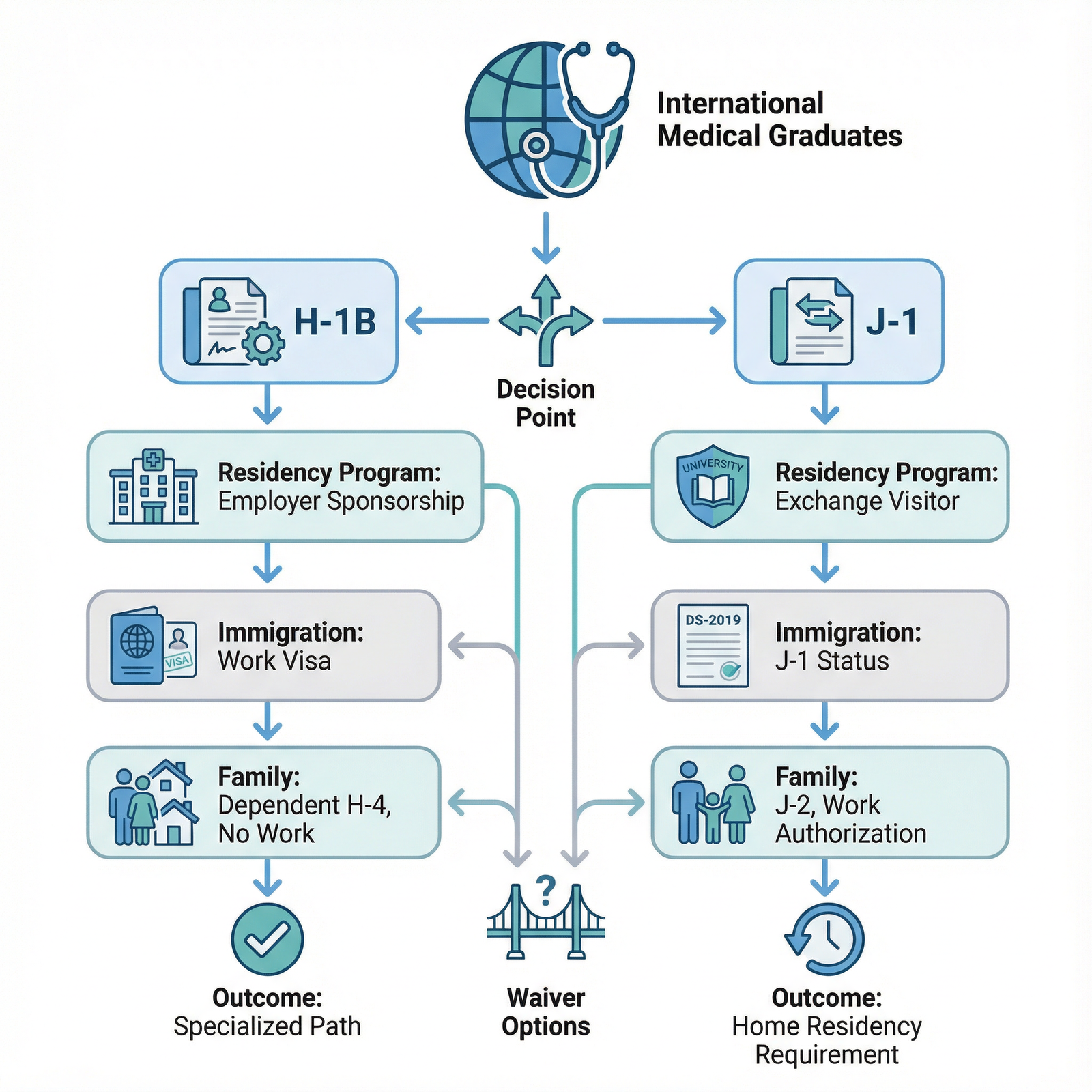
| Factor | J-1 (ECFMG Sponsored) | H-1B (Employer Sponsored) |
|---|---|---|
| Who sponsors | ECFMG for training, then employer for waiver | Employer only |
| Home residency requirement | Yes (2 years) unless waived | No |
| Typical in residency | Very common for IMGs | Less common, program-dependent |
| Fellowship on same status | Yes, usually straightforward | Sometimes, but cap and wage issues |
| Common waiver path | Conrad 30 / federal waivers | Not needed (but still need job + work visa options) |
| Employer burden | Lower during training | Higher (LCA, wage, filings) |
Two big mistakes IMGs make:
- Treating H‑1B as “freedom” and J‑1 as a “primary care sentence.”
- Completely ignoring the fact that many H‑1B‑friendly programs are fewer, more competitive, or not in your desired specialty.
Here’s what actually shifts with J‑1:
- You must think earlier about your post‑training geography; small-town Midwest might become your friend
- Fellowship on J‑1 is common, but each new training program renews the HRR clock until your last J‑1 stint; you still need a waiver at the end
- You get less flexibility to hang around big cities on “nice to have” subspecialty jobs; the job has to solve a workforce problem for someone (state or federal agency)
What does not change with J‑1:
- Your ability to match into IM, Psych, Peds, FM, Path, Neuro, Anesthesia, many surgical fields
- Your ability to do ACGME‑accredited fellowships in most subspecialties
- Your ability to have an academic career in an underserved region
How to Think Strategically as an IMG Considering J‑1
If you’re serious about this, you don’t just ask “J‑1 vs H‑1B?” in the abstract. You ask much more annoying, specific questions.

| Step | Description |
|---|---|
| Step 1 | Choose Specialty Interest |
| Step 2 | Open to Smaller Cities/Rural |
| Step 3 | Research H-1B Friendly Programs |
| Step 4 | Apply Broadly incl. J-1 Only |
| Step 5 | Prioritize H-1B Programs |
| Step 6 | Reassess: Location vs Specialty vs Visa |
| Step 7 | Competitive & Urban-dependent? |
| Step 8 | Enough H-1B Slots? |
Here’s how a rational approach looks:
Be honest about your specialty plans
Want Cardiology, GI, Pulm/CCM, Nephrology, Rheum, Endocrine? J‑1 is very workable if you’re flexible on location after training.
Want Derm in Manhattan long-term? J‑1 is going to be a serious uphill battle. Might still be the only path into U.S. training, but do not kid yourself about the waiver stage.Look at actual state policies, not WhatsApp rumors
State health department websites list Conrad 30 priorities. Read them. Many explicitly include:- Hospitalists
- IM subspecialties
- Psych
- Sometimes even Radiology, Anesthesia, Surgery in rural zones
Realize that H‑1B is not unlimited magic
Even if you finish training on H‑1B:- You still need an employer willing to sponsor a work visa or green card
- H‑1B has its own caps, specialty occupation rules, wage requirements
- Some fellowships prefer J‑1 because it’s simpler administratively
Use J‑1 as a bridge, not a prison
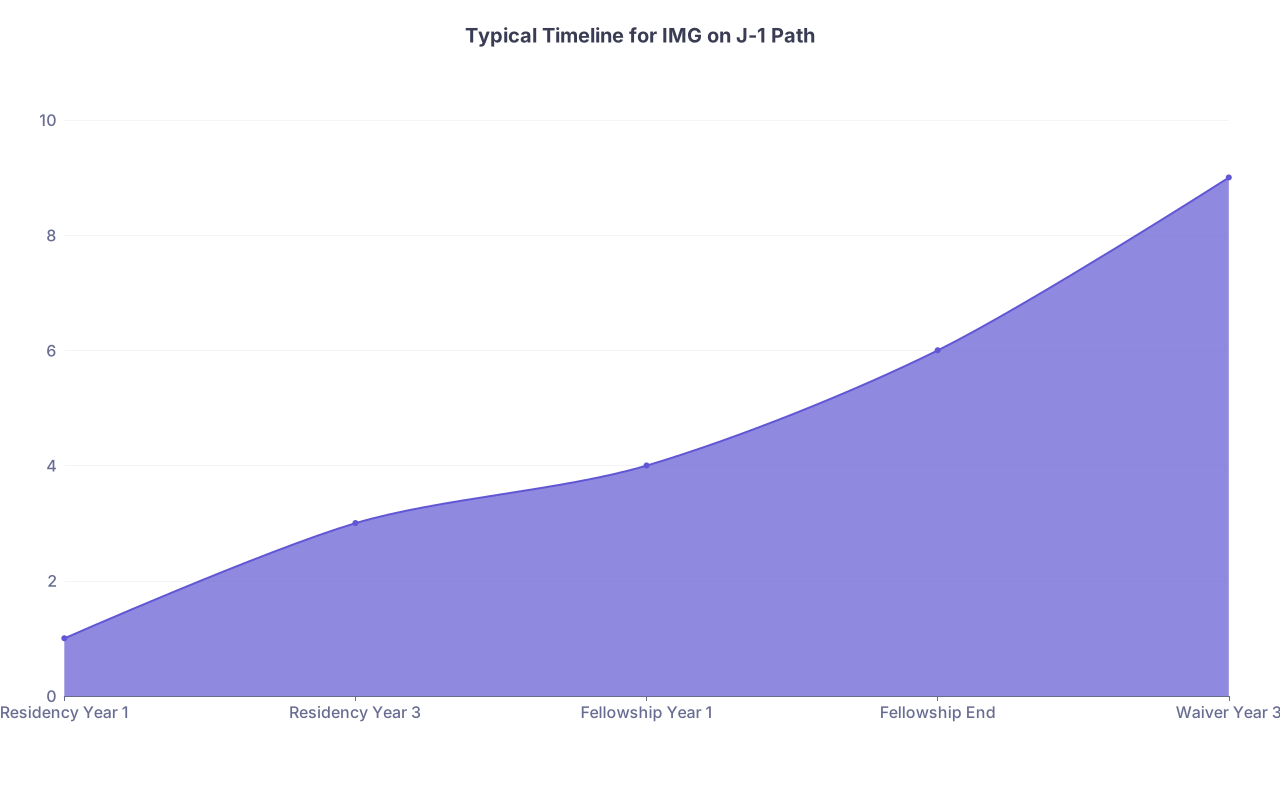
Many IMGs do this path:- J‑1 residency → J‑1 fellowship → Conrad 30 waiver job → transition to H‑1B or direct green card sponsorship after waiver obligation
On paper, that’s a decade‑plus journey. In real life, that’s exactly how a lot of successful subspecialists got where they are.
- J‑1 residency → J‑1 fellowship → Conrad 30 waiver job → transition to H‑1B or direct green card sponsorship after waiver obligation
| Category | Value |
|---|---|
| Residency Year 1 | 1 |
| Residency Year 3 | 3 |
| Fellowship Year 1 | 4 |
| Fellowship End | 6 |
| Waiver Year 3 | 9 |
(The “values” here are cumulative years in the U.S. from start of residency. It’s long. But it works.)
Who Actually Should Worry About J‑1
There are people for whom J‑1 is a bigger red flag:
- You’re dead‑set on hypercompetitive subspecialties with weak underserved‑area demand (Derm, certain surgical subs) and you refuse to be flexible on geography
- You have strong, credible reasons to believe you might need a hardship or persecution waiver down the line (political, safety, etc.) and want maximum legal maneuvering space
- You absolutely must remain in a specific metro area for family issues, dual‑career partner, or other constraints that make relocating to a shortage area almost impossible
If that’s you, then “J‑1 only” programs should trigger extra scrutiny. Not because they make you a primary care doctor, but because they might box you into waiver options that don’t match the life you’re trying to build.
For a lot of other IMGs though? Avoiding J‑1 across the board is self‑sabotage.
You end up:
- Cutting out strong university programs that only do J‑1
- Shrinking your match list in already competitive specialties
- And basing the whole thing on a myth about “J‑1 = primary care”
The Bottom Line: What You Should Actually Remember
Let me strip this down.
J‑1 is not limited to primary care specialties. You can and many people do train in IM subspecialties, anesthesia, psych, surgery, and more on J‑1.
The “primary care” issue is about waiver jobs, not residency training. Conrad 30 and other waivers favor primary care and psychiatry, but plenty of hospitalist and subspecialty roles qualify—if you’re open to underserved regions.
For IMGs, blanket avoidance of J‑1 is usually a mistake. The smart move is to align your visa choice, specialty, and long‑term geography rather than chasing an oversimplified rule someone repeated in a Telegram chat.
If you treat J‑1 as a tool instead of a curse, it can get you exactly where you want to go. Just probably not in the exact zip code you had in mind on day one.


