

Switching specialties mid-residency on a visa can quietly destroy your immigration footing if you do it blindly.
Let me break this down specifically, because most people—program directors included—only half-understand how ugly this can get for international medical graduates.
You are not just changing specialties. You are changing the underlying training plan that your visa is built on. And the government actually cares about that far more than most residents realize.
We will go system by system.
1. The Core Problem: Your Visa Is Tied to a Training Plan
Every IMG on a training visa is essentially promising the U.S. government:
“I will be here, in this type of training, for roughly this long, at this place.”
When you switch specialties, you are potentially changing:
- The total length of training
- The type of training (e.g., IM → Anesthesia, Surgery → Radiology)
- The institution (if you switch programs)
- The funding source or training category (on J-1 in particular)
For citizens and permanent residents, this is an academic and career decision. For you, it is also an immigration decision with three recurring risks:
- Falling out of status (even briefly).
- Violating a J-1 training category or maximum duration.
- Making your future waiver or H-1B options much worse.
Most “I want to switch” conversations happen first with a chief or a trusted attending. They almost never start with immigration. That is backwards. The very first conversation should be with GME and your international office / ECFMG (for J-1) or your hospital immigration counsel (for H-1B).
2. J-1 Clinical Visa: Where Switching Can Hurt You Fast
J-1 is the most brittle status for mid-residency specialty changes, because it is locked to:
- A specific training category (e.g., Internal Medicine, General Surgery)
- A specific ACGME program at a specific institution
- A specific maximum duration for that category
And the sponsoring body is not USCIS. It is ECFMG. They have their own rules and they can simply say “no.”
2.1 How J-1 Training Duration Really Works
ECFMG does not give you a generic 7-year training allowance to spend however you want. It is program- and category-specific.
Typical J-1 caps:
| Category | Usual J-1 Max Years |
|---|---|
| Internal Medicine | 3 |
| Family Medicine | 3 |
| Pediatrics | 3 |
| General Surgery | 5 |
| Psychiatry | 4 |
| Neurology | 4 |
Key point: Subspecialty fellowships are separate J-1 sponsorship requests, usually within the 7-year overall cap, but the initial residency duration is tightly controlled by ECFMG.
So if you are in PGY-2 IM on J-1 and suddenly want to switch into a full 5-year surgery program starting as PGY-1 again, you are asking ECFMG to approve:
- A change in category;
- A longer total training period;
- A reset to earlier PGY level.
That is not an automatic “sure, fine”. It is a careful review.
2.2 Types of J-1 Moves and How Risky They Are
Let me categorize the real-life scenarios I see.
Same institution, same category, internal realignment
Example: Categorical IM → Categorical IM (different track or schedule).
Visa impact: Minimal, often no formal “switch.” GME just keeps your DS-2019 aligned with an updated end date. This is the safest.Same institution, different specialty, but overlapping duration
Example: PGY-1 Transitional Year → PGY-1 Neurology at same hospital; or IM → Neurology.
Visa impact: Needs new ECFMG approval, updated DS-2019, and program letters. Often feasible if total years stay within category rules and overall cap.New institution, same specialty
Example: IM PGY-2 at Program A → IM PGY-2 at Program B.
Visa impact: Transfer of sponsorship. Common, but requires coordination of start/end dates so you never go “out of status” between programs.New institution, new specialty, extended duration
Example: IM PGY-2 → Surgery PGY-1 at another hospital.
Visa impact: This is where J-1 gets ugly. You are asking for more years plus a new category. ECFMG can refuse if they see the new plan as excessive or outside norms.Switching into a more competitive procedural field with extra required years
Example: Pediatrics → Radiology requiring a full 4-year DR program.
Visa impact: Possible conflict with 7-year limit and with ECFMG’s willingness to support a complete reset.
2.3 What ECFMG Actually Looks At
They do not publish every internal rule, but the patterns are clear:
- Is there a clear educational rationale?
- Is the resident in good standing academically and professionally?
- Does the new plan fit within standard length and the 7-year cap?
- Is the transfer supported by both current and future program directors?
They are allergic to “serial trainees” jumping around fields just to stay in the U.S. for longer. If your story even looks like that, the bar gets higher.
You will need:
- Letter from current PD describing your standing and supporting the change/transfer.
- Letter from new PD explaining the training plan and how prior training will or will not be credited.
- GME confirmation that funding and position are stable.
If that package looks weak, ECFMG can and does say no.
3. H-1B in Residency: More Flexibility, Different Traps
On H-1B, you are not dealing with ECFMG. You are dealing with the employer, their immigration lawyers, and USCIS.
The good news:
- No 7-year J-1 training cap.
- No J-1 home residency requirement (2-year 212(e)).
- Category changes are not inherently prohibited.
The bad news:
- Every switch that involves a new institution or a new job description requires a new or amended H-1B petition.
- You cannot start working in the new role until that petition is properly filed or approved (depending on portability rules and timing).
- You are cap-exempt in residency, but that may not follow you if you leave academic medicine.
3.1 Within Same Hospital vs New Employer
Two very different situations.
Same hospital / same H-1B employer, new specialty
Example: You are on H-1B sponsored by “University Hospital System” and move from their IM program to their Neurology program.- Likely requires an amended petition because your underlying position (ACGME residency in a specific field) changes.
- Usually manageable because the employer stays the same and is still cap-exempt.
- Immigration counsel updates job description, training details, and duration.
Different hospital / new employer
Example: IM PGY-1 at Hospital A (H-1B) → Anesthesia PGY-2 at Hospital B.- Needs a new H-1B petition from Hospital B.
- You remain in “cap-exempt” world as long as Hospital B is also a qualifying institution (most teaching hospitals are).
- You must mind the gap: you cannot start at B until B’s H-1B is properly active under portability rules.
And yes, if Hospital B has weak immigration support or moves slowly, you can find yourself “stuck” or forced to delay your switch.
4. Comparing J-1 vs H-1B When You Want to Switch
Here is the blunt comparative picture.
| Factor | J-1 (ECFMG Sponsored) | H-1B (Employer Sponsored) |
|---|---|---|
| Authority over training changes | ECFMG + program + GME | Employer + USCIS |
| Max duration constraint | Typically 7 years total (res + fellowship) | 6-year H-1B max; can recapture/extend with GC |
| Category-specific rules | Yes (IM vs Surgery vs Peds, etc.) | No formal specialty categories |
| Ease of changing institutions | Moderate; needs ECFMG transfer approval | Moderate; new petition needed |
| Risk of being denied change | Higher; ECFMG can reject new training plan | Lower if employer and funding are solid |
| Impact on future waiver/GC | J-1 waiver required; specialty consistency can matter | No 212(e); more flexibility in career path |
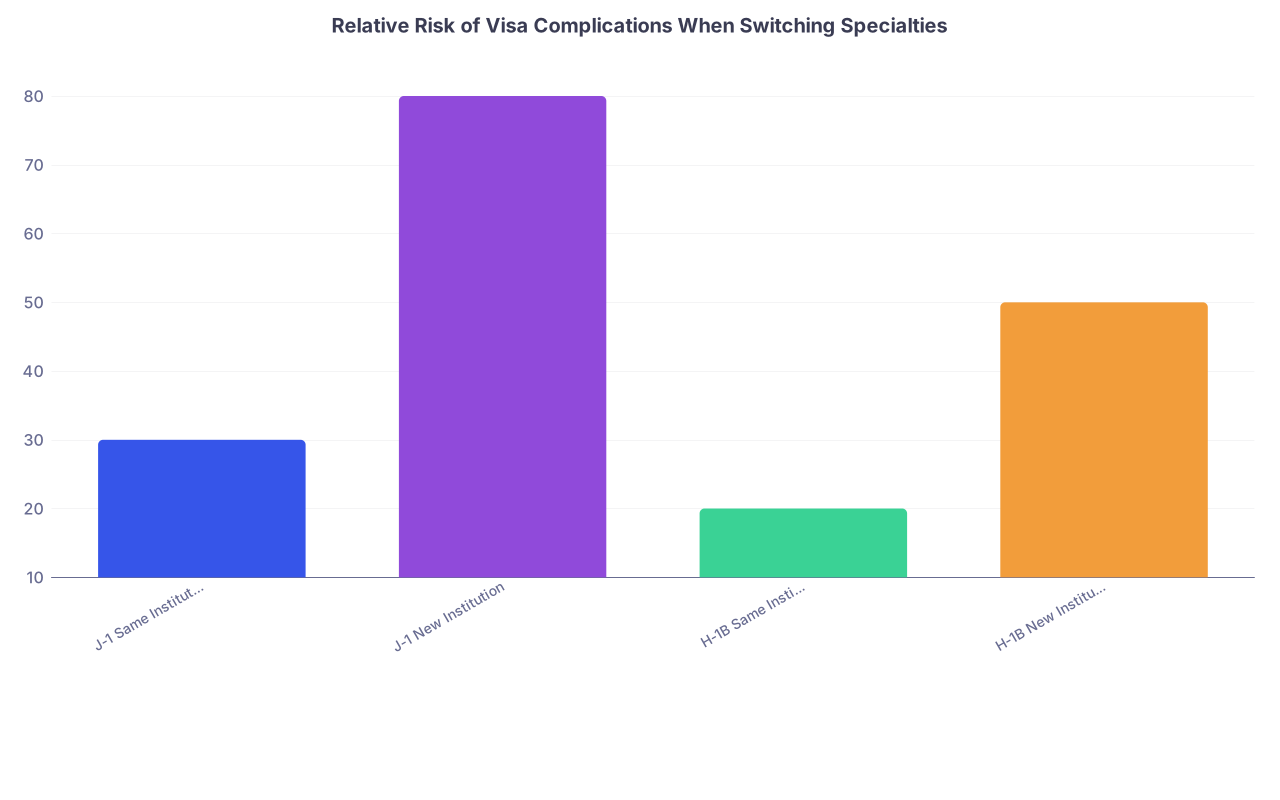
| Category | Value |
|---|---|
| J-1 Same Institution | 30 |
| J-1 New Institution | 80 |
| H-1B Same Institution | 20 |
| H-1B New Institution | 50 |
Those numbers are not from an official source; they reflect practical risk based on what actually goes wrong in real cases. J-1 + new institution + new specialty is where I see the most disasters.
5. Common Switching Scenarios and Their Visa Fallout
Let me walk through the exact situations IMGs ask about every year.
5.1 PGY-1 Realizes “Wrong Specialty” and Wants Out
This is the classic one. You matched categorical IM, Surgery, or OB/GYN. Six months in, you hate it and want to move to something else.
On J-1:
- You are still early in your training timeline.
- You may be able to switch to a PGY-1 spot in another field the following July.
- ECFMG must approve a new DS-2019 with the new category and institution.
The danger: a gap between programs. If your current program ends June 30 and the new one starts July 1, that is clean. If you resign in March with no backup, you immediately risk losing J-1 status.
On H-1B:
- Your current hospital either keeps you on payroll and in status through June, or terminates early.
- If terminated, your grace period (up to 60 days) becomes critical for filing a new H-1B.
- A clean switch with facility A ending June 30 and B starting July 1, with B’s petition filed before you start, is ideal.
The wrong move: resigning emotionally with no lined-up position and no lawyer involved.
5.2 Mid-Residency Lateral Switch: Same PGY Level, Different Field
Example: IM PGY-2 (J-1) → Neurology PGY-2 (J-1) or H-1B equivalent.
On J-1:
- You need:
- Written release/termination date from IM program.
- Acceptance and start date from Neurology program.
- ECFMG approval for transfer and possibly category change.
- If years add up to a reasonable total (e.g., 1 year IM + 3 years Neuro = 4 years), this can be defensible.
On H-1B:
- New hospital files new H-1B petition describing your ACGME Neuro PGY-2 role.
- If Neuro is at the same hospital, often an amended H-1B rather than a completely new one.
- You cannot have a dead period of unauthorized work between those roles.
The nuance: previous PGY years may or may not “count” academically, but immigration does not care if you lose credit. It cares that your visa dates match your actual employment and training.
6. Two Huge Hidden Issues: Time Limits and Future Waivers
Switching specialties is not only about “can I stay right now.” It also affects:
- Whether you hit the J-1 7-year cap sooner than you think.
- How your profile looks when you apply for a J-1 waiver or H-1B job later.
6.1 J-1 Seven-Year Trap
Example:
- You do:
- 1 year IM (J-1)
- 3 years Neurology (J-1)
- 2 years Neurocritical Care fellowship (J-1)
You are at 6 years. Now you suddenly want Stroke fellowship for 1 more year. That is 7. You are at the cap. Another switch after that? Not happening.
Now layer in specialty switching that restarts years:
- 1 year Surgery PGY-1
- 2 years IM categorical (start again PGY-1)
- 3 years Neurology (start again PGY-2)
You have burnt 6 years with nothing linear. ECFMG will not indulge indefinite reshuffling.
6.2 Waiver and Post-Training Reality
For J-1s, you almost always need a waiver job (Conrad 30, VA, ARC, etc.) in a “shortage” setting.
Here is where specialty-switching can haunt you:
- If your final specialty is something like Radiology or Dermatology that has far fewer rural/underserved waiver slots, your choices shrink.
- Some waiver programs want clear alignment: family medicine training → primary care job; internal medicine → hospitalist or outpatient IM. They do not love “IM + half a neuro residency then family med.” It looks confused.
On H-1B, similar issue but different angle:
- Employers (especially community hospitals) value a clean, straightforward training path.
- If your CV looks like: 1 year Surgery + 1 year IM + 1.5 years Anesthesia + then you finally finish 3 years of Family Med, that raises flags about commitment and stability.
So every mid-residency switch on a visa should be evaluated not just for the next 12 months, but for the downstream 5–7 years.
7. Process Map: How to Switch Without Blowing Up Your Status
Here is the order people should follow but rarely do.

| Step | Description |
|---|---|
| Step 1 | Decide to Explore Switch |
| Step 2 | Check Current Visa Type & Dates |
| Step 3 | Meet GME & Program Director |
| Step 4 | Contact International Office/Immigration Lawyer |
| Step 5 | Identify Target Programs & Visa Policies |
| Step 6 | Secure New Offer Contingent on Visa Approval |
| Step 7 | File J-1 Transfer/New DS-2019 or H-1B Petition |
| Step 8 | Confirm Start/End Dates Match |
| Step 9 | Resign Current Position After Approvals Lined Up |
| Step 10 | Start New Specialty in Status |
Notice the absence of “send angry email and resign tomorrow.”
The discipline is:
- Always know your current status: J-1 vs H-1B, expiry date, 212(e) status (for J-1).
- Get GME involved early. They see more of these cases than your co-residents do.
- Treat international office / immigration lawyers as central players, not afterthoughts.
8. High-Risk Moves That Often Backfire
Let me call out the patterns that end badly.
8.1 Resigning Before a Concrete Offer and Visa Plan
Resident hates current specialty. Sends resignation with two weeks’ notice. Assumes they can “just find another program and transfer the visa.”
Consequence:
- On J-1: once your program ends and no other ECFMG-sponsored program picks you up immediately, you are out of status and must leave.
- On H-1B: termination triggers the end of status. You may get a short grace period, but that is not a guaranteed buffer to coordinate a new H-1B.
Never resign before you have:
- A formal written offer from the new program;
- Confirmation from international office / lawyers that the visa path is viable;
- Clear start date that lines up with your end date.
8.2 Switching Late in Residency to a Brand-New Field
PGY-3 IM on J-1 decides to move to a PGY-1 Anesthesia slot.
Educationally, maybe interesting. Immigration-wise, aggressive.
You have already used 3 of your allotted years. Now you want to start a 4-year program. That is 7 years total. Any talk of a fellowship later becomes extremely restricted. ECFMG will scrutinize whether it makes educational sense or just looks like gaming the system to stay longer.
8.3 Trying to Use a New Fellowship to “Fix” a Messy Specialty Path
Occasionally, someone with partial training in one field and completion in another tries to layer on a fellowship that does not quite match.
Example: Half-finished surgery → completed IM → wants GI fellowship on J-1.
It is not impossible, but the more fragmented your story, the more you rely on program directors making a very clear, coherent justification to ECFMG. If it sounds like “I bounced around until I found something that would keep me,” you are in trouble.
9. Planning Strategy: If You Think You Might Switch
You cannot always foresee disliking a specialty, but you can set yourself up to have more options.
9.1 During Application Season
Three specific things:
- Know the visa policies of your target programs. Some will never sponsor H-1B. Some will only do J-1. Some are flexible. That flexibility matters if you later need to move.
- Prefer strong academic centers with robust GME and international offices. These institutions are just better at handling complicated training and visa paths.
- Avoid ultra-narrow, rigid tracks early if you are uncertain. For example, a straight 5-year categorical surgery slot with zero option to switch internally is riskier for the ambivalent applicant than a prelim / TY year at a big institution with multiple residencies.
9.2 Once You Are in Residency
If you suspect within the first 6–12 months that your specialty is the wrong fit:
- Start collecting objective data: evaluations, feedback, your own notes on what you like/dislike.
- Talk to trusted faculty about fit and alternative paths (e.g., IM → Neurology, Peds → Child Neuro, etc.).
- Quietly ask GME what internal transfer patterns have looked like in recent years.
The earlier you move, the easier the immigration mechanics.
10. A Concrete Example: J-1 IMG Switching from IM to Neurology
Let me walk through one clean scenario start to finish.
Profile:
- J-1 IMG from India.
- PGY-1 categorical IM at University Hospital.
- Realizes by month 8 that Neurology is a better fit.
- Same institution has an ACGME-accredited Neurology program with a vacant PGY-2 slot.
Steps:
- Resident discusses with IM PD. Standing is good; no professionalism issues. PD is supportive.
- Resident meets with Neurology PD. They agree to take resident as PGY-2 Neuro starting next July, crediting 1 year of IM.
- GME confirms position and funding for 3 years of Neuro.
- International office contacts ECFMG:
- Request category change (IM → Neurology) and internal transfer.
- Provide letters from both PDs, GME, updated training plan (1 year IM + 3 years Neuro = 4 years).
- ECFMG issues updated DS-2019 reflecting new category and end date.
- Resident completes IM PGY-1, switches smoothly to Neurology PGY-2 with no gap in J-1 status.
Outcome: Immigration stays clean. Total years reasonable. Future fellowship still possible within 7-year cap.
Change one detail—say the Neuro program was at another institution starting 2 months later with a gap—and the whole case becomes more delicate.
11. A Concrete Example: H-1B IMG Switching Institutions and Specialties
Profile:
- H-1B IMG from Pakistan.
- PGY-2 General Surgery at Community Hospital A.
- Burned out by surgery lifestyle; wants Anesthesia.
- Gets offer for Anesthesia PGY-2 at University Program B.
Steps:
- Resident contacts Hospital B’s GME and immigration counsel early, discloses H-1B details and exact dates.
- Hospital B files a new cap-exempt H-1B petition for “ACGME Anesthesia PGY-2 resident” with a start date of July 1.
- Resident stays fully employed and in status with Hospital A until June 30.
- Once USCIS issues receipt, portability may allow the resident to start as soon as allowed (depending on counsel strategy), but conservative approach: wait for approval.
- Resident resigns from A effective June 30 only after confirming B’s petition is filed and clearly viable.
- Starts Anesthesia at B on July 1 in valid H-1B status.
If the resident had quit A in March with no filed petition from B, they would have been dangling dangerously in status and probably forced to leave if B’s paperwork lagged.
12. What You Should Do Before You Even Hint at Switching
Before you say a word about switching specialties to your co-residents, have these in your back pocket:
- Your exact visa type, expiration date, and any attached conditions (e.g., J-1 212(e) subject).
- Whether your institution sponsors both J-1 and H-1B (many do J-1 only).
- The name and contact route for your hospital’s international office / legal counsel.
- A list of plausible alternative specialties at your own institution first (lowest-risk moves).
Then, when you talk to your PD, you are speaking from a position of knowledge, not confusion.
13. The Bottom Line
Three key points you should not forget:
- Your visa is built on a specific training plan. Any specialty switch is not just academic; it is an immigration event, especially on J-1.
- J-1 changes that involve new institutions, new categories, or extra years are high risk and must go through ECFMG with a coherent, well-supported story. H-1B gives more flexibility but still requires precise timing and new/amended petitions.
- Never resign or switch programs without a fully mapped visa strategy: written offer, confirmed start date, and explicit clearance from GME and immigration professionals that your status will remain continuous.


