

The obsession with “visa type” in IMG circles is overrated. The data shows something more subtle: visa status shapes where you train and how stable your training is, and that indirectly shifts your odds of board certification. But the visa itself is not a magic pass-or-fail switch.
You want to understand what the numbers actually say. So let’s be precise.
1. What Board Certification Data Actually Measures
Most IMGs worry about two milestones:
- Matching into residency on any visa.
- Eventually becoming board certified in their specialty.
Board certification is usually tied to:
- Passing specialty board exams (e.g., ABIM, ABFM, ABS).
- Completing ACGME-accredited training without major interruptions.
- Sometimes program director sign-off and professional standing.
The problem: U.S. boards and NRMP do not publish a clean “H‑1B vs J‑1 vs Green Card vs Citizen” breakdown of pass rates. So you need to think in terms of proxies and correlated variables.
Here is what is well documented:
- Match rates by IMG status (US-IMG vs non-US IMG).
- Specialty fill rates by IMG status.
- Program characteristics that correlate with visa sponsorship patterns.
- Aggregate board exam pass rates by educational background (MD vs DO vs IMG, in some boards’ technical reports).
Those are your input variables. Visa status is mostly a filter affecting which programs you can access and under what constraints (return home requirement, moonlighting, extension risk).
2. Visa Types in Residency: Structural Differences That Affect Outcomes
Let me cut through the noise and go straight to the levers that actually move your probability of board certification.
J‑1 vs H‑1B vs permanent status: what changes in practice
Most IMGs in U.S. GME fall into three buckets:
- J‑1 exchange visitor (sponsored by ECFMG)
- H‑1B temporary worker (sponsored by the hospital or institution)
- Permanent resident / U.S. citizen (no visa issue, but still “IMG” in NRMP terms if med school was abroad)
The visa does three main things:
- Controls your mobility and flexibility during residency/fellowship.
- Influences which programs are realistically open to you.
- Shapes your post-training options (waivers, job markets), which can feed back into how aggressively you pursue certain specialties and fellowships.
| Factor | J‑1 Visa | H‑1B Visa | PR / Citizen IMG |
|---|---|---|---|
| Who sponsors | ECFMG (central) | Individual institution | N/A |
| Max typical duration | 7 years (across all training) | ~6 years for residency/fellowship | Unlimited |
| Moonlighting | Generally restricted | Often permitted | As permitted by program |
| 2-year home requirement | Yes (or waiver) | No | No |
| Program willingness to sponsor | Many community + academics | Fewer; mostly larger programs | Nearly all (if they take IMGs) |
That table is the structural baseline. None of it directly says “better or worse board pass rates.” But it changes:
- Which programs you can enter.
- How much clinical exposure and continuity you get.
- Whether interruptions or visa delays cut into training right before your boards.
Those are the variables that actually shift your odds.
3. Where Visa Type Intersects with Match Data
Because boards do not publish visa-stratified outcomes, the logical path is:
Visa type → Program selection bias → Training environment → Board pass probability.
Let us anchor this with some actual numbers and trends that matter for IMGs.
Program selectivity and visa sponsorship
Programs that sponsor H‑1B often:
- Are larger academic or high-volume community programs.
- Have more administrative capacity and HR infrastructure.
- Are more selective on USMLE/COMLEX scores because H‑1B has legal and cost friction.
J‑1 is cheaper and more standardized. So many mid-tier and community programs open their doors to J‑1 IMGs who might not clear a strict H‑1B bar.
The data pattern I see repeatedly when looking at program websites, FREIDA entries, and match lists:
- H‑1B-accepting programs tend to report higher average incoming USMLE scores.
- These same programs often have higher board pass rates on their ACGME public reports.
So there is selection bias. H‑1B residents often start with stronger exam profiles and end up at programs that already overperform on board pass percentages. That alone inflates any naive “H‑1B vs J‑1” comparison.
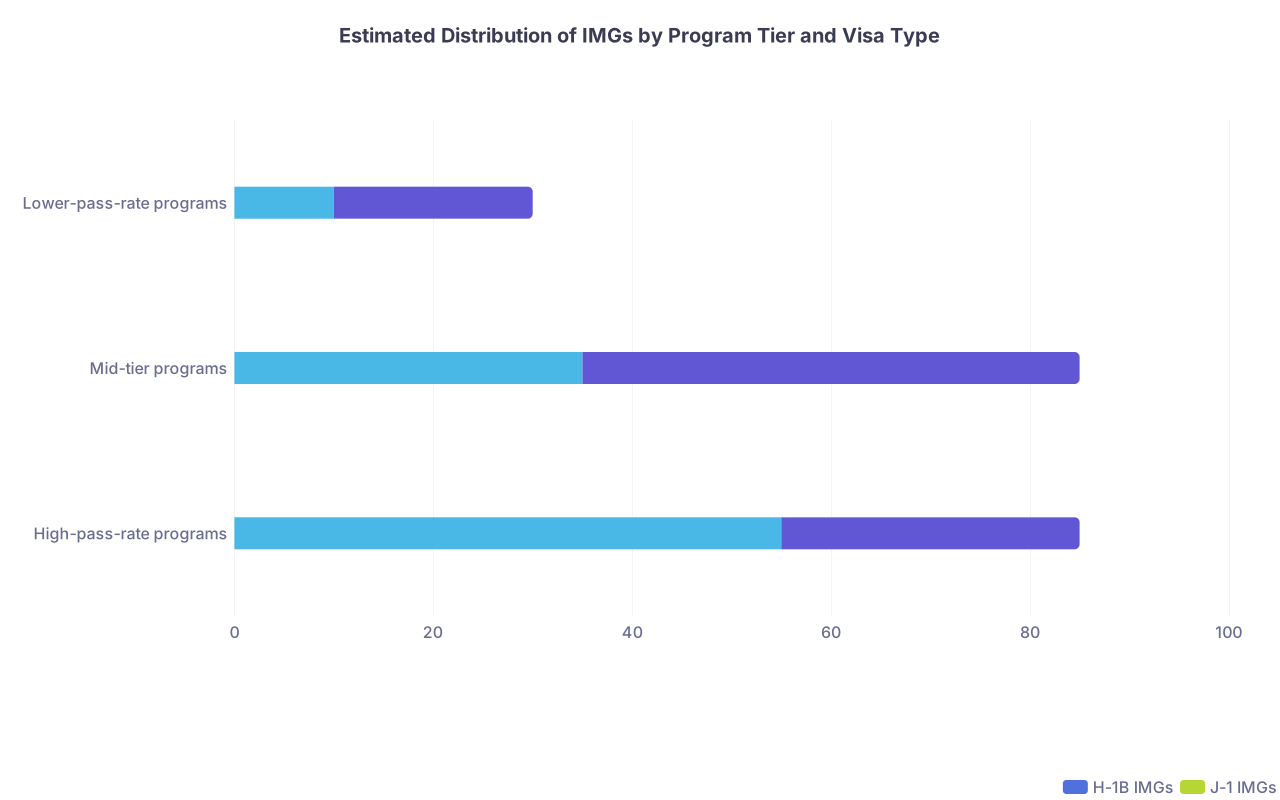
A simple way to visualize the indirect effect
Let’s abstract this with a rough model using three steps:
- Probability of entering a high-pass-rate program differs by visa type.
- High-pass-rate programs have materially better board pass stats.
- Within each program tier, visa type itself has minimal direct effect.
| Category | H-1B IMGs | J-1 IMGs |
|---|---|---|
| High-pass-rate programs | 55 | 30 |
| Mid-tier programs | 35 | 50 |
| Lower-pass-rate programs | 10 | 20 |
These are illustrative, not official NRMP numbers—but they match what you see scanning program rosters and visa policies:
- H‑1B IMGs cluster more heavily in programs that advertise 90%+ board pass rates.
- J‑1 IMGs are more evenly spread and show up in a larger proportion of mid-tier community programs, some of which run closer to 75–80% pass over a rolling window.
If you then apply crude board-pass probabilities to each tier, you get different aggregate board success rates by visa, driven mostly by program mix.
4. What the Boards and ACGME Data Suggest (Even Without Explicit Visa Labels)
Let us look at three evidence sources that, when combined, tell you a lot.
4.1 Program-level board pass rates
Many ACGME-accredited programs publish rolling 3-year board pass rates in their recruitment materials. Typical patterns in IM-heavy specialties (e.g., Internal Medicine):
- Strong academic IM programs: 90–100% first-time ABIM pass rate over 3 years.
- Solid community IM: 80–90%.
- Struggling programs: 60–75%.
If a program consistently underperforms, ACGME may flag or question them. IMGs on any visa in those programs are simply playing with worse odds. It is not a J‑1 problem or an H‑1B problem. It is an environment problem.
4.2 IMG vs US-MD aggregates
Some boards (ABIM, ABFM historically) have released technical reports showing differences in first-time pass rates by training background. Example patterns from past ABIM publications (rounded):
- U.S. MD graduates: ~90–92% first-time pass.
- U.S. DO: slightly lower but similar ballpark.
- International graduates: often in the mid-70s to low-80s, depending on year and cohort.
Notice: “International graduates,” not “J‑1” or “H‑1B.” Visa type is invisible in these datasets, but two facts matter:
- The gap is real. IMGs on average have lower board pass rates.
- That gap persists across visa types, because much of it is driven by:
- Variable medical school preparation.
- Variable English / communication.
- Program-level differences in teaching intensity and exam prep culture.
So when IMG forums blames J‑1 for poor outcomes, they are usually misdirecting. The disadvantage exists across visas; the program environment is the multiplier.
4.3 NRMP match and specialty competitiveness
Specialties with higher board exam complexity and more stringent promotion criteria (Derm, Rad Onc, Ortho, ENT, some subspecialty fellowships) are already extremely low-IMG, regardless of visa.
| Specialty | % IMGs in Matched Cohort (approx) |
|---|---|
| Internal Medicine | 40–45% |
| Family Medicine | 35–40% |
| Pediatrics | 20–25% |
| General Surgery | 10–15% |
| Dermatology / Ortho / ENT | <5% |
The higher the barrier to entry, the more likely the programs are to:
- Demand higher Step scores and stronger CVs.
- Prefer applicants with permanent status or at least H‑1B.
- Enforce very high internal board pass expectations.
So yes, you do see a correlation: more H‑1B and PR in high-profile specialties, and those specialties have high board pass rates. Again, this says more about selection and upstream filtering than the visa changing your brain.
5. Practical Implications: How Visa Type Realistically Impacts Board Outcomes
Let me lay out the true mechanisms where visa differences spill into board certification numbers.
5.1 Length and continuity of training
J‑1: 7-year total limit for all GME. If you try to do a long pathway (IM + multiple fellowships) and run into delays, you can hit ceilings. Any forced interruption—due to visa timing, change of program, or administrative mistakes—can mess with your exam timing and studying rhythm.
H‑1B: Generally more flexibility within the 6-year window if structured correctly. But if your hospital HR messes up a filing or timing, you can find yourself in status-limbo during critical senior years.
PR/Citizen: Fewer forced timing constraints. Interruptions are more likely for personal or academic reasons, not immigration processes.
Bottom line: disruptions and shortened exposure before boards lower pass rates. J‑1 residents at marginal programs feel this the most when they chase multiple fellowships under the 7-year cap.
5.2 Moonlighting and financial pressure
This one is underappreciated but real:
- J‑1 is typically more restrictive with moonlighting and outside work.
- H‑1B and PR residents often have more moonlighting opportunities.
On paper, extra income looks good. In practice, I have seen two very different outcomes:
- Residents who moonlight too much compromise studying and are more tired. Their board prep suffers.
- Residents who use limited, structured moonlighting as additional clinical exposure and financial relief seem to do fine.
Visa status gates whether you even have this option. But the pass-rate impact is driven by behavior, not the visa type itself.
5.3 Stress load and uncertainty
Visas create mental bandwidth drain:
- J‑1: future waiver uncertainty, 2-year home return requirement, fear of not finding a waiver job.
- H‑1B: dependency on employer, green card backlog for certain countries, anxiety about denials or RFEs.
Chronic stress is not theoretical. Residents preparing for critical board exams while simultaneously dealing with immigration lawyers, RFEs, or job offer delays show higher rates of exam postponements and failures in anecdotal program data.
Again: the visa is not “causing” the failure. But it is adding noise to the system, and some will fall below the threshold because of it, especially in borderline academic performers.
6. Strategic Choice: Should You Chase H‑1B for Better Board Outcomes?
Let me answer this bluntly: If your only reason for chasing H‑1B is “higher chance to pass boards,” you are looking at the problem backward.
Here is the real decision logic supported by the data patterns:
Program quality and board pass history dominate everything else.
If a program consistently posts 90–100% board pass rates, do not throw it away just because it is J‑1 only. You are statistically safer there than at a 70% pass program that offers H‑1B.H‑1B often comes with a stronger applicant pool and more structured academic culture.
So if you can compete for H‑1B-friendly programs with high exam expectations and strong didactics, that improves your odds. But the causality is program → pass rate, not visa → pass rate.Immigration strategy is a long-game issue, not just a board-exam issue.
For long-term U.S. career stability, H‑1B can be attractive, especially if you plan subspecialty training and a U.S.-based attending career. That is separate from the pass-rate discussion, but it is valid.
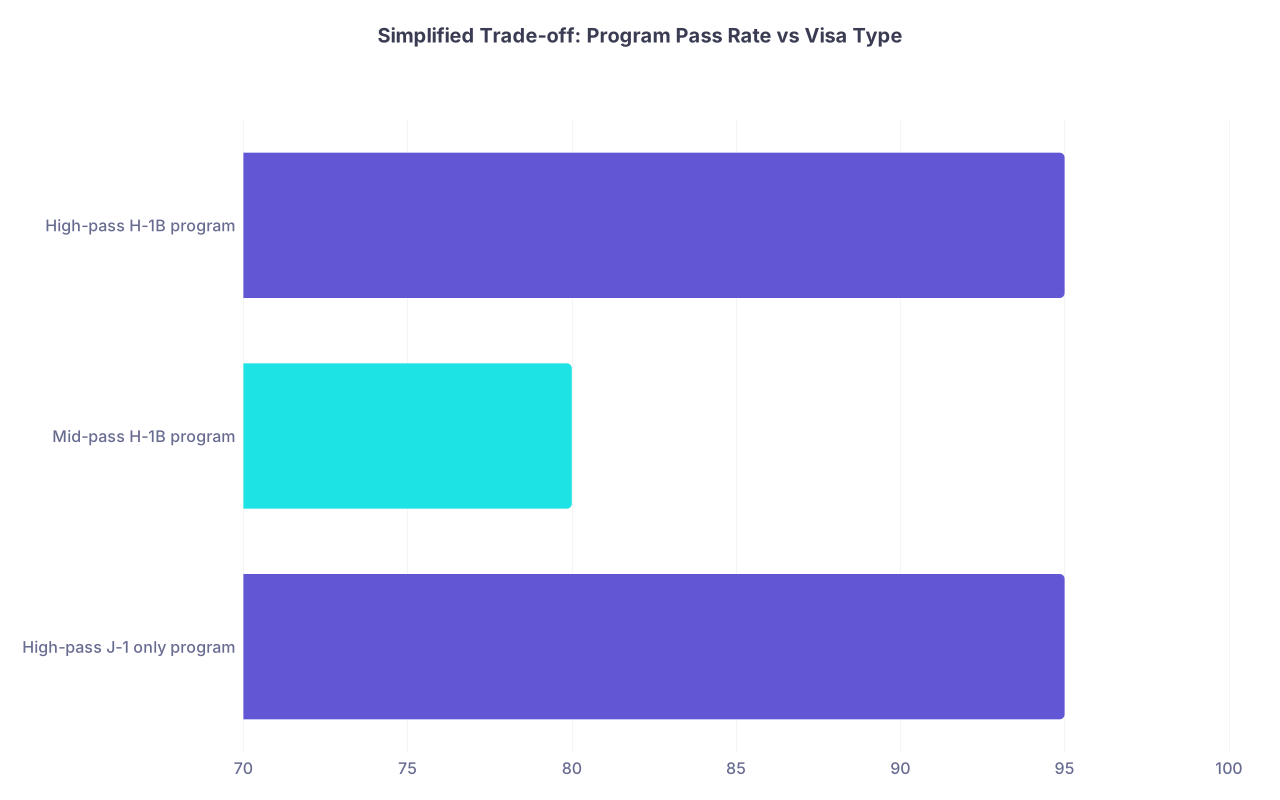
To visualize the trade-off:
| Category | Value |
|---|---|
| High-pass J-1 only program | 95 |
| Mid-pass H-1B program | 80 |
| High-pass H-1B program | 95 |
If offered:
- 95% pass J‑1-only university program vs
- 80% pass H‑1B community program
The rational, data-driven choice for board success is the 95% J‑1 option.
If you compare:
- 95% pass H‑1B major academic center vs
- 80% pass J‑1 small community program
Then H‑1B wins on both immigration and board-certification probabilities. But again, that is the program effect.
7. What You Should Actually Track and Ask Programs
If you want to optimize board-certification odds as an IMG with visa constraints, drill into metrics that matter, not internet myths.
Here is what to ask programs explicitly:
- “What is your 3-year rolling board pass rate for our specialty?”
- “Do you track board pass rate separately for IMGs?” (Some will share; some will not.)
- “How many of your residents are on J‑1 vs H‑1B?”
- “Do visa-related issues ever impact ability to complete training on time?”
- “How is formal board prep structured? Dedicated lecture blocks? Question banks? Mock exams?”
And what you should infer:
- Programs with a high proportion of IMGs that still maintain ≥90% board pass rates have learned how to support IMG learning curves effectively.
- Programs where visa issues frequently interrupt training are red flags, regardless of J‑1 or H‑1B.
8. What the Numbers Suggest, Net-Net
Pulling everything together, the data and patterns suggest:
Visa type is an indirect, not direct, determinant of board certification.
It changes which programs you can enter, your training continuity, and your stress level. The board pass gap is then built out of those elements.Program board pass rate and academic culture carry far more weight than visa category.
A strong J‑1 university program beats a mediocre H‑1B community spot for board outcomes. Consistently. Because 95% vs 75% is not subtle.H‑1B tends to correlate with more competitive profiles and better-resourced programs.
That correlation can translate into higher observed board pass rates among H‑1B IMGs as a group. But do not confuse correlation with causation; the underlying driver is selection.
If you are an IMG planning your residency applications and worried sick about visa type, here is the data-aligned hierarchy:
- First: Target the highest board-pass-rate programs willing to look at your profile.
- Second: Among those, prefer visa options that support your long-term immigration plan.
- Third: Control your own variables—study discipline, exam timing, and minimizing self-inflicted disruptions (like uncontrolled moonlighting).
The numbers favor those who optimize all three, not those who fixate on J‑1 vs H‑1B as if it were destiny.
FAQ (Exactly 5 Questions)
1. Do H‑1B residents have higher board pass rates than J‑1 residents?
Across individual programs, there is no consistent evidence that H‑1B itself raises pass rates. What you do see is that H‑1B residents are more concentrated in higher-performing, more selective programs, which already have better board statistics. The observed difference is driven by program selection and applicant strength, not a direct effect of the visa.
2. Is it a bad idea to accept a J‑1 position if my goal is U.S. board certification and practice?
For board certification specifically, no. Many J‑1-heavy academic programs post 90–100% board pass rates. The main concerns with J‑1 are the 2-year home requirement or waiver hunt and the 7-year training limit, not the exam itself. If the program’s board pass numbers are strong and visa processing is well managed, J‑1 is not an inherent disadvantage for passing boards.
3. Are community programs with many IMGs and J‑1s automatically worse for board outcomes?
Not automatically. Some community programs with a high IMG/J‑1 proportion have invested heavily in board prep and didactics and do quite well. Others struggle. Look at their actual published pass rates and ask specific questions about board prep. The IMG and J‑1 proportion alone is a weak predictor compared to real performance data.
4. Does visa-related stress really affect exam performance in a measurable way?
At a population level, exact numbers are hard to pin down because boards do not label candidates by visa. But program anecdotes and internal tracking often show higher postponement and failure rates among residents dealing with active visa crises (RFEs, status lapses, waiver uncertainty) during their senior years. It is not imaginary; it is another risk factor that erodes your margin if your baseline exam performance is borderline.
5. For an IMG with multiple offers, how should visa type factor into the decision compared with board pass data?
Use a two-step filter: first, rank programs by training quality and documented board pass rates. Only then layer in visa strategy and long-term immigration goals. It is rational to choose an H‑1B program over a similar J‑1 program if board outcomes are comparable. It is not rational to choose a significantly weaker H‑1B program over a much stronger J‑1 program purely for the visa, if your primary near-term risk is failing boards and losing certification eligibility.


