

Last week on rounds, the resident cracked a joke, the attending laughed, the extroverted student jumped in with some witty comment…and I just stood there clutching my list, nodding like a bobblehead. Walking back to my car, I had this pit in my stomach: “If this is how I am on every rotation, am I just invisible? Is anyone ever going to want to rank me?”
If your brain spirals like that after rounds, you’re in the right place. I’m the quiet one too. And I’ve seen way too many good students convince themselves they’re doomed because they’re not the loudest voice on the team.
Let me be blunt: you do not need to be the charismatic, joke-cracking superstar on rounds to stand out and match well. But you can’t be totally passive either. There’s a middle path—and it actually fits quieter, more anxious people better than you think.
What programs actually remember about you (hint: not your banter)
Everyone acts like rounds is this giant stage audition. It’s not. It’s data collection. Faculty and residents are subconsciously collecting “signals” about you over weeks, not minutes.
Here’s what they actually retain when it’s time for evals or to argue your name at a rank meeting:

Things that really stick:
- Are you reliable? (Do you show up, follow through, not disappear?)
- Do you make their lives easier or harder?
- Do you care about patients in a real, observable way?
- Do you improve over the rotation?
- Are you safe? (Know your limits, ask for help)
- Do you seem like someone they’d trust on call at 3 a.m.?
Things you’re panicking about that barely matter:
- How many jokes you cracked
- Whether you always had the “coolest” question
- Whether you’re the most talkative student
- Whether you have a “big personality”
I’ve literally watched attendings write “quiet but thorough; would be a solid resident” and advocate strongly for that student later. Nobody said, “Well, she wasn’t funny on rounds, so let’s tank her.”
But here’s the catch: “quiet but thorough” is very different from “silent and checked out.” One is memorable in a good way. The other is forgettable or even concerning.
Quiet ≠ forgettable: how to stand out without being “on” all the time
Your worst fear is probably: “If my personality doesn’t shine, they won’t notice me at all.” Fair. That can happen—if you never put anything on the table.
You can’t change your baseline personality in 4 weeks. But you can build a quiet, deliberate presence that people notice.
1. Pick your spots instead of trying to talk constantly
You don’t need to be the running commentary person on rounds. But you do need a few consistent, visible behaviors:
- One thoughtful question per day
- One concrete way you help the team before they ask
- One patient you know inside out
That’s it. If you did just those three every day, your “quiet” would read as “engaged and reliable,” not “checked out and anxious.”
Example:
- On surgery: “I noticed Mr. X’s urine output has been trending down since yesterday—should we be worried about his fluids?”
- On medicine: “I pulled the overnight note and flagged that they were worried about possible AFib on telemetry; I put the EKG in the chart for you.”
- On peds: “I talked with the mom about the plan for the day and made sure she understood why we’re keeping them an extra night.”
You’re not trying to dominate. You’re choosing your moments.
2. Use your strengths as a quiet person
You probably:
- Listen more than you talk
- Pick up on details
- Notice when families are confused or scared
- Don’t interrupt
Those are gold in clinical settings. So lean into them.
Examples that actually register on evals:
- “Student sat with family after rounds to clarify the plan.”
- “Always had an updated list and knew labs before we asked.”
- “Picked up on subtle social issues (housing/transport) and told the team.”
That kind of line will get written about you. And none of it requires a loud personality—just intentional action.
How clerkships help you for residency even if you’re not “the star”
You’re worried about the wrong scoreboard. You’re watching “how I look on rounds today.” Programs are watching “how you performed over time and what your letters say.”
Your clerkships set up your residency application in three big ways:
- Grades / evaluations
- Narrative comments and MSPE (Dean’s letter)
- Letters of recommendation from key rotations
If you’re quiet but strong, your evals can still look like this:
| Aspect | Quiet, Consistent Student | Flashy, Inconsistent Student |
|---|---|---|
| Reliability | Always prepared, on time | Sometimes late, forgets tasks |
| Patient care | Thorough, knows details | Knows headlines, misses details |
| Teamwork | Supportive, low drama | Dominates talk, interrupts |
| Growth | Steady improvement | Up and down performance |
| Overall impression | “Solid intern material” | “Unclear how they’ll be as intern” |
Guess who programs trust more when they’re ranking? The “solid intern material,” even if that student never once told a joke on rounds.
Okay, but what if my personality truly doesn’t show at all?
Let’s go worst-case for a second, since that’s where your brain lives anyway.
Worst-case on a single rotation:
- You’re quiet, nervous, don’t ask many questions
- You do your work, but no one gets to know you
- Your eval ends up generic: “Met expectations, punctual, pleasant”
Not glowing. But not fatal.
A single bland eval won’t sink your residency app. The danger is if every rotation looks like that, and:
- You don’t build relationships strong enough for good letters
- You don’t have anyone who really knows you as a clinician
So your job isn’t “be charming.” It’s:
- Make sure at least 2–3 people over your clerkship year really see how you think, work, and care about patients.
- Be a little braver than feels comfortable, a little more visible than your default.
You don’t need to transform. You just need to be…noticeable.
Simple scripts when your brain freezes on rounds
Sometimes it’s not that you don’t have a personality. It’s that your anxiety locks it in a closet the moment the attending looks at you.
When your mind goes blank, have “backup lines” ready so you default to something competent instead of silence.
Here are a few you can literally memorize:
When you’re asked, “Any questions?” and your brain screams but nothing comes out:
- “I’m still processing a lot of this—could we go over how you narrowed the differential between X and Y?”
- “I’m okay right now, but I’d love to talk through the plan for [patient] after rounds if you have a minute.”
When you don’t know an answer:
- “I’m not sure, but I think it might be related to [brief thought]. I’d like to look that up and report back this afternoon.”
- “I don’t know off the top of my head, but I can look it up and tell you tomorrow.”
When you want to show engagement without over-talking:
- “I noticed that [small detail]. Does that change what you’re thinking for management?”
- “Can I try to summarize the plan for this patient to make sure I’ve got it right?”
None of this is flashy. But it signals: “I’m engaged. I’m thinking. I’m safe.”
How to get strong letters even if you feel “boring”
Letters are where your clerkships really help with residency match. And you can get excellent letters without being the charismatic one.
You just need:
- Consistent performance
- At least one attending or senior resident who sees you clearly
- One short, direct conversation
Here’s the uncomfortable part: you’re going to have to ask people to get to know you a bit. I know. Horrifying. Doable, though.
Try something like this in week 2 or 3 of a rotation you care about:
“Dr. X, I’m hoping to go into [specialty / or I’m still deciding but really like this field]. I’m pretty quiet on rounds but I really want to grow. Is there anything specific I can work on over the next couple weeks to be a stronger student?”
Why this works:
- You’ve named the quiet thing out loud without apologizing for existing
- You’ve signaled motivation and openness to feedback
- You’ve invited them to pay attention to your growth
Those are the students who get comments like:
- “Started off quiet but really grew in confidence over the rotation.”
- “While not the most vocal, they consistently delivered excellent patient care.”
Those are powerful lines in a letter.
How clerkships build your residency story, not just your scores
You’re probably obsessing over: “Did I answer that one pimp question wrong? Did they think I was dumb?” Faculty don’t have that level of recall on you. What they remember is a pattern.
Your clerkships help your residency match in a few big, quiet ways:
- You figure out where you actually fit (there’s a huge difference between liking a field on paper vs. at 5 a.m. on call).
- You collect stories: patients you helped, mistakes you learned from, moments where you stepped up. These become your personal statement and interview answers.
- You learn what kind of team environment you thrive in—and which to avoid.
As your rotations add up, you get data on yourself:
- Do attendings consistently call you “reliable,” “thoughtful,” “good with patients”?
- Do residents seem relaxed around you?
- Do patients open up to you?
That’s your “personality on the wards,” even if you never feel like the life of the party.
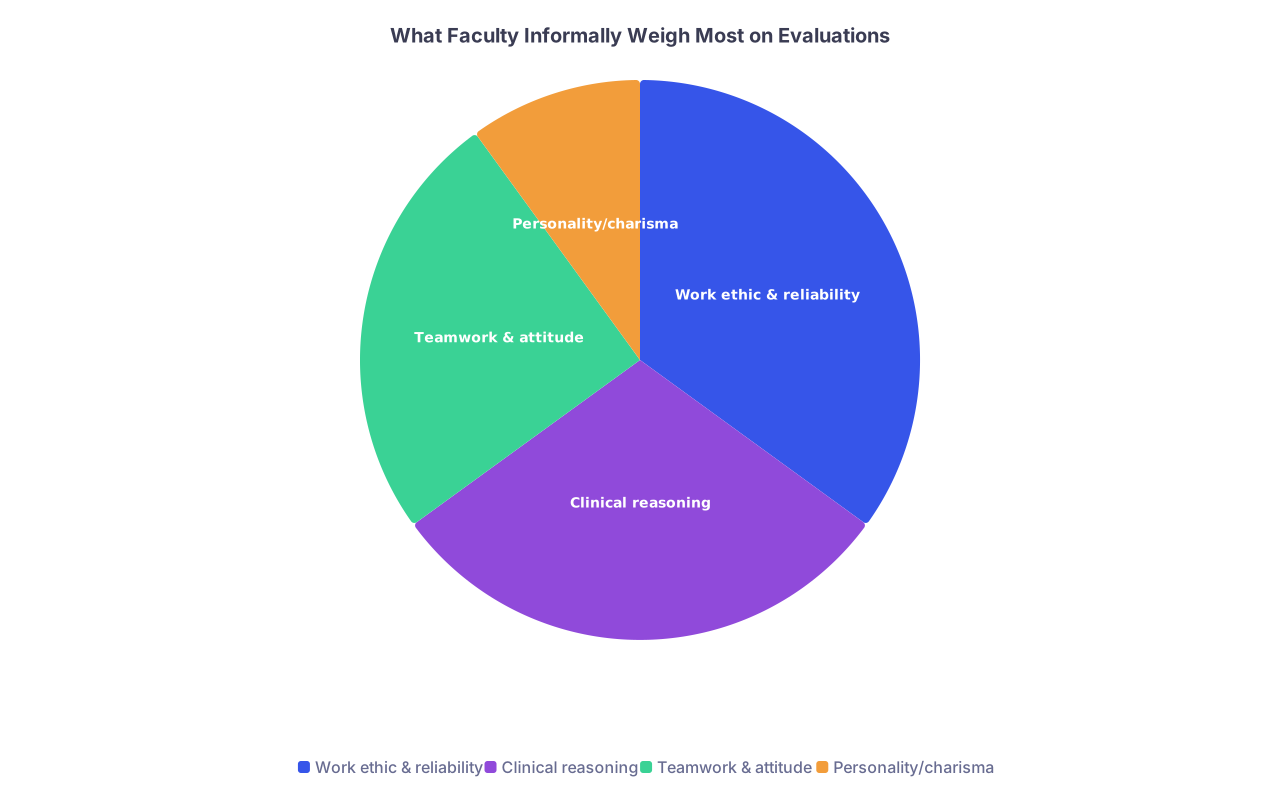
| Category | Value |
|---|---|
| Work ethic & reliability | 35 |
| Clinical reasoning | 30 |
| Teamwork & attitude | 25 |
| Personality/charisma | 10 |
Is this exact data from a study? No. But it matches what I’ve seen over and over: charisma is a small slice. Helpful, safe, teachable people get ranked.
How to practice standing out without faking a personality
I’m not going to tell you to “just be yourself” because that’s useless advice when your “self” feels frozen by anxiety. So here’s a more honest framework.
Pick one of these to work on each week of a rotation:
Week 1 – Reliability:
- Be on time. Actually early.
- Have your patient notes done before they’re needed.
- Know vitals, labs, imaging before rounds.
Week 2 – Visibility:
- Ask one question per day.
- Volunteer for one small extra task: “I can call the outside hospital for records.” “I can update the family.”
- Present one patient with a bit more structure and confidence.
Week 3 – Ownership:
- Know your primary patient better than anyone: social situation, fears, preferences.
- Anticipate: “The attending usually asks X—let me find it first.”
- Offer a plan, even if it’s simple: “Given [A, B, C], I’d suggest we…”
Week 4 – Relationships:
- Ask for feedback from one resident and one attending.
- Tell at least one person you appreciate something they did for you (“Thanks for walking me through that admit—really helped.”)
- If you’re considering that field, quietly signal interest.
You’re not playing personality theater. You’re building a track record.
Reality check: worst-case vs actual risk
Let’s map what your brain says versus reality.

| Step | Description |
|---|---|
| Step 1 | Quiet on rounds |
| Step 2 | No good evals |
| Step 3 | No good letters |
| Step 4 | No residency match |
| Step 5 | Eval based on pattern |
| Step 6 | If reliable and engaged |
| Step 7 | Comments highlight strengths |
| Step 8 | Competitive for many programs |
| Step 9 | Brain prediction |
Your catastrophe chain—“quiet on rounds → no match”—skips about 10 very important steps. The truth is:
- You can be quiet and still get good evals.
- You can have a few mid evals and still get strong letters.
- You can have non-flashy clerkships and still match into solid programs.
Where people get into trouble is:
- Chronic disorganization
- Defensiveness about feedback
- Being unreliable or checked out
- Being unkind to nurses / patients / other students
None of those are about your “personality shining.” They’re about behavior.
What you can do today to feel less invisible
Not tomorrow. Not “next rotation.” Today.
Pick one patient on your current service (or think about your next rotation if you’re between blocks) and do this:
- Learn one extra non-medical fact about them: who they live with, what they’re worried about, what they do for work.
- Bring that into rounds tomorrow: “I asked, and he’s most worried about getting back to work—he’s the only income in his household.”
That single line:
- Shows you talked to the patient
- Shows you care about their life
- Shows initiative
Quiet, yes. Forgettable, no.


