
The belief that program directors carefully read every word of your clerkship comments is naïve. They don’t. But they absolutely care when those comments contain certain phrases—and they care a lot about how those comments line up with your shelf and Step scores.
Here’s the actual hierarchy: a single shelf score rarely makes or breaks you. Patterns do. And narrative comments matter, but only the distilled, high‑signal pieces that survive onto your MSPE and letters. Program directors (PDs) weigh all of that together, not in isolation.
Let me break it down in the way you actually need for residency applications.
The Short Answer: Which Matters More?
If you’re asking, “Do PDs care more about shelf scores or narrative clerkship comments?” you’re asking the wrong binary question. Here’s the real answer:
- For screening and first-pass filters: PDs care more about objective metrics (Step 1/2, sometimes shelf-derived clerkship grades).
- For ranking and final decisions: PDs care more about global clinical performance signals, which come through clerkship grades, key narrative comments, and letters.
If I had to force a one-line priority list for most programs:
- USMLE/COMLEX (especially Step 2 once Step 1 went pass/fail)
- Overall clerkship grades (Honors/HP/P) – often driven by shelf + evals
- Narrative comments (MSPE + letters) – but only the standout or concerning ones
- Individual shelf scores (if visible at all)
So no, PDs do not sit there comparing your 76 on surgery shelf to your 82 on medicine shelf. They care if:
- You failed or barely passed a shelf
- You have a pattern of weak exams
- Your narrative comments say you’re “a pleasure to work with” but “needs considerable supervision” while your scores are high—or the reverse
It’s the story those two data streams tell together that moves the needle.
How PDs Actually See Your Clerkship Performance
Start with how your clinical performance reaches a PD’s eyes. They are not logging into your school portal and reading raw evaluations. They see a curated summary.
Typical inputs they get:
MSPE (Dean’s Letter)
- Summary of each core clerkship (grade + 2–4 sentences)
- Selected comments, not every line
- Any flags: remediation, professionalism issues, failures
Transcript
- Clerkship grades only (Honors/HP/P/F or equivalent)
- Sometimes notes on “with distinction” or “clinical honors”
-
- Free-text, but PDs skim for specific patterns and red flags
USMLE/COMLEX performance
- Step 1 (Pass/Fail)
- Step 2 CK/Level 2 scores (critical now)
- Occasionally shelf exam performance if your school chooses to report it in the MSPE
Many schools do not report raw shelf scores at all. Some give deciles or statement-level summaries like “performed above average compared to peers.” A few provide an ugly table with all your shelf percentiles.
| School Reporting Style | What PD Actually Sees |
|---|---|
| No shelf reporting | Only clerkship grades |
| Decile or quartile bands | Relative standing (e.g. top 25%) |
| Single sentence summary | “Above/at/below average” |
| Full score table | All raw/percentile scores |
The key detail: in most cases, PDs see shelf performance in aggregate, not as isolated numbers. Your narrative comments, in contrast, are hand-picked lines curated by your school.
When Shelf Scores Really Matter
Shelf scores themselves aren’t prestige points. They matter when they trigger consequences or reveal a pattern.
They become important when:
They drive your clerkship grade
At many schools, the shelf is 30–50% of the clerkship grade. A weak shelf can turn what would have been Honors into High Pass or Pass. PDs care about the resulting grade, not that you got a 68 vs 78.You fail or have to remediate
A failed shelf that requires remediation goes into the MSPE. That’s a clear signal. PDs look for:- Was it a one‑off early in MS3?
- Did you fix it later (strong Step 2, later shelves OK)?
- Or is there a pattern of poor test performance?
You have a pattern of low exam performance
If your school shows shelf percentiles and you’re consistently bottom quartile, then post a Step 2 CK of 215, PDs start worrying about:- Test-taking ability
- Knowledge base
- Board pass risk as a resident
You’re going for a hyper‑competitive specialty
For specialties like dermatology, neurosurgery, plastics, ortho, PDs look for any signal that you’re top-tier. Some of them will glance at shelf percentiles if they have them, especially on core relevant rotations (e.g., surgery shelf for ortho).
Here’s what they do not care about: whether you got a 72 vs 80 on a single psychiatry shelf while everything else is solid. That will not sink you.
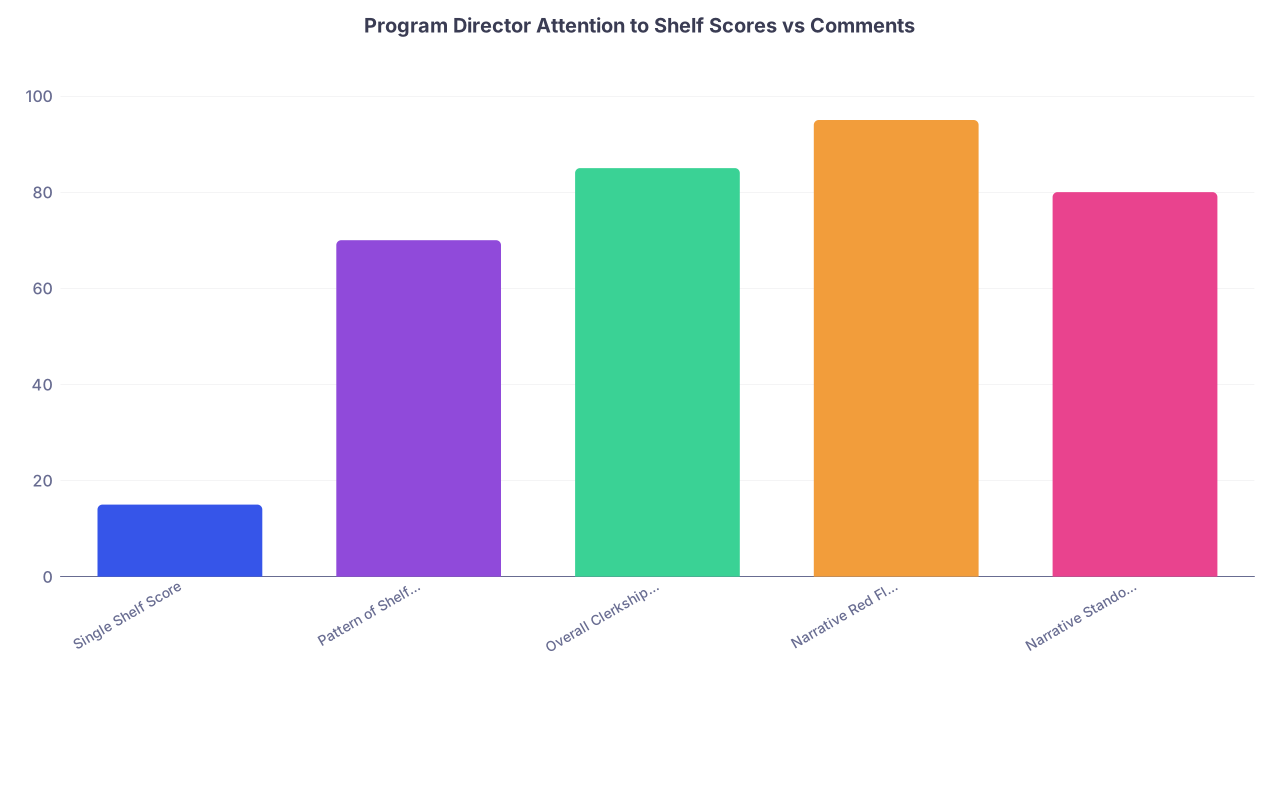
| Category | Value |
|---|---|
| Single Shelf Score | 15 |
| Pattern of Shelf Weakness | 70 |
| Overall Clerkship Grade | 85 |
| Narrative Red Flags | 95 |
| Narrative Standout Praise | 80 |
Those numbers aren’t from one specific study—they reflect the reality I’ve seen sitting in on rank meetings: patterns, grades, and strong/negative comments get brought up; exact shelf numbers basically don’t.
When Narrative Clerkship Comments Matter More
Narrative comments are not all created equal. Most of what’s written about you during third year will never be seen by a PD. The only ones that matter are:
- Lines chosen for the MSPE
- Quotes or summaries referenced in your LORs
- Any explicit mention of concern, professionalism issues, or below-level performance
PDs are scanning for a few specific things:
Work ethic and reliability
Phrases like:- “Hard-working and dependable”
- “Always prepared and went above expectations”
- Bad version: “Arrived late on multiple occasions” or “Needed frequent reminders”
Team behavior and teachability
- “A pleasure to work with”
- “Responded very well to feedback”
- Red flag version: “Defensive to feedback” or “Challenging interactions with team”
Clinical reasoning and independence
- “Functioned at the level of an intern” (gold)
- “Strong clinical reasoning and ownership of patients”
- Red flag version: “Required close supervision for basic tasks”
Communication and professionalism
- “Communicated effectively with patients and families”
- “Demonstrated mature professionalism”
- Red flag: any mention of professionalism concerns, boundary issues, or formal reports
Those comments matter a lot more than whether your shelf was 1 SD above vs 0.5 SD above the mean. One strong line like “Top 5% of students I’ve worked with in the last 10 years” weighs more heavily than a handful of mid‑70s shelves.
The Real Game: Alignment Between Scores and Comments
What PDs truly key in on is whether your story is consistent.
Scenario 1: High shelves + strong comments
- Shelf percentiles mostly above average
- Step 2 CK 250+
- MSPE comments: “Outstanding,” “functions as an intern,” “top student”
Interpretation: High performer, likely low-risk, good bet. Programs love this.
Scenario 2: High shelves + lukewarm or negative comments
- Strong exam performance
- Comments: “Quiet, somewhat disengaged,” “required frequent prompting,” “needs to work on teamwork”
Interpretation: Smart but potentially problematic to work with. Depending on specialty, this can hurt more than an average shelf.
Scenario 3: Average shelves + glowing comments
- Mostly Pass/High Pass with occasional Honors
- Step 2 CK 235–245 range
- Comments: “Incredibly compassionate, team-oriented,” “patients loved working with them,” “independent and reliable”
Interpretation: Solid physician potential, someone residents will like having on the team. For many fields (FM, IM, peds, psych, etc.), this combination does very well in the Match.
Scenario 4: Low shelves + weak or concerning comments
- Pattern of low exam scores, maybe a failure/remediation
- Comments: “Below level,” “concerns about knowledge base,” “needed close supervision”
Interpretation: High risk. This is where applications die in committee.

| Step | Description |
|---|---|
| Step 1 | See Application |
| Step 2 | High Confidence |
| Step 3 | Moderate Confidence |
| Step 4 | Proceed With Caution |
| Step 5 | Possible Late Bloomer |
| Step 6 | Board Risk Concern |
| Step 7 | Likely No Interview |
| Step 8 | Exam Performance Pattern |
| Step 9 | Narrative Summary |
| Step 10 | Narrative Summary |
The worst mismatch a PD sees is:
Strong test scores + “hard to work with,” “does not take feedback well,” or any whiff of professionalism problems. That’s far more damaging than a mediocre shelf.
Specialty Differences: Who Cares About What?
Not every specialty weighs these elements the same way.
| Specialty | Boards/Shelves Weight | Narrative/Comments Weight |
|---|---|---|
| Dermatology | Very High | High |
| Orthopedic Surg | Very High | High |
| Neurosurgery | Very High | High |
| Internal Med | High | Very High |
| Family Med | Moderate | Very High |
| Psychiatry | Moderate | Very High |
In very competitive, procedure-heavy fields (ortho, ENT, neurosurgery, derm), PDs lean on objective metrics first to narrow the pile. Once they’re in the serious-interview zone, narrative comments, sub-I performance, and letters start to dominate.
In more holistic, relationship-driven fields (IM, FM, psych, peds), PDs pay a ton of attention to how you function on teams and how patients react to you. They still care about Step 2 and clerkship grades, but a candidate with middle-of-the-road shelves and stellar comments will often beat a test-taking machine who’s a disaster on the wards.
Practical Strategy: What Should You Actually Prioritize?
You don’t have infinite energy. So where should you spend it in clerkships?
1. Avoid shelf disasters, do not chase perfection
You want shelves that:
- Keep you safely away from failure
- Support at least High Pass, possibly Honors, when combined with clinical evals
- Show improvement if you had a rough start
Perfect shelves are not worth burning out for if they make you a ghost on the wards. PDs won’t reward that trade.
2. Aggressively protect your narrative reputation
You get a disproportionate return on behaviors that shape comments. Focus on:
- Showing up early, staying engaged, volunteering for tasks
- Owning a small number of patients and knowing them cold
- Asking for feedback and visibly using it
- Never, ever getting near a professionalism issue (phones, HIPAA, absences, complaining about work)
One strong line in the MSPE like “Among the best students I’ve worked with in years” can counterbalance a merely decent exam history.

3. Use your strengths to cover your weaknesses
If you’re a weak test taker:
- Study hard enough to stay out of failure territory and steadily improve
- Crush the clinical side: be memorable for the right reasons, seek strong letters
- Aim for specialties that care more about people skills and teamwork than hyper-elite scores
If you’re socially awkward but great at tests:
- You cannot hide on the wards forever. Practice basic social behaviors (introducing yourself to patients, checking in with nurses, asking “what can I help with?”)
- Ask explicitly how you’re doing and what to fix
- One bad narrative comment can seriously hurt you; do not ignore that risk
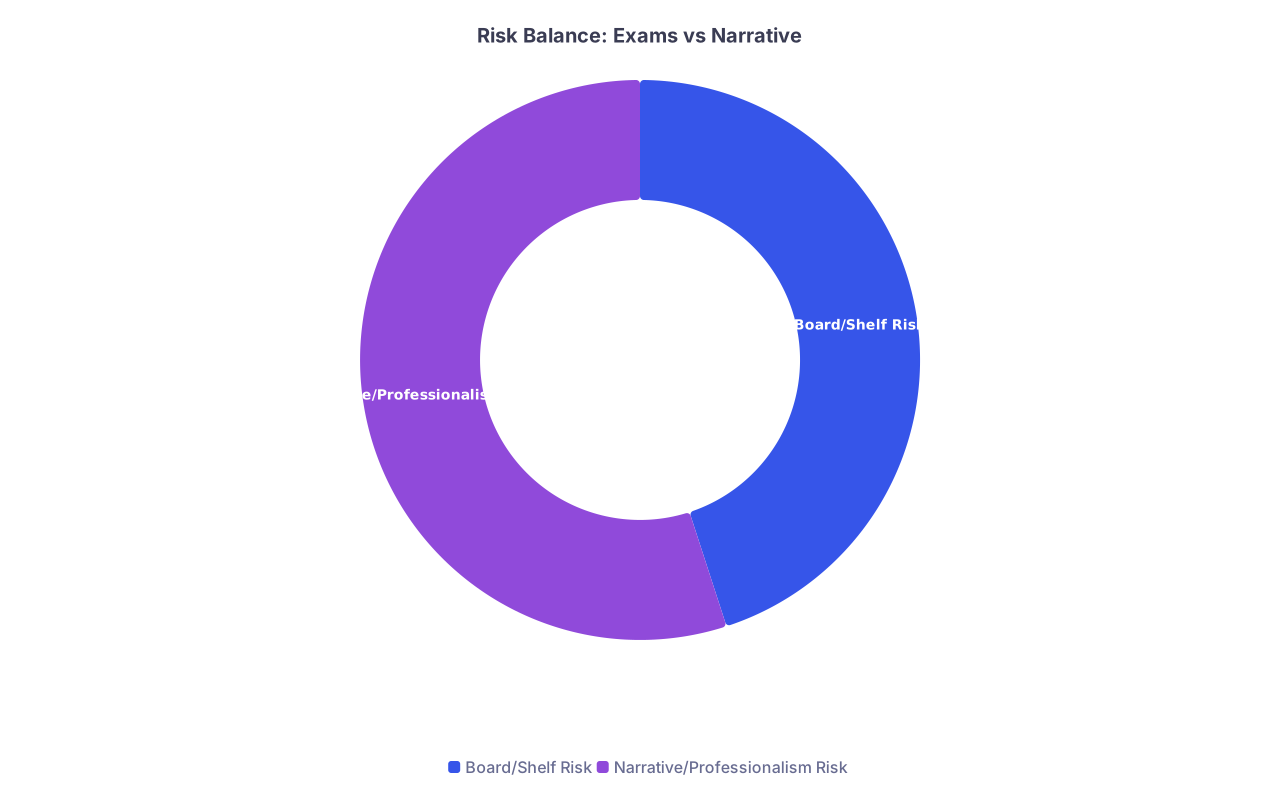
| Category | Value |
|---|---|
| Board/Shelf Risk | 45 |
| Narrative/Professionalism Risk | 55 |
How This Plays Out in Application and Ranking Meetings
I’ve watched this conversation more times than I can count. It sounds like this:
- “Step 2 is strong, clerkship grades are mostly Honors/HP, comments say ‘hard-working, team player.’ Good.”
- “Shelves are all in the 60–70th percentile range but comments are glowing. No concerns.”
- “Step 2 borderline, had to remediate surgery shelf, MSPE mentions ‘needs to work on reliability.’ I’m worried about this one.”
- “Comments say ‘top 5%’ on multiple rotations. Even with a 230 Step 2, I’d be happy to have them.”
Notice what’s missing: “They got a 78 on psych shelf, that’s not high enough.” That sentence basically never comes out of anyone’s mouth.

| Step | Description |
|---|---|
| Step 1 | Review Application |
| Step 2 | Screen Out |
| Step 3 | Offer Interview |
| Step 4 | Consider If Space |
| Step 5 | Debate In Committee |
| Step 6 | Step 2 Above Cutoff |
| Step 7 | Clerkship Grades Pattern |
| Step 8 | Narrative Comments |
| Step 9 | Narrative Comments |
Bottom Line: What PDs Actually Care About
Strip away the noise and it comes down to three core truths:
Shelf scores only matter to PDs indirectly: through how they affect your clerkship grades, any failures/remediations, and the overall pattern of your test performance. One low shelf in isolation is almost never fatal.
Narrative clerkship comments matter when they’re extreme—good or bad: generic “pleasant to work with” is background noise. What changes your trajectory are standout praise lines and any hint of professionalism or “below level” concern that survives into the MSPE or letters.
Consistency beats perfection: PDs are trying to answer one question—“Will this person be a safe, reliable, teachable resident who passes boards?” If your shelves, Step scores, grades, and comments tell a coherent, upward-trending story that says “yes,” you’re in good shape. If they conflict or show repeated problems, that’s when people start worrying.
Focus on avoiding big negatives, building a clear pattern of solid performance, and earning a few truly outstanding comments. That combination beats obsessing over a handful of shelf score points every single time.