

You’ve just finished your medicine clerkship. Final eval looks decent. You didn’t crash and burn, your comments are mostly “pleasant to work with” and “reads around patients.”
But here’s what you cannot see: two days after you leave, the clerkship director is in a residency selection meeting. Someone says, “Any students we should keep an eye on from this block?” And one attending says, casually:
“Yeah, that student—Alex S.—I’d keep them on your short list. Really strong.”
That’s the “quiet recommendation.” It’s not in your eval. It’s not in your MSPE. There’s no email you’re CC’d on. But it absolutely changes how your application is read later.
Let me walk you through how those decisions really get made—because the stories students tell themselves about “working hard and being nice” are only half the truth.
What a “Quiet Recommendation” Actually Is
Programs don’t run purely on ERAS filters and official letters. Behind every rank list, there’s a web of small, informal nudges.
A “quiet recommendation” usually looks like one of these:
A chief resident leans over during file review:
“By the way, that MS3 we had on nights—phenomenal. If they apply here, we should interview them.”
Or a subspecialty attending emails the PD:
“I worked with this student on consults last month. Excellent clinical instincts. Would absolutely take them as a resident.”
Or the clerkship director in your home department adds a comment in a selection meeting:
“They’re in the top 5% of students we’ve had the last few years.”
No formal LOR attached. No “Dean’s letter addendum.” Just a spoken or emailed endorsement from someone whose judgment the program trusts.
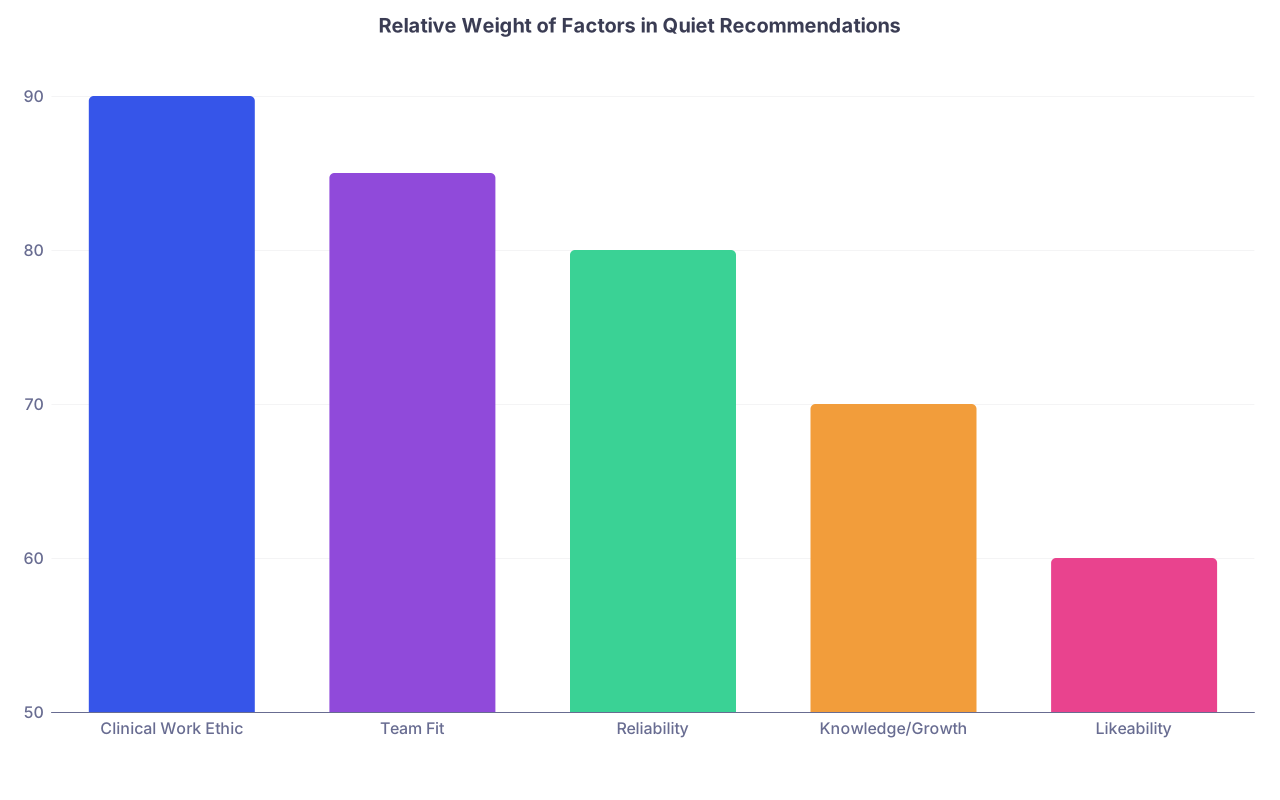
| Category | Value |
|---|---|
| Clinical Work Ethic | 90 |
| Team Fit | 85 |
| Reliability | 80 |
| Knowledge/Growth | 70 |
| Likeability | 60 |
Those quiet nudges matter most in three situations:
- Deciding who gets interviews from a huge pile of “good but not perfect” applications.
- Choosing between similar applicants when building the rank list.
- Salvaging a slightly weaker score profile if someone trusted says, “They’ll be great here.”
You don’t hear about these because faculty don’t want a line of students asking, “Can you quietly recommend me?” But the conversations absolutely happen.
Where These Conversations Happen (That You’re Not In The Room For)
You need to understand the venues where your name can come up positively after a clerkship.
1. Department Education Meetings
Think noon in a conference room, faculty and chiefs around a table, laptops open, half the room catching up on notes, the other half actually paying attention.
Agenda item: “Review applicants from our own institution / rotators.”
This is where you want someone to say, “Oh yeah, I know them.”
What they actually say, verbatim, sounds like:
- “Solid, will do the work, no drama.”
- “Honestly, one of the best students I’ve worked with in the last couple of years.”
- Or the kiss of death: “They were…fine.” (Translation: don’t spend an interview spot.)
2. Hallway / Workroom Comments
I’ve watched this a hundred times.
PD walks through the workroom, sees a familiar attending:
“Hey, didn’t you have one of our applicants on your team? How were they?”
You’re not evaluated by a committee at that moment. You’re reduced to a 10-second sound bite:
“Very independent, didn’t need hand-holding.”
or
“Nice, but always needed to be told what to do.”
Those micro-summaries stick.
3. Informal Emails From Faculty
The most powerful recommendations are short and unsolicited.
I’ve seen emails like:
“Had Jane D. on surgery last month. She functioned like a sub-I by the end. Very strong work ethic, excellent with patients. If she applies to our program, would interview.”
No flowery paragraph. No boilerplate. Just clear, specific praise from someone the PD knows does not hand out praise easily.

| Step | Description |
|---|---|
| Step 1 | Clerkship Performance |
| Step 2 | Attending Impression |
| Step 3 | Standard Eval Only |
| Step 4 | Attending Mentions to PD/Chiefs |
| Step 5 | Quiet Recommendation |
| Step 6 | Boost in Interview/Rank Decisions |
| Step 7 | Standout? |
The Real Selection Criteria: What Actually Triggers a Quiet Endorsement
Students obsess over the wrong things. You think it’s being the gunner who knows every UpToDate article. That’s not what reliably gets faculty to stick their necks out.
Here’s what I see faculty actually respond to.
1. The “I Don’t Have to Worry About You” Factor
Program directors hate uncertainty. A quiet recommendation is basically someone saying: “If we match this person, they will not be a problem.”
How do you signal that?
You show up.
On time, consistently, without drama.
You do what you say you’ll do.
If you tell the team you’ll follow up on a lab, you actually check the lab and report it back without being chased.
You don’t disappear.
You’re in the workroom, on the floor, in patients’ rooms. Not constantly “going to the bathroom” or “checking one thing quickly in the library.”
Faculty will say things like:
“They were just…reliable. I never had to worry about whether the work would get done.”
That alone can bump you into the “recommend” category.
2. How You React When You’re Wrong
This is huge. You will be wrong constantly as a clerk. That’s not the issue. The issue is whether you become defensive, crumble, or adapt.
Attendings remember:
- Do you double down when corrected?
- Do you blame the resident, the nurse, the EMR, the schedule?
- Or do you say, “Got it, I’ll fix that now,” and then you actually fix it?
I’ve heard attendings advocate for students like this:
“They took feedback better than half my interns. I’d trust them to grow fast.”
That’s catnip to a PD.
3. Situational Awareness and Initiative (Without Being a Menace)
The students who get quietly recommended are rarely the loudest. But they are always tuned in.
They notice when the team is drowning with new admits and quietly take on tasks they can actually handle. They pre-write notes, call a family back, grab the EKG.
They don’t ask, “Anything I can do?” every five minutes. They ask targeted, useful questions:
“Do you want me to start the discharge summary for bed 12 since they’re going home today?”
There’s a line between helpful and intrusive. The ones who get recommended walk that line well.

4. How Residents Talk About You When You’re Not There
Every PD I know cares deeply about this one.
Residents are the ones living with you at 2 a.m. on call. They know if you:
- Vanish when admissions pile up
- Volunteer for scut but mess up every actual clinical responsibility
- Or quietly do the unglamorous tasks and make the team run smoother
I’ve sat in meetings where a PD asked the chiefs: “Anyone rotate with this student?” and the response decided the whole file:
“Honestly, they worked like a sub-I. Very little oversight needed.” → Interview.
or
“They complained a lot and seemed disinterested unless the attending was around.” → Pass.
If your residents genuinely like working with you, that goodwill travels.
5. Emotional Stability Under Stress
Nobody wants an intern who melts down every time something unpredictable happens. Faculty watch how you handle chaos.
- The pager goes off three times during pre-rounds.
- A patient crashes while you’re trying to present.
- The attending pimping gets more intense.
Do you spiral? Or do you stay functional?
The students who earn quiet recommendations aren’t unflappable robots. They just recover quickly and keep going. One attending of mine used to say:
“I don’t need perfect. I need sturdy.”
If they describe you as “sturdy,” you’re in good shape.
What Makes Faculty Actually Speak Up (Instead of Just Liking You Quietly)
Here’s the uncomfortable truth: Lots of attendings like you. Very few will go out of their way to recommend you unless something triggers action.
Trigger #1: You Explicitly Signal Interest (The Right Way)
If you want someone to quietly recommend you, they need to know you care about that field/program.
The effective play is not, “Can you put in a good word for me?” That puts people on the defensive.
You say something like:
“I’ve really enjoyed working with you this month. I’m strongly considering [specialty] and thinking about applying to programs like [X/Y]. Do you have any advice for how to be a strong applicant?”
That does two things:
- It flags you as someone serious about the field.
- It gives them a natural opening to say, “If you end up applying here, let me know—I’d be happy to support you.”
That “happy to support you” often turns into the quiet recommendation later.
Trigger #2: You Ask for Feedback Before the End
The student who asks for real-time feedback mid-rotation gets remembered. Because that’s how residents and good interns behave.
Three weeks in, say to your attending:
“I want to improve as much as possible while I’m still here. Is there one or two things I could focus on in the next week to function more like a sub-I?”
That line hits every faculty member’s bias toward “growth mindset.” If you then actually improve in those areas, you’ve just written your own talking points for them.
Later, in a selection meeting, that attending will say:
“They actively sought feedback, and I watched them change their behavior within days. Very coachable.”
Program directors love “coachable.”
Trigger #3: You Close the Loop
Students underestimate how much this matters.
If a faculty member gave you advice, flagged opportunities, or spent time teaching you, and then months later you send a short, specific follow-up:
“I wanted to thank you again for your teaching on [unit/rotation]. I ended up applying into [specialty] and have an interview at [place]. Your advice about [X] really helped me frame my personal statement.”
You just converted a generic positive memory into a relationship. And when that faculty later sees your name on a list—or gets an email from your PD—they’re far more likely to speak up.

Concrete Behaviors On Clerkship That Lead to Quiet Recommendations
Let me be less abstract. Here’s what I’ve seen real students do that later got them brought up by name.
The “Shadow Intern”
On an inpatient service, the student quietly mirrored the intern’s workflow:
- Showed up when the intern showed up
- Picked one or two patients to truly own—knew overnight events cold, knew families, anticipated discharge needs
- Pre-charted intelligently, not copy-pasting, but updating assessment and plan
- Asked the intern at the start of each day: “What would be most helpful for me to take off your plate today?”
The intern’s later comment to faculty?
“They were basically an intern already.”
That’s a golden phrase. Faculty repeat it in meetings.
The “Resident Protector”
On a busy consult month, one student ran interference in small but critical ways:
- Collected imaging CDs, tracked down outside records
- Called primary teams back promptly with the consult plan
- Took responsibility for updating families on routine questions so the resident could go to the OR/clinic
End result? The fellow emailed the PD:
“That student was a force multiplier. I’d love to have them as a resident.”
I’ve watched that exact email move someone from “maybe” to “interview.”

The “Owns Their Gaps” Student
On surgery, a student was weak on anatomy at the start. It showed. Instead of pretending, they said to the chief:
“I’m realizing my anatomy is not where it should be. If you point me to what to review each night, I’ll make sure I’m prepared for the next case.”
Then they did it. You could see the difference case by case.
The chief later:
“They came in average and left strong. They did the work.”
That’s exactly the story faculty like to tell about future residents.
What Does Not Get You Quietly Recommended
Let me also clear some illusions.
Being the Loudest Gunner
Constantly answering every question first, arguing minutiae, pulling up obscure papers mid-round to win an intellectual duel—that doesn’t make people think “future resident.”
It makes them think “this will be exhausting at 3 a.m.”
Unless you pair knowledge with humility and actual work, you won’t trigger advocacy. At best, you become “smart but maybe a bit much.”
Generic Niceness
“Very nice, pleasant to work with, always polite.”
That’s not enough. That describes half the class.
If your entire rotation can be captured by “they were nice and tried,” no one is going to email the PD about you. You’ll get a solid eval, and that’s it.
Trying to Charm Just the Attending
Residents see right through the “turn it on when the attending walks in” act. And they talk.
If you’re checked out when it’s just you and the intern, then magically transform when the attending shows up, your evaluation will be fine. But residents will throw sand on the gears of any quiet recommendation.
I’ve heard exact phrases like:
“They were great when staff was around, invisible the rest of the time.”
That kills advocacy fast.
How This Plays Into Your Residency Application and Match
Let’s connect this to the bigger game: your actual match.
Quiet recommendations show up in a few concrete ways:
Interview Invite Decisions
When your file is borderline—scores fine, experiences normal—a single strong off-the-record endorsement can bump you onto the invite list.How Your Interview Day Is Framed
I’ve watched PDs tell interviewers:
“By the way, Dr. X really liked this student on their rotation.”
You start the day with halo bias already in your favor.Rank List Tiebreakers
When two applicants are similar on paper, comments like “our residents loved working with them” or “our faculty know them and were impressed” can absolutely push you higher on the rank list.
Here’s the pinch: you can’t force this. You can only behave in ways that make faculty and residents want to stick their neck out for you later.
| Stage | Effect of Quiet Recommendation |
|---|---|
| Pre-interview | Increases chance of interview offer |
| During interview | Frames you positively to interviewers |
| Rank list discussion | Serves as tiebreaker in your favor |
| Borderline applicants | Can overcome slightly weaker metrics |
How to Stack the Deck on Your Next Clerkship
If you want to walk off a clerkship having planted seeds for quiet recommendations, your plan is not complicated, but it must be deliberate:
- Make one senior resident or attending’s life easier every day in a concrete, visible way.
- Ask for specific, mid-rotation feedback—and then visibly integrate it.
- Signal serious interest in the specialty or program if that’s genuine.
- Close the loop afterward with a short, specific thank-you/update.
Repeat that across a couple of key rotations in your chosen field, and you’ve just built a small, invisible network of people who might speak up when your name crosses their screen months later.
You won’t see those conversations. You won’t get a notification. You’ll just notice that you got more interviews at certain places than you expected, or that your home program treated you like more than “just another applicant.”
That’s not luck. That’s the quiet part of this process that nobody explains to you.


