

It’s early spring of your M3 year. Your core clerkships are mostly done, you finally know what specialty you want, and now you’re staring at a draft M4 schedule trying to answer one question:
“How many total months in my target specialty do programs actually want to see?”
If you overdo it, you risk looking one-dimensional and burning prime real estate on your transcript. If you underdo it, you worry programs will think you’re not serious or haven’t seen enough to know what you’re signing up for.
Here’s the answer you’re looking for.
The Short Answer: The 3–5 Month Rule
For most U.S. MD/DO students targeting a single specialty:
- The sweet spot is usually 3–5 total clinical months in your target field on your transcript by the time you apply.
- Those months should typically include:
- 1 home “sub-I” / advanced rotation in your target field
- 1–2 away/audition rotations (if your field uses them)
- 0–2 additional elective months in the same or closely related field
That’s the core framework. Now let’s break it down by competitiveness and context, because it’s not one-size-fits-all.
| Specialty Tier | Examples | Ideal Months Range |
|---|---|---|
| Ultra-competitive | Derm, Ortho, Plastics, ENT | 4–5 |
| Competitive | EM, Anesth, Rad, Neuro, Urology | 3–4 |
| Moderately competitive | IM, Gen Surg, ObGyn, Peds | 3–4 |
| Less competitive | FM, Psych, PM&R, Path | 2–3 |
Think of this as months visibly committed to the field, not counting research blocks or non-clinical time.
What Actually “Counts” as a Month in Your Target Field?
Not all “months” are created equal. Programs care about:
Sub-Internships / Acting Internships (Sub-Is) in the field
Gold standard. You’re working at near-intern level on that service. This is where you get your most influential letters.Away / Audition Rotations
Crucial in some specialties (EM, Ortho, Derm, many surgical subspecialties), less critical in others (IM, Peds). These double as prolonged in-person interviews.Home Elective Rotations in the Same Field
These show sustained interest and let your department get to know you.Closely Related Rotations
For example:- Neuro + Stroke service + Neuro ICU for Neurology
- Surgical ICU + Trauma for General Surgery
- Cardiology + MICU for Internal Medicine Programs see those as “on brand” for your target.
Here’s how I’d “count” different months toward your total:
| Rotation Type | How Programs View It |
|---|---|
| Home Sub-I in field | Essential, high impact |
| Away in field | High impact, especially letters |
| Home elective in field | Helpful, moderate impact |
| Related subspecialty | Supportive, context-building |
| Completely unrelated | Neutral, does not hurt |
If you’re saying “I have 4 months in EM,” and three of those are random ICU/urgent care with no SLOEs, programs will not treat that as 4 solid EM months. Quality and alignment matter more than raw count.
By Specialty: How Many Months Look “Right”?
Let’s be more concrete. Here’s the rough target range for total months visibly aligned with your specialty on your application, not just pure-name rotations.
Ultra-Competitive (Derm, Ortho, Plastics, ENT, Integrated Plastics, Some Surgical Subspecialties)
Target: 4–5 months in or tightly around the field.
Example Derm breakdown:
- 1 month: Home Derm elective / sub-I
- 1–2 months: Away Derm rotations
- 1–2 months: Related (Rheum, Allergy/Immunology, Path with derm focus)
Example Ortho breakdown:
- 1 month: Home Ortho sub-I
- 2 months: Away Ortho
- 1–2 months: Related (Trauma surgery, Sports med, PM&R with MSK focus)
Why so many? Because in these fields:
- Programs expect you to have seen enough of the work to know what you’re signing up for.
- Letters from multiple sites matter a lot.
- Away rotations are quasi-mandatory at many places.
But going above 5 months? Usually wasteful unless you pivoted late or had a non-traditional path. Beyond that, you start cannibalizing time you could use to look like a strong doctor in general.
Competitive (EM, Anesthesia, Radiology, Neuro, Urology)
Target: 3–4 months
Example EM:
- 1 month: Home EM rotation (ideally sub-I or acting intern style)
- 2 months: Away EM rotations (for SLOEs)
- Optional 0–1: Related (ICU, ultrasound-heavy rotation, urgent care with strong EM involvement)
Example Anesthesia:
- 1 month: Home Anesthesia sub-I
- 1–2 months: Away Anesthesia
- 1 month: ICU or PACU-heavy experience
For EM in particular, SLOE-generating rotations are the backbone. Three EM months (home + 2 aways) is extremely common and usually sufficient. Four if you’re worried about red flags or coming from a smaller school.
Moderately Competitive (IM, General Surgery, ObGyn, Pediatrics)
Target: 3–4 months, but the shape is different from the “audition-heavy” fields.
Example Internal Medicine:
- 1 month: IM sub-I (ward heavy, not consult-only)
- 1 month: MICU or CCU
- 1 month: Another IM sub-I/ward rotation (home or away)
- Optional 0–1: Cardiology, Heme/Onc, Pulm consults, etc.
Example General Surgery:
- 1 month: Surgery sub-I (home)
- 1 month: Away General Surgery (if you’re shooting for more competitive programs)
- 1–2 months: Trauma, Surgical ICU, or additional gen surg blocks
Most IM and Peds programs aren’t judging you on how many months you did in IM vs. ICU vs. Cardiology. They want to see that:
- You performed at resident level at least once (sub-I)
- You can function on inpatient medicine or wards
- You have strong, recent letters in their field
More than 4 months that all say “Internal Medicine” without diversity elsewhere starts to make you look narrow, not committed.
Less Competitive (FM, Psych, PM&R, Pathology)
Target: 2–3 months can be totally adequate. But you still need quality in those months.
Example Family Medicine:
- 1 month: FM sub-I (inpatient or strong continuity clinic)
- 1 month: Another FM month (rural, underserved, or away at a program you love)
- 0–1: Related (Ob outpatient, Peds clinic, Geriatrics)
Example Psych:
- 1 month: Psych sub-I or advanced inpatient psych
- 1 month: Another psych month (consult-liaison, addiction, CAP)
- 0–1: Related (Neurology, Addiction, ED psych, etc.)
These fields care a lot about fit, communication, and letters. They do not need to see six different months of “Psych” to be convinced.
Common Pitfalls: Too Few vs. Too Many Months
Too Few Months
Red flags to programs:
- No sub-I in the chosen field
- Only one clinical month in the target field
- No recent exposure (e.g., only a core clerkship from over a year ago and nothing since)
This triggers questions like:
- Are you sure you know this field?
- Are you serious about it, or is it a backup?
- Did your school or department not want to give you more time in it?
If you’re at risk of landing in this category:
- Add at least one sub-I and one additional elective in the field before application season.
- Use personal statement and letters to show deliberate interest, not a last-minute pivot.
Too Many Months
On the other side:
Students who stack 6–7 months of the same specialty because they’re anxious.
Problems:
- You look one-dimensional.
- You miss chances to strengthen your “doctor” identity with ICU, ED, radiology, palliative, etc.
- Programs quietly wonder if you’re a narrow technician rather than a mature clinician.
Once you hit that 3–5 month range, extra months in the same label rarely change the decision. At that point, stronger letters or a more balanced transcript would help more.
Timing: When Those Months Should Happen
Timing matters almost as much as count. Programs read recency as commitment.
Best pattern:
- Late M3 / early M4: First elective in the field (to confirm interest)
- Early M4 (June–September): Sub-I in your target field
- Summer–early fall M4: Away rotations if your specialty uses them
You want:
- At least 1–2 strong letters from your target field uploaded early in application season.
- Evaluations from your sub-I and early aways visible on your MSPE.
Stacking all your target-field time in November–February of M4 is a waste from an application standpoint. It might be fun experience, but it will not move the needle for the current match.
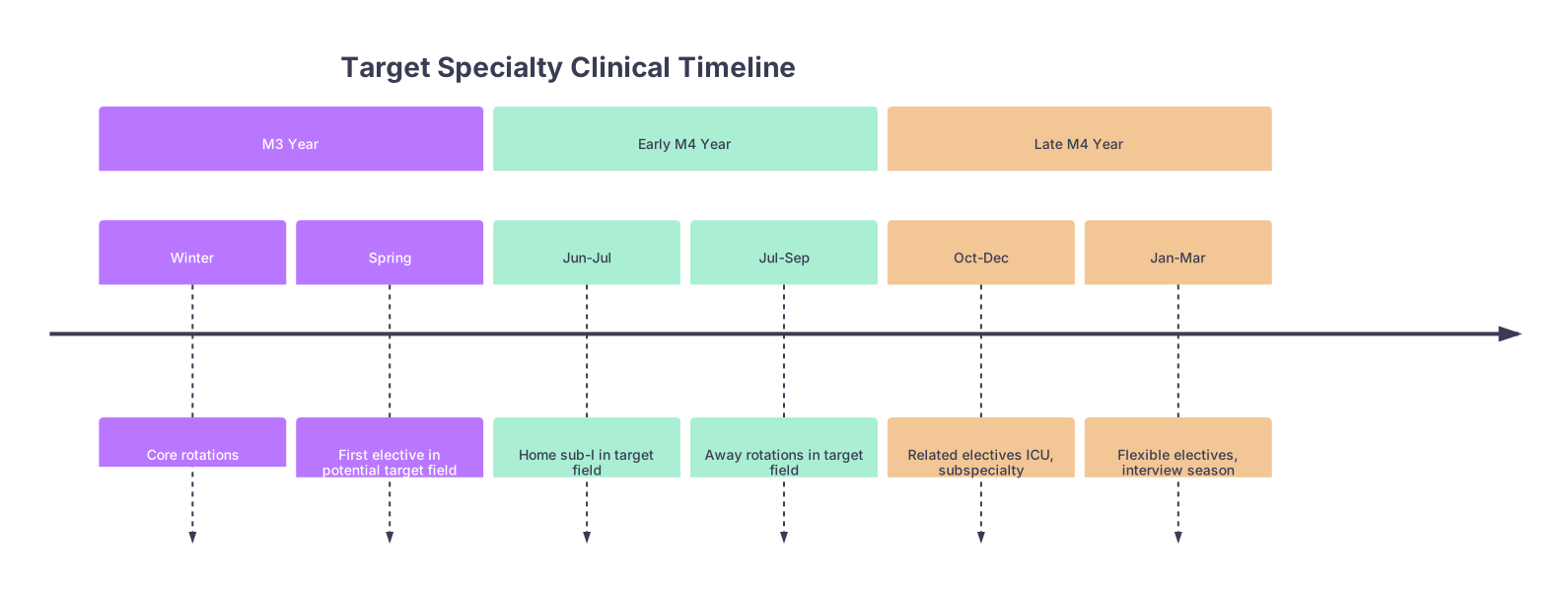
| Period | Event |
|---|---|
| M3 Year - Winter | Core rotations |
| M3 Year - Spring | First elective in potential target field |
| Early M4 Year - Jun-Jul | Home sub-I in target field |
| Early M4 Year - Jul-Sep | Away rotations in target field |
| Late M4 Year - Oct-Dec | Related electives ICU, subspecialty |
| Late M4 Year - Jan-Mar | Flexible electives, interview season |
Balancing Your Schedule: Depth vs. Breadth
Here’s the tradeoff you’re managing:
- Depth: Enough months in your target field to look serious, get letters, and prove capability.
- Breadth: Enough variety to look like a competent future resident who can think outside one narrow lane.
A simple planning rule:
- Aim for 3–5 months “in or adjacent to” your field as we’ve laid out.
- Make sure you have:
- 1 ICU-type month (if not already in your specialty blocks)
- Some ED or acute care exposure
- At least one “different” elective that shows you’re a whole person (palliative, ethics, ultrasound, QI, etc.)
That mix sends a much stronger signal than a wall of identical rotations.
Special Situations
Couples Match
You do not both need to stack 5 months each in your respective fields. In fact, doing so can backfire. Programs also care that you:
- Can handle cross-coverage
- Are realistic about where both specialties line up geographically
Stick to the same 3–4 month rule but be thoughtful about geography and timing so your aways overlap regionally when possible.
Late Switchers
If you decided on a new field late M3 or even early M4:
- Prioritize 1 sub-I + 1 away in the new field as early as possible.
- Use related rotations you already did (ICU, wards, relevant subspecialties) to “backfill” your story.
- In this case, 2–3 targeted months plus a coherent narrative often beats a panicked overcorrection.
Dual-Interest Applicants (e.g., IM vs. Neuro)
You cannot fully court two specialties at once without looking lukewarm somewhere. My threshold:
If you are truly 50/50 between two fields:
Do 2 months in one, 2 months in the other, plus shared relevant blocks (ICU, wards). Then commit by the time ERAS opens.Do not try to apply aggressively to two unrelated fields with 1–2 months in each. Programs will sniff that out very fast.
Visual: Months vs. Match Benefit
Here’s the rough shape of the “return on investment” of additional months in your target field.
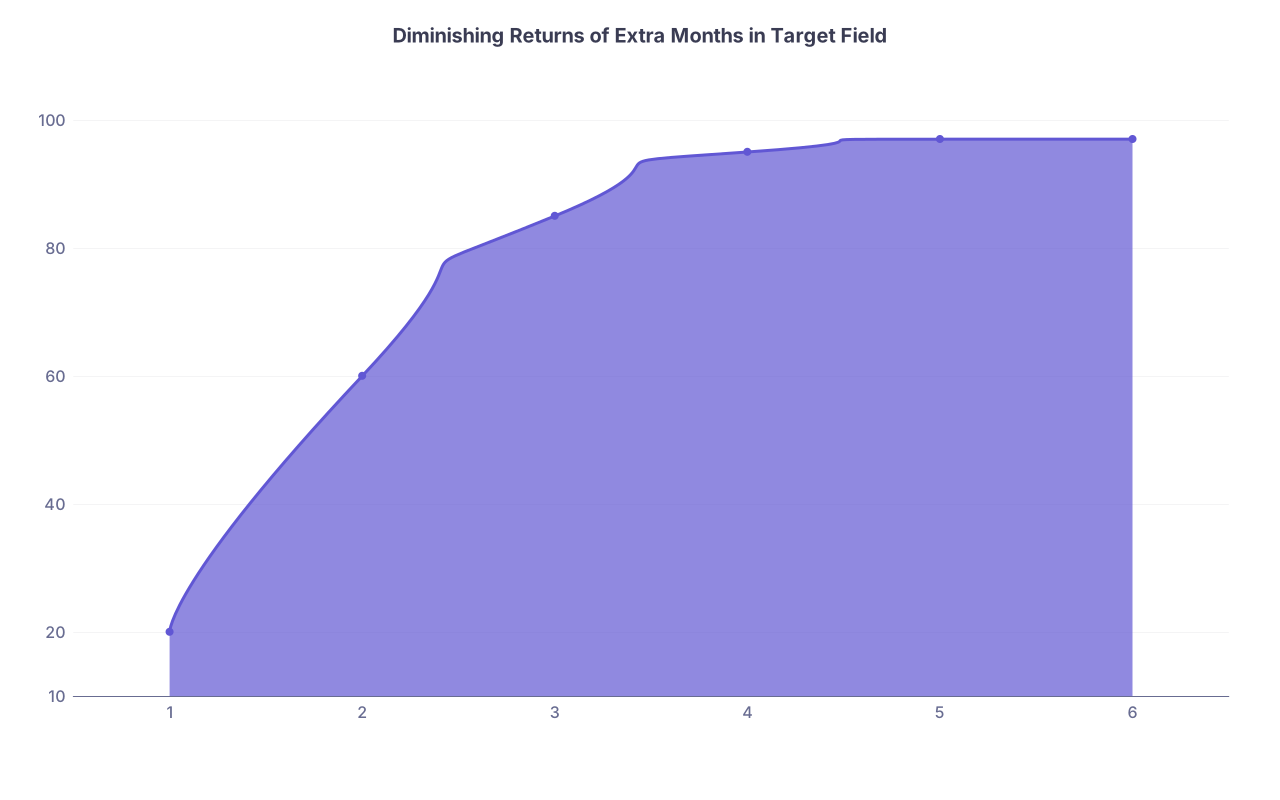
| Category | Value |
|---|---|
| 1 | 20 |
| 2 | 60 |
| 3 | 85 |
| 4 | 95 |
| 5 | 97 |
| 6 | 97 |
You get:
- Huge benefit going from 1 → 3 months
- Small but real gain going from 3 → 4 months
- Almost no extra benefit beyond 5 months, except in rare edge cases
So stop at the plateau and spend the rest of your time rounding out your skill set.
Practical Step: How to Audit Your Current Plan
Do this today:
- List every M3/M4 rotation you’ve done or scheduled.
- Mark each as:
- Direct target field (e.g., EM for EM)
- Related (ICU, trauma, subspecialty aligned with your field)
- Unrelated / other
- Count the “direct” + “related” months.
Now ask:
- Are you in the 3–5 month total band for your target?
- Do you have at least one sub-I in that field?
- Do you have 1–2 opportunities for strong letters?
- Is your timing early enough to matter for ERAS?
If the answer is “no” for any of these, adjust now while you still can.

FAQs
1. Is there such a thing as “too little” exposure to my target field?
Yes. If you only have:
- The core clerkship from early M3 and
- No sub-I and no later electives in the field
Programs will question your commitment and understanding of the specialty. You should have at least 2–3 total months of visible involvement, including one sub-I.
2. How many away rotations should I do?
For most specialties that use aways:
- 2 away rotations is the standard sweet spot.
- 1 away can be enough in some fields if you have strong home resources.
- 3 away rotations rarely adds much and can burn you out or limit variety.
For IM, Peds, Psych, and FM, aways are often optional and more about geographic signaling than raw numbers.
3. Do research months in my specialty count as “clinical months”?
No. Research months help your CV and narrative, but they don’t substitute for clinical rotations on your transcript. Programs want to see you functioning as a near-resident on actual clinical services in the field.
4. What if my school does not offer a sub-I in my chosen field?
Then you should:
- Do the most intensive, closest analog (e.g., IM sub-I for cards, surgery sub-I for surgical subspecialty).
- Strongly consider 1–2 away rotations where you can function at sub-I level.
Explain this in your application if needed; programs understand structural limitations but still want to see advanced-level work somewhere.
5. I’m worried I chose my field late. Can I still be competitive with only 2 months?
You can, but you must be smart about it:
- Make sure those 2 months are high-yield: a sub-I and an away or major elective, both with potential for excellent letters.
- Use related prior rotations (ICU, wards, relevant subspecialties) to build your story.
- Be clear in your personal statement about how you arrived at this choice and why it’s thoughtful, not impulsive.
Open your draft M4 schedule right now and highlight every month that is in or clearly related to your target field. If that total is not in the 3–5 month range, fix it before the next scheduling deadline.


