

The way most students handle a late specialty switch is a disaster. They either pretend their past clerkships did not happen, or they list everything and hope programs “get it.” They won’t. You have to weaponize your existing clerkships for your new plan.
If you switched specialties late—January of MS4, after an away, after a bad sub-I, or after not matching—you’re not doomed. But you do not have the luxury of vague strategy. You need a surgical approach to every prior rotation, every evaluation, every line on your CV.
Here’s how to do it.
Step 1: Get Completely Clear On Your “New Story”

| Step | Description |
|---|---|
| Step 1 | Realize old specialty not fit |
| Step 2 | Reflect on values and interests |
| Step 3 | Identify new specialty |
| Step 4 | Find bridging experiences in prior clerkships |
| Step 5 | Craft clear narrative for ERAS and interviews |
Before you repurpose anything, you need a clean, believable narrative. Not a novel. Just a story that makes sense to a tired PD reading ERAS at 11:30 PM.
You need to answer three questions for yourself first:
- What did you think you wanted originally?
- What specifically changed your mind?
- Why is this new specialty a better fit, based on real experiences?
Write that out in 5–7 sentences in a document. Not for ERAS yet—for your own brain. Example:
“I started medical school convinced I wanted orthopedic surgery after years as a college athlete. On my third-year rotations, I realized I was consistently more engaged in complex medical management and longitudinal follow-up than in the OR. During my MICU month and a later hospitalist elective, I found myself excited by diagnostic puzzles and systems-of-care questions. After an honest conversation with my ortho mentor, I recognized that internal medicine aligned much better with what I actually enjoyed day-to-day and how I like to think. I’m now committed to internal medicine with an interest in critical care and hospital-based medicine.”
You’re going to use that skeleton everywhere:
- Personal statement
- ERAS experiences descriptions
- “So, why [new specialty]?” in every interview
- Conversations with letter writers
If you cannot explain your switch in clear English, no amount of clerkship repurposing will save you.
Step 2: Classify Your Existing Clerkships By “Transfer Value”
Not all clerkships are equal for your new specialty. Some are obvious assets. Some are neutral. A few might be liabilities if you mis-handle them.
Make a quick table for yourself like this:
| Clerkship | Transfer Value to New Specialty | Notes |
|---|---|---|
| Internal Medicine | High | Core reasoning, inpatient care |
| Surgery | Medium | Procedures, acute care, teamwork |
| Pediatrics | Medium | Communication, breadth, family interaction |
| Psychiatry | Medium | Interviewing, adherence, complex patients |
| OB/GYN | Low–Medium | Depends on new field; labor triage valuable |
| Neurology | Medium–High | For IM, EM, PM&R, neuro-adjacent fields |
| EM | High | For IM, FM, EM, anesthesia, many others |
Now map your record. Put each rotation into one of three buckets:
- High transfer value: Directly supports your new specialty.
- Indirect value: Not obviously related, but with skills you can frame (procedures, communication, crisis management).
- Legacy rotations: Stuff clearly aimed at your old specialty (away rotations, extra electives) that you now have to explain intelligently.
You’re not erasing anything. You’re deciding:
- Which rotations to highlight
- Which to neutralize
- Which need narrative spin
Step 3: Rewrite The Story of Each Rotation
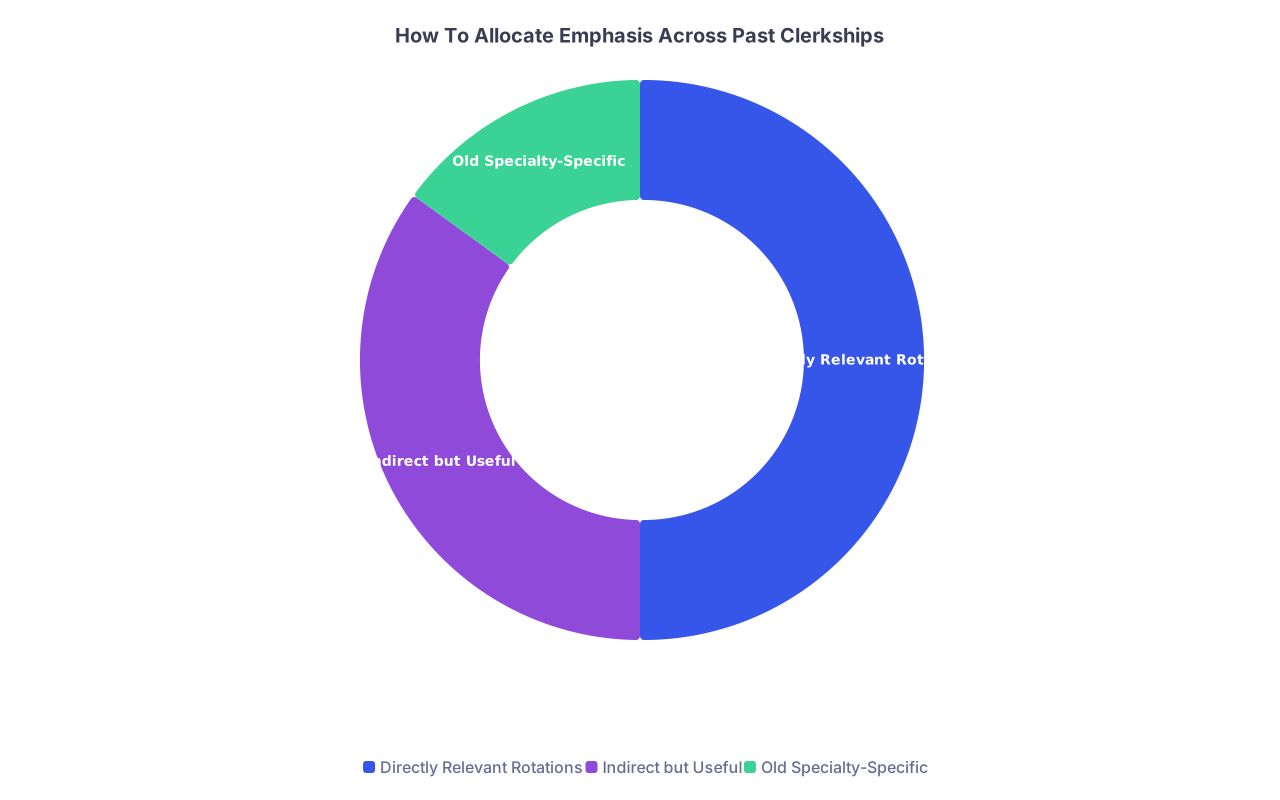
| Category | Value |
|---|---|
| Directly Relevant Rotations | 50 |
| Indirect but Useful | 35 |
| Old Specialty-Specific | 15 |
Next, you go rotation by rotation and ask: “If I were already committed to my new specialty back then, how would I describe what I did and learned on this clerkship?”
Three concrete moves for each one:
- Extract 2–3 skills or themes that matter to your new field.
- Identify 1–2 patient encounters you can reuse in personal statements or interviews.
- Decide how aggressively you’ll feature this rotation in ERAS (top experiences, “other,” or almost buried).
Example: You’re switching from surgery to EM.
Surgery core rotation:
- Skills to highlight: Acute resuscitation on trauma calls, quick decision-making, handoffs, working in high-stakes teams.
- Patient story: The crashing post-op patient you helped stabilize in PACU who went through a “trauma activation” type scenario.
- Strategy: Mention in 1–2 ERAS entries and as an example of comfort in acute care, not as “I used to love the OR.”
Surgery sub-I (aimed at ortho or gen surg residency originally):
- Skills: Ownership of complex inpatients, prioritization on busy services, calling consults, time-sensitive decisions.
- Strategy: Rebrand this as “intense exposure to acute surgical illness and inpatient management” rather than “my dream to be a surgeon.”
Repeat this process systematically. Do not wing it in interviews. Have each rotation mentally “pre-framed” for your new identity.
Step 4: Turn Old Letters and Mentors Into Assets
This is where most late-switch folks screw up. They either:
- Stop talking to mentors in their old field (bad move), or
- Ask them for generic letters that say nothing transferable.
Here’s the play:
- Tell your old mentors the truth early.
Send a short, clear email:
Dr. Smith,
I wanted to share an update on my plans. After completing my third-year rotations and a sub-I in surgery, I realized that I’m most drawn to longitudinal management and diagnostic complexity, so I’ve decided to apply in internal medicine.
I’m deeply grateful for the mentorship and opportunities you gave me on surgery. The work ethic, ownership of inpatients, and acute care exposure I had with your team were pivotal in shaping what I value in clinical practice, even though my path is changing.
I’d appreciate any advice you have as I make this transition.
Do this before you ask for any letters.
- If asking an old-specialty letter writer to still write for you, be explicit.
When you request the letter, say:
If you feel comfortable, it would be extremely helpful if you could comment on aspects of my performance that would translate well to internal medicine: ownership of patient care, communication with consulting teams, reliability, and ability to manage complex inpatients.
You’re handing them the frame. Most attendings will appreciate the guidance.
- Do not over-weight letters from your prior target specialty.
If you’re applying to IM after chasing surgery, your letter mix shouldn’t be 3 surgery, 1 IM. You want 2–3 strong letters in your new field, plus 1 from a prior field that speaks to general clinical excellence.
Step 5: Rewrite Your ERAS Experiences Like Someone Who Always Loved The New Specialty
This is where repurposing really shows up.
Look at every experience (clerkships, research, leadership) and ask: “How does this support my new specialty, or my character as a clinician?”
Concrete example: You’re moving from psych to EM.
Instead of:
“On psychiatry clerkship, I learned to perform detailed psychiatric evaluations and manage medication titrations for mood and psychotic disorders.”
Try:
“On psychiatry, I became comfortable assessing patients in crisis, de-escalating agitated individuals, and quickly determining risk and disposition—skills I now rely on in emergency settings where behavioral health and medical emergencies often intersect.”
Same rotation. Different angle.
Your priorities when rewriting:
Replace specialty-specific jargon from the old field with cross-cutting skills:
- “in the OR” → “in high-acuity settings”
- “arthroscopic cases” → “procedural work requiring precision and focus”
- “psychopharmacology management” → “complex medication management balancing risks and benefits”
Tie experiences to:
- Diagnostic reasoning
- Acute care
- Longitudinal follow-up
- Multi-disciplinary teamwork
- Systems-based practice
- Communication across settings
Whatever your new field actually cares about.
Step 6: Handle The “Obvious Contradictions” Head-On
Programs are not stupid. If you did:
- Two ortho aways
- An ortho research year
- Or applied and didn’t match last year in derm/surg/rads
…then suddenly you show up as “lifelong passionate internist,” they’ll smell the disconnect.
So you own it. Briefly, cleanly, and early.
In your personal statement, you might write:
During the first three years of medical school, I pursued orthopedic surgery, drawn by the opportunity to restore function in active patients. On my third-year clerkships, however, I noticed that my favorite parts of the surgical service were not in the OR, but on the wards and in consults—working through complex medical problems, counseling families, and coordinating care. Over the next several rotations, including a busy MICU month, it became increasingly clear that my interests and strengths aligned more with internal medicine than surgery. That realization was uncomfortable but ultimately clarifying, and it’s the reason I’m applying in internal medicine now.
That’s enough. Do not write a 2-page confession about your “journey.” One paragraph, then move on to why you fit the new field.
In interviews, a 20–30 second version:
“I was originally aiming for ortho, and I did an away. The more clinical exposure I got, the more I realized the parts I liked most were the complex medical management and long-term follow-up rather than the OR itself. After my MICU and wards rotations, I switched to internal medicine and haven’t looked back.”
Say it without apology. Then pivot to specific IM experiences you’ve sought since the switch.
Step 7: Leverage Specific Clerkships For Common Late-Switch Scenarios
Let’s get concrete. Here’s how to repurpose different cores depending on what you switched to.
Scenario A: Switching To Internal Medicine Late
Clerkships that help you most:
- Internal Medicine (obvious)
- ICU, cardiology, nephrology electives
- Surgery (for inpatient ownership and acute care)
- EM (triage and diagnostic speed)
- Neurology
How to frame:
- Medicine: talk about liking complexity, uncertainty, longitudinal thought.
- Surgery: “taught me to take full ownership of sick inpatients and make time-sensitive decisions.”
- EM: “helped me recognize and initially stabilize decompensating patients before transfer to the floor or ICU.”
- Psych: “useful for understanding adherence, complex social factors, and communication with challenging patients.”
Scenario B: Switching To EM Late
Best clerkships to highlight:
- EM (even if only one rotation—get a sub-I or second EM month if at all possible)
- Surgery and ICU (resuscitation, procedures)
- Medicine (diagnostic breadth)
- OB triage, peds ED shifts if you had them
How to frame:
- Surgery: “exposed me to trauma call, rapid resuscitations, and procedural skills.”
- IM: “gave me a broad base of adult medicine and reinforced my enjoyment of undifferentiated complaints.”
- Psych: “critical for managing agitation, suicidality, and complex psychosocial situations at the front door.”
Scenario C: Switching To Psych Late
Helpful clerkships:
- Psychiatry (obviously)
- Primary care, IM, FM (chronic disease and comorbidities)
- EM (acute agitation, crisis evaluation)
- Neurology (neuro-psych overlap)
Frame:
- IM/FM: “showed me how mental health and medical illness are tightly intertwined, and how often untreated psychiatric disease drives ED visits and readmissions.”
- EM: “taught me to rapidly assess safety, risk, and capacity in patients presenting in crisis.”
You get the pattern. Ask yourself: in my target specialty, what settings will I work in, and what patients will I see? Then raid your past clerkships for any moment that matches that reality.
Step 8: Patch Holes With Targeted Late Rotations
You can’t totally rewrite history. But you can add a few strategic “patches.”
If you’re late MS3 / early MS4 and just switched:
- Add at least one sub-I or acting internship in the new specialty.
- If you can, add one more related elective (ICU for IM, trauma for EM, CL psych for psych, etc.).
If you’re a reapplicant after not matching your prior specialty:
- Set up a structured “transition” year: prelim year, TY, or research year with heavy clinical time in the target specialty.
- Get fresh letters from your new field. Programs will look at the newest data harder than the old clerkships.
Think of it like this: your older clerkships tell programs who you were exploring. Your recent rotations tell them who you are committed to now.
Step 9: Prepare 4–5 Clerkship Stories You Can Use Everywhere
Interviewers are going to ask:
- “Tell me about a challenging patient.”
- “A time you made a mistake.”
- “A time you worked with a difficult team member.”
- “A time you had to adapt quickly.”
You are not going to invent new stories on the spot. You’re going to repurpose clerkship moments you’ve already identified.
Choose 4–5 episodes from any rotations:
- 2 that show clinical reasoning/patient care
- 1 that shows teamwork/conflict resolution
- 1 that shows resilience/mistake and learning
- 1 that shows why you fit your new field
Then practice telling each one in 60–90 seconds, always closing the loop with: “…and that reinforced for me that [new specialty] is where I’m the best fit because…”
Clerkships are not just lines on your transcript. They are your story inventory. If you don’t deliberately pick your stories, you’ll babble about some random patient that does nothing for your application.
Step 10: Fix The One-Page That Ties Everything Together
Your personal statement and CV summary should reflect all this repurposing work. Quick checklist:
- Do you acknowledge the original plan and the switch in 1–2 sentences, without drama?
- Do you immediately pivot into specific experiences (from multiple clerkships) that show why the new specialty fits?
- Do your ERAS descriptions echo those same skills and themes, rather than hinting at your old dream?
- Does at least one letter writer in your old field explicitly say things like “regardless of specialty, I would be happy to have this student as a resident”?
If the answer is yes, you’ve done the job. You’ve turned a late switch from “red flag” to “mature course correction.”
One More Thing No One Tells You
Program directors do not hate late switchers. They hate:
- People who look indecisive.
- People who look like they settled for their specialty.
- People who cannot explain their own choices coherently.
If you present as:
- Clear about why you switched
- Grateful for what you learned in your prior path
- Specific about how those clerkships make you a stronger [new specialty] resident
…you come across as exactly the kind of adult they want.
The honest truth: plenty of residents end up in the wrong field because they were too scared to pivot. You actually did the harder thing. Own that.
Open your ERAS activities section or your CV right now. For the first three clerkships listed, rewrite a single bullet point for each so it clearly supports your new specialty. If you cannot do that in 10 minutes, you don’t have a repurposing problem—you still have a clarity problem about who you’re trying to be. Fix that first.


