
The residency match does not reward “good test‑takers.” It rewards people who can prove clinical value under pressure.
If standardized exams are your weak spot, clinically heavy rotations are not just helpful—they’re your way back into the game.
You’re not going to magically turn into a 270 Step scorer if you’ve been hovering in the low 220s. But you can absolutely become the student attendings remember, fight for, and write absurdly strong letters for. And programs care a lot more about that than Reddit makes it seem.
Here’s how to use clinically intense rotations to offset weak test performance—step by step, with zero fluff.
Step 1: Be Honest About Your Starting Point
Before you plan anything, you need a clear baseline. No denial. No magical thinking.
Ask yourself:
- Are your standardized tests consistently below average, or just “not superstar”?
- Are you better on longer, integrated questions or short recall?
- Do you freeze in high‑stakes settings, or just run out of time?
- Have you ever had an attending say “You’re so much better clinically than your scores”?
If the last one is true, you’re in the ideal category: clinically strong, test‑weaker. That’s the exact profile that clinically heavy rotations can showcase.
Your goal is not: “Hide my scores.”
Your goal is: “Make it obvious to programs that my clinical performance is a much better predictor of residency success than my test scores.”
Step 2: Target the Right Clinically Heavy Rotations
Not all rotations are created equal. Some are PowerPoint and shelf exam factories. Others are “you’re basically an intern with a short white coat.”
You want the second group.
Think of clinically heavy rotations as those where:
- You carry a real patient load daily
- You pre‑round, write notes, and present
- You’re asked for your plan, not just the HPI
- You see the same patients over multiple days and watch your decisions play out
Here’s how some common core rotations typically line up:
| Rotation Type | Clinical Intensity | Face Time with Attendings | LOR Strength Potential |
|---|---|---|---|
| Inpatient Internal Med | High | Moderate-High | Very High |
| General Surgery | High | Variable | High |
| ICU/Sub-I (any field) | Very High | High | Extremely High |
| Outpatient Family Med | Moderate | High | High |
| Psych Inpatient | Moderate | High | Moderate-High |
Rotations that usually give you the most leverage
Inpatient Internal Medicine
- Daily rounding, multiple patients, lots of thinking.
- Attending sees you present, adjust plans, and follow through.
- Great for “not a test person, but extremely solid clinically.”
Surgery (especially general or trauma)
- High intensity, long hours, real responsibility if you lean in.
- If you show up prepared and reliable, attendings notice quickly.
- Shelf may crush you—but the letters from here can be gold.
ICU (medical, surgical, neuro, doesn’t matter)
- Hard rotation. Complex patients. Constant decisions.
- You can demonstrate the exact skills programs want in interns: prioritization, ownership, communication.
Acting Internship/Sub‑I in your desired specialty
- This is where you act like an intern.
- You’ll never be more visible before residency than here.
- If you’re weak on tests, you should treat this rotation like your personal audition month.
Busy inpatient Family Med or Pediatrics services
- If they’re truly inpatient‑heavy, they carry similar weight to medicine with more holistic care focus.
- Excellent for showing communication, follow‑up, and continuity.
You’re trying to stack your schedule so that between now and ERAS submission, you can generate at least:
- Two rotations where you were clearly clinically strong
- Two truly strong letters from attendings who saw you handle real patient care
If there’s flexibility, front‑load these before application season. Programs read letters before they ever see your face.
Step 3: Redefine Success on Each Rotation (Beyond the Shelf)
If tests are your weak point, you cannot let your brain label “honors” or shelf scores as the only win condition for a rotation. That mindset will destroy you.
For clinically heavy rotations, your success criteria change to:
- Did at least one attending say, “You’re functioning like an intern”?
- Did your residents trust you to follow up on labs/imaging without chasing you?
- Did you improve noticeably from Week 1 to Week 4+ in presenting and planning?
- Did a patient or family member thank you by name?
Those are not soft, feel‑good markers. Those are predictors of whether someone will write:
“I would be thrilled to have this student as an intern on my team.”
That sentence, in a letter, is worth more than any single percentile on a shelf.
Step 4: Work the Rotation Like It’s an Audition… Because It Is
On clinically intense rotations, attention equals opportunity. Your scores do not follow you into the patient room. Your behavior does.
Concrete behaviors that matter way more than you think:
Own 3–5 patients like they’re your responsibility
- Know every lab, every medication, every vital trend.
- Have answers ready before you are asked: “Yes, the Cr trended from 1.1 to 1.4; I already paged nephrology and changed fluids.”
- When the resident says, “Who’s on top of bed 12?” your name should come up.
Present like you’ve thought, not just copied
- Always end your presentation with “Assessment and Plan” that is actually yours, even if it’s imperfect.
- Example: “I’d like to start with pneumonia coverage, but given his recent hospitalization, I’m thinking about HCAP organisms and would choose cefepime plus azithro—what do you think?”
- Attendings love effortful thinking more than perfect recall.
Follow up without being told
- After rounding, write your to‑do list: CT results, consult recs, family updates.
- Check off relentlessly and circle back to your senior: “Cardiology recommended X; I put in orders and updated the note.”
- This looks exactly like a functioning intern. Programs want that more than another 10 points on a test.
Be early, not just “on time”
- On heavy rotations, the student who shows up 20–30 minutes early to pre‑round, print lists, and help organize wins.
- You don’t have to be the smartest in the room. But if you’re the most useful, people remember.
Handle bad days like a future resident, not a student
- When things go sideways—late consults, angry families, pages during sign‑out—your calm reaction is being evaluated.
- The student who says, “I can call them and figure this out” is remembered differently from the one who shrinks back.
Step 5: Turn Clinical Work into Powerful Letters
This is where most test‑weak students blow it. They work hard, do well, then accept generic letters that sound like every other applicant.
You do not have the luxury of generic.
You need letters that scream: “Score is not the full story here. I’d rehire this person tomorrow.”
How to set yourself up for those letters
Pick your letter writers mid‑rotation, not on the last day
- Notice which attendings see you consistently and give you feedback.
- Example script mid‑rotation:
“Dr. Lee, I really want to improve as much as possible this month. Can you watch my presentations closely this week and give me any feedback? I’m hoping to ask you for a letter if I earn it.”
Ask with context, not just a bland email
- Toward the end:
“Dr. Lee, I’ve really valued working with you on the medicine service. I’m applying in internal medicine, and I’m hoping to offset some test scores that don’t fully reflect my clinical ability. If you feel you can write a strong letter commenting specifically on my clinical reasoning, work ethic, and growth over the month, I’d be very grateful.”
That line—“if you feel you can write a strong letter”—gives them an out and nudges them to either commit or decline.
- Toward the end:
Give them ammo
- Send a one‑page summary:
- 3–4 patients you owned and what you did for them
- Specific feedback you acted on
- Any compliments they gave you that they may have forgotten
- Example: “You mentioned on 7/14 that my presentation of Mr. J with sepsis was at intern level after I revised it—just including that as a reminder.”
- Send a one‑page summary:
Good attendings appreciate this. You’re not writing the letter for them; you’re reminding them of concrete facts.
Step 6: Choose Rotations That Signal Readiness to Programs
If your test‑taking is weak, your strategy should also include which clinically heavy rotations you pick and when, especially in the months leading into ERAS and interview season.
Think about your chosen specialty.
Applying Internal Medicine with a 215/225 Step 2?
You want: medicine ward, ICU, maybe nephro/cardio consult, and a strong sub‑I.Applying Surgery with mediocre exams?
You want: general surgery sub‑I, high‑volume trauma or acute care surgery, maybe SICU.Applying Pediatrics with mid‑tier scores?
You want: inpatient peds, NICU or PICU if possible, plus a sub‑I at a place that writes strong narrative letters.
Here’s a simple view of where to focus:
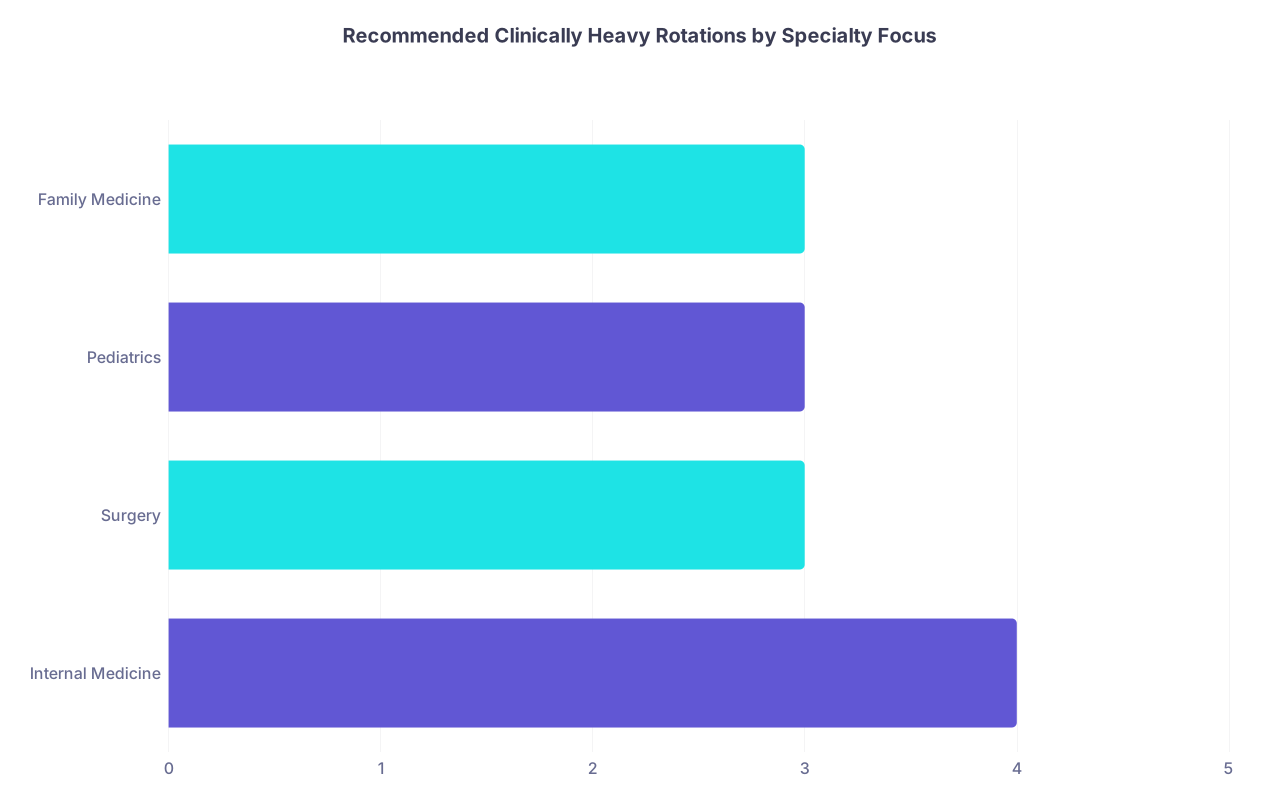
| Category | Value |
|---|---|
| Internal Medicine | 4 |
| Surgery | 3 |
| Pediatrics | 3 |
| Family Medicine | 3 |
(Think of the numbers as priority weight: the higher it is, the more you should emphasize those inpatient/sub‑I style rotations for that specialty.)
Step 7: Use Clinical Stories Strategically in Your Application
You’ve done the hard part: performed well clinically. Now you have to weaponize it in your application materials.
Personal statement
If tests are a known weakness, you do not have to front‑page your scores. But you should subtly pivot your narrative toward clinical performance.
Ways to do that without sounding defensive:
- “I’ve always performed best when I can see the patient, not just the page.”
- Tell a short, specific story: the ICU patient you followed from near‑code to discharge; the complex social situation on family med you helped untangle.
- Highlight feedback: “On my sub‑internship, a senior resident told me, ‘You’re ready to be an intern now,’ after I…”
You’re not making excuses. You’re reframing: “Here’s the domain that matters most for residency, and here’s why I’m good at it.”
ERAS experiences section
Do not waste your top slots on “shadowing” or “random club membership” if clinically heavy rotations are your strength.
Use your Clinical Experiences and Work/Volunteer sections to emphasize:
- Longitudinal patient care
- Roles where you took on incremental responsibility
- Any times you taught juniors or new team members
For each, emphasize actions and outcomes, not just duties.
Example instead of “Rounded on patients and presented daily”:
- “Followed 4–6 complex inpatients daily, independently tracked labs/imaging, updated families, and proposed management plans that were frequently adopted by the team.”
That last clause is the money phrase.
Step 8: Address Weak Tests Directly—But Briefly—If Needed
Some of you are in the “scores are not just average—they’re a problem” category. You had a fail or a very low pass. Pretending it did not happen is usually worse than a short, mature explanation.
The key is to anchor the explanation to growth that’s visible in clinically heavy rotations.
For example, in a supplemental statement or advisor‑guided email to PDs:
“Standardized tests have historically been a challenge for me, which is reflected in my Step 1 failure on first attempt. After structured remediation and changing my study approach, I passed Step 2 and have focused intensely on building clinical skills. On my medicine and ICU rotations, attendings consistently commented that my performance was at the intern level, and my letters speak directly to my clinical readiness.”
Short. Direct. Then redirect to clinical proof.
Step 9: Know Which Rotations Not to Overinvest In
If you’re weak in test‑taking, you have finite time and finite energy. Stop pretending you can maximize every domain equally.
You can certainly still do well on ambulatory and lighter rotations, but don’t bet your future on them.
Rotations that are usually lower yield for offsetting bad tests:
- Purely didactic electives with minimal face time (e.g., “online radiology” month)
- Specialty clinics where students just shadow and never own patients
- Research electives with no clear deliverable before ERAS (poster, abstract, etc.)
Those are fine to fill schedule gaps or maintain sanity. They will not rescue a 205 Step score.
Your rescue plan is simple: be so obviously good clinically that programs feel uncomfortable ignoring you.
Step 10: Make Your Interview Day Sound Like Your Wards
Your clinically heavy rotations give you stories, language, and confidence that test‑focused applicants often lack.
Interviewers will ask things like:
- “Tell me about a difficult patient interaction.”
- “Describe a time when you made a mistake in patient care.”
- “What makes you ready to be an intern?”
If you’ve truly leaned into your heavy rotations, you should have:
- A code situation where you learned about communication under pressure
- A near‑miss you caught because you were on top of labs or meds
- A family meeting where you handled conflict or confusion well
- A time your plan was adopted, or your idea changed management
Use concrete details: “It was 2 a.m. on the MICU rotation; my senior asked me to…” rather than vague “There was this one time…”
Those details subconsciously reassure interviewers: “This person has actually done the work.”
Last Piece: Build a Mini “Clinical Performance Portfolio”
This is just for you, but it will sharpen everything.
During each clinically heavy rotation, keep a running document (one page per rotation) with:
- 3 cases where you had real impact
- 2–3 specific quotes or comments your attendings or residents made about you
- Any objective markers: entrusted with more patients, asked to teach other students, etc.
- What you improved between Week 1 and the end
This document becomes:
- Raw material for personal statements and secondary questions
- Bullet points you can send to letter writers
- Memory prompts before interviews so you sound specific, not generic
It also helps your mindset: you’ll see in writing that you’re better than your score report suggests.
Open your current or upcoming rotation schedule right now. Identify the next two clinically heavy rotations where you can actually own patients and be seen daily. For each, write a one‑sentence goal: “By the end of this month, Dr. X will be comfortable saying I work at intern level.” Then act on those rotations like your future depends on them—because for a test‑weak applicant, it largely does.