

The usual advice for clerkships completely fails you if you’re couples matching.
Most guidance assumes you’re a solo applicant optimizing just for yourself. When you’re couples matching, that advice can quietly sabotage both of you—too many aways in random places, misaligned timing, or both of you chasing the same reach programs without a safety net.
Let’s fix that.
This is the playbook I wish every couples match pair had before scheduling clerkships and aways, not after they realize their calendars are a mess and it’s July.
Step 1: Get Bluntly Clear About Your Joint Reality
Before you touch a scheduling portal or email a coordinator, you and your partner need a brutally honest status check.
Skip the vague “we’ll make it work anywhere” nonsense. You need numbers and tiers.
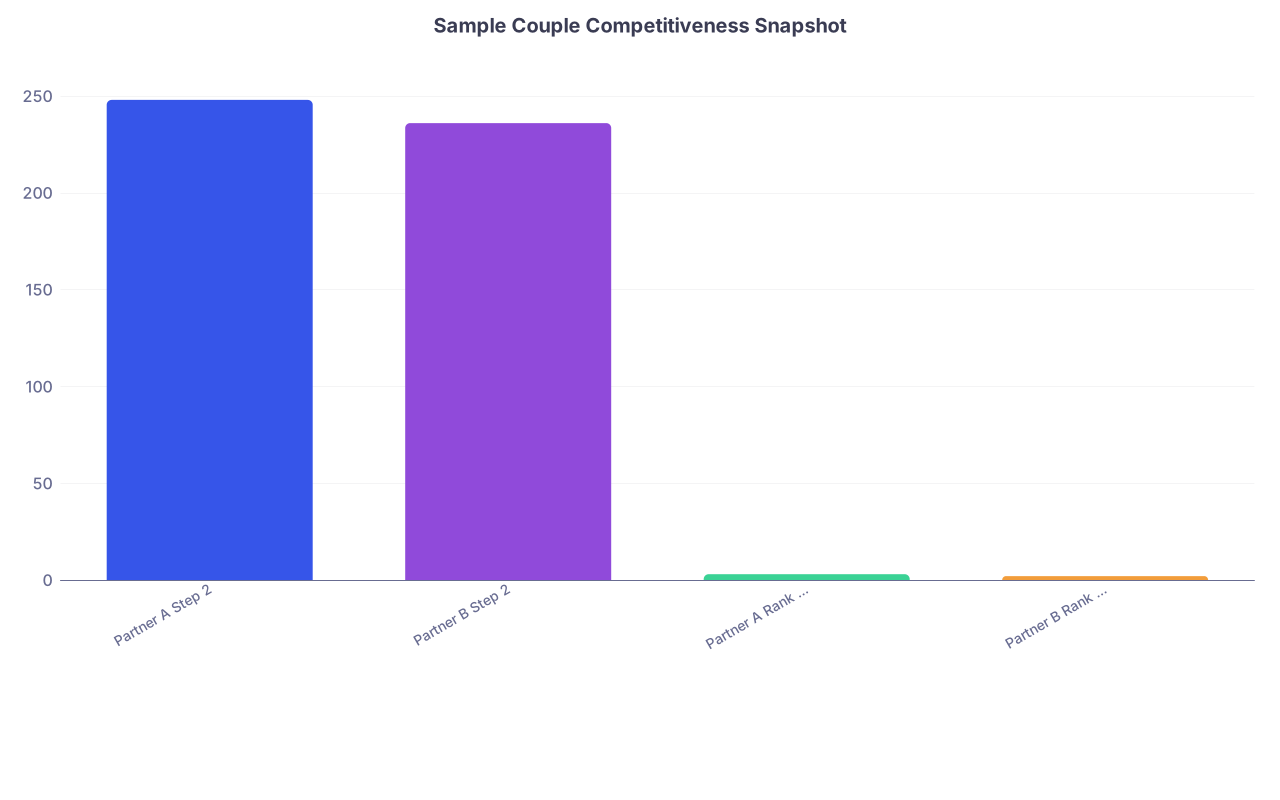
| Category | Value |
|---|---|
| Partner A Step 2 | 248 |
| Partner B Step 2 | 236 |
| Partner A Rank Tier | 3 |
| Partner B Rank Tier | 2 |
Think in three buckets for each of you:
Competitiveness
- Step 2 score range: underscored, average, strong for your specialty
- Class rank/AOA/Gold Humanism
- Research: none / basic / strong with pubs
- Letters: already have strong ones or still need anchors?
Specialty Difficulty
- High-competitiveness: Derm, Ortho, Plastics, ENT, Ortho, Ophtho, Neurosurg, some EM/Anes at big-name places
- Moderate: IM, Gen Surg, Anes, EM, OB, PM&R, Neuro, etc.
- Relatively less competitive: FM, Psych, Peds (though good programs are still selective)
Geographic Flexibility
- Are there true “must be near X city” constraints (kids, visas, care for parents)?
- Or just “would prefer” (which won’t matter if you both go unmatched)?
Have an explicit conversation like this:
- “If we had to choose between both matching in our second-choice city vs only one of us matching at a dream program, which do we pick?”
- “If one of us is in a much more competitive specialty, do we prioritize that person’s opportunities?”
The honest answers decide your clerkship and away game plan. Not the brochure version of your life.
Step 2: Decide Your Couples Strategy Type
Most couples fall into one of four patterns. Your clerkship choices differ for each.

Type 1: Both in Competitive Specialties
Example: Derm + Ortho, Ortho + ENT, Anesthesia + EM at top tiers.
Reality: You don’t get to be casual. You need focused, targeted aways and strong home experiences in the right markets.
Clerkship implications:
- You probably both can’t do four aways each. Cost and schedule will break you.
- You pick 1–2 shared target regions (e.g., Midwest academic hubs, Northeast corridor).
- Within those, each of you picks:
- 1 away at a stretch-but-realistic place
- 1 away at a solid mid-tier where you could actually match
Type 2: One Competitive, One Moderate
Example: Ortho + IM, Derm + Psych, ENT + Peds.
This is extremely common. And mismanaged all the time.
Clerkship implications:
- The competitive person gets priority for:
- Earlier away rotations (July–September)
- Highly strategic locations
- The moderate-competitiveness person:
- Loads up on strong home sub-I’s and one well-selected away in the same region as the partner, not necessarily the same institution.
- Focuses more on being geographically flexible to accommodate the harder match.
Type 3: Both in Moderate Competitiveness but Different Fields
Example: IM + OB, Peds + Anes, Psych + FM.
You have leverage here—if you plan.
Clerkship implications:
- You can afford to diversify regions a bit, but you still want overlap.
- Think: each of you picks 1 away in the same city (different hospitals or same), plus home sub-I’s that will produce top-tier letters.
- Your main risk is not competitiveness; it’s failing to signal you’re a package deal in certain cities.
Type 4: One Anchor, One Exploratory
Example: One partner rock-solid in FM/Psych/Peds/IM with strong home options, other is still undecided or switching late.
Clerkship implications:
- The “anchor” partner should prioritize:
- Strong home rotations and local programs in multiple cities
- Flexibility to rank a wide menu of locations
- The exploratory partner:
- Needs targeted experiences fast in the chosen specialty (sub-I or audition).
- Might need to give up some geographic preference to avoid tanking both of you.
Step 3: Build a Region-First, Not Program-First, Plan
Couples that think “Where could we both live and work?” rather than “Which programs have shiniest logos?” usually do better.
You are not applying to 30 individual programs. You’re building a grid of regions and overlap options.
| Region | Partner A (Ortho) Targets | Partner B (IM) Targets | Priority |
|---|---|---|---|
| Midwest Hub | 2 aways + 3 applications | 5–6 applications | High |
| East Coast | 1 away + 4 applications | 4–5 applications | Medium |
| Home Region | Home sub-I + 3 programs | 4–6 applications | High |
For clerkships and aways, that means:
Pick 2–3 main regions where both of your specialties have multiple programs.
- Example: You want academic IM and they want Ortho. Cities like St. Louis, Pittsburgh, Chicago, Cleveland, Minneapolis—more overlap than, say, a single coastal boutique city.
Within each region, identify:
- At least 2 programs for Partner A
- At least 2 programs for Partner B
That’s a viable region. Anything less is a lottery ticket.
Use aways and sub-I’s to “plant flags” in those regions.
- You doing an away at Chicago Program A.
- Your partner doing an away or strong sub-I with a letter from Chicago or a nearby system.
- Residency PDs notice when couples clearly signal regional commitment.
Step 4: Sequence Your Clerkships Intelligently
Timing will help or hurt you just as much as location.
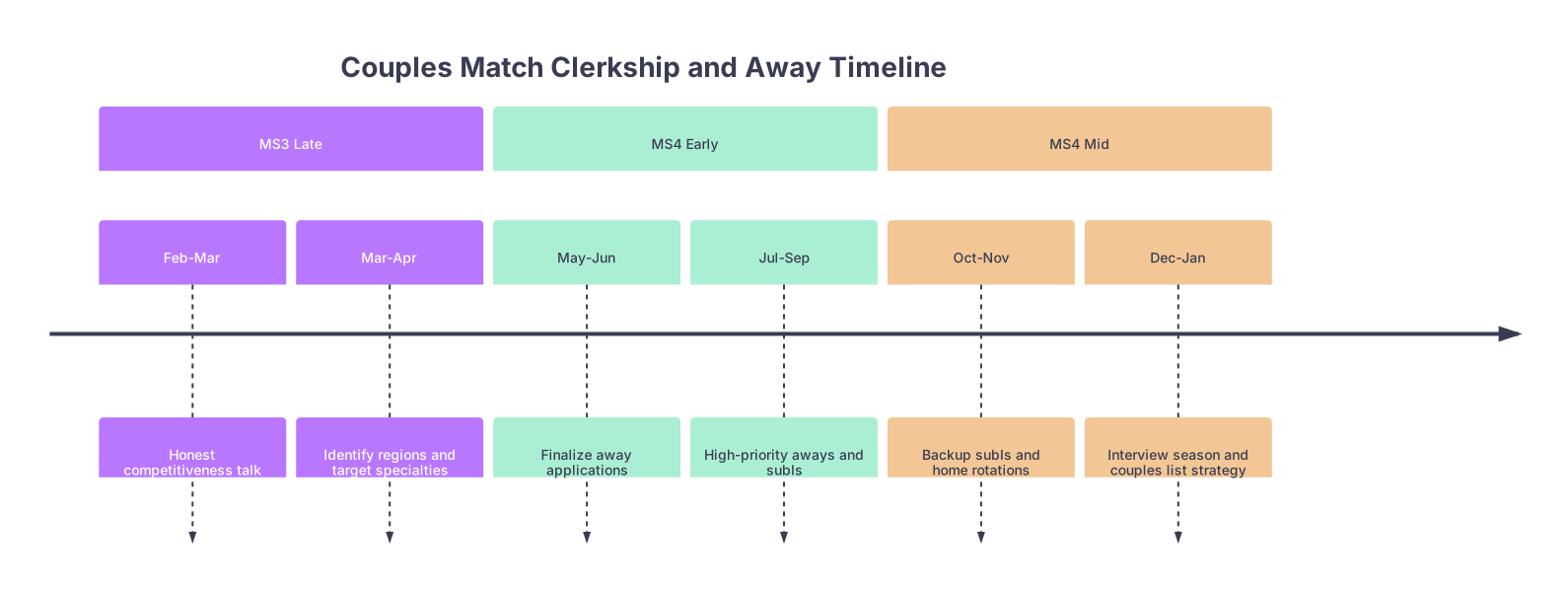
| Period | Event |
|---|---|
| MS3 Late - Feb-Mar | Honest competitiveness talk |
| MS3 Late - Mar-Apr | Identify regions and target specialties |
| MS4 Early - May-Jun | Finalize away applications |
| MS4 Early - Jul-Sep | High-priority aways and subIs |
| MS4 Mid - Oct-Nov | Backup subIs and home rotations |
| MS4 Mid - Dec-Jan | Interview season and couples list strategy |
Golden rule: July–September is premium real estate
Those months are prime audition season for most specialties. You cannot both cram all your highest-stakes aways in those windows without compromising quality.
Better approach:
If one of you is more competitive-dependent (Ortho, Derm, ENT, etc.):
- They get July/August/September for aways at key programs.
- The other front-loads strong home sub-I’s and maybe a single away in that same region, but doesn’t overload.
If you’re both in moderate specialties:
- You can both do:
- 1 away in July–September (at different times or sites)
- 1 home or nearby sub-I in October–November to lock in another letter.
- You can both do:
Clerkship scheduling rules I’ve seen work in real life:
- Do not both schedule your absolute highest-stakes away in the same month if you share a household, car, or childcare. You’ll both underperform.
- Make sure at least one of you has a home or “safety” program sub-I finished by October with a locked-in letter.
- Avoid back-to-back brutal rotations (Surgery sub-I followed immediately by ICU) for both of you at the same time.
Step 5: Choose Aways Based on Leverage, Not Ego
Aways are not souvenirs. They’re job interviews. When you’re couples matching, they’re regional job interviews.
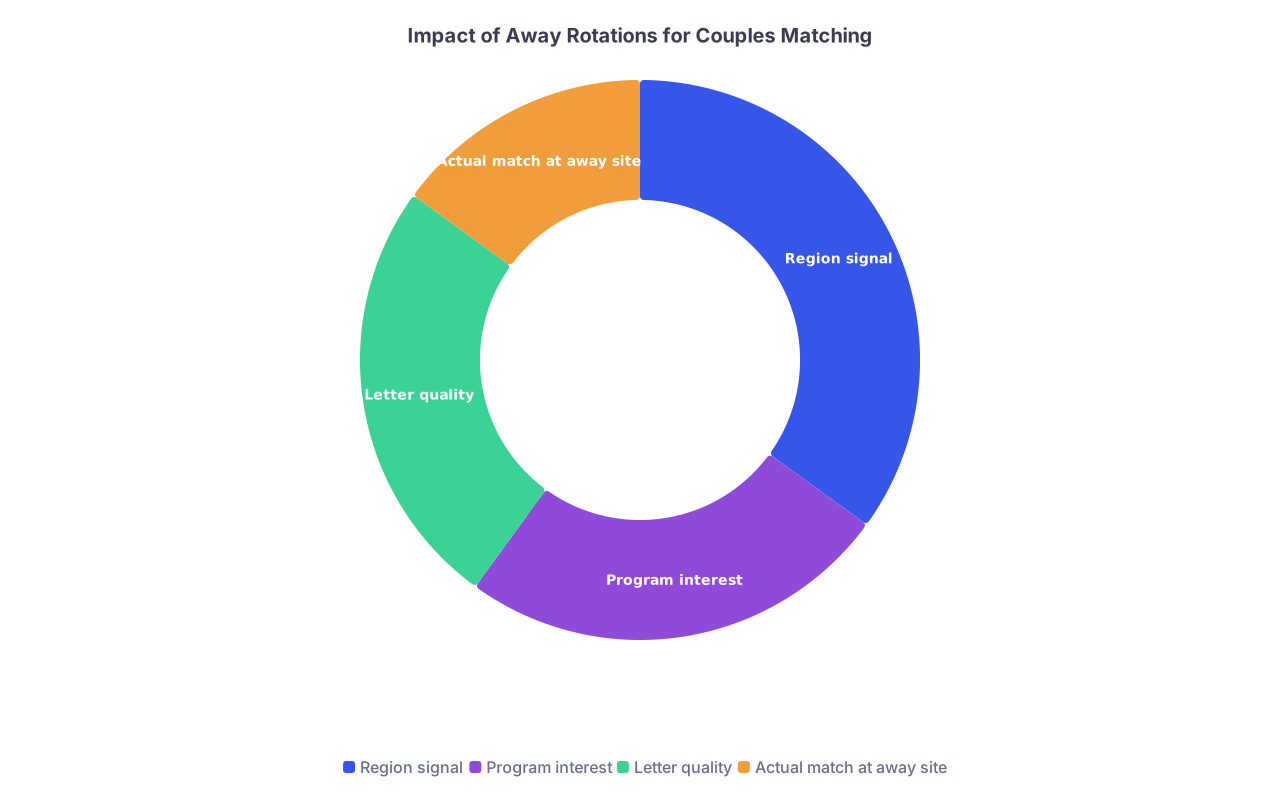
| Category | Value |
|---|---|
| Region signal | 35 |
| Program interest | 25 |
| Letter quality | 25 |
| Actual match at away site | 15 |
Here’s how to pick them.
Prioritize places that check multiple boxes:
For each potential away, ask:
- Does this city have 2+ programs in my partner’s specialty?
- Does this hospital/program routinely take their own rotators?
- Is my competitiveness aligned with their typical matched residents?
Good choice example:
- You (Anes) do an away at a solid Midwest academic center.
- Your partner (OB) has 3 nearby OB programs in the same city/metro.
- Both fields are mid-competitive. The region cares about “fit” and likelihood to stay.
Bad choice example:
- You (Derm) do an away at a hyper-elite program that rarely takes away students.
- Your partner (FM) has only 1 small community program in that city.
- If Derm doesn’t pan out there, you’ve wasted that region.
Step 6: Coordinate Letters and Sub-I’s With the Couples Story in Mind
Your letters and experiences should quietly support the narrative that you’re a strong candidate and a stable, committed couple anchoring in certain regions.
Concrete moves:
Each of you needs:
- 1–2 stellar letters from your home institution.
- 1 letter (if possible) from a region you’re heavily targeting as a couple.
When appropriate, faculty can reference:
- Your maturity, stability, and ability to balance life demands.
- That you’re couples matching, if it’s been discussed and framed well.
No, you don’t need your letter to be a romance novel. But PDs absolutely understand that stable, organized couples can be assets to programs, especially in less glamorous cities.
Step 7: Communicate With Programs—Deliberately, Not Desperately
Couples often under-communicate or over-communicate. Both can hurt.
Here’s how to thread the needle.
During Aways and Sub-I’s
Do:
- Tell your attending or PD near the end of the rotation that you are couples matching and very interested in that region.
- Make it clear you value the city and lifestyle, not just the name.
Don’t:
- Lead with “we’re couples matching, please rank us high.” People hear “neediness” and “baggage” if that’s your entire pitch.
During Application and Interview Season
Once interviews are out:
If one of you gets an interview in a region with limited overlap:
- The other sends a polite, specific email to nearby programs:
- Acknowledge partner’s interview.
- Briefly highlight fit and interest in the region.
- This is especially valid in less competitive specialties.
- The other sends a polite, specific email to nearby programs:
Later, as rank lists form:
- A carefully worded couples email to your top shared city can help:
- “We are couples matching, and [City/Region] is our top priority. We would both be thrilled to train here.”
- Don’t spam this to 15 cities. It loses all meaning.
- A carefully worded couples email to your top shared city can help:
Step 8: Avoid the Classic Landmines
I’ve seen the same five mistakes over and over.

“We’ll each just do the best for ourselves and deal with the couples part later.”
Translation: We will waste our best-away months on unattainable or random places, then realize in January that we have no overlapping regions.Both choosing only hyper-competitive coastal cities.
Yes, sometimes it works. Often it does not. Add at least one region where both of you are above average applicants.Over-rotating.
Four aways each because “we need options” is how you burn out and get 6 mediocre evaluations instead of 2 excellent ones.Ignoring the calendar.
You can’t both be on brutal surgical sub-I’s in different cities with a single car and think you’ll also be on time with ERAS, personal statements, and couples list strategy.No true backup region.
Every couples pair should be able to point to one region and say: “If everything else collapsed, we’d still be happy ranking 8–10 programs here.”
Step 9: If You’re Already Late in the Game
If you’re reading this and it’s already late MS3 or early MS4 and your schedules are basically set, you still have levers.
Focus on what you can control:
- Double down on performance in the rotations you do have.
- Use electives and later blocks (Oct–Dec) to:
- Get at least one sub-I in a region where you both can apply broadly.
- Get letters that emphasize your reliability and “fit” for those regions.
- Start building your couples narrative now:
- Why these regions, how you’ve both thought this through, and what you bring as a pair.
You can’t magically create July Derm or Ortho aways in September. But you can still shore up realistic, shared options.
Step 10: Practical Planning Workflow You Can Use This Week
Here’s the stripped-down version of what to actually do.

| Step | Description |
|---|---|
| Step 1 | Start - Couples Match |
| Step 2 | Assess competitiveness |
| Step 3 | Define 2 to 3 regions |
| Step 4 | Map programs for both |
| Step 5 | Assign aways Jul-Sep |
| Step 6 | Plan home subIs Oct-Nov |
| Step 7 | Confirm letter strategy |
| Step 8 | Adjust based on interviews |
| Step 9 | Finalize couples rank list |
Sit down together with a map, your CVs, and a spreadsheet. Then:
- List your specialties and competitiveness level side-by-side.
- Circle 2–3 regions where:
- Each of you has at least 3–4 realistic programs.
- For each of those regions, assign:
- Who does an away there (if anyone).
- Who focuses on home rotations but applies heavily in that area.
- Lock in:
- 1–2 aways for the more competitive specialty.
- 0–2 aways for the less competitive specialty, prioritized to overlapped regions.
- Block your calendar:
- Hard-rotations not overlapping in a way that crushes both of you.
- Enough breathing room before ERAS and interview season.
Then actually email your dean’s office or clerkship coordinator and sanity-check the plan. They’ve seen couples crash and burn; use that intel.
FAQ (Exactly 3 Questions)
1. Should we ever both do aways at the same program to show we’re a package deal?
Sometimes, but rarely is it the best move. If the program is large, dual-specialty (like big academic centers with IM and Anes, or Surg and OB), it can make sense. You might get some goodwill, and logistics are easier. But if it’s a small or very competitive program, you risk both being evaluated under a microscope with no diversification. Usually, it’s smarter for one of you to rotate there and the other to rotate at another program in the same city or region, widening your grid.
2. How many regions should we realistically target as a couples match?
For most couples: 2–3 serious regions. Not 7. Two if one of you is in a very competitive specialty and you need deep density (lots of programs in one area). Three if you’re both in moderate or less-competitive fields and have some geographic flexibility. Beyond 3, you dilute your signal so much that PDs do not see you as committed to any one area, and your aways and letters stop working for you.
3. What if our school’s clerkship office is rigid and our schedules are already mostly fixed?
You still have levers. First, identify which already-assigned rotations could double as “auditions” for your target regions (e.g., affiliated hospitals, community sites that feed certain residencies). Second, adjust electives and late sub-I’s to strengthen at least one shared region. Third, use your personal statements, supplemental ERAS responses, and interview conversations to clearly explain your couples story and regional priorities. Many couples match outcomes are saved not by perfect clerkship timing, but by clear, consistent signaling to the right cities.
Open your calendars and a blank spreadsheet today. Map your three best shared regions and mark, for each upcoming month, which of you is doing something that helps that region. If any month is blank across all regions, that’s your first fix.


