
The myth that “fourth year does not matter” is dangerous nonsense.
Your late MS4 rotations are not a victory lap. They are your last live interaction with the programs and attendings who will be voting on your future. Handled correctly, these “last chance rotations” can tighten your rank list, rescue borderline applications, and quietly move you up someone’s order of merit.
Here is how to use every week from ERAS submission through rank-list certification.
Big Picture Timeline: Where Late MS4 Rotations Actually Matter
Let me anchor the year first, then we will zoom week-by-week.
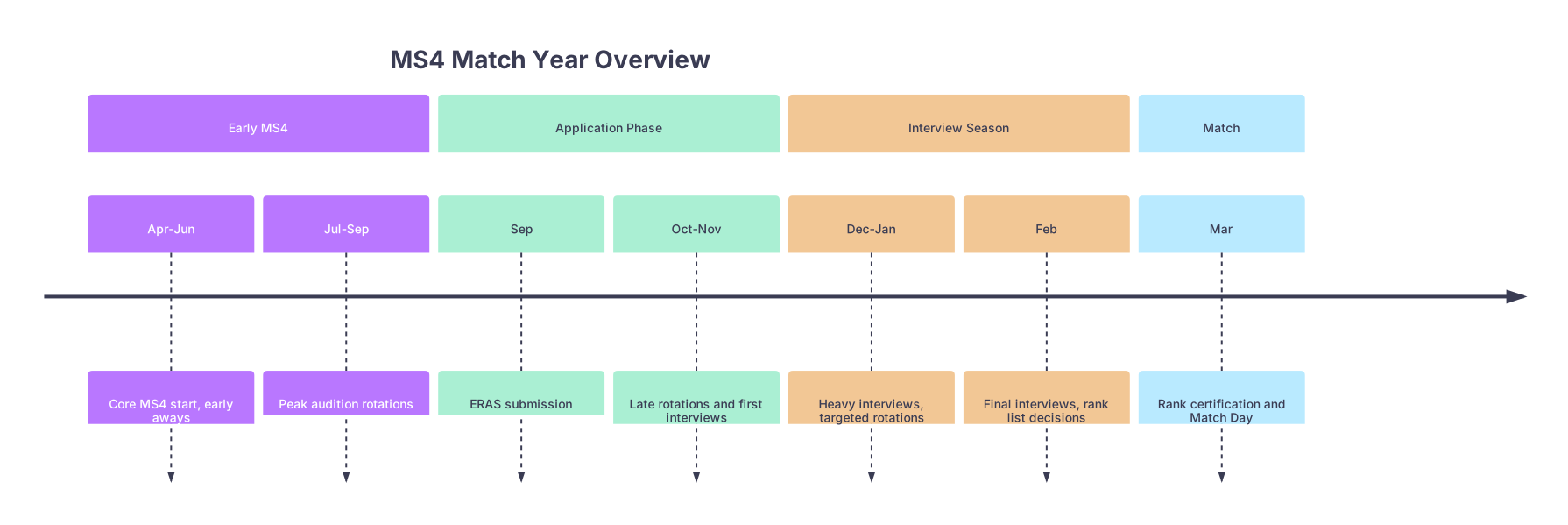
| Period | Event |
|---|---|
| Early MS4 - Apr-Jun | Core MS4 start, early aways |
| Early MS4 - Jul-Sep | Peak audition rotations |
| Application Phase - Sep | ERAS submission |
| Application Phase - Oct-Nov | Late rotations and first interviews |
| Interview Season - Dec-Jan | Heavy interviews, targeted rotations |
| Interview Season - Feb | Final interviews, rank list decisions |
| Match - Mar | Rank certification and Match Day |
At this point in the year, aways are mostly done. You are working with what you have:
- Your application is already submitted.
- Your Step scores are whatever they are.
- Third-year narratives are fixed.
What can still move?
- Fresh clinical impressions with faculty who know the PD.
- New letters of recommendation that can be quietly emailed.
- Program-specific enthusiasm that shows up on both sides of the rank list.
Late MS4 “last chance” rotations fall into three main windows:
- October–November blocks – Right after ERAS submission, before interviews peak.
- December–early January blocks – Overlapping with interviews.
- Late January–February blocks – After most interviews, just before rank lists lock.
Each window has a different job. Treat them that way.
October–November: Positioning Rotations (Weeks 1–8)
This is the last period where a rotation can still influence who interviews you and how they perceive you.
At this point (early October) you should…
- Choose rotations with intent, not convenience
If you are in October–November:
- Do a sub-I or heavy clinical elective in:
- Your home program in your chosen specialty, if you have not yet.
- A realistic reach program where you are already getting positive signals.
- A “safety but solid” program you would genuinely be okay matching at.
Avoid:
- Random electives at places you are not ranking.
- Super light “vacation” rotations at critical programs that still need convincing.
- Clarify your objective for each rotation
Pick one primary goal per block. Do not pretend a single month will do everything.
| Rotation Type | Primary Goal | Secondary Benefit |
|---|---|---|
| Home program sub-I | Lock top rank, visibility | Strong chair/PD letter |
| Reach away rotation | Secure interview invite | Build resident advocates |
| Safety/backup program | Assured rankable option | Confidence in backup plan |
If your main problem is lack of interview invites at target programs, your rotation goal is straightforward: get noticed enough that someone says, “We should interview this student.”
- Week 1–2 of the block: Send a clear signal
By the end of your first week:
- Tell your attending and chief resident, directly:
“I am very interested in this program for residency. I would love feedback on how I am doing and any advice that could make me a stronger candidate here.”
During week 2:
- Ask (once, not repeatedly) if there are any opportunities to:
- Give a short presentation.
- Take on a slightly higher level role (pre-rounding independently, calling consults).
- Join a resident teaching conference.
Quietly demonstrate that you already function like an intern. That phrase—“already functioning at the intern level”—shows up in written comments more than you think.
- Make yourself easy to advocate for
By the midpoint of the rotation (week 2–3), you want residents and attendings to be able to summarize you in one sentence during selection meetings:
- “Hard worker, no drama, takes feedback well.”
- “Smart, calm, good with patients, would not mind being on nights with them.”
You get there by:
- Taking responsibility for 2–4 patients and really knowing them.
- Volunteering for unglamorous tasks—calling families, following up micro, tracking consult recommendations accurately.
- Owning your mistakes out loud and fixing them once.
- End-of-rotation: Convert performance into a concrete benefit
By week 4:
- Ask 1–2 people for a targeted letter or quiet advocacy, depending on what you need most.
Two scripts I have literally heard work:
For a letter:
“Dr. Smith, I am applying to this program and a few similar ones. If you feel you can write a strong letter about my performance here, it would really help me. I especially value your perspective on how I’ve grown this month.”For advocacy:
“Dr. Lee, I am very interested in training here. If my application comes up, I would be grateful if you felt comfortable mentioning your experience working with me.”
You are not asking them to lie. You are asking permission for them to speak honestly on your behalf. Different thing.
December–Early January: Clarifying Rotations (Weeks 9–16)
By now you are in the thick of interviews. Your priority shifts.
These rotations are less about getting new interviews and more about:
- Deciding how high to rank programs.
- Tightening program interest in you right before they build rank lists.
- Showing consistency – that your earlier strong rotation was not a fluke.
At this point (early December) you should…
- Intentionally pair rotations with interviews
Whenever possible:
- Rotate at a program within 2–4 weeks of interviewing there, or
- Rotate at a similar-style program (county vs academic vs community) right before interviewing across that tier.
The idea: show up to interviews with fresh, detailed stories that signal you understand the day-to-day reality of that style of training.
For example, if you are on a county surgery service in December:
- On interviews mid-December you can say, “On my current county rotation, we are seeing a huge volume of penetrating trauma overnight; I like that balance of acute operative experience and resource-limited problem solving.”
You sound like you understand what you are signing up for. Because you do.
- Week 1–2: Use your rotation to test your assumptions
By the end of week 2 in December:
Make a short, brutal list after call or clinic:
- What do I actually like here?
- What is tolerable but not ideal?
- What would be a deal-breaker if it lasted 3 years?
Base this on specifics:
- Admit-to-cut times.
- How attendings talk to residents at 2 a.m.
- Who actually writes the notes, calls consults, does procedures.
This reality check should guide how you rank similar programs in January and February.
- Do not ghost your rotation because of interviews
Common mistake: students vanish for interviews and mentally check out of the rotation.
How to handle interviews without sabotaging the rotation:
At the very start: give your schedule to the chief or scheduler:
- “I have three interviews this month: Dec 8, 14, 20. I will be gone the day before and of. I will make sure my patients are covered and notes done early.”
Before each absence:
- Reassign your patients explicitly.
- Pre-write notes or organize data.
- Follow up with the resident afterward and catch up.
Residents notice. This is how you get described as “reliable even during interview season,” which is rare praise.
- Late in the block: Ask the hard question—“Could I be happy here?”
By week 3–4:
- Talk privately with:
- 1 senior resident.
- 1 junior resident.
Ask both, separately:
- “If you had to match again, would you rank this program first again? Why or why not?”
You will hear real answers. “I like it but the call is brutal,” or “I would probably still come here, but I would tell my best friend to think twice if they want research.”
Use this to:
- Move similar programs up or down on your mental board.
- Decide whether to use your last MS4 block (January/February) to:
- Revisit your home program.
- See a different style of program.
- Or finally take a strategically-timed lighter elective to protect your sanity.
Late January–February: Decision Rotations (Weeks 17–24)
By now:
- Interview season is winding down.
- Programs are assembling their rank lists.
- You are trying to finalize yours.
Rotations in this phase are not primarily about gaining interviews. They are about fine-tuning both sides’ rank lists and avoiding late self-sabotage.
At this point (late January) you should…
- Choose one of three clear strategies for your block
Your February block should have a single dominant purpose:
Seal your top choice home program
- Rotate again in your home department in a more senior role:
- Night float.
- Consult service.
- ICU with the same faculty who influence your match rank.
- Become familiar, competent, and low-maintenance. The senior resident should be able to honestly say, “They will be easy to plug in as an intern on day one.”
- Rotate again in your home department in a more senior role:
Reassure yourself about a backup
- Rotate at a lower-tier but stable program you are considering ranking in your top 5–8.
- Make sure you are not lying to yourself that “I would be fine matching there” when in reality you would be miserable.
Protect your floor
- If your season has been rocky (few interviews, weaker application), use this time at your home or affiliated hospital to reinforce strong faculty support and avoid any professionalism missteps.
Use the calendar to your advantage
Program rank meetings cluster in late January and February.
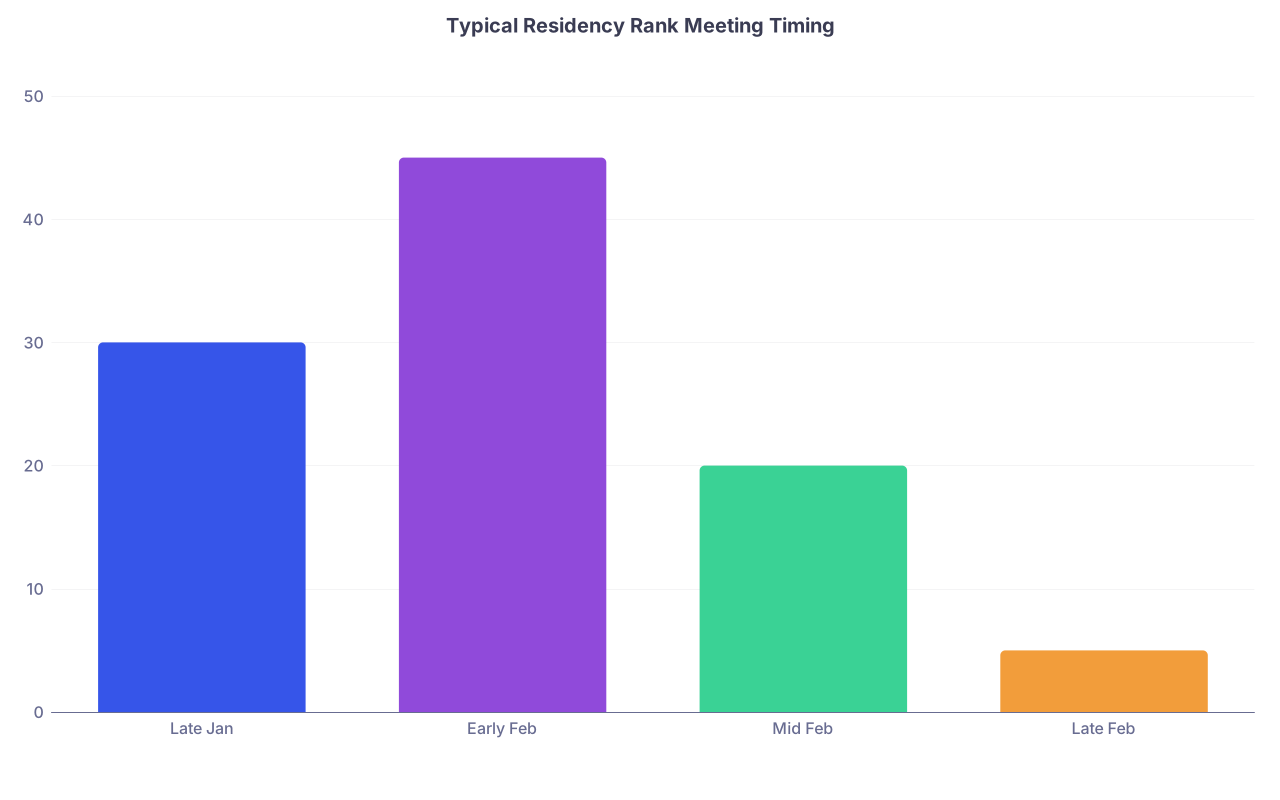
| Category | Value |
|---|---|
| Late Jan | 30 |
| Early Feb | 45 |
| Mid Feb | 20 |
| Late Feb | 5 |
If you are rotating at a program you might rank highly:
- Ask around (quietly) when their rank meeting is.
- About a week before that date:
- Make sure you are on your game—no late notes, no missing sign-outs.
- Have at least one senior person who can say, unprompted, “They have been great.”
Right before or right after their rank meeting:
- A brief, direct expression of interest can matter:
- “This has been my favorite rotation of the year. I would be very excited to train here.”
Never demand to know where you stand. That makes you memorable in the wrong way.
- Do not trash your professionalism this late in the game
I have seen this more than once: great applicant, strong interviews, then in February they:
- Start showing up late.
- Leave early all the time.
- Say out loud, “Well, this does not really matter anymore; I am basically done.”
Some of those comments make it into casual emails between attendings and PDs.
“Just so you know, this student really checked out after interviews.”
Your checklist for February:
- On time. Every day.
- Notes done. Orders legible and appropriate.
- Respectful to nursing and ancillary staff.
- No complaining about being “over it.”
Boring, adult behavior. That is precisely what programs are suddenly looking for when they picture you alone on nights in July.
- Use this time to finalize your rank list logically, not emotionally
By mid-February, while you are still on service:
Make three lists, on paper, not in your head:
- “Absolutely thrilled to match here” (even if only 2–3 programs).
- “Genuinely content, solid training”.
- “Only acceptable if nothing else”.
Ask yourself for each program in groups 2 and 3:
- Does this program actually train residents well in my intended career path?
- Could I tolerate the call schedule and culture described by residents for 3–7 years?
- Is there any deal-breaker (geography, family, culture) that I am trying to rationalize away?
While you are still actively caring for patients and working with residents, your judgment tends to be more grounded and less fantasy-based.
How Different Specialties Should Think About Last Chance Rotations
Briefly, because students never get straight talk on this.
| Specialty | Late Rotation Impact | Priority Use |
|---|---|---|
| Internal Med | Moderate | Clarify fit, secure home support |
| General Surgery | High | Seal home or strong backup |
| EM | Very high | SLOE-style feedback, advocacy |
| Psych | Moderate | Culture check, backup reassurance |
| Pediatrics | Moderate | Home visibility, lifestyle fit |
| Ortho/Neurosurg | High | Additional advocacy, backup plan |
Blunt translation:
Procedural, competitive fields (EM, surgery, ortho, neurosurg):
Late rotations can still move your spot on a program’s list, especially at your home or backup program.Medicine, peds, psych:
Less likely to create brand-new interview opportunities this late, but extremely useful to decide who you trust to train you and to strengthen home advocacy.
Week-by-Week Micro-Timeline Template
Use this as your default approach for any late MS4 rotation that matters for the Match.
Week 1
- Introduce yourself clearly to:
- Attendings.
- Senior and junior residents.
- State your interest level once, succinctly:
- “I am applying in X and am seriously considering this program.”
- Learn the workflow fast:
- Rounding structure.
- Note templates.
- Who calls which consults.
Goal: Do not be the student people have to constantly orient.
Week 2
- Ask for mid-rotation feedback from one resident and one attending:
- “Anything I can adjust over the next two weeks to function more like an intern on this team?”
- Increase your ownership:
- Anticipate overnight issues.
- Pre-chart for your patients.
- Offer to take new admissions when it is safe for you to do so.
Goal: Transition from “helpful student” to “proto-intern.”
Week 3
Volunteer for something slightly extra:
- Short teaching talk.
- QI or mini-chart review.
- Help with a small task the team has been avoiding.
Quietly reinforce your interest again, with substance:
- “Working with this ICU team has been one of the best parts of my MS4. The teaching and autonomy are both exactly what I am hoping for in residency.”
Goal: Be the student residents mention positively to each other without you in the room.
Week 4
Solidify advocacy:
- Ask 1–2 people if they would feel comfortable speaking on your behalf.
- If appropriate and still timely, request a letter explicitly for future use (prelim transitions, fellowships, scramble/SOAP as a backstop).
Close strong:
- Work just as hard in the last 48 hours as the first 48.
- Send a brief thank-you message to attendings you worked closely with:
- One or two sentences, no essay.
Goal: Leave behind a memory of consistency and professionalism.
Final 7–10 Days Before Rank List Certification
This is the real “last chance” window.
During your current rotation, you should:
- Gut-check your top 3–5 choices
Ask yourself while on a typical long day:
“If this exact workload and culture were my reality for the next 3–5 years, at [Program X], would I be okay with that?”
If the answer is “no” for any program in your top 5, change your list. Do not get romantic about prestige.
- Send a single, honest communication to your true #1 (if appropriate in your specialty)
If your specialty culture accepts it (e.g., IM, peds, psych; more controversial in some surgical fields):
Email the PD or program coordinator:
- “After completing interviews, I wanted to let you know that [Program Name] is my first choice. The [specific reasons] convinced me that this is where I would be most excited to train. Thank you again for the opportunity to interview and spend time with your residents.”
Do this once. To one program. No “you are among my top choices” nonsense.
- Lock your rank list logically, then stop tinkering
Submit a list that:
- Reflects where you truly want to train, not where you think you “should” match.
- Respects your non-negotiables (location, family, culture, training quality).
- Ranks any program you would rather attend than go unmatched, even if it bruises your ego a bit.
Then be done. Second-guessing daily usually makes the list worse, not better.
Bottom Line
- Late MS4 rotations are not throwaway months; they are targeted tools to secure interviews, clarify fit, and quietly nudge your position on program rank lists.
- Each block—Oct–Nov, Dec–Jan, Jan–Feb—has a different job. Treat them as positioning, clarifying, and decision rotations, and structure your behavior week-by-week around that goal.
- Your performance and professionalism in these final rotations can either confirm the strong story your application already tells—or undermine it right before programs vote. Use the time wisely.