

You’re standing in a new hospital lobby with a temporary badge that still has a sticker on it. New EMR. New attendings. New classmates who already seem to know each other. You transferred before MS3, and now your very first clerkship here is about to start—and you’re thinking: “If I screw this up, this could tank my letters and my match.”
This is that situation.
You’re not just “starting clerkships.” You’re doing it at a new school, with a record that’s already partly written somewhere else, and you need this place to:
- Give you strong clinical grades.
- Produce serious letters of recommendation.
- Not label you as “the transfer who’s behind.”
So let’s talk about how to make these new rotations work for you—strategically—for residency applications and the Match.
1. Understand How Being a Transfer Changes the Game
First, reality check.
Program directors do not really care that you transferred. They care about:
- Shelf scores
- Clinical evaluations
- Letters of recommendation
- Class ranking / honors
- Your narrative (personal statement, MSPE)
But your new school absolutely cares that you’re a transfer. They’re trying to figure out:
- Are you a problem they inherited?
- Are you going to drag down their stats?
- Or are you a quiet win they’ll be happy to claim as “our grad”?
Your job in the first 2–3 rotations: make it painfully obvious you’re the third type.
Here’s what’s different for you versus your non-transfer classmates:
- You don’t have a reputation here—good or bad.
- You may not know the hidden rules or unspoken expectations.
- You’re being evaluated harder early on, whether anyone admits it or not.
So you have to front‑load professionalism and performance. You don’t get a “slow start” here. Your first clerkship at the new school is effectively your audition for the whole MS3 year.
2. Before Rotations Start: Set Up the Chessboard
You’re not just “showing up and working hard.” That’s the baseline. You need structure and intel.
A. Meet with the clerkship director early
Do this before your first rotation if you can.
You say something like:
“I transferred in before MS3 and I want to make sure I understand exactly what honors-level performance looks like here. Could you walk me through the expectations, evaluation forms, and anything students who do well tend to do differently?”
You are signaling three things:
- You care about doing well.
- You’re not entitled; you want the rules.
- You’re proactive and coachable.
Ask specifically:
- How are clinical grades weighted vs. shelf exam?
- Who actually fills out the evaluations? Residents? Attendings? Both?
- What separates “High Pass” from “Honors” on this rotation?
- Are there written policies for remediation, professionalism flags, or grade appeals?
Document their answers. Not in a paranoid way. Just so you know the game you’re playing.
B. Get clarity on how your old school data will show up
Your MSPE (Dean’s Letter) will often include:
- Preclinical grades from old school
- Any MS3 rotations you did before transfer
- Comments about why you left (sometimes vaguely, sometimes not)
You want to know now what’s going to be in there.
Ask Student Affairs something like:
“Can we review how my prior evaluations and grades will be represented in my MSPE? I want to be sure there’s a consistent narrative.”
You’re not rewriting history. You’re making sure they don’t accidentally frame your transfer as “academic trouble” if it wasn’t.
If you did have academic problems before transfer (fails, repeats, leaves of absence), you need a clean, boring explanation that you’ll later reuse in interviews:
- “Family medical issue, I stepped away, problem resolved, I returned full-time.”
- “There was a mismatch with the curriculum style; I transferred into a setting that fits me better, and my performance since then reflects that.”
Short. Factual. No drama.
C. Build a quick intel network
Transfer students who crash usually do it because they operate blind.
You need:
- One or two MS4s at your new school who matched in the specialty you’re considering.
- One classmate per core clerkship who actually did well and will tell you the truth.
Ask them:
- “On this rotation, what annoys residents?”
- “What do people who get honors actually do differently?”
- “Which sites/attendings are known to give strong letters?”
You’re looking for patterns, not gossip.
3. First Rotations: Manage Perception Like It’s Part of the Grade (Because It Is)
You are new. People will test you without admitting they’re testing you. How you handle weeks 1–2 sets your default label.
Labels I’ve literally heard on teams:
- “Quiet but solid.”
- “Gun but useful.”
- “Seems checked out.”
- “Honestly, surprisingly good.”
You want to live in the “solid, reliable, pleasantly overprepared” zone.
A. Day 1–3: Control the introduction
When you introduce yourself to residents/attendings:
“I’m [Name], MS3, I transferred here this year and this is my first (or second) rotation at [New School]. I’m particularly interested in doing well clinically and getting to know how things are done here, so please let me know if there’s anything I should be doing differently.”
Short. No apology for transferring. No over-sharing.
You’ve now:
- Given them context.
- Invited feedback early.
- Framed yourself as adaptable, not defensive.
B. Overprepare for the first week’s basic tasks
Here’s what you want nailed in the first few days:
- Writing a SOAP/progress note in the exact style they want.
- Presenting a new patient in a clear, organized way.
- Knowing the common orders for bread‑and‑butter cases on that service.
The hack: Get example notes and presentations before you start. Ask a senior student from that service, “Can you send me one of your notes that got good feedback?”
Then practice mimicking the style. Not plagiarizing. Adapting the structure.
Clinicians will think: “Oh, this one gets it.” That translates into better evaluations even before they’ve seen your full depth of knowledge.
C. Ask for micro-feedback in week 1 and 2
This part separates the “fine” students from the ones who grow fast.
End of week 1:
“Dr. X, since I’m new to the system here, could I get quick feedback on how I’m doing and one or two specific things I should focus on next week to be at a higher level?”
Important: Shut up and write down what they say. Don’t defend, don’t explain. Just nod and thank them.
Then in week 2, you explicitly implement their feedback and point it out indirectly:
“On rounds today I tried to tighten my assessment and plan like you suggested—does this format work better?”
Now they feel invested in your growth. People give better evals to students they feel they’ve “coached up.”
4. Target Rotations and Sites That Help Your Match
Here’s where you stop being purely reactive and think like someone planning a residency application.
You’re asking: “Which rotations at this new school will turn into the experiences and letters that actually move my application?”
| Goal | Rotation Type |
|---|---|
| Strong home specialty letter | Sub-I / Acting Internship |
| Broad clinical comments for MSPE | Core Medicine / Surgery |
| Specialty exposure + networking | Elective in target specialty |
| Backup specialty credibility | Medicine or Peds sub-I |
| Shelf-based academic signal | Medicine, Surgery, OB/GYN |
A. If you already know your specialty
Example: You want Internal Medicine.
Priorities:
- Crush Medicine clerkship at the new school. This is non-negotiable.
- Do a Medicine Sub‑I or Acting Internship early enough to get a letter for ERAS.
- Identify 2–3 attendings in IM who are known letter writers and aim to work with them.
You literally plan: “Which teams/services do they staff? How do I get on those months?”
If you want a competitive specialty (Derm, Ortho, ENT, etc.), your top priority is:
- Find the PD and a senior faculty person early, and ask:
“As a transfer student who’s serious about [specialty], which rotations and which months would give me the strongest chance to earn a meaningful letter here?”
Let them help you game it. That’s their job.
B. If you’re undecided
Then your goal is to build a “neutral but impressive” profile.
You want:
- Strong performance in Medicine, Surgery, and one other core.
- At least one Sub‑I in a field that keeps many doors open (IM Sub‑I, Peds Sub‑I).
- Shelf scores that say “this student is at least above average at a new school.”
You don’t need your whole life plan now. You need enough objective and narrative strength that when you do decide, the file doesn’t limit you.
5. Letters of Recommendation: You Need Quality, Not Pity
Being a transfer means one thing: don’t rely on old-school letters unless they’re exceptional and still relevant.
Residency committees want to see letters that:
- Are from your current institution, especially for core fields.
- Comment on your clinical performance, not just “worked hard in preclinical small group.”
- Include direct comparison language (“top 10% of students I’ve worked with in five years”).
A. Identify letter targets early on each rotation
Within the first week, you should already be quietly asking yourself:
- Does this attending see enough of me to judge me?
- Do they give specific teaching and feedback?
- Are they actually known to write good letters?
Ask a senior student privately: “Would Dr. Y be a good letter writer if I end up doing really well with them?” You’ll get an honest answer most of the time.
B. Ask for the letter while you’re still fresh
Don’t wait 3 months.
End of rotation, you say:
“Dr. Y, I’m starting to think seriously about [specialty or at least ‘residency applications’], and I’ve really valued working with you. If you feel you’ve seen enough of my work to write a strong letter of recommendation, I’d be grateful.”
Key word: strong. You’re giving them an out. If they hedge, don’t use them.
And yes, as a transfer, you should quietly aim for 1–2 more letters than the minimum for your specialty. Not to send all of them, but to have options if one is lukewarm.
6. Handling the “So, Why Did You Transfer?” Question
This will come up on the wards and in residency interviews. Sometimes casually. Sometimes suspiciously.
You need one polished, boring, consistent answer that:
- Is short.
- Does not attack your old school.
- Ends focused on your growth and current performance.
Example patterns that work:
Academic fit version:
“My prior school had a very problem-based, independent curriculum. I realized I learn better with more structured clinical exposure and mentorship, so I transferred to [New School] for my clinical years. It’s been a good fit—my performance and feedback here reflect that.”
Personal circumstances version:
“I had a significant family situation that required me to be geographically closer to home. Transferring to [New School] allowed me to support that and continue training. The situation is now stable, and I’ve been full-time and fully engaged here.”
Do not go into:
- Politics at the prior school
- “I didn’t like the vibe”
- Deep trauma dump
Residency PDs are listening for: “Is this person going to bring drama into my program?” Keep it clean.
7. Document Your Wins Aggressively (You’ll Need Them for ERAS)
You’re in a new environment. People don’t know your arc. You want hard receipts.
Keep a simple running document where you track:
- Shelf scores (with percentiles if provided)
- Core clerkship grades + key comments
- Specific patient care stories where you made a clear impact
- Projects/QI/research you picked up after transfer
You’ll use this later to:
- Fill in ERAS experiences with specific examples.
- Help your letter writers remember what you did.
- Build talking points for interviews (“Tell me about a time you received constructive feedback and responded to it”).
If you’re a transfer because of prior issues, this documentation is your proof of redemption. It shows a clean line of improvement.
8. Avoid the Common Transfer Landmines
I’ve watched transfers do things that quietly tank them. Don’t repeat these.
Landmine 1: Over‑explaining your transfer to everyone
Your story is for attendings who ask directly, Student Affairs, and later PDs. Residents don’t need the full saga. Classmates definitely don’t.
Short version for peers:
“I transferred for family and fit reasons. I’m glad to be here now.”
Then change the subject. You’re not here to litigate your past.
Landmine 2: Acting like you “already know how rotations work”
Different school = different culture.
At your old school, maybe it was fine if you left at 3 pm post‑rounds on a slow day. At this one, that’s “not a team player.”
So early on each rotation, ask residents directly:
“What do students who do really well on this rotation do differently here? And what bothers teams that I should avoid?”
You’ll get gold. Stuff like:
- “Don’t run to the OR without telling anyone.”
- “Don’t disappear to the library during rounds prep.”
- “Do not pre-round on patients before labs result here; attendings hate that.”
Tailor your behavior.
Landmine 3: Waiting too long to fix a bad start
If the first 2 weeks are rough—wrong style of notes, shelf practice way behind, feedback clearly lukewarm—you cannot just “hope it improves.”
You ask for help. From:
- A trusted MS4 or chief.
- The clerkship director.
- The resident who seems to like teaching.
Say:
“I’m worried I’m not hitting the level I want on this rotation so far. Could you help me identify my top 1–2 priorities for the next two weeks to finish stronger?”
This is not weakness. It’s damage control. And it’s the only way out if your start went sideways.
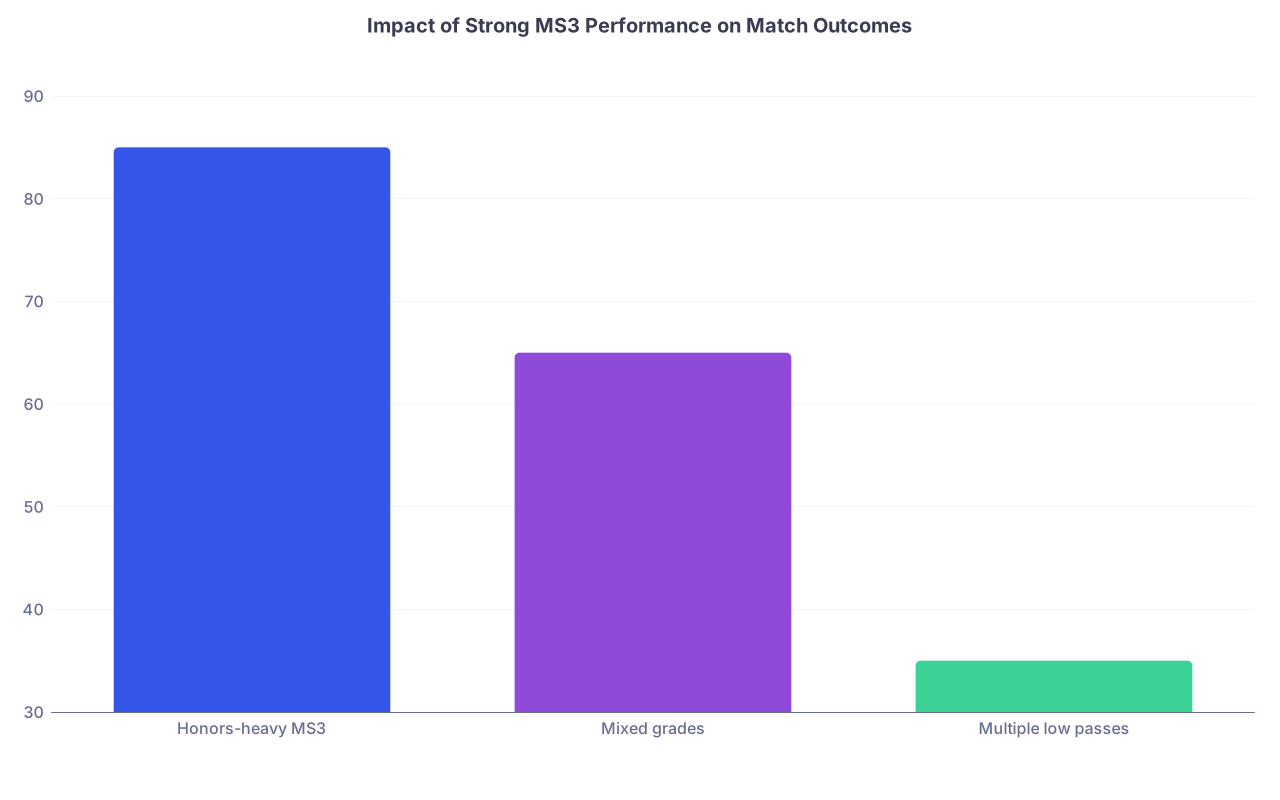
| Category | Value |
|---|---|
| Honors-heavy MS3 | 85 |
| Mixed grades | 65 |
| Multiple low passes | 35 |
(Hypothetical percentage of students matching into their top 3 choice specialties based on MS3 performance pattern. Point is: the clinical year matters. A lot.)
9. Use Your “New Start” to Build a Stronger Narrative
Here’s the upside that most transfer students never exploit: you actually get a reset button on your story.
You can intentionally choose to be known here as:
- The reliable workhorse.
- The detail‑oriented note machine.
- The student who reads on every patient and brings one useful paper to the team.
- The quietly kind person families remember.
Then your letters and MSPE can say things like:
- “Although [Name] joined our institution as a transfer student, they quickly distinguished themselves as one of the most prepared and professional MS3s in the cohort.”
- “Despite transitioning institutions before clerkships, [Name] consistently performed at the top level in our clinical rotations, demonstrating adaptability and rapid growth.”
Those sentences are gold in applications. They flip “transfer” from a red flag into a resilience/flexibility asset.
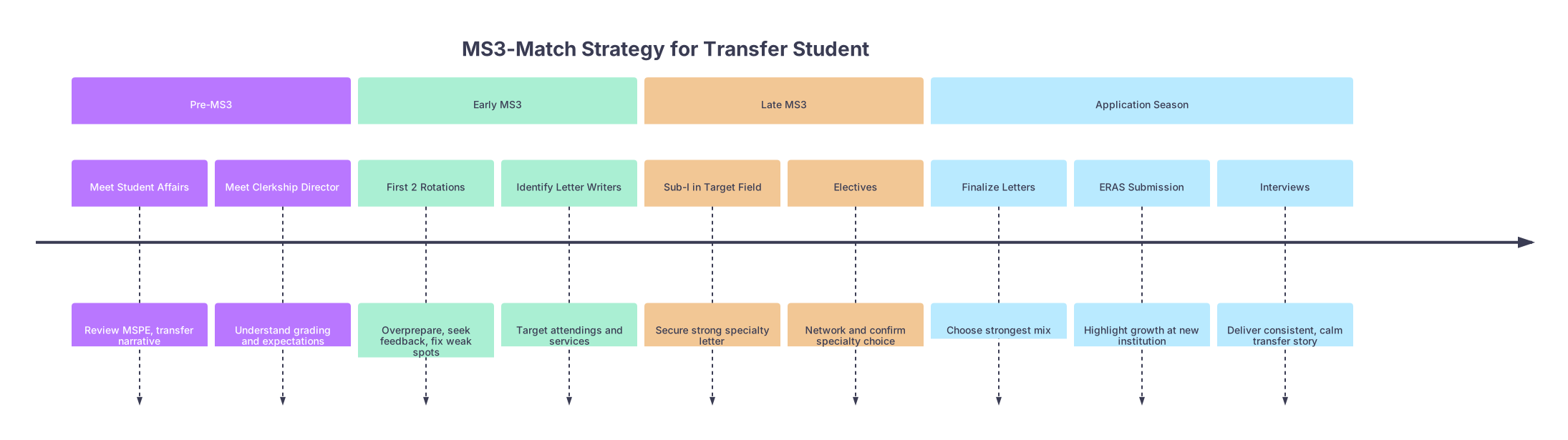
| Period | Event |
|---|---|
| Pre-MS3 - Meet Student Affairs | Review MSPE, transfer narrative |
| Pre-MS3 - Meet Clerkship Director | Understand grading and expectations |
| Early MS3 - First 2 Rotations | Overprepare, seek feedback, fix weak spots |
| Early MS3 - Identify Letter Writers | Target attendings and services |
| Late MS3 - Sub-I in Target Field | Secure strong specialty letter |
| Late MS3 - Electives | Network and confirm specialty choice |
| Application Season - Finalize Letters | Choose strongest mix |
| Application Season - ERAS Submission | Highlight growth at new institution |
| Application Season - Interviews | Deliver consistent, calm transfer story |
FAQ (exactly 5 questions)
1. Will residency programs see that I transferred schools and assume something was wrong?
They’ll see it, yes. It’s in your MSPE and transcript trail. But most programs do not automatically assume the worst; they’re too busy to play detective on every transfer. What does matter is whether there’s a coherent, non-dramatic explanation and whether your performance after the transfer is strong. If your third-year clinical work, letters, and shelves at the new school look good, the transfer becomes background context, not a central issue.
2. Should I use letters from my old school or only from my new school?
Prior letters are only useful if they’re excellent and directly relevant to your target specialty or clinical skill. But you still need at least one or two strong letters from the new school, especially in the field you’re applying to. If you’re applying to Internal Medicine, for example, and all your letters are from another institution where you only did preclinical or an early shadowing elective, that’s weak. Aim for a mix, but let current, clinical letters lead.
3. How many rotations does it take at the new school to “erase” a rough record at the old one?
You never fully erase it, but you can absolutely override it. If you have 3–4 strong core rotations (with shelves and comments to match) plus a solid Sub‑I at your new school, most PDs will focus on that more than a single failed or marginal course from two years ago. The key is consistency: no new professionalism flags, no repeated “needs to be more engaged” comments. You’re buying a new narrative with each solid eval.
4. Is it a bad idea to do away rotations if I just transferred and barely know my new system?
Not inherently, but timing matters. You don’t want your first exposure to serious clinical expectations to be at a visiting elective where no one knows you and the culture is different again. Generally, get through at least a few core rotations—and ideally a home Sub‑I—before jumping into aways, especially for competitive specialties. You want to be in “operational mode” already, not still figuring out how to preround and present without getting lost.
5. What if my first rotation at the new school went badly—did I just ruin my match chances?
One bad rotation does not kill your match. Programs look at patterns, not isolated stumbles. But you can’t ignore it. Meet with the clerkship director to understand exactly what went wrong and what needs to change. Then, on your very next rotation, be aggressive about early feedback and visible improvement. If later attendings write comments like “showed remarkable growth over the course of the year,” you’ve reframed the story from “weak student” to “responsive, improving student,” which most PDs actually respect.
Key takeaways:
- As a transfer starting MS3 at a new school, your first few rotations are your audition—overprepare, ask for feedback early, and adapt fast.
- Be deliberate about which rotations and attendings you work with so you walk away with high-impact evaluations and letters that support your residency goals.
- Keep your transfer story short, calm, and consistent, and let your post-transfer performance do the real talking for your Match.


