
Contacting programs during SOAP does not magically blacklist you. The idea that “if you email or call, they’ll punish you” is mostly mythology passed down by panicked MS4s and risk‑averse advisors. But that doesn’t mean you should blast every program director with a copy‑pasted sob story either.
Let me cut through the noise: how you contact programs matters a lot more than whether you contact them.
SOAP is a pressure cooker. Rumors spread faster than facts. I’ve seen students who matched happily in SOAP after emailing 30 programs—and I’ve seen others get completely ignored after one poorly timed, entitled message. Same behavior category (“contacting programs”), opposite results. The difference was execution and realism.
You’re in the “BEST STRATEGIES FOR SOAP” category. Not “best ways to feel productive while changing nothing.” So let’s talk what actually helps, what is neutral, and what really does hurt you.
The Core Myth: “If You Contact Programs, They’ll Blacklist You”
This is the big scary story: if you email or call programs during SOAP, they’ll think you’re desperate or annoying and take you off their list.
Reality:
Programs are already drowning in chaos during SOAP. They’re not running a secret blacklist for the “guy who sent a polite email with his ERAS ID.” They care about:
- Filling their spots with people who can do the job
- Doing it fast
- Minimizing headaches
Nobody has time to build a petty vendetta file.
Here’s what’s actually true, based on what PDs, APDs, and coordinators say when they’re off‑script at conferences and over coffee:
A brief, tailored, professional email from you does not hurt you. Many will ignore it. A few may skim it. Occasionally, it bumps you from “random name in ERAS” to “oh yeah, that person who seems genuinely interested and local.”
Aggressive, repeated, or entitled contact can hurt you. Think:
- Multiple emails over 24–48 hours
- Calling the main hospital line asking for the PD’s cell
- Asking why you weren’t invited or arguing with decisions
Coordinators are gatekeepers. If you’re rude or weird with them, word spreads instantly. That can kill your chances.
So the myth is half‑baked. Contacting programs doesn’t inherently hurt you. Being obnoxious or tone‑deaf can.
What The Data Actually Shows (And What It Doesn’t)
Let’s be honest: there’s no randomized controlled trial of “50 students emailed programs during SOAP vs 50 stayed quiet.” The data we have is:
- NRMP SOAP outcomes data (who matched/where/by specialty)
- Survey data and PD surveys (NRMP Program Director Survey, etc.)
- Repeated, consistent anecdotes from coordinators and PDs over multiple cycles
NRMP and PD surveys show this pattern:
Programs value:
- Fit with their program trajectory (community vs academic, etc.)
- Connection to region
- Step scores/COMLEX, class performance
- Professionalism, communication
“Applicant signaled interest” (emails, calls, etc.) ranks much lower than core metrics, but it’s not negative. At worst: neutral. At best: mild positive.
What we don’t see:
- Any evidence that “contacting during SOAP” is a systematic disadvantage
- Any program policy that says: “Do not contact us or we will not rank you” (you might see “do not call,” but that’s an operational preference, not a threat)
So the actual evidence‑based position:
- Contacting programs is low‑yield, not high‑risk.
- It’s a marginal tactic in a process mostly driven by your existing application, school, test scores, geography, and specialty flexibility.
- Your time is better spent strategically choosing where you apply and tightening your ERAS materials than sending 100 generic emails.
When Contact Helps, When It’s Neutral, When It Hurts
Let’s sort this out clearly.
| Strategy Type | Likely Impact |
|---|---|
| Targeted, tailored single email | Mild positive/neutral |
| Mass generic email to 50+ programs | Neutral/slight negative |
| Polite faculty advocate email | Mild positive |
| Multiple emails + phone calls | Negative |
| Rude/entitled communication | Strong negative |
Mild Positive: Targeted, Sane Outreach
This is what “smart” contact looks like:
- You apply to a program in SOAP.
- You have at least one real linkage:
- Region (grew up there, family nearby, same state)
- School connection (your school has sent residents there)
- Specific track that fits your background (FM with OB, IM with strong hospitalist pathway)
- You send a short email (less than 200 words):
- To the program coordinator and/or generic program email
- With your ERAS ID, very brief background, and 1–2 program‑specific sentences
- No demands, no requests for special consideration
That can occasionally push you from “random applicant #147” to “huh, this person might actually stay here and seems grounded.”
Neutral: The Generic Blast
This is what too many students do at 3 a.m.:
- They copy‑paste the same email to 30+ programs
- Content is vague and could fit literally any program
- No real geographic or program‑specific rationale
- Sometimes the wrong program name in the greeting (yes, coordinators laugh about this)
Result?
Most programs will ignore it. A few will roll their eyes. It probably won’t destroy your chances, but it won’t help either. It wastes your energy in the most time‑compressed 72 hours of your life.
Negative: Pestering + Entitlement
These are the behaviors that actually do hurt:
- Email in the morning, call in the afternoon to “confirm you received my email”
- Call the main institutional line asking to directly speak to the PD or chair
- Ask why you weren’t selected or try to “sell” yourself in a live unscheduled phone pitch
- CC multiple attendings or hospital leadership trying to pressure the program
SOAP is already chaotic. Anyone creating extra work or friction gets mentally downgraded fast.
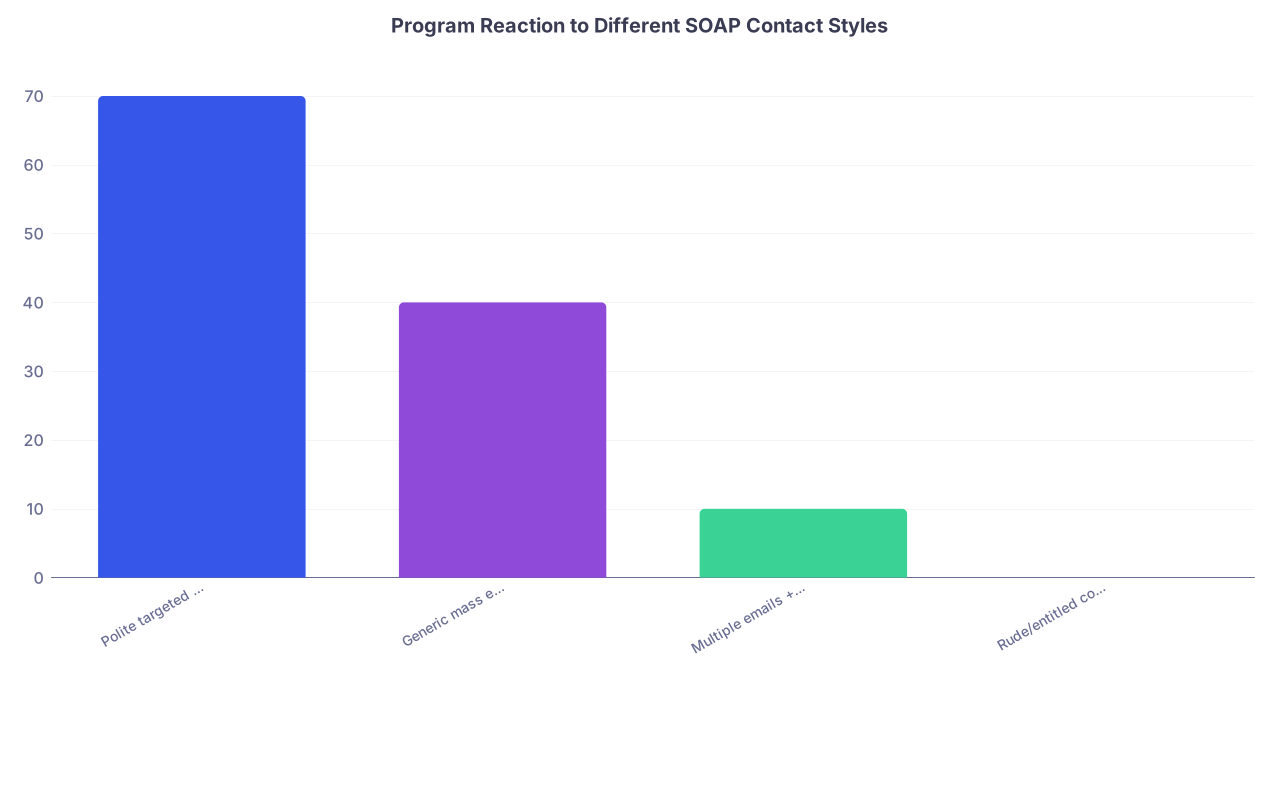
| Category | Value |
|---|---|
| Polite targeted email | 70 |
| Generic mass email | 40 |
| Multiple emails + calls | 10 |
| Rude/entitled contact | 0 |
Interpretation: That’s not a literal dataset, but it mirrors what I hear—programs are much more open to “polite, targeted contact” than applicants think, and intolerant of high‑maintenance behavior during SOAP.
Who Should Contact, And Who Should Stay Quiet
Let me be blunt: if your file is fundamentally noncompetitive for a specialty (e.g., no Step 2, multiple failures, red flags, applying to Derm in SOAP), no email is going to rescue you. You are not being “undermarketed.” You are applying to the wrong thing.
Contact can be slightly helpful if:
- You’re within the realistic range for that specialty (FM, IM, Psych, Peds, many prelims, some Gen Surg)
- You have a real regional tie or institutional connection
- You’re willing to do the unsexy, community‑heavy, non‑prestige programs seriously
- You’re customizing your message and applying to a thoughtfully chosen set of programs
Contact is probably a waste of time if:
- You’re shotgun‑applying to every open position in every state
- You have no specific interest or tie to the program
- You’re sending emails because it feels like hustling, not because there’s a strategy
Where it can be surprisingly effective: when a faculty advocate reaches out.
If a PD receives an email from someone they actually know or respect, saying:
“We have a solid, hardworking student in SOAP—ERAS ID X—who applied to your program. They’re geographically tied to your area, team‑oriented, and I’d vouch for their reliability.”
That’s more likely to bump you into the “take a look” pile than anything you say about yourself.
If your school advisor or department chair is willing to do that for a short list of programs that fit you? That’s worth more than 20 self‑sent emails.
How To Contact Programs During SOAP Without Shooting Yourself In The Foot
Here’s the part you actually need: what to do on Monday–Thursday.
1. Respect the Timeline and Rules
SOAP is tightly structured. Programs:
- Get the list of SOAP applicants
- Review ERAS files
- Conduct quick phone/virtual interviews if needed
- Submit preference lists via NRMP
They’re doing this on a compressed clock. Some explicitly say “do not contact us” in their listing or website. If they say that, don’t be clever. Don’t contact them. Follow instructions. Programs test basic professionalism that way.

| Step | Description |
|---|---|
| Step 1 | Interested in program |
| Step 2 | Do not email or call |
| Step 3 | Skip contacting |
| Step 4 | Send brief tailored email |
| Step 5 | Program says do not contact |
| Step 6 | Have real tie or reason |
2. Choose Targets, Not Everyone
Pick programs where you can make a believable case:
- Geographic: “Grew up in X region,” “Partner already working there,” “Family in the city.”
- Institutional: Your school has sent residents there, or your faculty know their faculty.
- Training fit: Community vs academic, strong in something you’re actually interested in.
Don’t bother emailing a place you’d never actually go if it’s your only option. SOAP is not the time for pretending.
3. Keep the Email Surgical
Template structure that does not annoy coordinators:
- Subject: “SOAP Applicant – [Your Name], ERAS ID [XXXXX] – [Specialty]”
- 1 sentence: Who you are (MS4/IMG, school, specialty)
- 1–2 sentences: Why this program/region specifically (real reason, not fluff)
- 1 sentence: Key strength or unique angle (research, language skills, prior RN, etc.)
- 1 sentence: Clear statement you’ve applied via SOAP and would be grateful for consideration
Total: ~100–150 words.
No attachments. No begging. No comparing yourself to others. You’re trying to add signal, not drama.
4. Don’t Call Unless Invited To
Cold calls are a high‑risk, low‑return move in SOAP:
- Phones are ringing nonstop already—for logistics they actually need to handle.
- On the program side, they’re moving fast between reviewing, meeting, interviewing, and updating lists.
If a program invites calls or has a recorded message asking applicants to call for X reason, fine. Otherwise: email only.
The Bigger Truth: Contact Is a Multiplier, Not a Foundation
Here’s the unglamorous part most people ignore.
Your SOAP outcome is dominated by:
- Specialty choice realism
- Number and type of programs you apply to
- Test performance and red flags
- Geography flexibility
- Whether you fix the errors that got you into SOAP (if fixable in the moment—e.g., personal statement, LORs uploaded, clarity on red flags)
Contacting programs is a tiny multiplier on top of that. If your base is zero, 1.1 × 0 is still zero.
Where contacting helps most:
- Breaking ties when you’re already on the radar
- Clarifying your willingness to actually come and stay in that city
- Signaling “I’m paying attention, and I’d be happy there” in a believable way
Where students overvalue it:
- As a magic rescue move
- As a substitute for expanding specialties (e.g., not considering FM/Psych/Prelim when IM/Categorical is not happening)
- As a way to outrun red flags they refuse to acknowledge
SOAP is not a moral judgment; it’s a market reality. The smartest SOAP strategy is grounded in that reality, not superstition about “never email” or “email everyone.”
FAQs
1. Will contacting a program that says “no calls or emails” actually hurt me?
Yes, that can absolutely hurt you. If the listing or website explicitly says “Do not contact the program during SOAP,” and you do it anyway, you’ve just demonstrated poor reading, poor judgment, and inability to follow instructions under pressure. That’s the trifecta programs hate. Those are the ones coordinators complain about.
2. Should I have my dean or advisor contact programs for me?
If they know the program or region well and are willing to vouch for you to a short list of realistic programs, yes, that can help a bit. A faculty‑to‑faculty or dean‑to‑PD message is more influential than your 15th email. But don’t have them mass‑spam 40 places. That reads as desperate and unfocused.
3. Is it better to call than to email because they “can’t ignore a call”?
No. They can ignore a call very easily—by sending it to voicemail or having the coordinator politely shut it down. In SOAP, unscheduled calls from unknown applicants are mostly seen as interruptions, not initiative. Email is safer, more respectful, and easier for them to handle on their timeline.
4. Should I follow up if I don’t hear back after my first email?
No. SOAP moves too fast for email “campaigns.” You send one concise, professional email. If they’re interested and have time, they’ll find your ERAS file or contact you. A follow‑up 12–24 hours later just looks needy and increases annoyance without real benefit.
5. If I’m an IMG, does contacting programs help more or less?
For IMGs, contact is still a small factor. The main filter is: visa status, exam scores, school reputation, prior U.S. clinical experience. Where it can help is clarifying your visa situation, your U.S. ties, and your seriousness about a specific geographic area. But again, it’s a marginal advantage at best, not a replacement for the core metrics they care about.
Bottom line, stripped of superstition:
- Contacting programs during SOAP, done briefly and professionally, does not hurt you. It’s usually neutral, occasionally helpful.
- Annoying, repeated, or rule‑breaking contact absolutely can hurt you—and programs remember high‑maintenance behavior.
- Your SOAP outcome is driven almost entirely by specialty choice, geography, and the strength of your existing file. Contact is a minor, not major, lever.