
27% of PGY-1 categorical internal medicine positions in 2023 were filled outside the main Match algorithm—through SOAP or later offers.
So no, SOAP residents are not some tiny, desperate exception. They’re a sizable chunk of the workforce. You work with them every day and usually have no idea who matched on Monday and who got an offer on Thursday.
Let’s dismantle this myth properly.
The Myth: “Programs Only Take Whoever They Can Get in SOAP”
Here’s the story you hear whispered in hallways:
“If you end up in SOAP, programs are just taking warm bodies. The ‘real’ residents matched on Monday. SOAP picks are the leftovers and everybody knows it.”
I’ve heard versions of this from:
- A PD who was venting about their admin saying “Just get these SOAP slots filled with anyone with a pulse.”
- Students telling each other, “If you SOAP into a program, be prepared to be treated like second-class.”
- Faculty who honestly should know better, throwing around “SOAP kid” like an insult.
It sounds plausible. Panic week. Fast decisions. Programs scrambling.
But here’s what the data and actual PD behavior show once you move past the drama.
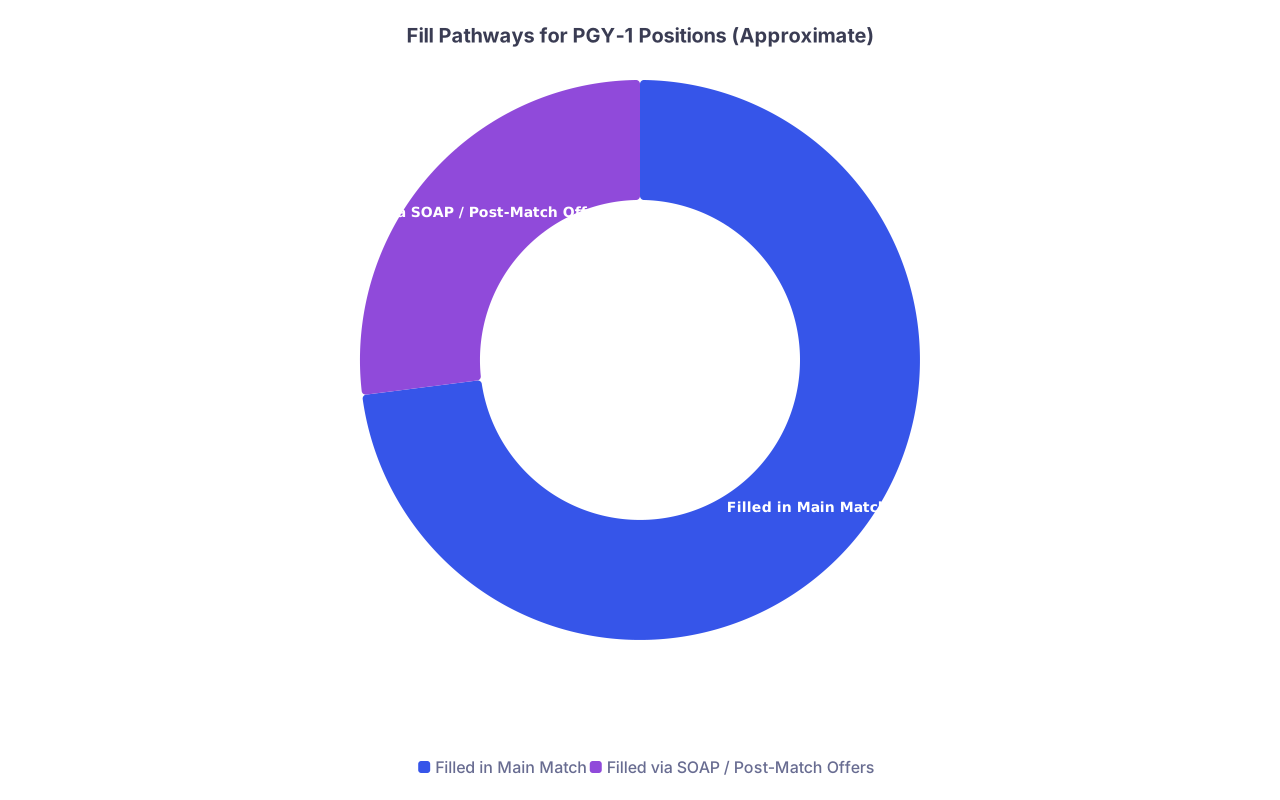
| Category | Value |
|---|---|
| Filled in Main Match | 73 |
| Filled via SOAP / Post-Match Offers | 27 |
Programs don’t suddenly become irrational just because SOAP starts. They still have ACGME requirements, service coverage realities, fellowship pipelines to protect, and reputations to maintain. Acting “desperate” is exactly what they cannot afford to do.
Does SOAP change their risk tolerance? Yes.
Do they grab anyone breathing? No. That’s fantasy.
What Programs Actually Do During SOAP
Forget the Reddit panic narrative. Think like a PD for a second.
It’s Wednesday of Match Week. You’ve got two unexpected unfilled categorical IM spots. You’re still responsible for:
- Protecting your board pass rate.
- Not overburdening your seniors.
- Keeping your chair, GME office, and hospital administration happy.
- Not creating disciplinary headaches for the next three years.
Are you going to blindly click “offer” on the first ten names you see? Of course not.
Here’s the reality of how most programs behave.
1. They start with a pre-built SOAP plan
Well-run programs don’t wake up on Monday and say, “Oh no, we’re unfilled, what now?” They had a meeting in February.
They usually have:
- A short list of “highly acceptable but not ranked high enough” applicants from interview season.
- Agreed-upon minimums: Step 2 CK cutoffs, red-flag criteria, visa stance, etc.
- A ranked approach: who they’d SOAP if they end up unfilled, in order.
I’ve watched PDs pull up old interview spreadsheets and say:
“Remember this AMG who we liked but were over-subscribed? If she’s SOAP-eligible and applied, she’s our top target.”
That’s not desperation. That’s adaptive triage based on months of data.
2. They still screen. Hard.
SOAP isn’t a free-for-all.
Programs:
- Filter by Step 2 CK/COMLEX 2.
- Ignore clear professionalism red flags.
- Avoid people who obviously want a completely different specialty (e.g., EM personal statement applying to FM with zero continuity clinic experiences).
- Often prioritize prior interviewees—they already vetted you.
SOAP compresses timelines, but it doesn’t erase standards. Most faculty I know would rather leave a spot unfilled than bring in a resident they’re confident will be a problem. An unfilled spot is painful. A problematic resident is worse.
3. They value “SOAP interest” more than you think
In SOAP, signals matter more than in regular season.
Programs pay attention to:
- Who tailored their application and PS to the specialty and program type.
- Who quickly replies to messages and paperwork.
- Who sounds realistic and grounded in email or short interactions.
I’ve seen PDs bump someone up because their SOAP communication was concise, professional, and specific. Meanwhile, the 260 board score applicant who sent a generic “I would be honored” form email? Passed over.
Not exactly “we’re desperate, we’ll take anyone.”
Why the “Desperate SOAP Pick” Stigma Exists (and Why It’s Wrong)
The stigma has three main sources, and they’re all flawed.
1. Survivorship bias from the 240+ crowd
People who match their top 3 categorical spots love to explain the system as if their experience is universal. They’ll say stuff like:
“SOAP is basically for folks who failed exams or had big red flags.”
Reality: Plenty of SOAP candidates have:
- 220–240+ Step 2 CK.
- No professionalism issues.
- Solid LORs and clinical evals.
- Completely normal applications that ran into bad luck, strategy errors, or overly aggressive rank lists.
You don’t hear their story as loudly because they’re not bragging about “accidentally going unmatched.”
2. Misunderstanding of why programs go unfilled
Programs go unfilled for a lot of reasons that have nothing to do with “bottom of the barrel” applicants:
- New or expanding programs that overshoot how competitive they are.
- Geographic issues—undesirable city, small town, or poor perceived safety.
- Toxic reputations lagging behind internal improvements (or vice versa).
- Poor interview season strategy or late accreditation changes.
That has nothing to do with the inherent quality of their SOAP candidates. It just means their initial recruitment strategy failed. SOAP becomes version 2.0.
| Reason Program Is Unfilled | Directly Implies Weak Applicants? |
|---|---|
| New / expanding program | No |
| Unpopular location | No |
| Late accreditation or changes | No |
| Poor interview season logistics | No |
| True malignant culture / word out | Sometimes |
The “desperate” narrative erases all this context and pretends every SOAP slot is radioactive. It’s lazy.
3. Garbage hallway commentary
You’ve heard it:
“Oh, he SOAPed in.”
“She had to scramble.”
“Yeah, he’s one of the SOAP kids.”
That’s not data. That’s ego.
Ask attendings who’ve actually supervised both matched and SOAPed residents over 5–10 years. Most will tell you:
They can’t reliably guess who came in via which path based on performance by PGY-2. The only way they know is whether they sat on the rank list meeting or SOAP call that year.
The “obvious SOAP resident” idea falls apart under real observation.
What SOAP Residents Look Like 1–2 Years Later
Here’s what actually happens after the dust settles.
Performance? Indistinguishable from “Monday matchers”
Once you survive internship, nobody cares how you entered the building.
Program directors, if they’re honest, judge residents based on:
- Reliability on call.
- Clinical reasoning.
- Ability to work in a team without generating drama.
- Progress in autonomy and ownership.
I’ve seen:
- A SOAP categorical IM resident become chief.
- A SOAP FM resident match into a very solid sports medicine fellowship.
- A SOAP prelim who used the year, re-applied, and matched categorical surgery the next cycle.
And I’ve also seen Monday-match residents implode because their interpersonal issues or laziness finally caught up with them.
If there’s a performance gap, it’s usually driven by the same factors as everyone else: maturity, work ethic, support systems. Not SOAP status.
How programs treat SOAP vs non-SOAP residents
Two groups here:
Decent programs with functioning leadership. They treat you based on how you show up, not how you got there. If they’re professional during interview season, they’re usually professional about SOAP.
Dysfunctional or malignant programs. They’ll find a reason to degrade someone, whether it’s “SOAP,” “IMG,” “DO,” or “community vs university.” The label just changes.
If a PD or senior constantly jokes “Yeah, he was a SOAP pick,” that’s a red flag about the culture, not about SOAP. That program would likely find another axis to punch down on even if SOAP disappeared tomorrow.
How Programs Actually Use SOAP Strategically
Here’s the piece almost no one tells students: SOAP is not just a panic patch; it’s also a strategic tool for programs.
Filling genuine gaps in their class
Programs under-fill a specific track, then use SOAP to:
- Balance gender, diversity, or language skills in a class.
- Add someone with specific background (rural, community ties, research experience).
- Prioritize AMGs or local grads who can hit the ground running.
I’ve watched PDs say:
“We’re a community-heavy program. That applicant with strong volunteer primary care, even with average scores, is better for us than the 260 test taker chasing cardiology research.”
In SOAP, they can pivot faster to what they actually need.
Recruiting strong candidates who over-reached
This part is almost taboo to say aloud, but it’s real.
Every year there are applicants who:
- Applied only to extremely competitive specialties.
- Ranked a laughably short list.
- Treated prelims or backups as an afterthought.
Some are actually strong—on paper and in real life—but they played a stupid game and lost. SOAP gives programs a second chance to grab these people for categorical or prelim slots.
Not a sign of “desperation.” It’s opportunistic, and from the program’s point of view, often smart.
How YOU Should Think About SOAP (If You Want to Win It)
Let’s pivot from myth-busting to strategy, because believing the wrong myth will absolutely tank your SOAP outcome.
1. Stop acting like SOAP is a shame badge
Program directors can smell shame, desperation, or entitlement in how you present yourself.
If your mindset is, “I failed, I’m trash, I’ll take anything,” you act:
- Vague in your interest.
- Sloppy in your communication.
- Over-apologetic or weirdly defensive.
Better framing: “The main Match didn’t go my way. I still have a lot to offer, and SOAP is the mechanism to find the right fit from what’s open.”
Confident, not delusional. Forward-looking, not obsessed with autopsy.
2. Bring clarity, not chaos
Programs don’t want “desperate.” They want “easy to onboard and likely to succeed.”
You signal that by:
- Having your documents and explanations already polished before Monday.
- Giving a short, clean story for any red flags (and then shutting up).
- Being very explicit about why you’re applying to that specialty and program type now.
Your goal is to make the PD think: “This person will plug in cleanly and do the work.” That’s it.
3. Choose strategically, not emotionally
The biggest SOAP disaster I see every year: people cling to prestige fantasies instead of getting into a solid training environment.
Given two SOAP options:
- Known malignant university program in a big name city.
- Stable, mid-tier community program with decent fellowship outcomes and humane hours.
Most smart attendings would tell their own kids to take the second. SOAP or not.
You don’t need to prove anything by suffering at a name-brand toxic institution. Programs are not judging you for where you SOAP in. They are judging you for how you come out the other end.
What the Data + Experience Really Say
Strip away the gossip, and you’re left with this:
- SOAP is messy, fast, and stressful.
- Programs are under pressure.
- Applicants are panicking.
But the underlying incentives do not change.
Programs still need:
- Residents who will pass boards.
- Residents who will not implode on call.
- Residents who will not blow up the program’s reputation.
That reality alone kills the “they just take desperate picks” story. Desperate picks cause long-term pain. Most PDs have been burned enough times to know better.
Bottom line
- Programs do not suddenly abandon standards and rationality in SOAP; they adapt them under time pressure.
- SOAP residents are not inherently weaker, and within 1–2 years, performance differences between SOAP and Monday-match residents mostly disappear.
- The real “desperation” risk in SOAP is not on the program side—it’s on applicants who panic, believe the stigma, and then make sloppy, emotional decisions instead of strategic ones.