
SOAP is not a career death sentence. For most people, it is a messy, stressful detour that becomes irrelevant within a few years—unless you let the story in your head cripple you longer than the data says it should.
You will not hear that on Reddit. Or in the panicked GroupMe chats where people whisper “SOAP” like it’s Voldemort. But if you actually follow these people 5–10 years out, the big “SOAP vs. matched on Monday” divide mostly dissolves into: Are you competent? Did you learn? Can people stand working with you?
Let’s walk through what actually happens to SOAP applicants long-term, what the data shows, and where the real, non-theoretical landmines are.
What the Match Data Really Shows (And What It Doesn’t)
Here’s the first problem: no one runs a big glossy NEJM paper titled “SOAP Applicants Are Fine, Calm Down.” Long-term tracking of SOAP vs. non-SOAP is messy, because once you’re a PGY‑3, most databases don’t care how you got there. You’re just “a resident in X program.”
But we do have several useful data points:
- NRMP reports on SOAP participation and post-match status
- Program-level outcomes: ABMS board pass rates and attrition
- Surveys on burnout, satisfaction, and career paths by specialty and program type
- Anecdotal but consistent experience from faculty and PDs who’ve watched multiple classes cycle through
Put those together and a pattern emerges:
Your match mechanism (SOAP vs main match) is far less predictive of your career than:
- Specialty choice
- Program quality and fit
- Your performance during residency and early attending years
Where SOAP matters most is what it correlates with: being unmatched during the main match is often a sign of weaker application metrics, red flags, poor strategy, or taking a swing at an ultra-competitive specialty from a weak position. Those factors can follow you—if you don’t fix them.
But the fact that the “residency seat” came via SOAP? That signal fades very fast.
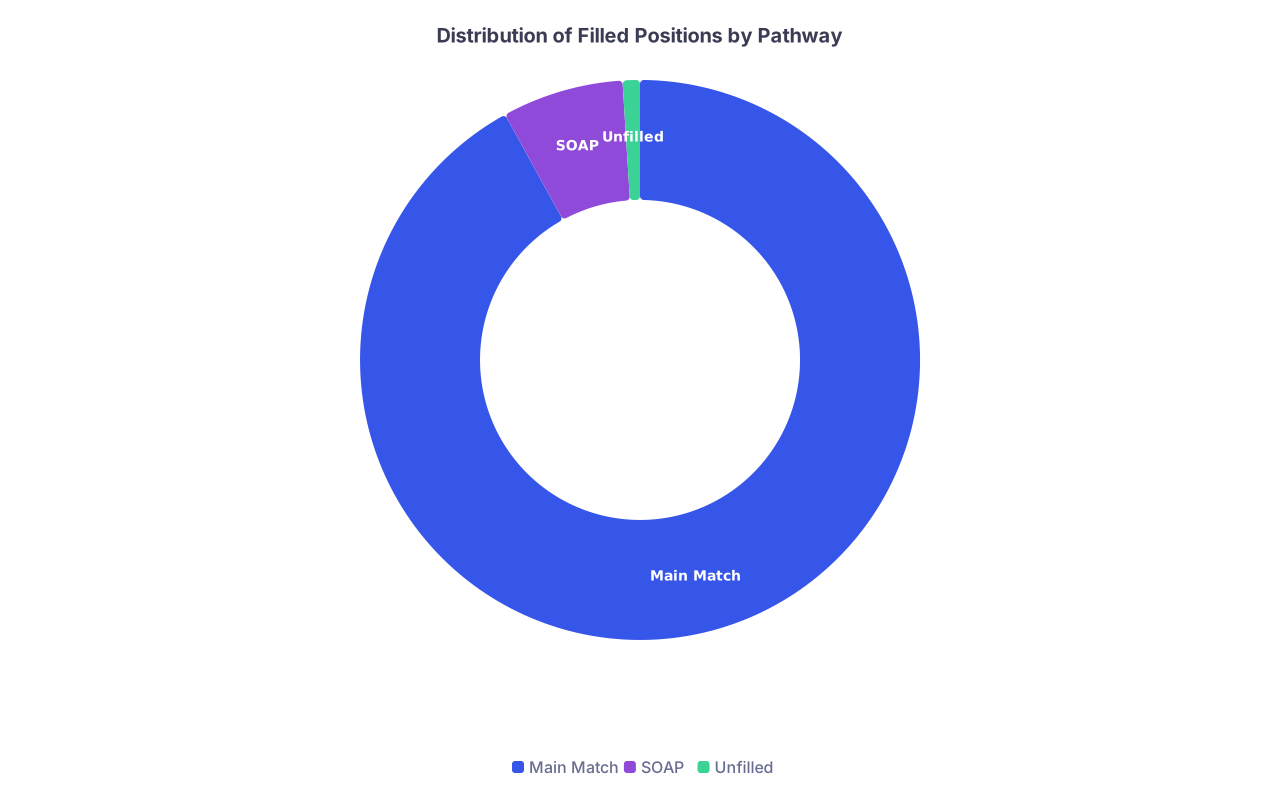
| Category | Value |
|---|---|
| Main Match | 92 |
| SOAP | 7 |
| Unfilled | 1 |
The rough U.S. trend in many recent cycles: the vast majority match in the main process, a non-trivial minority fill through SOAP, and a small fraction end up truly unmatched. But in the ABIM or ABFM board pass rate tables, no one’s labeling “SOAP grads” vs “main match grads.” Because by that point, it doesn’t matter operationally.
Myth: “SOAP Means You’ll Be a Worse Doctor”
Let me be blunt: how you enter residency is a terrible proxy for how you finish it.
I’ve seen:
- SOAPed prelim IM interns become absolute monsters (in the good way) on the wards, then land categorical spots at big-name programs one year later.
- Monday-matched categorical residents get put on remediation for professionalism, almost lose their contracts, or quietly leave medicine altogether.
Residency performance is driven by things like work ethic, teachability, resilience, and not being a jerk at 3 a.m. when the ED calls for the fifth time about chest pain. SOAP has nothing to do with those.
The better question is: does SOAP push people into programs or specialties where they’re mismatched, leading to higher burnout and attrition?
Sometimes, yes. That’s the real risk. Not “you’re a SOAPer so you’re doomed,” but “you panicked, grabbed a spot you never wanted, and now you hate your life.”
But if you SOAP into a specialty you can accept, at a program that actually trains, and then you show up and work—there is no evidence you are destined to be a second-rate clinician.
Board pass data backs this up. Board pass rates are driven by:
- Program-level teaching and exam prep culture
- Resident study habits
- Underlying test-taking ability and baseline knowledge
They are not stratified by “how you got your contract.” PDs who’ve been around will tell you the same thing: after roughly the first 3–6 months, nobody remembers who came in via SOAP except maybe the program coordinator.
Career Trajectories: Academic, Community, Fellowship
Here’s where people really start spiraling: “If I SOAP, I’ll never get a fellowship / an academic job / a competitive attending position.”
Let’s separate fear from evidence.
Fellowship Prospects
Fellowship directors do not sit around sorting “SOAP vs non-SOAP” columns. They care about:
- Reputation of your residency program
- LORs from people they trust
- Your in-training exam scores and research output (for competitive subspecialties)
- How you present on paper and in person
Does a SOAP-into-community-IM-then-apply-GI pathway look different from a match-into-MGH-IM-then-GI? Obviously. But that’s about institution, pedigree, and your CV—not the SOAP mechanism itself.
I’ve seen SOAPed IM residents match into cardiology, GI, pulm/crit from solid mid-tier programs because they:
- Crushed their in-training exams
- Published or did meaningful QI/research
- Had attendings willing to call fellowship PDs and say, “Take this person”
SOAP might make your starting point less ideal. It does not cap your ceiling.
Academic vs Community Careers
Another misconception: “If you SOAP, you’re locked out of academia.”
Reality: academic medicine is already a small slice of the physician workforce. Most graduates—SOAP or not—end up in community practice or hospital-employed roles.
When you look at who ends up on faculty, patterns you actually see:
- Heavy clustering from big academic residencies (because they’re locally recruited)
- People who did fellowships at academic centers
- Residents who stayed as “chief then junior faculty” at the same place
Once again: the SOAP label mostly disappears after PGY‑1. The address on your residency diploma and the strength of your mentors matter a lot more.

Income and Job Quality
If you really want to be cynical, zoom out to what determines income:
- Specialty
- Geography
- Practice setting and ownership
- Negotiation skills
SOAP doesn’t appear anywhere on that list.
A SOAPed FM resident in a high-demand rural area is going to out-earn plenty of ivory-tower academic subspecialists in expensive coastal cities. A SOAPed EM graduate in a brutally staffed group can burn out ten times faster than a main-matched pediatrician with sane call.
Your long-term career satisfaction is going to ride on the usual suspects: schedule, team culture, support staff, leadership, and whether you chose (or grew into) a specialty that fits your personality. Not on whether your Match Monday email said “Congratulations” or “You are unmatched.”
Where SOAP Can Hurt You (If You’re Not Careful)
Now let’s be honest about the downsides. There are real ways SOAP can set you up for a harder road—if you go in blind.
1. Rushed, Poor-Fit Specialty Choice
The pressure cooker of SOAP week pushes people into bad decisions. I’ve watched students who were lukewarm on primary care suddenly accept categorical FM spots in places they’d never even heard of 24 hours prior, purely out of panic.
Years later, some of those people are fine and happy. Others are stuck in a specialty they never liked, too deep and too tired to pivot.
The damage here is not the SOAP. It’s the mismatch. That mismatch can absolutely increase burnout, depression, and mid-career dissatisfaction.

| Step | Description |
|---|---|
| Step 1 | Unmatched Email |
| Step 2 | SOAP Participation |
| Step 3 | Apply Broadly To Any Open Spots |
| Step 4 | Target Acceptable Specialties Programs |
| Step 5 | Higher Risk Poor Fit |
| Step 6 | Better Long Term Fit |
| Step 7 | Panic Driven? |
2. Weak or Malignant Programs
Here’s the ugly truth: SOAP slots disproportionately live in programs with issues. Not always. But often enough that you need your eyes open.
Common patterns among perpetual SOAP-heavy programs:
- Chronic understaffing and service load
- Poor reputation in the region
- High attrition or probationary ACGME status
- Weak fellowship pipelines
End up at one of these without realizing it, and yes—your training, board pass likelihood, and next-step prospects can suffer.
This is where strategy matters. During SOAP, you have less time, but you still have a phone and a brain. You can:
- Check ACGME and board pass data
- Call current residents (not just the ones they hand-pick)
- Scan for patterns: constant open positions, frequent leadership churn, or horror stories from multiple independent sources
If you treat SOAP like eBay at 3 a.m.—clicking “buy now” on the first thing that isn’t obviously trash—you increase your odds of a career headache.
3. Internalized Stigma and Self-Sabotage
This one’s more common than people admit.
I’ve seen SOAP residents come in convinced they’re “less than.” They apologize for existing on day one. They over-explain their match story on rounds. They assume every bit of feedback proves they never should’ve been here.
You carry that for three years, and it will blunt your growth. Not because the label matters, but because you’re letting it run your internal narrative.
The PDs who are actually good at this will sit these folks down early and say: “You’re here now. You matched. I don’t care how the paperwork got done. Prove yourself from this point forward.”
If your program doesn’t send that message and instead treats SOAPers as second-class citizens, that’s a red flag about the program, not about you.
What the Numbers Suggest About Long-Term Outcomes
We do not have randomized trials of “SOAP vs non-SOAP career success,” but we have adjacent data that points in one direction.
Look at:
- Board certification rates by specialty
- Overall physician workforce surveys on burnout, income, and satisfaction
- Specialty switching rates and attrition
None of these break out by SOAP status. Why? Because structurally, once you’re in an ACGME-accredited program, you’re just another trainee. The credentialing bodies don’t care how frenzied your Match Week was.
Residency outcomes correlate with:
- Specialty competitiveness and baseline applicant quality
- Program resources and culture
- Your own performance, habits, and choices
SOAP correlates with being in a weaker initial position, but it is not determinative.
Think of SOAP more like starting a marathon from the second corral instead of the front line. You’re slightly back. It’s a bit more crowded. But if you’re fit, focused, and you run your race, you still cross the same finish line.
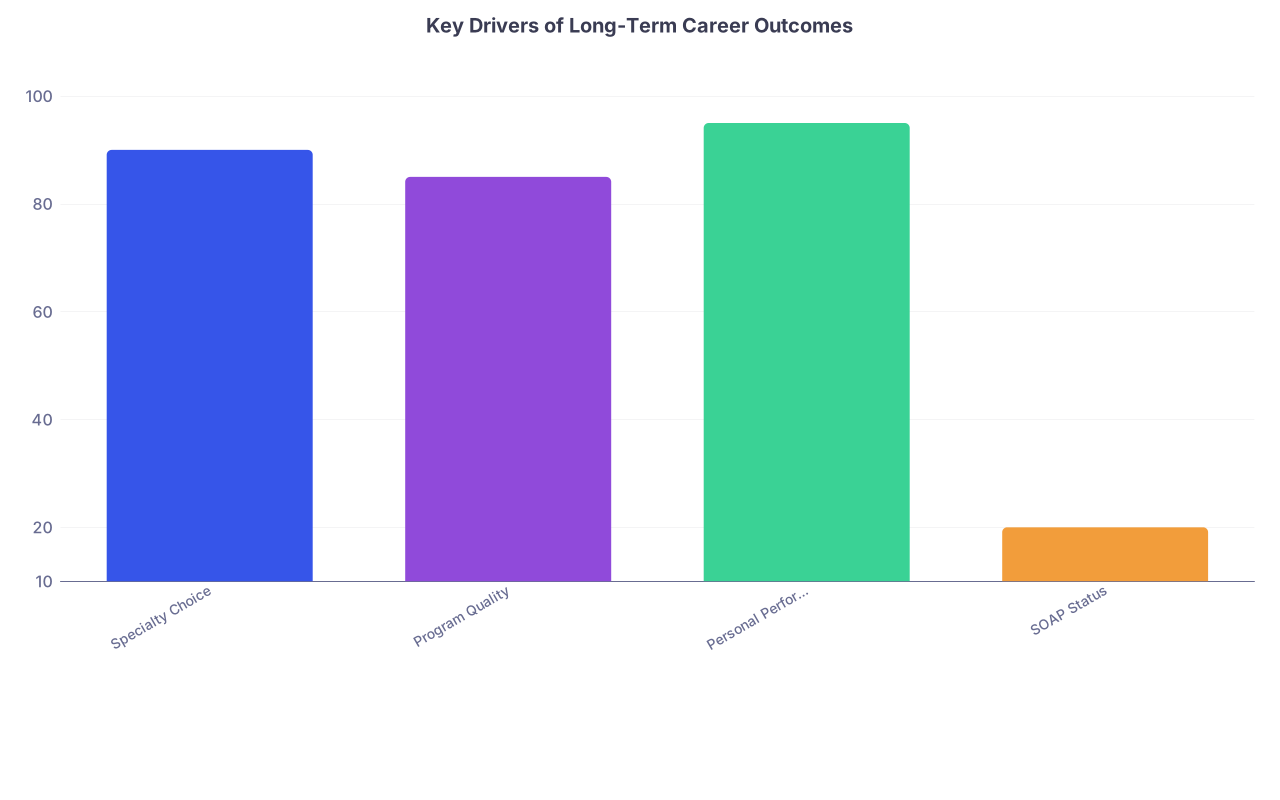
| Category | Value |
|---|---|
| Specialty Choice | 90 |
| Program Quality | 85 |
| Personal Performance | 95 |
| SOAP Status | 20 |
That chart is conceptual, not literal percentages, but it reflects reality: SOAP status is a weak predictor at best compared with the big three.
Strategic SOAP: How To Prevent Real Damage
Since this is “Best Strategies for SOAP,” let’s talk tactics—not fluff.
Your goal during SOAP is not “any job.” It’s “the least-regrettable path that keeps doors open.”
That usually means:
- Prioritizing categorical positions in specialties you can actually tolerate, rather than panic-prelim in something you hate with no clear upgrade path.
- Favoring programs with documented stability over brand-name illusions. A mid-tier, well-run community IM program that trains solid hospitalists beats a chaotic “university-affiliated” line on paper.
- Thinking one step ahead. If you might want fellowship, pick environments where prior grads have successfully placed into something, even if not your dream specialty.
| Scenario | Likely Long-Term Impact |
|---|---|
| SOAP into solid categorical IM at mid-tier community program | Normal career trajectory, hospitalist or generalist, fellowship possible with hustle |
| SOAP into malignant program with high attrition | Higher burnout, risk of non-completion or weak training, harder next steps |
| SOAP into acceptable FM program in desired region | Stable career, strong job market, good lifestyle options |
| SOAP panic into prelim in unwanted specialty with no plan | One-year limbo, more reapplication pain, higher risk of exit |

If you’re in SOAP right now, the strategic questions are:
- “Can I see myself doing this specialty for real, not just surviving residency?”
- “Does this program actually graduate people into normal jobs or fellowships?”
- “Am I choosing this from a place of thought or pure terror?”
The less your answer is “terror,” the better your long-term odds.
How Programs Actually Remember You
Here’s a reality check that surprises students: by the end of PGY‑1, most faculty couldn’t tell you who SOAPed unless they sit on the recruitment committee. They can tell you:
- Who they trust on night float
- Who writes clean notes and decent orders
- Who they want on their team when things are on fire in the unit
Careers are built on those impressions, not your ERAS status on Match Monday.
By the time you’re asking for fellowship letters or job references, the question isn’t “Were you a SOAP applicant?” It’s “Would I want this person as my colleague?” If the answer is yes, the rest is noise.

The Bottom Line
Let me cut through it.
SOAP does not inherently doom you to a worse career. The specialty you end up in, the program you train at, and your performance once you get there matter exponentially more than the fact that your position came through SOAP.
The real danger is not the label “SOAP”; it’s panic-driven choices into bad-fit specialties or dysfunctional programs. That’s what ruins careers, increases burnout, and closes doors—not the act of SOAPing itself.
If you use SOAP strategically, pick a tolerable specialty, land at a stable program, and then do the work, your long-term outcomes will look indistinguishable from thousands of colleagues who matched on Monday and then coasted.
The myth is that SOAP applicants have worse careers.
The reality is that SOAP applicants have more fragile starting conditions. What you do next is what decides the rest.