
What if the residency you end up loving comes from a process everyone told you was “for failures”?
That is exactly what happens every single year with SOAP.
SOAP (Supplemental Offer and Acceptance Program) has picked up a disgusting amount of stigma. Students whisper about it like it’s academic exile. Advisors still say things like, “Do everything you can so you don’t end up in SOAP,” as if SOAP itself is the problem rather than whatever got you there.
Let’s dismantle that.
The belief that a SOAP position is “lower tier” or permanently marks you as second-rate is not just wrong. It is mathematically, structurally, and clinically wrong. The data says so. The way GME hiring works says so. And what actually happens to residents and attendings after SOAP absolutely says so.
You want best strategies for SOAP? You will not execute them properly if in the back of your mind you believe, “This is shameful. This is my last resort.” People who think like that freeze, under-apply, and sabotage themselves.
So I’m going to do two things:
- Tear apart the myths and show you what actually happens to SOAP residents long term.
- Walk through how to approach SOAP strategically so you do not play small when it matters most.
Myth #1: “SOAP programs are inherently worse than Match programs”
Let’s start with the sacred cow: “If it’s going through SOAP, it must be a bottom-of-the-barrel program.”
No. That’s not how the system works.
Programs end up in SOAP for several reasons, and “trash program” is far from the main one. Here are the actual, boring, data-driven reasons slots go unfilled:
- Miscalculated rank list (too few applicants ranked, too top-heavy)
- Overestimation of program attractiveness in a competitive specialty
- Institutional expansion adding new positions late
- Funding changes or new residency accreditation creating brand-new programs
- Geographic undesirability, but solid training (classic: great community program in a less popular region)
- Visa issues or specific applicant pool filters backfiring
I’ve seen internal medicine programs at well-respected community hospitals in the Northeast miss their expected fill rate by a couple of spots because they got cocky with their rank list. Nothing about the program changed. They did not suddenly become “worse.” They just miscalculated.
Here is what the macro-level data looks like.
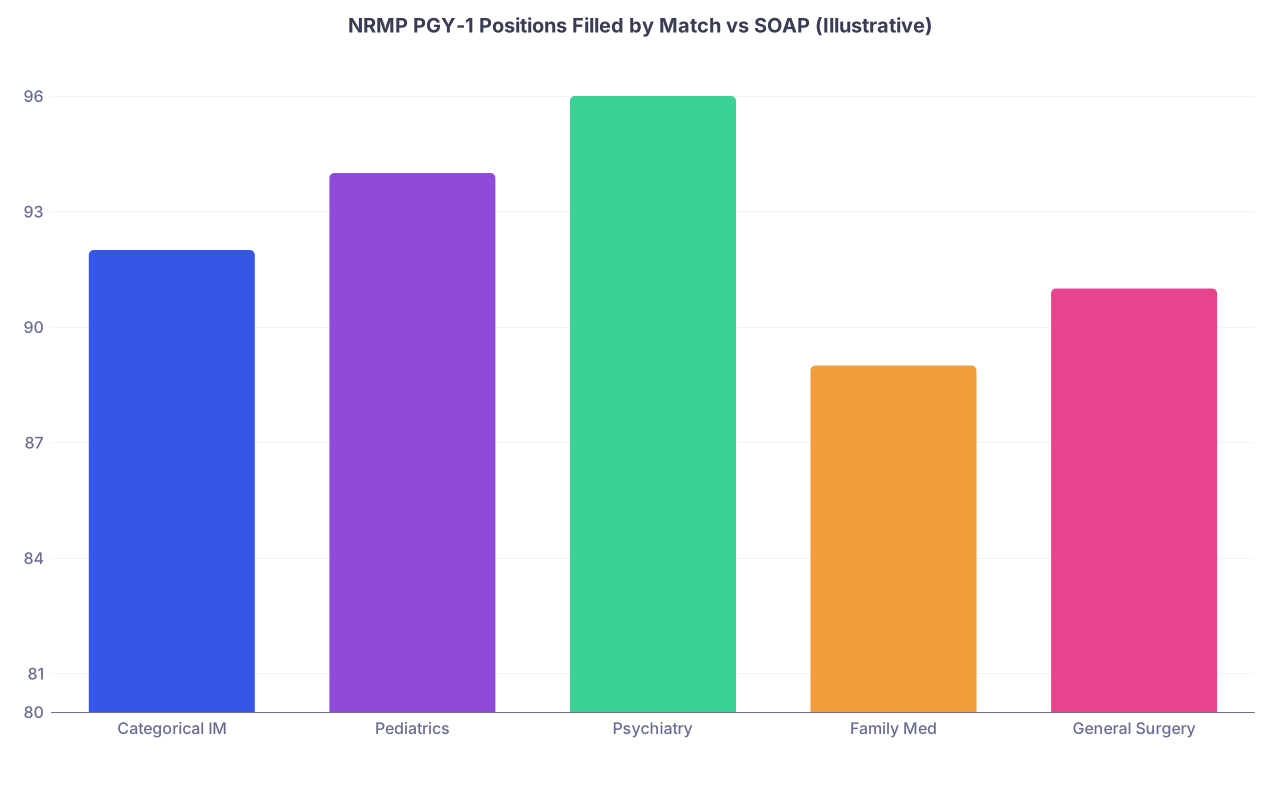
| Category | Value |
|---|---|
| Categorical IM | 92 |
| Pediatrics | 94 |
| Psychiatry | 96 |
| Family Med | 89 |
| General Surgery | 91 |
Interpretation: In many core specialties, the vast majority of positions fill in the main Match. The remaining fraction go through SOAP. Those SOAP positions are not a fundamentally different species of training. They are the same ACGME-accredited slots, under the same institutional oversight, with the same board requirements.
The idea that “Match slots are real; SOAP slots are bargain bin” ignores one core truth:
Your ACGME accreditation and board eligibility do not care whether that position filled on Monday of Match Week or through SOAP on Thursday.
Program directors care about:
- ACGME accreditation status
- Case volume and patient mix
- Faculty quality
- Graduates’ board pass rates and fellowship/placement outcomes
They do not care what day the contract was signed.
Do some marginal programs hide in SOAP? Yes. They also hide in the main Match. Junk is not exclusive to SOAP. The difference is that in SOAP, students suddenly become hyper-judgmental while under time pressure, and they conflate “SOAP” with “sketchy,” instead of judging programs on real metrics.
If you want a simple mental reframe: SOAP is not a different universe of programs. It is the same universe, just the subset of chairs and PDs who missed their target and still need doctors.
Myth #2: “Being a SOAP resident marks you forever”
Here’s the paranoia: “If I SOAP into residency, every fellowship director and every employer will know and judge me.”
Reality: once you’re a resident, your label is your specialty and your program. Not your entry route.
I’ve sat in meetings where PDs review fellowship applications. You know what the spreadsheet has?
- Medical school
- Residency program
- USMLE/COMLEX scores
- Research, publications
- Letters of recommendation
- Class rank or AOA (sometimes)
You know what is never a field on that sheet?
“Matched via SOAP? Y/N”
That information is not even systematically captured in a way that’s usable down the line. There is no standardized “SOAP marker” that follows you through ERAS for fellowship or onto a job credentialing form later. If anyone knows, it is because you told them or they happened to remember that specific year’s Match chaos. Which most people do not.
What they actually remember:
- Did this resident show up ready to work?
- Did they pass Step 3 and boards?
- Did they take ownership on the wards?
- Were they clinically strong and not a professionalism problem?
That’s it.
SOAP is a chapter heading, not your book title. Graduates of SOAP-filled positions:
- Match into cardiology, GI, pulmonary/critical care, sports medicine, etc.
- Get chief resident positions.
- Are hired by major hospital systems and academic centers.
- Open private practices and no patient on earth knows or cares how they matched.
If you still do not believe that, ask any attending in a community hospital clinic, “Did you match initially or through SOAP?” Watch how many stare at you like, “Why would I remember that or tell you?”
They moved on. You will too.
Myth #3: “SOAP means you were not good enough for a ‘real’ match”
This one stings the most, so let’s be blunt.
Some very strong applicants end up in SOAP:
- High Step scores but overly narrow specialty choice (e.g., 260s applicant applying plastics only, no backup)
- Couples match pairs aiming for the same hospital and gambling too hard
- International graduates with strong CVs but immigration barriers
- Applicants whose red flag surfaced late (fail, leave of absence, professionalism issue) causing programs to drop them in February
Does SOAP also contain applicants who objectively had weaker applications? Sure. But the conclusion “You weren’t good enough” is too simple and, frankly, childish. The Match is not a pure meritocracy. It’s a market with distortion:
- Geography games: Some people refuse to leave a certain region for family reasons.
- Program risk aversion: PDs may over-weight one exam failure and ignore a clear upward trend.
- Over-specialization: People apply to only derm or ortho with no backup, then act baffled when the math does exactly what the math always does.
SOAP is where all those variables get rebalanced under time constraints.
The real dividing line is not “those good enough for the main Match” and “SOAP leftovers.” The line that matters is:
Did you secure an accredited position where you can become board-eligible in something you can tolerate—or even learn to love?
If yes, you’re in the game. From there, what you do as a resident matters 100 times more than the route you took to get there.
Reality Check: How SOAP Positions Compare
Let’s put some structure on this. Here’s how SOAP vs main Match positions actually differ in ways that matter.
| Factor | Main Match Slot | SOAP Slot |
|---|---|---|
| Accreditation | ACGME required | ACGME required |
| Board Eligibility | Yes | Yes |
| Contract Type | Same institutional GME contract | Same institutional GME contract |
| Pay/Benefits | Same within institution | Same within institution |
| Fellowship Eligibility | Yes | Yes |
If you line up two interns on July 1 in identical programs—one who matched on Monday, one who SOAPed on Thursday—nobody outside the GME office can tell who is who. They have the same badge, same EMR login, same sign-out list.
SOAP is not a lesser degree. It is just a different on-ramp.
The Hidden Advantage of SOAP (Yes, There Is One)
Here’s something almost nobody says: if you handle SOAP correctly, it can save your career trajectory.
I’ve seen two versions of the same applicant:
Version A: Goes unmatched, refuses to SOAP because of “stigma,” spends a year doing a random research fellowship, re-applies, still does not get their dream specialty, ends up in a backup specialty anyway, now one year older, with more anxiety and financial strain.
Version B: Swallows pride, SOAPs into a solid internal medicine or pediatrics program, crushes residency, gets strong letters, and three years later matches into a competitive fellowship they actually enjoy.
One of these people used SOAP as a launchpad. The other treated it like a poison and paid the price.
Is SOAP always the right answer? No. If literally the only options you have are clinically unsafe or catastrophically wrong for your life, you do not sign a binding contract out of panic. But most years, there are plenty of reasonable programs in core specialties. And those programs produce strong attendings who do just fine.
Best Strategies for SOAP: How to Play This Like an Adult
If you are in SOAP or planning for the possibility, here is how to approach it without self-sabotage.
1. Drop the ego in the first 10 minutes
The biggest SOAP killer is pride disguised as “thoughtful decision-making.”
I’ve watched smart students say, “I’ll only SOAP into categorical positions in my original specialty” and then end Match Week with nothing. Meanwhile, their peer with similar stats took a categorical IM or FM slot at a mid-tier program and is now an attending while they are still trying to recover.
During SOAP, your question is not “Is this my dream?” It is:
“Is this an ACGME-accredited program that:
- Will train me safely,
- Give me board eligibility,
- And keep future doors reasonably open?”
If yes, it goes on your list.

| Step | Description |
|---|---|
| Step 1 | Unmatched on Monday |
| Step 2 | Apply broadly to those |
| Step 3 | Apply, plan long game |
| Step 4 | Consider gap year with structured plan |
| Step 5 | Any categorical ACGME programs you could tolerate? |
| Step 6 | Any prelim/transitional year that keeps you clinically active? |
Notice the word “tolerate.” Not “soulmate.” You are choosing a training pathway, not a spouse.
2. Apply wider than your emotions want
In SOAP, over-selectivity is a form of self-harm.
You should be applying to far more programs than feels “comfortable” initially—within the realm of realistic tolerance. If you can reasonably see yourself doing IM, FM, psych, peds, or prelim year, you apply to them. You do not sit there filing and re-filing the same five ultra-specific applications.
This is not about desperation. It is about respecting the math under time pressure.
3. Evaluate programs on reality, not fear
Here’s what to actually look at when assessing a SOAP program:
- ACGME accreditation status (look it up; if there’s probation or warning, investigate why)
- Board pass rates of graduates (for some specialties, this is public; ask current residents)
- Hospital type and case mix (single small site vs multi-site system; volume matters)
- Resident workload and culture (ask bluntly in any contact you have)
Ignore internet gossip from years ago that may no longer be relevant. Ignore one disgruntled anonymous review. I would rather be at a high-volume community program with solid teaching and okay vibes than at a “name brand” program that cannot keep residents and is hemorrhaging faculty.

4. Use SOAP as a strategic pivot, not a surrender
Sometimes SOAP is where you pivot specialties intelligently.
Example I’ve seen multiple times:
- Applicant does not match in general surgery.
- SOAPs into a solid preliminary surgery year or a categorical internal medicine spot.
- During residency, builds a strong CV, gets letters, and either:
- Re-enters a surgical field via PGY-2 transfer, or
- Discovers they actually like critical care, cardiology, hospital medicine, etc., and never looks back.
The key is to choose a SOAP option that:
- Keeps you clinically active,
- Minimizes dead ends (board eligibility matters),
- Leaves at least one exit route you can live with (fellowship, hospitalist work, primary care, etc.).
You are not “giving up on your dream.” You are choosing to stay in the arena rather than sitting in the stands for a year hoping the rules change.
The Mental Game: Shame Will Make You Stupider If You Let It
I’ve watched SOAP crush people not because they lacked options but because shame hijacked their decision-making.
Signs stigma is running you instead of data:
- You avoid asking mentors for help because you “don’t want them to know.”
- You refuse to apply to perfectly good programs because “my classmates will see where I ended up.”
- You consider going unmatched over signing a contract that would objectively move your career forward, because it feels like “settling.”
This is backwards.
Your classmates will forget your Match story faster than you think. You know who will remember whether you’re employed, board-certified, and not crushed by debt in 10 years? You.
Use SOAP as a professional, not as a wounded ego. Ask for honest feedback. Have an advisor or PD help you quickly triage which programs are acceptable. Have someone read your SOAP messages so you do not sound frantic or bitter.
And stop rehearsing your “explanation” story. By PGY-2, nobody is asking. They’re too busy asking, “Can you help me cross-cover these patients?”
What Actually Matters After You SOAP
Once July 1 hits, the hierarchy shifts dramatically. No one cares about your Match Week war story. They care about:
- Are you safe?
- Are you reliable?
- Are you teachable?
- Can you handle feedback without melting down?
- Do you do the work?
I’ve seen SOAP interns become chiefs. I’ve seen “trophy” main-match interns flame out, get put on remediation, or quit medicine entirely.
Residency is a long, grinding equalizer. Your performance there rewrites your narrative more than whatever happened that one chaotic week in March.
Final Thought
Years from now, you will not be replaying SOAP offer timestamps in your head. You will be thinking about the patients you took care of, the colleagues who had your back on brutal nights, and the doors you opened for yourself by staying in the game.
SOAP is not a scarlet letter. It is a second doorway into the same building everyone else is walking into. The question is not whether that door is “lower tier.”
The question is whether you are willing to walk through it with your head up and then prove, day after day, that how you entered mattered far less than what you did once you were inside.