
Program directors are not obsessed with whether you SOAPed. They are obsessed with whether you are good.
Let me be blunt: the fear that “If I go through SOAP, I’ll be blacklisted for fellowship” is wildly overblown and often used to scare students into panicked decision‑making. It is also not how most fellowship PDs actually think.
You want the truth? SOAP is a data point. Not a scarlet letter.
Let’s dismantle this myth properly and then talk strategy—how to SOAP in a way that protects, and even strengthens, your long‑term fellowship chances.
What Fellowship PDs Actually Care About
You hear a lot of hallway folklore:
- “Once SOAP, always SOAP.”
- “Top fellowships don’t take SOAP residents.”
- “They’ll assume you were a bad applicant.”
None of this survives contact with how real selection works.
Fellowship PDs, in practice, rank applicants based on a few dominant buckets:
- How strong you are now as a resident
- Your letters of recommendation (especially from known faculty)
- Your clinical performance and reputation
- Your scholarly output (research, QI, presentations) relative to their field
- Board exams (Step 2 / Level 2, in‑training, boards)
- Fit with their program’s needs and culture
Where you matched for residency matters some. How you matched (main match vs SOAP) is usually:
- Unknown
- Unclear
- Or frankly, irrelevant unless there is a concerning pattern
And that’s the key: patterns, not isolated events.
Does SOAP Show Up on Applications?
Here’s where people are just wrong on the facts.
There is no “SOAP” checkbox on ERAS fellowship applications. Your fellowship PD does not get an automatic pop‑up: “Warning: This applicant SOAPed.”
What they do see:
- Your medical school
- Your residency program and dates
- Any gaps in training
- Sometimes: whether your residency is categorical vs prelim vs transitional
- Your CV narrative
What they don’t get as a routine data field:
- “Matched via SOAP”
- “Unmatched in main NRMP match”
Could they infer it in certain situations? Yes, sometimes:
- You’re at a less common or smaller program that mostly fills in SOAP
- Your residency start date is slightly delayed or nonstandard
- There’s a visible gap between graduation and residency start
- Your narrative or MSPE hints at it
But that’s inference, not a system flag. And it usually only matters if the rest of your application is borderline.
What the Data and Behavior Actually Show
We do not have a tidy NRMP table that says “SOAP vs No SOAP and fellowship match rate.” But we do have:
- NRMP fellowship match data by residency program type and background
- Tons of real‑world examples of SOAP residents matching competitive fellowships
- Plain observation of PD behavior
Most big IM, peds, surgery, EM, and anesthesia programs that fill partly through SOAP still send graduates to strong fellowships every year. Many of those fellowship classes absolutely include residents who SOAPed.
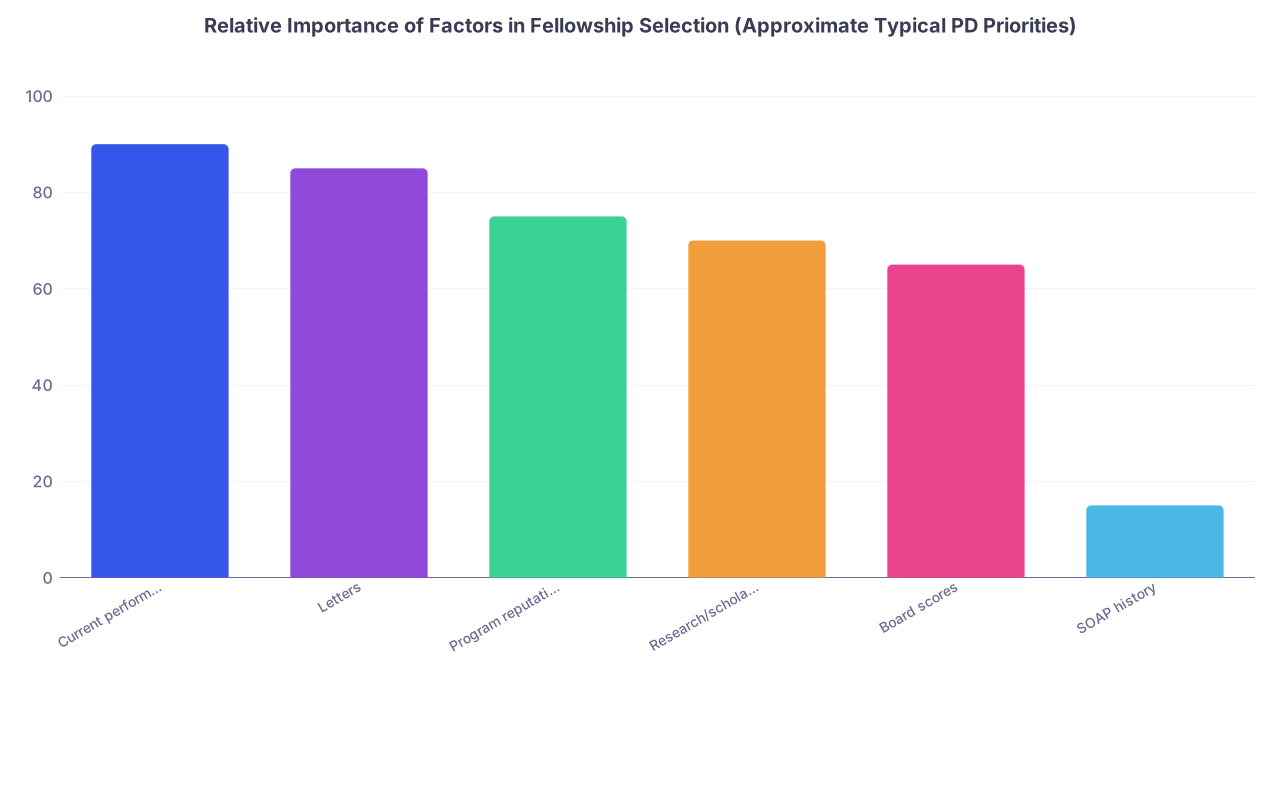
| Category | Value |
|---|---|
| Current performance | 90 |
| Letters | 85 |
| Program reputation | 75 |
| Research/scholarship | 70 |
| Board scores | 65 |
| SOAP history | 15 |
Is this exact? No. But it matches what you hear when you sit in those selection meetings: intense debates about letters and fit, barely any time on “how did they enter residency three years ago.”
Fellowship PDs care about:
- Your trajectory
- Your current competence
- Whether their trusted colleagues say, “You want this person in your program.”
SOAP status doesn’t automatically tank any of that.
When SOAP Can Hurt You Later (And When It Doesn’t)
SOAP by itself is not the problem. The reasons you SOAPed, and what you did afterward, are what matter.
Let’s slice it:
Scenario 1: Strong applicant, bad strategy, over‑reach → SOAP
- Applied too narrow
- Aimed only at hyper‑competitive programs or locations
- Ignored safety programs
- Still graduated on time, good evaluations, solid Step 2
These applicants SOAP into reasonable programs all the time.
Does this hurt fellowship chances? Minimally, if at all.
By fellowship time, what people see:
- Resident at a solid (maybe mid‑tier) program
- Great letters, research, strong in‑training exams
- No performance issues
If anyone even suspects they SOAPed, it’s chalked up to “over‑reached as an M4” and forgotten. I’ve watched these folks match cardiology, GI, heme/onc, PCCM, competitive subspecialties. Repeatedly.
Scenario 2: SOAP due to serious underlying concerns
Examples:
- Failed multiple exams
- Significant professionalism issues
- Pattern of marginal performance
- Needed an extra year to graduate
- Weak letters from multiple faculty
Here, SOAP is a symptom, not the disease. The real problem is the underlying pattern, which does follow you:
- Your MSPE may hint at concerns
- Your residency performance may remain shaky
- You may accumulate mediocre or cautious letters
- You may struggle with in‑training and board exams
Fellowship PDs are wary of that pattern. Not the word “SOAP.”
Scenario 3: SOAP into a poor‑fit or unstable program
Sometimes you SOAP into:
- A program with toxic culture
- Very limited mentorship or research
- Constant leadership turnover
- Weak fellowship placement history
Now you’re at risk, but again, not because of SOAP. Because your current environment makes it hard to build a strong fellowship application.
The fix here is strategic: find mentors, create or join projects, maybe consider a chief year or an extra research year if needed.
How SOAP Actually Affects Fellowship—The Real Mechanisms
Let’s be concrete. SOAP may influence your fellowship trajectory through a few indirect channels:
Program name recognition
Yes, coming from a brand‑name residency helps. SOAPing into a lesser‑known community program can mean fewer automatic looks from ultra‑elite fellowships. But lots of solid academic fellowships recruit from community and mid‑tier programs every year.Available mentorship and research
Some SOAP‑heavy programs have less research infrastructure. That can make it harder (not impossible) to build the usual “fellowship CV”: posters, abstracts, manuscripts.How you psychologically respond
I’ve seen two types of SOAP residents:- Those who spend two years ashamed and avoidant
- Those who decide, “Fine, I’ll out‑work everybody from here forward”
Guess which group matches better.
SOAP is a fork in the road for mindset, not a permanent label on your forehead.
Smart SOAP Strategy If You Want Fellowship Later
If you’re in SOAP week now and you care about future fellowship, here’s the no‑BS playbook.
1. Prioritize training quality over ego
Do not obsess over, “What will they think when they see this program’s name?” Worry about:
- Adequate volume and case mix
- Reasonable supervision and teaching
- A track record (even modest) of graduates going to fellowship
- At least a couple faculty in or adjacent to your desired field
Saying no to a decent academic or hybrid program because it is “below your perceived level” is how people end up unmatched twice. That, unlike SOAP, really does haunt you.
| Feature | High Impact | Low Impact |
|---|---|---|
| Mentors in your interest | ✔️ | |
| Program name only | ✔️ | |
| Research infrastructure | ✔️ | |
| City prestige | ✔️ | |
| Fellowship placement | ✔️ |
2. Choose a field with a realistic long‑term path
In SOAP, some students try to “hold out” for their dream specialty even when:
- Their scores are well below typical
- They have no field‑aligned experiences
- Their application already underperformed badly
Harsh truth: hanging on to an unrealistic specialty in SOAP can be more damaging than pivoting to a realistic one where you can excel, develop a niche, and later subspecialize.
Your fellowship PD cares that you’re excellent at something. Not that you clung to dermatology until the bitter end.
3. Ask explicitly about mentorship and fellowship outcomes
When you talk to SOAP programs (and yes, you should ask questions, even in SOAP), ask:
- “Do graduates from this program commonly pursue fellowship?”
- “Are there faculty in [your interest] who mentor residents?”
- “Have any residents presented at national conferences recently?”
You’re not bargaining like in the main match, but you are choosing among offers. Silent desperation is how you end up at a place that boxes you in.
How To Talk About SOAP Later (On Fellowship Interviews)
If it comes up—and sometimes it will—you need a clean, non‑defensive answer ready.
Core principles:
- Own it
- Frame it as a past mismatch, not a personal defect
- Pivot fast to your trajectory since then
A few examples.
If you over‑reached:
“As a fourth‑year, I applied very narrowly to a small set of highly competitive programs in specific cities for personal reasons. When that didn’t work out, I SOAPed into my current program, which has actually been a great fit. Since starting residency, I’ve focused on building my clinical foundation, taken on research in [X], and that ultimately clarified my interest in [fellowship field].”
If you had academic struggles but recovered:
“I struggled early in medical school and that made my initial application less competitive, so I entered residency through SOAP. Since then, I addressed those gaps—passed all in‑training exams comfortably, took on extra call when needed, and earned strong evaluations. My recent performance is a much better reflection of me than my M4 application.”
Notice what you’re doing there:
- No oversharing
- No groveling
- Just: brief context → strong arc → present competence
Most PDs will mentally file it under “ancient history” and move on.
What Hurts You More Than SOAP
There are things that will damage your fellowship application much more than having SOAPed:
- Lukewarm or bland letters from your own faculty
- Documented professionalism issues during residency
- Failing your boards or in‑training repeatedly
- No demonstrated interest in the field you’re applying to
- A non‑coherent application story (e.g., sudden random switch to a subspecialty you’ve never touched)
You know what PDs whisper about in ranking meetings? “I’m not convinced this person is reliable.” Or “I don’t see any evidence they really care about this field.” I have literally never heard, “We should rank them lower because they probably SOAPed.”
Case Reality: SOAP → Strong Fellowship Happens All The Time
You won’t see glossy brochures about this, but behind closed doors:
- The cardiology fellow at a well‑known university who SOAPed into a mid‑tier IM program after over‑reaching geographically
- The GI fellow from a smaller community IM program that fills partly through SOAP—but he had three first‑author abstracts and a killer letter from his PD
- The heme/onc fellow who was very open: “I SOAPed because my Step 1 was terrible and I applied too top‑heavy.” No one cared once they saw her residency performance and research
These stories are not rare. They’re just not talked about loudly because nobody likes to advertise SOAP.
The Real Myth: “SOAP = Permanent Stigma”
SOAP is not a permanent mark. It is a rough chapter.
What matters for fellowship is:
- Where you land
- What you do once you’re there
- Whether you convert that opportunity into evidence that you belong in the subspecialty you are chasing
Fellowship PDs select on present value and projected future, not your fourth‑year Match Day trauma.
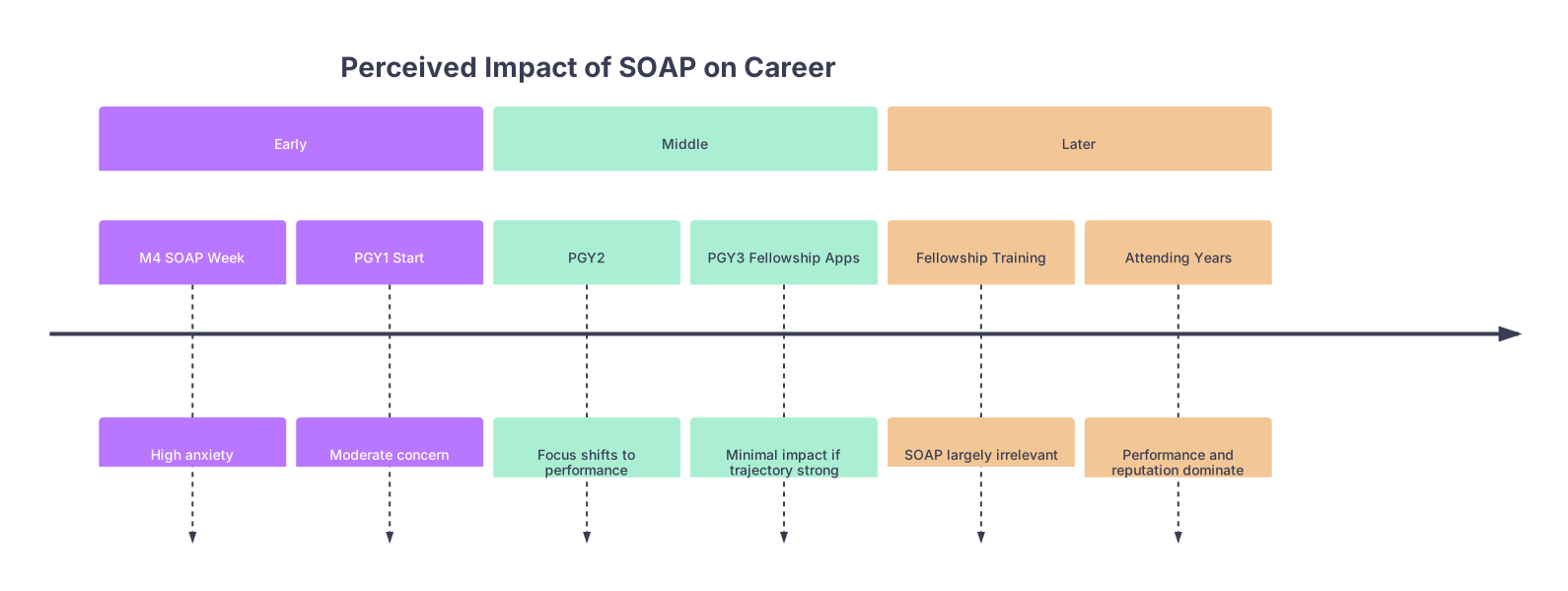
| Period | Event |
|---|---|
| Early - M4 SOAP Week | High anxiety |
| Early - PGY1 Start | Moderate concern |
| Middle - PGY2 | Focus shifts to performance |
| Middle - PGY3 Fellowship Apps | Minimal impact if trajectory strong |
| Later - Fellowship Training | SOAP largely irrelevant |
| Later - Attending Years | Performance and reputation dominate |
FAQ: SOAP and Fellowship Applications
1. Will top‑tier fellowships automatically reject me if I SOAPed?
No. They may be more selective overall, but they aren’t running a SOAP‑filter. If you’re at a strong residency, have great letters, meaningful scholarship, and strong performance, you’ll be in the conversation. SOAP history might be inferred; it is not usually decisive.
2. Do fellowship PDs even know that I SOAPed?
Not from a dedicated field. They infer it occasionally from your program, start dates, or gaps. Even when they suspect it, most treat it as neutral background unless linked to ongoing performance or professionalism problems.
3. Should I explain SOAP in my fellowship personal statement?
Usually no. Unless it’s directly tied to a clear, resolved arc (e.g., academic remediation and then sustained excellence), bringing it up unprompted can anchor attention on old weaknesses. Save any explanation for an interview if asked, and keep it brief and forward‑focused.
4. Is it better to go unmatched than to SOAP into a “lower” program if I want fellowship?
Absolutely not. Going unmatched creates a much steeper uphill battle and often leads to odd gaps and patchwork CVs. SOAPing into a reasonably functional program, then excelling there, is almost always better for your fellowship prospects than trying to re‑apply from zero.
5. What’s the single best thing I can do in residency to overcome a SOAP history?
Crush your current job. That means: be a top‑tier resident on the wards, secure at least one outstanding letter from a respected faculty member in your target field, engage in focused scholarship, and avoid professionalism issues. A strong present reality beats a messy past almost every time.
Key takeaways:
- SOAP is not a permanent stain; it’s a data point that usually fades behind your residency performance.
- Fellowship PDs care far more about your current competence, letters, and trajectory than about how you entered residency.
- The smartest SOAP strategy is to secure a solid training environment and then build such a strong record that no one cares how you got there.