
The usual SOAP advice ignores the numbers. That is a mistake.
If you do not understand historical SOAP trends―positions, specialties, and applicant behavior over the last 5–10 years―you are flying blind in the most high‑stakes 48 hours of your training. The data shows clear patterns: where spots appear, who actually matches, and which “strategies” are statistically suicidal.
I am going to walk through those patterns and translate them into concrete strategy. Not vibes. Not Reddit folklore. Numbers.
1. What SOAP Actually Looks Like in the Data
Forget the narrative of SOAP as a “second match.” Statistically, it is a scramble for a narrow and shifting slice of the market.
To ground this, let us approximate the scale with typical NRMP‑reported patterns from recent cycles (numbers rounded, but directionally accurate):
- Total applicants in Match: ~48,000–50,000
- Unmatched after main Match: ~7,000–8,000
- Positions unfilled going into SOAP: ~2,500–3,000
- Positions filled during SOAP: ~90–95% of those unfilled
- Fully unmatched after SOAP: often >4,000 candidates
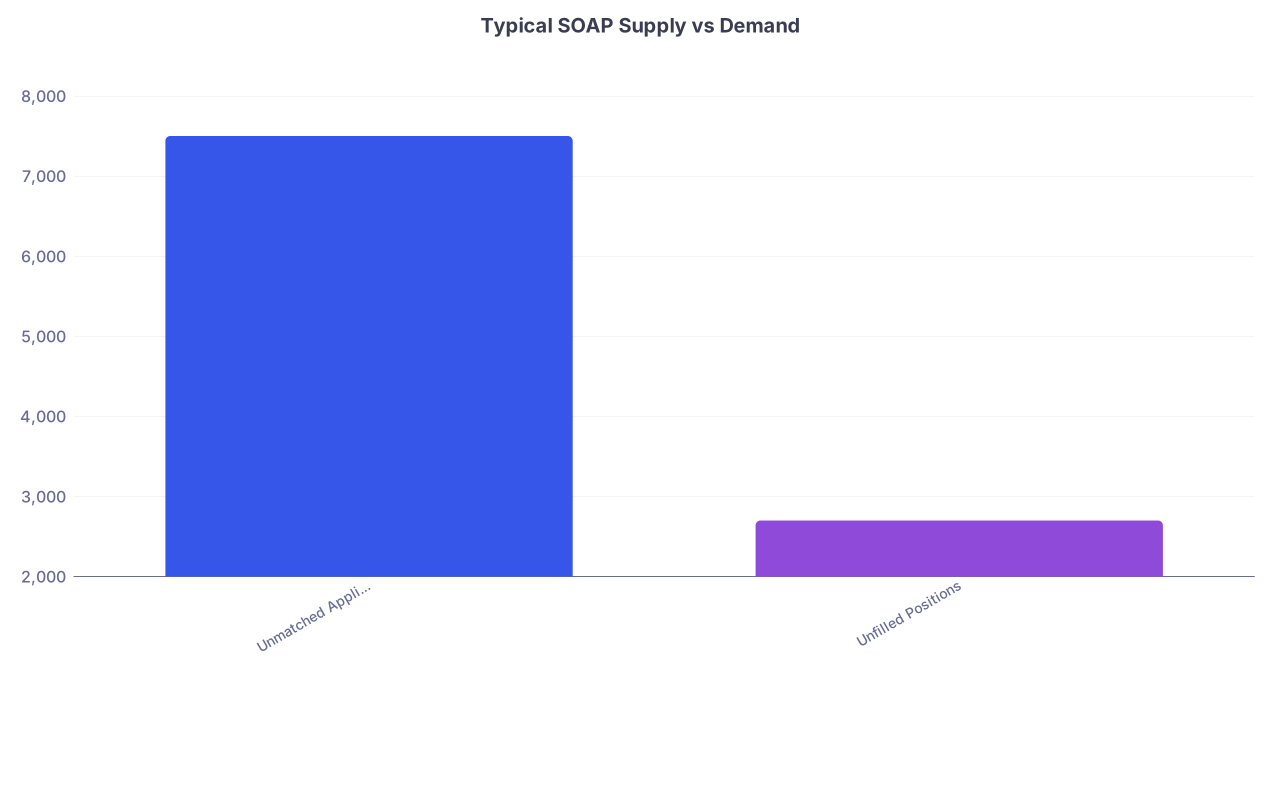
You can see the math problem immediately: far more people need positions than there are SOAP seats. If you are in SOAP, you are in a numerically unfavorable game.
| Category | Value |
|---|---|
| Unmatched Applicants | 7500 |
| Unfilled Positions | 2700 |
That chart is the core reality. Roughly 2.5–3 unmatched applicants per unfilled position. On average. In competitive fields, the ratio is much worse.
Your strategy must be built around that mismatch. Not your dream specialty. Not what your classmate did. The ratio.
2. How SOAP Positions Have Shifted Over Time
The mix of SOAP positions is not static. Programs and specialties have changed how they use SOAP, which changes how you should approach it.
2.1 Specialty composition: primary care dominates
Historically, the overwhelming majority of SOAP slots fall into a few buckets:
- Internal Medicine (categorical and prelim)
- Family Medicine
- Pediatrics (to a lesser extent)
- Transitional Year and Prelim Surgery/Medicine
- Psychiatry (variable by year, but often present)
By contrast, unfilled positions in the following are usually rare and vanish quickly:
- Dermatology
- Orthopedic Surgery
- Neurosurgery
- Ophthalmology
- ENT
- Integrated Plastic Surgery
If you are hoping SOAP will rescue a failed attempt at a highly competitive specialty, the data says that is almost never how it works.
Let us sketch a realistic distribution for illustrative purposes across a recent cycle:
| Category | Share of SOAP Positions |
|---|---|
| Internal Medicine (Cat + Prelim) | ~35–40% |
| Family Medicine | ~20–25% |
| Pediatrics | ~8–12% |
| Psychiatry | ~5–10% |
| Transitional/Prelim (Non‑IM) | ~10–15% |
| All other specialties | ~5–10% |
Even if these percentages move a bit year to year, the discipline tilt is consistent: SOAP is largely a primary‑care and prelim‑heavy market.
2.2 US vs IMG shift
Over the last decade, the Match has tightened. More US seniors match in the main cycle, and more IMGs are left competing in SOAP.
That means two things:
- SOAP is increasingly IMG‑dense.
- US grads who reach SOAP face stronger competition from both US and non‑US IMGs chasing the same IM/FM/Peds/Psych seats.
Anecdotally and in NRMP outcome data, programs use SOAP to:
- Backfill less desirable or newly expanded positions
- Fill in locations with chronic recruitment challenges
- Take late‑breaking opportunities on “good enough” applicants they did not rank
In plain language: SOAP is where programs reduce their risk, not where they gamble on longshots.
3. Historical Outcome Patterns: Who Actually Matches in SOAP?
NRMP data, program reports, and multi‑year trends converge on a few hard truths.
3.1 US MD > US DO > IMGs, but nuance matters
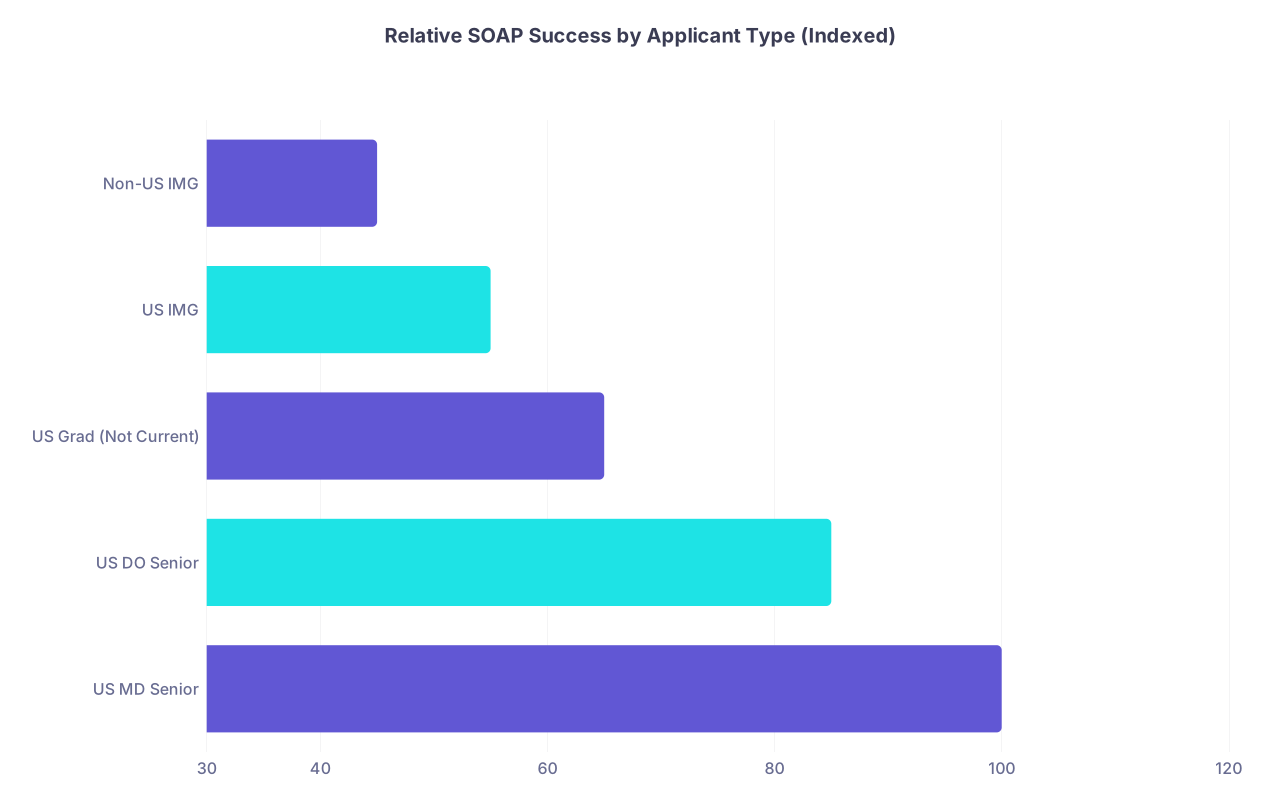
Year after year, match rates in SOAP tend to follow a hierarchy:
- US MD seniors unmatched after main match: highest SOAP success probability
- US DO seniors: slightly lower but still relatively strong
- Previous graduates (US MD/DO) and IMGs: substantially lower
Imagine a simplified view across multiple cycles:
| Category | Value |
|---|---|
| US MD Senior | 100 |
| US DO Senior | 85 |
| US Grad (Not Current) | 65 |
| US IMG | 55 |
| Non-US IMG | 45 |
Interpretation:
- US MD seniors operate as the reference (100).
- DO seniors typically trail but remain competitive.
- Older grads and IMGs face steeper odds and must be more aggressive strategically.
If you are an older grad or IMG, strategies built for current US MD seniors will fail you. The baseline conversion is different.
3.2 Specialty ambition kills SOAP outcomes
I have seen this too many times. Applicant unmatched in General Surgery or Ortho insists on only applying to:
- Prelim Surgery
- Transitional Year in large academic centers
- Maybe a couple of IM prelim “as backup”
Outcome? Frequently unmatched. The data shows:
- Many prelim positions, especially in surgery and TY in big academic centers, are flooded with high‑scoring unmatched surgery/anesthesia/rads applicants.
- Program directors often use these as “holding tanks” for strong surgical candidates, not as second chances for borderline applicants.
By contrast, applicants who pivot in SOAP to:
- Community Internal Medicine
- Community Family Medicine
- Less‑central Psychiatry or Pediatrics
have markedly higher success probabilities, even with weaker applications.
SOAP is not the time to chase prestige. It is the time to chase open FTE lines where your profile is above average for that micro‑market.
4. Timing Patterns: When Positions Disappear
SOAP is not only about what you apply to, but when you recognize reality and move.
The timeline mechanically looks like this (simplified):

| Step | Description |
|---|---|
| Step 1 | Unmatched Notification |
| Step 2 | View Unfilled List |
| Step 3 | Round 1 Applications |
| Step 4 | Program Reviews & Interviews |
| Step 5 | Round 1 Offers |
| Step 6 | Accept or Reject |
| Step 7 | Round 2-4 for Remaining Spots |
Historically, two things recur:
- Many desirable positions are gone after Round 1 offers.
- “Hope” that you will get a Round 2 offer from a competitive program leads people to under‑apply in Round 1.
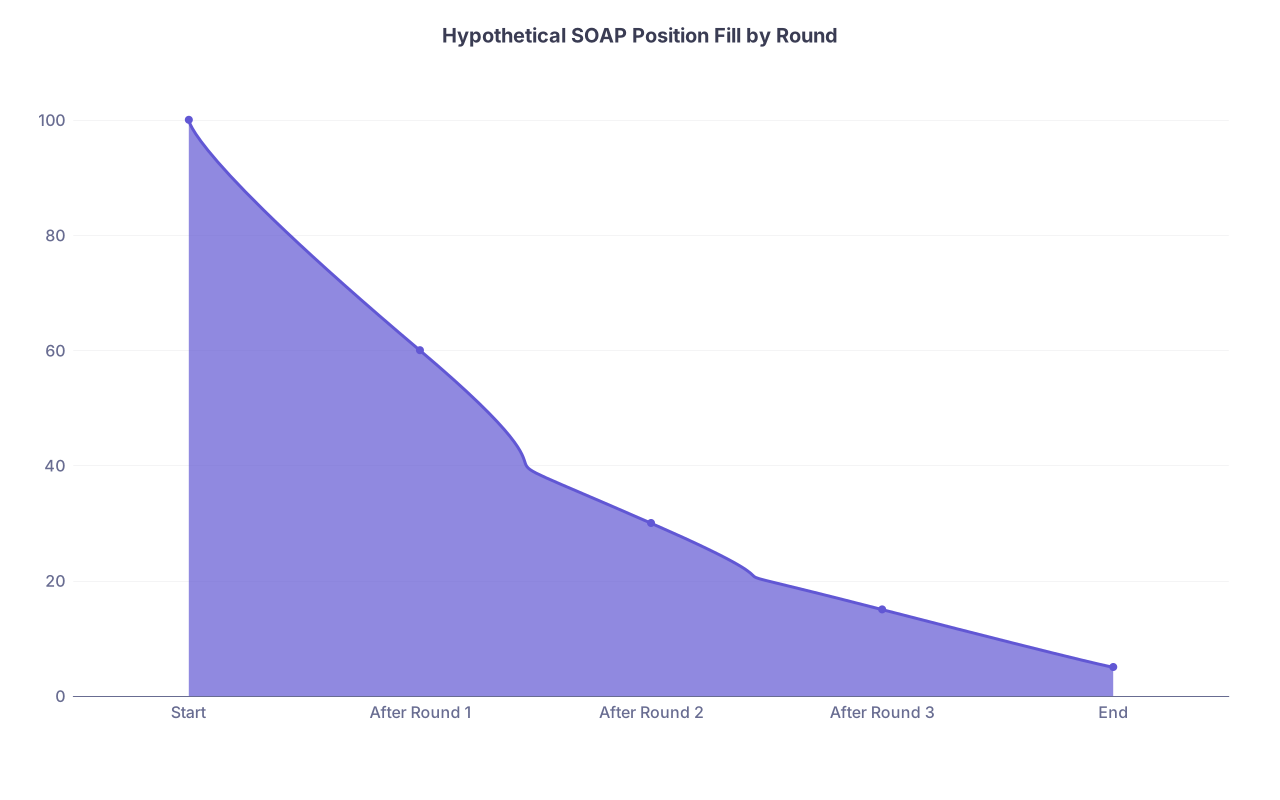
That is a statistical error. Early rounds are where the highest volume and best positions sit. Later rounds are for leftovers and chaotic reshuffling.
Take a hypothetical fill pattern by round for a given year:
| Category | Value |
|---|---|
| Start | 100 |
| After Round 1 | 60 |
| After Round 2 | 30 |
| After Round 3 | 15 |
| End | 5 |
Interpretation:
- 40% filled in Round 1
- Another 30% across Rounds 2 and 3 combined
- The odds get worse with each pass
If you approach Round 1 “conservatively” in hopes of better options later, you are gambling against this curve.
5. Translating Trends into SOAP Strategy
Now the useful part. How these historical and structural patterns should change your actual SOAP plan.
5.1 The 45‑application mindset
You can apply to up to 45 programs total in SOAP. Historically, successful applicants who were unlikely to match in their original specialty maximized or came close to this limit.
The data pattern:
- Applicants using <20 SOAP applications tend to have lower match rates in SOAP, especially if they restrict by geography or prestige.
- Those using >35, focused on realistic specialties and locations, fare better.
The core principle: SOAP is about breadth within realistic lanes. Not precision targeting.
Your application allocation should be skewed as follows (if you are genuinely at risk):
- 60–80% of applications → community IM, FM, Peds, Psych in broadly tolerable locations
- The remaining 20–40% → prelim IM, TY, prelim surgery (if relevant) or slightly more competitive programs where you still have a plausible profile
If that feels “beneath” your original plan, that is exactly the point. You did not match in the main cycle. The data has already given you feedback.
5.2 Geographic preferences vs statistical reality
Another repeated pattern: people cling to location preferences in SOAP and pay for it with a gap year.
Common behaviors that data punishes:
- Applying only within one region (e.g., Northeast)
- Refusing rural or mid‑sized cities
- Avoiding certain states entirely for non‑dealbreaker reasons
Historically, unfilled positions are disproportionately:
- In smaller cities or rural settings
- In regions with weaker applicant demand (Midwest, parts of the South, interior states)
If you mathematically constrain yourself to high‑demand metros during a process defined by scarcity, you are voluntarily compressing your already poor odds.
Strategy built from the data:
Treat anything that is not a true dealbreaker (visa, family care, severe health needs) as negotiable for SOAP. You can try to move for fellowship later. You cannot fellowship your way out of never starting residency.
6. Specialty‑Specific Strategic Adjustments
Different original specialty choices produce different SOAP strategies, and the trends over years give you templates.
6.1 If you went for a competitive specialty (Surgery, Ortho, Derm, etc.)
Historical pattern:
- Many unmatched surgery/anesthesia/rads applicants pivot successfully into Internal Medicine, Family Medicine, and sometimes Psychiatry during SOAP, especially if their board scores are strong.
- Those who fixate on prelim surgery alone have high failure rates.
Strategic translation:
- Allocate the majority of your SOAP applications to categorical IM/FM/Psych, not just prelim positions.
- Target community‑heavy and less‑urban programs where your prior interest in a competitive field is a net positive (“hard‑working, procedure‑oriented”) rather than a red flag.
- Reserve a minority of applications for prelim surgery/TY seats at realistic programs (not the same top‑tier institutions that just passed on you).
6.2 If you missed in primary care (IM/FM/Peds)
This is different. SOAP evidence suggests:
- Applicants who were already targeting IM/FM and still missed often have significant red flags: very low scores, multiple failures, professionalism issues, or very constrained geographic preferences.
- SOAP does offer some additional primary‑care capacity, but competition is intense because everyone else is pivoting into the same specialties.
What works better in this group:
- A brutally honest recalibration of geography. Drop limits completely unless impossible for personal reasons.
- Casting a wide net among all three major primary‑care disciplines (IM, FM, Peds) if at all feasible for you.
- Not obsessing over academic vs community labels. Data suggests community programs fill through SOAP more frequently and may be more flexible.
6.3 If you are an IMG
SOAP outcomes for IMGs, historically, are harsh. Many IMGs who fail to match in the main cycle also fail in SOAP, especially with:
- Extensive gaps since graduation
- Lower Step 2 scores
- Weak or foreign‑only letters of recommendation
Does that mean you should give up on SOAP? No. It means your strategy must be even more data‑aligned:
- Maximize the full 45 applications. There is no rational case for using fewer unless you have an extraordinary constraint.
- Focus almost entirely on programs with a history of taking IMGs in the main match (not only in SOAP). You can usually infer this from current resident rosters.
- Prioritize Internal Medicine and Family Medicine; Pediatrics and Psychiatry are possible but often more selective for IMGs.
7. Using Historical SOAP Lists and Trends Before You Need Them
The smartest SOAP strategies I have seen start months before Match Week.
People often say “you cannot plan SOAP because you do not know which programs will be unfilled.” That is only half‑true. You cannot know specifics, but you can know patterns.
Practical, data‑driven prep:
- Collect unfilled lists from 2–3 prior SOAP years (sometimes shared by advisors, de‑identified, or summarized online).
- For each year, tally by specialty and approximate region (Northeast, South, Midwest, West).
- Look for recurring program names and recurring patterns (e.g., same community IM program appears in SOAP 3 years in a row).
Over multiple years, you will see:
- Certain programs frequently underfill → they are natural SOAP targets
- Certain regions always produce more SOAP slots → you should be prepared to go there
You do not need perfect data, just enough to build a realistic “target map.” This map then drives your SOAP list building in minutes rather than panicked guesswork.
8. Common SOAP Myths That the Data Destroys
A quick pass through the most harmful beliefs that contradict historical patterns.
Myth 1: “I should hold out in early rounds for better programs in later rounds.”
Reality: Early rounds hold the most slots and best options. Fill curves show steep declines after Round 1. Waiting is a losing bet.
Myth 2: “SOAP is my chance to still get a categorical spot in my original competitive specialty.”
Reality: In most competitive specialties, unfilled categorical positions are essentially zero or filled instantly by an oversupply of high‑scoring, unmatched applicants. Your real opportunity is pivoting to another field.
Myth 3: “Programs are desperate in SOAP and will take bigger risks.”
Reality: Data and PD surveys indicate the opposite. Programs use SOAP to minimize vacancy risk, often with conservative filters (no failures, recent grads, etc.) because timelines are short.
Myth 4: “I should protect my ego and not apply to ‘lower tier’ programs or less desirable locations.”
Reality: Historical numbers are blunt. Many who follow this line of thinking end up fully unmatched. Those who match often accepted places they did not initially love, then built good careers from there.
9. A Simple Framework for SOAP Decisions Based on Trends
If I compress all of this history into a decision rule set, it looks like this:
- Assume scarcity. There will be far fewer positions than unmatched people.
- Specialties most likely in SOAP: IM, FM, Peds, Psych, prelims. Bias your list accordingly.
- Maximize volume: use most or all of your 45 applications unless you are a current US senior with an obviously strong profile and a mild miss.
- Go wide geographically. Treat non‑essential preferences as luxuries you cannot afford.
- Prefer categorical > prelim, unless you have a clear and realistic route via prelim (e.g., strong scores and clear reapp plan into surgery).
- Prioritize programs and regions that historically underfill, based on prior year patterns if you have them.
- Drop prestige thinking. Community > unmatched, statistically by a factor of “your entire career exists” vs “it does not.”
The applicants who do best in SOAP are not necessarily the strongest on paper. They are the ones who respond to new information the fastest and align with the underlying numbers, not their original fantasy.