
The mythology around SOAP is wrong. MDs are “safe,” DOs are “borderline,” and IMGs are “hopeless.” The numbers say something more nuanced and, frankly, more brutal: SOAP amplifies whatever leverage you built before Match Week. It does not magically equalize MD vs DO vs IMG.
If you want to use SOAP strategically, you must stop thinking in labels and start thinking in probabilities.
Below, I will walk through how MD, DO, and IMG status actually play out in SOAP using recent NRMP data patterns, then translate those statistics into concrete strategy.
1. What the Data Actually Show About Who Ends Up in SOAP
First, the pipeline. Who is disproportionately in SOAP to begin with?
Every year, NRMP data are consistent on a few facts:
- US MD seniors have the highest Match rate in the Main Residency Match (around the mid‑90% range).
- US DO seniors are slightly lower but reasonably close (upper‑80% to low‑90% range).
- IMGs (both US citizen and non‑US) have much lower primary Match rates (often in the 50–60% range, sometimes lower for non‑US IMGs).
The result: the SOAP pool is heavily enriched for IMGs and under‑represented in US MD seniors. DOs sit in the middle.
Think of SOAP as a conditional probability problem:
- P(SOAP | US MD senior) is low.
- P(SOAP | US DO senior) is higher.
- P(SOAP | IMG) is much higher.
So when you walk into SOAP as:
- A US MD senior, you are the statistical minority.
- A US DO senior, you are common but not dominant.
- An IMG, you are one of the main groups filling that pool.
Programs know this. Many program directors explicitly refer to SOAP as “where we fill the last few categorical or mostly prelim spots,” and they know that the backup pool is going to be heavily IMG and DO.
2. MD vs DO vs IMG Outcomes in SOAP: Relative Success, Not Absolutes
The NRMP does not always publish SOAP outcomes in a pretty table for each group, but combining patterns from Main Match data with SOAP reports and program director surveys, the hierarchy is consistent:
For SOAP offers per applicant, the order is:
- US MD seniors (highest probability of securing a SOAP position)
- US DO seniors
- US citizen IMGs
- Non‑US citizen IMGs (lowest probability)
To ground this, let’s build an approximate relative index based on recent cycles and what programs report about whom they rank and accept in SOAP. These are not official NRMP numbers but are a realistic proportional interpretation of the patterns:
| Applicant Type | Relative Offer Index* | Typical Specialty Outcome |
|---|---|---|
| US MD Senior | 1.0 (highest) | Categorical IM, FM, Peds, Prelim |
| US DO Senior | 0.7–0.8 | FM, IM, Transitional, Prelim |
| US Citizen IMG | 0.4–0.5 | FM, IM community, Prelim |
| Non-US Citizen IMG | 0.2–0.3 (lowest) | FM (rural), IM, few prelim |
*Index = relative likelihood of securing any SOAP offer compared to a US MD senior in a similar profile band.
The exact numbers can move year to year, but the ranking does not. US MD > US DO > US IMG > non‑US IMG.
The second dimension people ignore: specialty and position type. Even if you get a SOAP offer, the probability that it is:
- Categorical vs prelim
- Competitive metro vs rural
- University‑affiliated vs small community
is also strongly stratified by MD vs DO vs IMG.
US MDs and DOs more often land categorical internal medicine, family medicine, and pediatrics, plus transitional years. IMGs are over‑represented in:
- Undersubscribed family medicine programs (often rural or underserved)
- Lower‑profile community internal medicine
- Prelim internal medicine or surgery that went unfilled in the main Match
3. Where the Unfilled Spots Actually Are (and Who Gets Them)
SOAP strategy collapses if you misread where the unfilled positions exist. Programs that go into SOAP are not a random sample.
Year after year, the bulk of unfilled positions are in:
- Family Medicine
- Internal Medicine (categorical and prelim)
- Pediatrics (to a lesser extent)
- Transitional Year
- Prelim Surgery and Prelim Medicine
The competitive specialties—Derm, Ortho, ENT, Ophtho, Plastics, Rad Onc, IR—are effectively absent from SOAP.
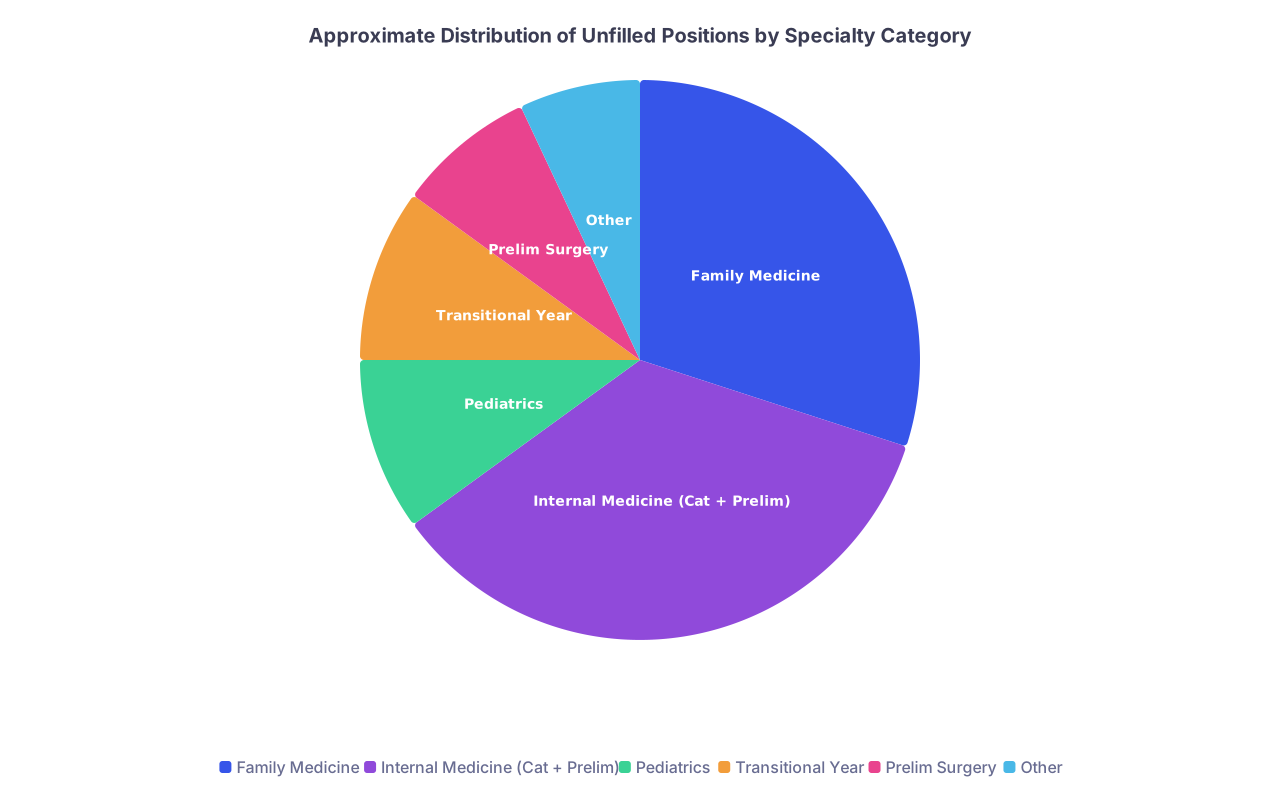
Let’s approximate a distribution of unfilled positions by broad category:
| Category | Value |
|---|---|
| Family Medicine | 30 |
| Internal Medicine (Cat + Prelim) | 35 |
| Pediatrics | 10 |
| Transitional Year | 10 |
| Prelim Surgery | 8 |
| Other | 7 |
Here is how MD vs DO vs IMG participation tends to align with those positions:
- Family Medicine SOAP fill: high proportion DOs and IMGs, fewer MDs relative to their national numbers.
- Internal Medicine categorical SOAP fill: mix of MD, DO, and IMG, but IMGs often cluster in specific programs (rural, historically IMG‑friendly).
- Transitional Year and Prelim Medicine/Surgery: large mix, but IMGs disproportionately land prelim rather than categorical.
The unsentimental takeaway: category of applicant determines where you are “allowed” to compete most effectively.
- US MDs can reasonably compete across FM, IM cat, Peds, TY, prelim.
- US DOs are very competitive for FM, IM cat (especially in community), TY, prelim.
- IMGs are fighting mostly over FM, lower‑tier IM cat, and prelim medicine; fewer realistic shots at TY and even fewer at pediatrics or prelim surgery unless there is existing IMG history.
4. Program Behavior in SOAP: How Directors Prioritize MD vs DO vs IMG
SOAP is speed dating with spreadsheets. Programs do not have time to deeply reevaluate each applicant. They default to heuristics.
From program director surveys and what I have seen in real selection meetings, the rough priority stack in SOAP is:
- US MD and DO seniors who applied to the program in the main Match and went unmatched.
- Other US MD and DO seniors in SOAP who look close to their usual accepted profiles.
- US citizen IMGs with solid exams and US clinical experience.
- Non‑US IMGs, especially those without strong US letters or significant visa headaches.
Many directors will literally filter their SOAP ERAS pool by:
- US MD / US DO first
- Step 2 CK or COMLEX Level 2 score thresholds
- “Applied here in the main Match” flag
- US clinical experience and letters
- Visa requirement
I have heard this exact line more than once:
“If we can fill with MDs and DOs, we will. If not, then we go to IMGs.”
That is not “fair” in some philosophical sense, but it is how many programs manage risk with minimal time.
So, MD vs DO vs IMG is not just label bias. It interacts with:
- Prior application to the same program
- USMLE/COMLEX comparability
- Visa issues (for non‑US IMGs)
- Institutional comfort with certain applicant types
5. Strategy for US MD Seniors in SOAP
If you are a US MD in SOAP, you are working from a position of statistical strength. Not immunity.
The data show that:
- Most US MD seniors who end up in SOAP are there because they aimed at highly competitive specialties, overshot in geography, or both.
- Their board scores and transcripts are usually average to strong compared with the entire SOAP pool.
Your leverage points:
You are a scarce resource. Programs still prefer to fill with US seniors when possible. Leverage that by applying widely across reasonable categorical specialties (IM, FM, Peds, TY) rather than clinging to one dream geography.
Your biggest risk is being too selective. A lot of US MDs self‑sabotage in SOAP by under‑applying or refusing prelim/TY options that would keep them in the system. Statistically, one SOAP categorical spot now is worth more than a theoretical reapplication later.
You can still pivot specialties. For MDs, SOAP is the last plausible pivot point into IM, FM, Peds, or TY with a decent shot of landing a categorical.
Practical target mix if you want to maximize probability of some position:
- Majority applications: Categorical IM and FM, including community and less desirable locations.
- Secondary tier: Peds and Transitional Year.
- Tertiary: Prelim Medicine/Surgery if your risk tolerance allows a non‑categorical path.
You are optimizing for match probability, not prestige. The data are unambiguous: those who lock themselves into a narrow geography or refuse FM/IM in SOAP have much higher rates of “unmatched after SOAP.”
6. Strategy for US DO Seniors in SOAP
DOs occupy an uncomfortable middle ground. You are statistically better off than IMGs in SOAP. You are still clearly behind US MDs in many program filters.
Patterns I see repeatedly:
- DOs do well in SOAP for FM, community IM, and transitional year programs, especially in the Midwest and South.
- DOs with only COMLEX and no USMLE are filtered out by some programs, even in SOAP, especially university or large academic centers.
- DOs chasing surgical prelims or highly competitive metro areas often come out of SOAP empty‑handed.
Your critical decisions:
Stop chasing the original specialty if the data say no. If you went unmatched in ortho, EM, anesthesia, or another competitive field, SOAP is not the time to keep that fixation alive. The SOAP list for those specialties is tiny or non‑existent.
Play to osteopathic strengths. Historically DO‑heavy fields—family medicine, community internal medicine, transitional year—are where your match probability in SOAP is closest to MDs. Apply aggressively there.
Signal flexibility clearly. In communications with programs (where allowed), emphasize willingness to work in community/rural settings, adjust preferred specialty focus within IM or FM, and relocate. Programs hate perceived rigidity, especially from late‑cycle applicants.
An aggressive DO SOAP application list usually looks like:
- Heavy FM representation (broad geography).
- Significant community IM (especially in IMG/DO‑friendly regions).
- Transitional Year / Prelim Medicine where there is documented DO or IMG presence historically.
From a numbers perspective, the worst strategy I see: DO applicant with mid‑tier scores who SOAPs almost exclusively into prelim surgery and big coastal cities. Low base rate of unfilled positions in those niches + structural bias against DOs there = terrible odds.
7. Strategy for US Citizen IMGs in SOAP
For US citizen IMGs, the brutal reality is this: you are the workhorse population of SOAP. There are many of you. There are not enough categorical seats for all of you.
You cannot approach SOAP like a US MD with slightly lower stats. The game is different.
The data patterns:
- US citizen IMGs are significantly more likely to remain unmatched after SOAP than US MDs or DOs, even after similar numbers of applications.
- When they do match in SOAP, it is overwhelmingly into FM, community IM, or prelim.
Your leverage is not prestige. Your leverage is alignment and realism:
Target IMG‑friendly programs first. Programs that already have multiple IMGs in their resident list are far more likely to consider you seriously. That pattern persists even in SOAP. If they have 50–60% of interns from IMG backgrounds today, your odds go up.
Accept that your realistic categorical options are limited to a few specialties. The data are unsympathetic here. FM and community IM make up the bulk of categorical options for IMGs in SOAP.
Differentiate on things that matter quickly. Program directors scanning hundreds of SOAP files will latch onto:
- USMLE Step 2 CK score (relative to their cutoff).
- US clinical experience in their specialty.
- Strong US letters, especially from community sites.
If your numbers are middling and your USCE is light, you cannot be picky on geography. The probability of “no position” is simply higher than for MDs/DOs; your primary goal is survival into any accredited training spot.
That may mean:
- Ranking FM in rural areas you would never have considered 6 months ago.
- Taking a prelim medicine position as a bridge, then re‑entering the match later with US residency experience.
8. Strategy for Non‑US Citizen IMGs in SOAP
Non‑US IMGs sit at the harshest intersection of all constraints:
- Lower base acceptance probabilities.
- Visa issues.
- Less US clinical experience on average.
- Programs that are risk‑averse in a compressed SOAP timeline.
Program directors routinely tell me: “If we have a choice between a US citizen IMG and a non‑US IMG with similar scores, in SOAP we take the citizen. Less paperwork.”
This is not universal. But it is common enough to shape outcomes.
Realistically, your best‑case probabilities in SOAP are:
- Rural FM programs that have historically sponsored visas.
- Some community IM programs with long‑standing IMG pipelines.
- Occasional prelim IM positions that have difficulty filling.
Your strategy, then, is hyper‑focused rather than broad:
Identify programs that:
- Explicitly state they sponsor visas.
- Already have multiple visa‑holding residents.
- Historically list IMGs as a majority of their residents.
Apply heavily there, even if geography is inconvenient or the hospital is small.
Treat every categorical FM or IM invite as a near‑top priority. From a strictly probabilistic standpoint, turning down a rural FM SOAP offer because of location preference is almost always a losing bet.
For many non‑US IMGs, the answer from the data perspective is blunt: your best path may not go through SOAP at all, but through strengthening your profile and reapplying, or exploring non‑US training systems. However, if you are already in SOAP, you maximize the thin margin you do have by zero‑targeting visa‑friendly, IMG‑heavy programs.
9. How Many SOAP Applications, and How to Allocate Them
Applicants consistently under‑ or mis‑allocate SOAP applications.
You get up to 45 programs per SOAP round. The question is not “How many should I use?” The question is “How many can I afford not to use given my risk profile?”
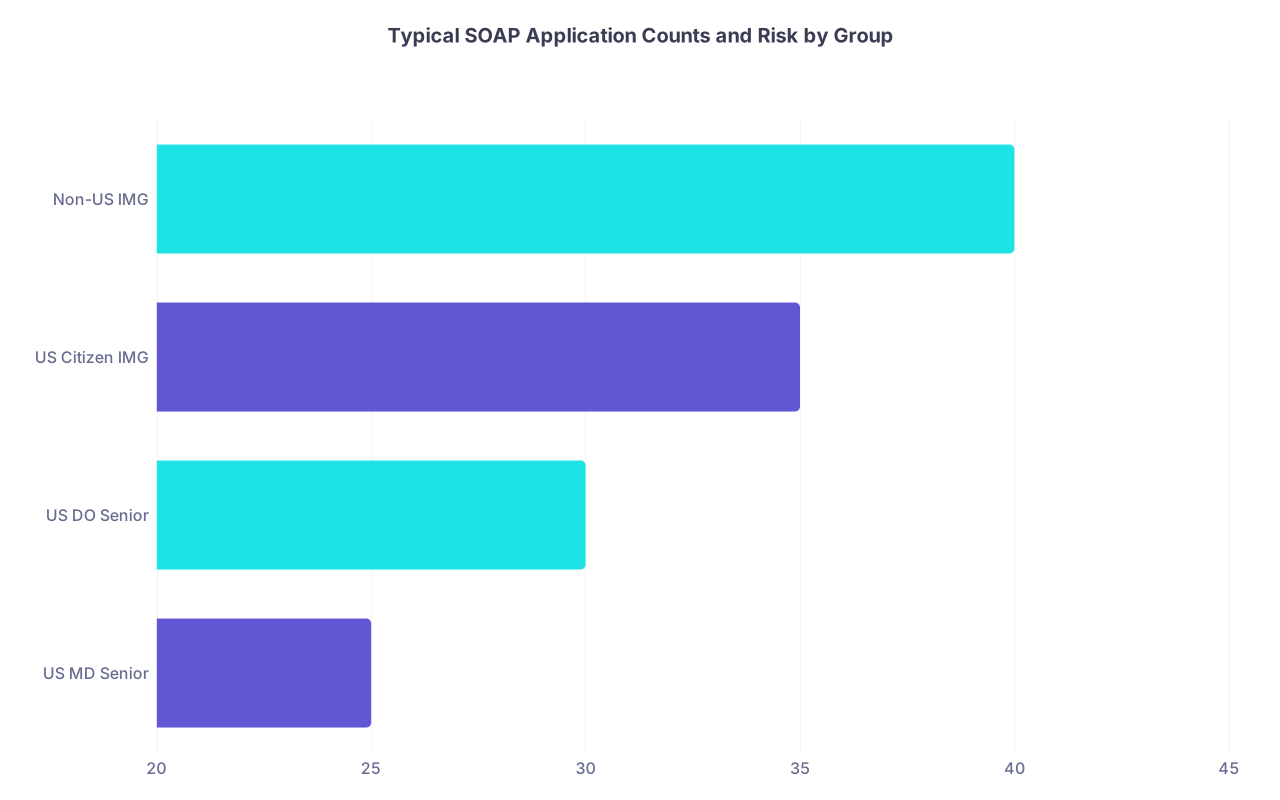
Let’s break typical behaviors by group and the outcomes they tend to generate:
| Category | Value |
|---|---|
| US MD Senior | 25 |
| US DO Senior | 30 |
| US Citizen IMG | 35 |
| Non-US IMG | 40 |
These “typical” counts are what I see; they are often too low.
Better allocation guidelines, driven by risk:
- US MD: Aim for 30–45, across multiple states and program types, with a strong tilt toward categorical IM/FM/Peds/TY.
- US DO: 35–45, heavily focused on FM, community IM, TY, prelim.
- US Citizen IMG: 40–45, strongly weighted toward FM and IMG‑friendly IM, very broad geography.
- Non‑US IMG: 40–45, but narrowly filtered to visa‑sponsoring, IMG‑heavy FM and IM.
Under‑applying is statistically idiotic once you are in SOAP. Every unused application is a deliberate decision to forgo a non‑zero probability of a training spot.
10. Timeline and Decision Flow: When to Pivot and How Fast
SOAP is compressed. The selection logic must be built before Monday of Match Week, not during.
Here is what an effective decision flow looks like when you factor MD vs DO vs IMG status:

| Step | Description |
|---|---|
| Step 1 | Unmatched on Monday |
| Step 2 | Target IM FM Peds TY |
| Step 3 | Target FM IM TY Prelim |
| Step 4 | Target FM IMG friendly IM |
| Step 5 | Target Visa friendly FM IM |
| Step 6 | Max 45 Applications Broad |
| Step 7 | Still 35 to 45 but Slightly Narrower |
| Step 8 | Prepare Standardized SOAP Message |
| Step 9 | Monitor Offers Respond Quickly |
| Step 10 | Applicant Type |
| Step 11 | Risk Tolerance |
If you are still trying to decide “Do I apply mostly to IM or FM?” on Monday afternoon, you are behind.
The group you are in (MD, DO, IMG) should predefine:
- Your primary specialty targets.
- Your acceptable geographic and program type flexibility.
- Your willingness to accept prelim vs categorical.
Think of this as writing your objective function before the optimization problem starts. If your objective is “any accredited ACGME position,” your decision rules will be different than if your objective is “categorical IM only, no prelim.”
11. How to Interpret These Statistics Without Self‑Destructing
A lot of students read this kind of breakdown and either panic or go into denial.
Here is the rational way to use the data:
Use relative, not absolute, numbers. Being an IMG with a 0.3 relative SOAP success index vs MD’s 1.0 does not mean you have 30% absolute odds. It means that within a similar score/geography profile, your odds are materially lower, so you must compensate with broader targeting.
Stop comparing across categories in fantasy scenarios. “If I were an MD, I would match easily in SOAP.” Maybe. But you are not. Strategy must start from your actual category.
Let probabilities dictate your flexibility. The lower your group’s historical success in SOAP, the less justified you are in holding tight constraints on:
- Location
- Prestige
- Categorical vs prelim
From a data perspective, many applicants—especially DOs and IMGs—fail SOAP not because there were literally no opportunities, but because they refused the opportunities that existed in favor of imaginary future cycles.
12. Key Takeaways: MD vs DO vs IMG in SOAP
Keep the core points straight:
The hierarchy is real. In SOAP, US MDs have the highest success rates, followed by US DOs, then US citizen IMGs, then non‑US IMGs. Ignoring this changes nothing; planning around it changes everything.
Specialty and program type matter more than you want to admit. SOAP is dominated by FM, IM, Peds, TY, and prelim spots—disproportionately in community and rural settings. MDs, DOs, and IMGs do not compete on equal footing for all of these.
Flexibility determines survival. Applicants who match in SOAP—especially DOs and IMGs—tend to be those who accept broad geography, primary‑care‑heavy targeting, and, if necessary, prelim or TY routes. The statistics are unforgiving to those who are rigid.
If you treat SOAP like a second chance to chase the same dream under the same constraints, the data suggest you’re likely to join the “unmatched after SOAP” group. If you treat it like a constrained optimization problem with clear probabilities and trade‑offs, your odds improve—regardless of whether you carry an MD, DO, or IMG label.