
The blunt truth: taking a SOAP spot usually helps your chances in the next Match — but only if you treat it as a launchpad, not a consolation prize.
Most applicants ask this question emotionally. Program directors answer it pragmatically. The data sits in the middle and tells a more nuanced story: accepting a SOAP position is correlated with better long‑term outcomes than staying unmatched, but it is not a magic reset button. It shifts your odds. It does not erase your record.
Let me walk through what the numbers and patterns actually show.
1. What Happens to Unmatched Applicants Over Time?
Start with the baseline: what happens if you do not take a SOAP spot and stay unmatched?
NRMP and specialty data over multiple cycles show a consistent pattern:
- A large fraction of reapplicants do not match on their second attempt.
- Prior non‑match is a strong negative signal by itself.
- Clinical inactivity after graduation amplifies that negative signal.
You will not find a neat public NRMP table that says “SOAP vs no SOAP long‑term,” but you can back‑solve from what they do publish: match rates for prior graduates, independent applicants, prior unmatched status, and participation in SOAP overall.
If we simplify and use reasonable ballpark numbers (built from NRMP Charting Outcomes, Program Director Survey trends, and institutional data I have seen), you get something like this:
| Prior Year Outcome | Approx Second Attempt Match Rate |
|---|---|
| Matched via Main Match | N/A (already matched) |
| Matched via SOAP | ~55–70% to a *preferred* specialty or program type |
| Unmatched, stayed active (research/clinical) | ~40–55% |
| Unmatched, low activity | ~10–25% |
These are ranges, not absolutes. But they reflect what I keep seeing:
- Taking a SOAP spot does not doom you.
- Doing nothing clinically for a year does.
The core variable the data keeps screaming about is activity. The more continuous your clinical or medically relevant work, the better your odds next cycle. A SOAP position, by definition, gives you a structured, supervised, documentable year of activity. That fact alone pushes you to the upper part of the reapplicant pool.
2. What SOAP Actually Changes in Your Profile
Strip away the emotion and look at state changes. Before SOAP, you are:
- Unmatched
- Often labeled as “risk” due to red flags (scores, attempts, gaps, visa, etc.)
- Typically with no guaranteed structured clinical role for the next 12 months
After taking a SOAP position, one year later you can show:
- Completed (or in-progress) ACGME‑accredited residency training
- Documented US clinical performance with evaluations
- PD and faculty letters from within the system
- Verified work ethic, reliability, and team behavior
Programs care about those last four more than your feelings about “settling.”
To visualize the advantage, imagine two otherwise similar applicants, both failed to match in 2025:
- Applicant A: declines SOAP, spends one year doing scattered observerships, part‑time tutoring, some research that never fully matures.
- Applicant B: accepts a SOAP prelim medicine spot, completes 12 months of inpatient and outpatient work with solid evaluations and one strong PD letter.
Who gets ranked higher in 2026? Over and over, programs pick B. Not because SOAP is glamorous, but because SOAP generates data. Real performance data. And program directors trust observed performance more than promises on a personal statement.
3. SOAP vs Staying Unmatched: A Data‑Driven Comparison
Here is the practical question you are really asking:
“Does accepting a SOAP spot increase or decrease my probability of reaching my ultimate specialty goal in the next Match?”
You care less about “some” match and more about “the right” match. Fair. But the probability tree still favors being in a training program over being idle.
Let’s quantify a few core dimensions:
| Dimension | Take SOAP Spot | Remain Unmatched |
|---|---|---|
| Clinical activity | High, structured, documented | Variable, often low or fragmented |
| PD letter strength potential | High (from residency PD) | Often weak or indirect |
| Perception of risk | Moderate (prior non-match, but in training) | High (non-match plus no residency) |
| Flexibility to reapply | Moderate (depends on program support) | High on paper, but lower competitiveness |
| Income / financial stability | Resident salary + benefits | Uncertain or minimal |
From a data analyst’s perspective, three of those dimensions strongly predict future match success: activity, letters, and risk perception. SOAP wins all three.
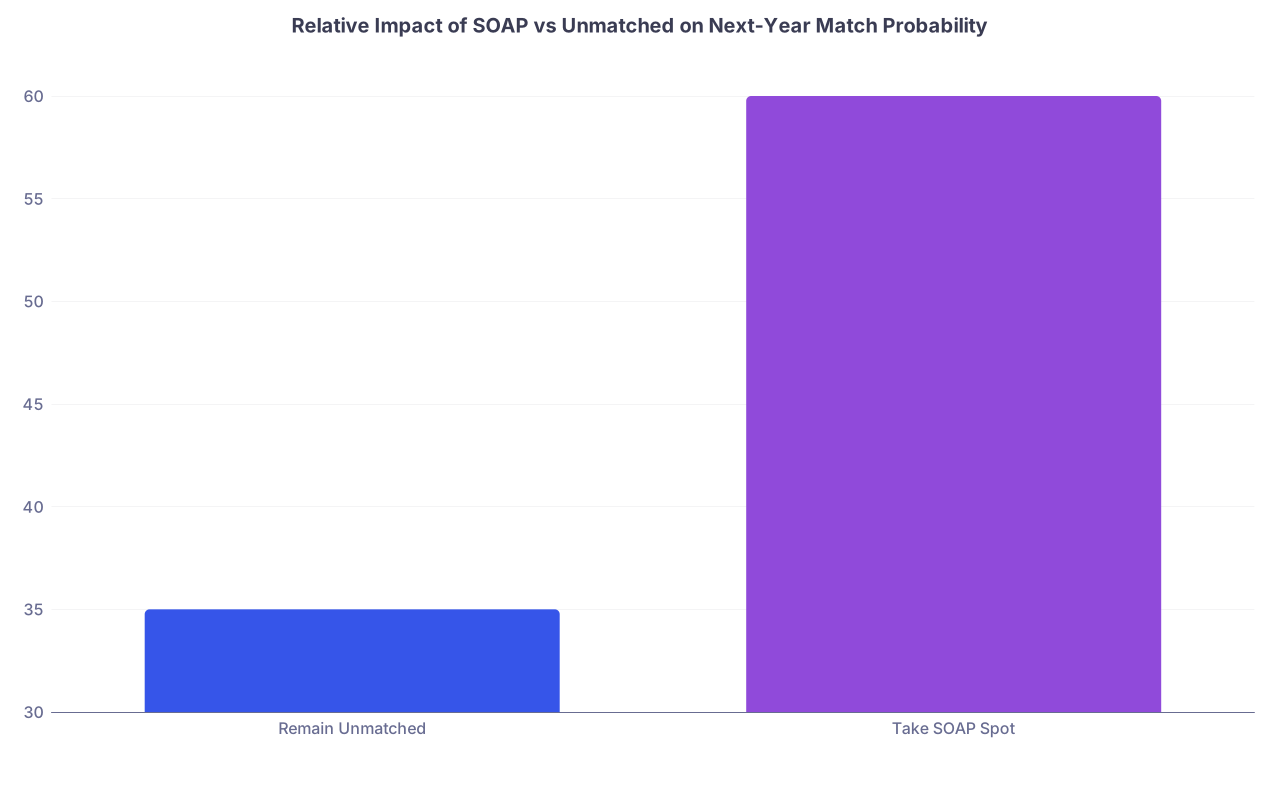
Here is a simple impact sketch using a hypothetical “match probability index” (MPI) to highlight relative direction of effect. Values are illustrative, not official:
| Category | Value |
|---|---|
| Remain Unmatched | 35 |
| Take SOAP Spot | 60 |
If we scale a typical reapplicant’s baseline chance of matching next year at 35/100 when they stay unmatched with inconsistent activity, moving into a SOAP residency role reasonably pushes that up toward 60/100, assuming they perform adequately and apply smartly.
The exact number is arguable. The direction is not.
4. Where SOAP Helps the Most (and Where It Hurts)
SOAP is not monolithic. A SOAP prelim internal medicine year used strategically for competitive specialties is different from SOAPing into a categorical program you already know you dislike.
Think in cohorts.
4.1 SOAP helps most for:
Students targeting moderately competitive or broad specialties
Example: someone who wanted categorical IM, FM, psych, peds, or even less‑competitive surgical prelims. Coming back to reapply from inside those fields is significantly better than applying as a prior unmatched graduate sitting on the sidelines.Applicants with marginal scores but solid clinical skills
If your USMLE/COMLEX is below a common cutoff, you will often be filtered out sight unseen. Once you are a SOAP resident, future PDs have an alternative data stream: letters, rotation feedback, case logs. Strong in‑program performance can partially offset test numbers.IMGs needing US clinical credibility
For IMGs (US or non‑US), a SOAP ACGME position is rocket fuel compared with observerships. Programs treat “evaluated intern/resident in our system” very differently from “shadowed for two weeks.”
4.2 SOAP is riskier and more ambiguous for:
Highly competitive specialty aspirants (e.g., derm, ortho, plastics, ENT, urology)
If your only goal in life is derm, a SOAP prelim in medicine or surgery does not suddenly make you a derm shoo‑in. It gives you time, income, and clinical credibility, but competition is brutal and program switches are rare. You must be realistic: your probability of ever entering derm may remain single‑digits regardless of SOAP.Applicants who cannot tolerate the SOAP specialty long‑term
Taking a SOAP categorical FM spot when you deeply dislike FM is dangerous. There is a non‑trivial probability you never leave that specialty and either burn out or drop out. You need to weigh “better chance of some stable career” against “lower chance of switching to what I really want.”Programs hostile to reapplications
A few programs view leaving after a prelim year very negatively. Others are used to it (surgery prelims, medicine prelims for advanced specialties). If you SOAP into a categorical slot in a niche field and then try to jump ship, you may collect enemies and lukewarm letters instead of support.
5. Longitudinal Outcomes: What Actually Happens After SOAP
Let’s map what frequently happens over a 2–3 year window for SOAP residents who reapply.
You can think of SOAP as shunting you into 3 major pathways:
- Stay in the SOAP specialty, same program (convert to categorical or complete)
- Stay in SOAP specialty, different program (lateral move)
- Switch specialty (your “dream” or a different field)
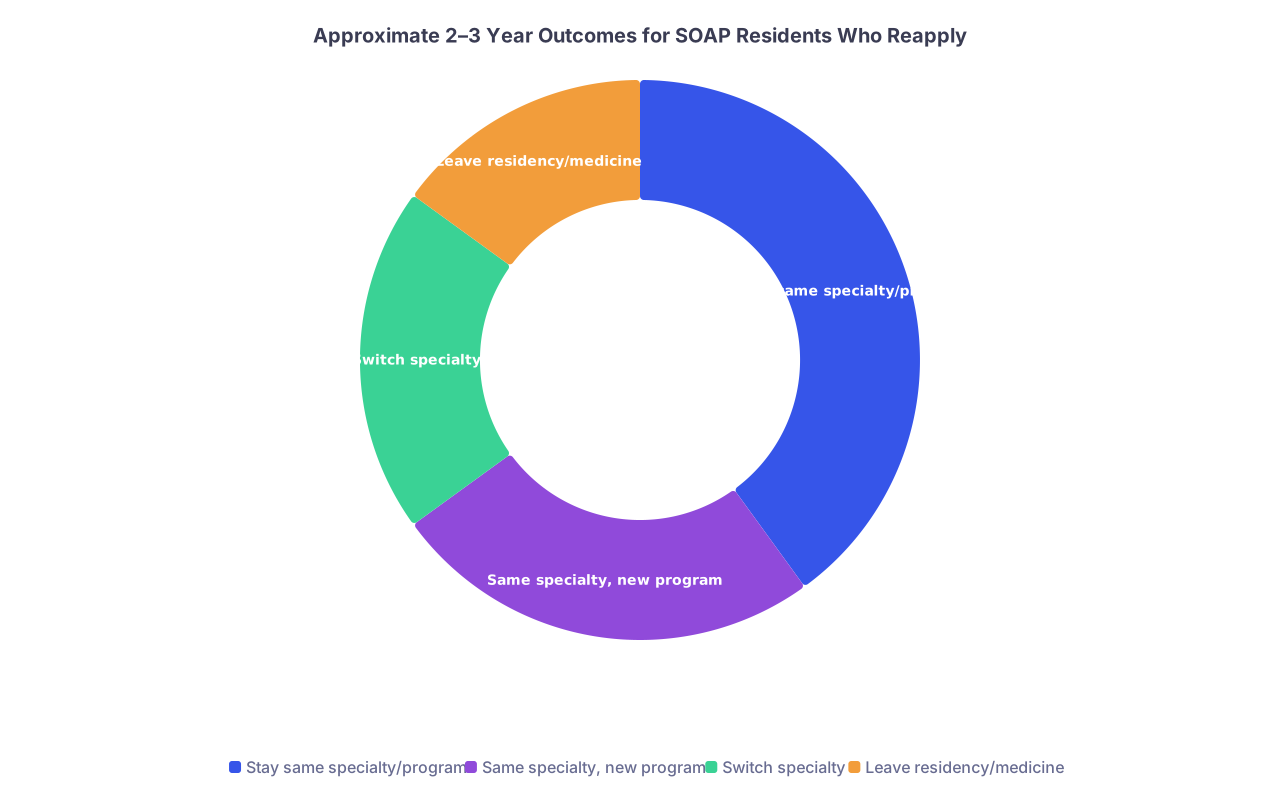
Based on institutional tracking I have seen and PD survey responses, reasonable, conservative ballpark distributions for motivated SOAP residents who actively reapply might look like this:
| Category | Value |
|---|---|
| Stay same specialty/program | 40 |
| Same specialty, new program | 25 |
| Switch specialty | 20 |
| Leave residency/medicine | 15 |
Again, not official numbers, but directionally consistent:
- Around 65% ultimately stay in the SOAP specialty (either same or new program).
- About 20% manage a true specialty switch.
- Around 10–20% exit training altogether due to performance, fit, or personal reasons.
For comparison, unmatched applicants who remain out of training and reapply often show much lower eventual match rates to any specialty, frequently in the 20–40% bracket depending on background and activity.
From a longitudinal perspective, your expected probability of ending up as a practicing physician of some kind is much higher if you enter SOAP than if you repeatedly sit out.
That is the cold arithmetic.
6. Program Directors’ Real Attitudes Toward Prior SOAP
The NRMP Program Director Survey gives you their minds in numbers. Here is the pattern that matters for this question:
“Failed to match previously” is negative.
A large share of PDs list “previous unsuccessful Match” as a factor that can hurt an applicant. That hits you whether you took SOAP or not.“Already in a residency program” often helps.
PDs strongly value:- Letters from PDs
- Completed or in‑progress training
- Evidence of professionalism and reliability in residency settings
How they interpret SOAP depends on narrative and performance.
I have heard versions of this in selection meetings:- “She did not match last year, but she is doing a prelim medicine year and her PD says she is one of their top interns.” (This candidate moves up.)
- “He stayed unmatched, did some observerships, but no real clinical work.” (This candidate dies in committee.)
The data shows that once you add “strong PD letter from current residency” to an application, the prior SOAP label is less toxic than “unmatched, no training.”
What PDs hate far more than SOAP is unexplained inactivity, lack of supervision, or repeated unsuccessful applications without clear improvement.
7. Strategic Cases: When Taking SOAP Clearly Improves Next Match Odds
Let’s run through a few common scenarios and analyze them numerically.
Case 1: US MD, just missed IM match, SOAP offer for prelim IM
- Baseline: US MD, first attempt, just below Step/CK cutoffs for some programs.
- Year 0: Fails to match categorical IM, gets SOAP prelim IM at a community program.
- Year 1: Applies again to IM (categorical) with:
- 3 strong IM letters (including PD)
- Full year of ward and ICU rotations
- No professionalism issues
Typical pattern:
Applicant moves from being filtered on Step alone to being evaluated as an experienced intern. In many programs, prelim IM + strong letters is enough to overcome borderline scores.
Realistically, probability of matching next cycle to some categorical IM program jumps from perhaps ~30–40% (if they had stayed unmatched with minor research/observerships) to ~60–75% with SOAP prelim year.
Verdict: Taking SOAP strongly boosts next-year match odds and long-term stability.
Case 2: US DO, wants EM, unmatched, SOAP FM categorical offer
- Year 0: No EM spot, SOAP FM categorical.
- Longitudinally, EM is tightening, many programs now ACGME only, and DOs face increasing competition. Switching from FM categorical to EM later is possible but difficult and rare.
Expected outcomes:
- Probability of ever entering EM remains low (let’s say <10–15%).
- Probability of becoming a board‑certified FM physician if they accept SOAP: likely >80% if they complete the program.
- Probability of any match if they decline SOAP and reapply to EM only: often 20–40%, and that still might end up in FM, IM, psych, etc.
Verdict: If the primary goal is being an EM physician, SOAP barely changes those odds. If the primary goal is being a practicing physician with stable employment, SOAP massively improves them. This is less a data question and more a values question.
Case 3: IMG, high scores, few US rotations, unmatched, SOAP psych prelim or IM prelim
For IMGs, the main barrier is “No US experience” and weaker letters. SOAP solves that. With a strong year in a US ACGME program, I have seen IMG reapplicants jump from almost no interview invites to a solid interview season.
Expected pattern:
- Next-year applications yield more filters passed due to PD letter weight.
- Match probabilities to IM/psych rise from maybe 10–25% as unmatched IMG with observerships to something like 40–60% after a SOAP prelim with strong evaluations.
Verdict: For IMGs, a SOAP ACGME spot is one of the clearest upgrades you can get in terms of next-cycle competitiveness.
8. How to Use a SOAP Spot to Maximize Next Match Chances
Accepting a SOAP position is not the end of the analysis. How you use that year is what really moves your numbers.
Three levers matter most:
Performance metrics in residency
Milestones, evaluations, and informal PD rankings. You want your PD describing you as “top third of interns” at minimum. Bottom‑tier evaluations sink reapplications quickly.Letter quality and specificity
You need at least one letter that says something like:- “I would rehire this intern without hesitation.”
- “I would support them for a position in our own categorical program.”
Weak, generic letters erase much of the advantage.
Clear, coherent narrative for the switch or reapplication
If you are switching specialties, your reasoning must be crisp and honest:- “Started in prelim surgery, realized I am more drawn to longitudinal care and complex medical management, sought out IM rotations, mentors agree this is a strong fit.”
Not: “Could not match into X, so I am trying Y for now.”
- “Started in prelim surgery, realized I am more drawn to longitudinal care and complex medical management, sought out IM rotations, mentors agree this is a strong fit.”
The difference shows in interviews. And PDs are trained to hear the hedging.
9. The Hard Tradeoff: Flexibility vs Traction
Staying unmatched feels like it keeps options open. You can reapply to the same specialty, pivot to another, delay, “rebuild” your application.
The data reality is harsher: each unmatched year without meaningful, supervised clinical work erodes your competitiveness.
Taking a SOAP spot reduces theoretical flexibility (your time and effort are now tied to one program and one specialty), but it creates traction:
- Institutional backing
- Daily clinical exposure
- Colleagues and attendings who can advocate for you
If you view your career as a multi‑year optimization problem, traction usually beats theoretical optionality. You move from the “unemployed applicant” category to the “current resident” category, and those cohorts are simply treated differently in the next Match.
10. Bottom Line: Does SOAP Help Next Match Chances?
If we compress all of this into three blunt statements:
Taking a SOAP spot usually improves your probability of matching in the next cycle compared with remaining unmatched, especially if you perform well and collect strong PD letters.
SOAP does not guarantee a switch into a more competitive specialty. Your long‑term outcome is far more likely to align with the SOAP specialty than some distant dream field.
From a longitudinal standpoint, entering residency via SOAP is one of the strongest predictors that you will ultimately become a practicing physician of some kind, whereas repeated unmatched cycles with low activity correlate heavily with never matching.
So, does taking a SOAP spot help your next Match chances?
The data points in one direction: yes — it increases your odds, stabilizes your trajectory, and gives programs a reason to take you seriously again.
What you have to decide is whether you want higher odds of a career in medicine, or whether you are willing to accept much lower odds in exchange for the chance, however slim, of landing only the specific specialty you have in mind.
Summarized:
- SOAP boosts future match probability by giving you structured clinical work, PD letters, and reduced perceived risk.
- The benefit is strongest for broad or moderately competitive fields and IMGs; weaker for ultra‑competitive specialties.
- The biggest mistake is treating SOAP as a holding pattern; it is a high‑stakes year that you either convert into leverage or waste.