
Programs do not all “use SOAP” equally. The data are brutally clear: a small cluster of specialties account for a disproportionately large share of SOAP activity year after year, while others barely touch it.
If you treat SOAP as a generic backup without understanding where the vacancies actually are, you are playing the wrong game.
Let’s walk through the numbers, the patterns, and what they mean for your SOAP strategy.
1. The SOAP Reality Check: Where the Open Spots Actually Are
Start with the macro view. In a typical recent NRMP Match cycle for MD seniors:
- Roughly 5–6% of PGY‑1 positions end up in SOAP at some point.
- But those spots are not evenly distributed across specialties.
- A handful of fields—mostly primary care and prelim tracks—dominate SOAP.
To make this concrete, here is an approximate breakdown (aggregated from several recent Match reports and vacancy lists; numbers rounded for clarity, not for publication-grade precision).
| Specialty Cluster | Share of SOAP Vacancies |
|---|---|
| Internal Medicine (Categorical + Preliminary) | 30–40% |
| Family Medicine | 15–25% |
| Pediatrics (Categorical + Preliminary) | 8–12% |
| Transitional Year / Prelim Surgery | 8–12% |
| Psychiatry | 5–10% |
| All other specialties combined | 10–20% |
This is the first hard truth: if your SOAP plan centers on Dermatology, Ortho, ENT, or similar, you do not have a plan. You have a fantasy.
The consistent high-SOAP-use categories are:
- Internal Medicine (especially community and lower‑tier academic programs)
- Family Medicine
- Pediatrics
- Psychiatry
- Transitional and Preliminary years (medicine and surgery)
Now let’s cut this further by looking at “SOAP intensity”: how likely a given specialty is to have a non‑trivial number of SOAP vacancies each year.
2. High-, Medium-, and Low-SOAP Specialties
From a strategy standpoint, you care less about exact counts and more about probabilities. Does this field reliably leave seats on the table by Monday of Match Week?
Using several recent cycles as a guide, we can roughly stratify specialties by “SOAP intensity.”
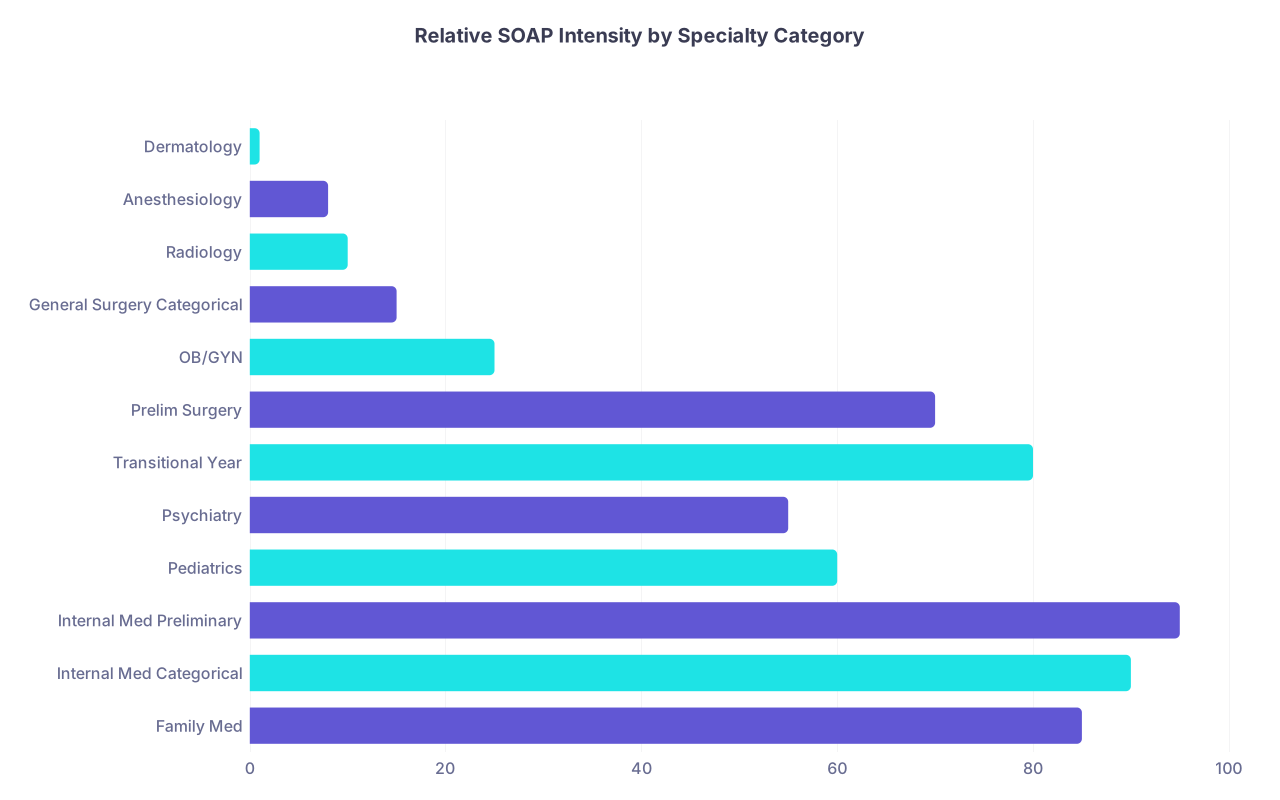
| Category | Value |
|---|---|
| Family Med | 85 |
| Internal Med Categorical | 90 |
| Internal Med Preliminary | 95 |
| Pediatrics | 60 |
| Psychiatry | 55 |
| Transitional Year | 80 |
| Prelim Surgery | 70 |
| OB/GYN | 25 |
| General Surgery Categorical | 15 |
| Radiology | 10 |
| Anesthesiology | 8 |
| Dermatology | 1 |
The values above are a relative index (0–100) representing how consistently each category shows up with meaningful SOAP volume across recent years.
High-SOAP specialties (reliable SOAP presence)
These are the ones that actually move the needle during SOAP:
- Internal Medicine (Categorical + Prelim)
- Family Medicine
- Pediatrics (mostly categorical)
- Psychiatry
- Transitional Year (TY)
- Preliminary Surgery
Patterns I see over and over:
- Dozens to hundreds of unfilled IM and FM spots nationally.
- Double‑digit TY and prelim surgery vacancies.
- A non‑trivial but smaller cluster of Pediatrics and Psychiatry positions.
This is where most successful SOAP outcomes occur for unmatched or partially matched applicants.
Medium-SOAP specialties (variable, niche rescue potential)
- OB/GYN
- General Surgery (categorical, at smaller community hospitals)
- Neurology
- Pathology
- PM&R
- EM (this one has changed dramatically post‑COVID; some years have had large vacancy spikes in specific regions, others far fewer)
These fields may have vacancies, but:
- They are more sensitive to year‑to‑year fluctuations.
- Positions are often geographically clustered (e.g., certain states or smaller cities).
- Many applicants shift into them during SOAP, increasing competition.
You cannot assume: “I’ll just SOAP into OB/GYN.” Some years you might see 5–15 spots; in others, effectively none that you are realistically competitive for.
Low-SOAP specialties (almost no rescue value)
- Dermatology
- Plastic Surgery
- Orthopedic Surgery
- Neurosurgery
- ENT
- Urology (outside NRMP Main Match, but same idea—vacancy is rare)
- Ophthalmology (SF Match)
- Radiation Oncology (historically had vacancies but volatile and shrinking)
These fields contribute negligible volume to SOAP. Any given year might show one or two scattered prelims or rare categorical surprises, but you cannot build a plan on them.
If you are aiming at these and do not have a SOAP‑compatible backup list in high‑SOAP specialties, the data say you are setting yourself up for a repeat cycle.
3. Categorical vs Preliminary vs Transitional: Where the Wiggle Room Is
Most SOAP conversations get this part wrong. The single greatest concentration of SOAP activity is not glamorous categorical positions. It is preliminary and transitional years.
| Position Type | Approx Share of SOAP Vacancies |
|---|---|
| Categorical (all fields) | 55–65% |
| Preliminary Medicine | 10–15% |
| Preliminary Surgery | 8–12% |
| Transitional Year | 10–15% |
Categoricals are the majority in raw numbers, but prelim/TY is where strategy gets interesting.
Categorical positions
- Heavily represented: Internal Medicine, Family Medicine, Pediatrics, Psychiatry.
- Occasionally present: OB/GYN, Neurology, Pathology, PM&R, EM, smaller General Surgery programs.
- Rare: high‑prestige specialties.
These are “true homes” where you can complete training and become board‑eligible. If you can land a categorical spot in SOAP that you can live with, that is usually the optimal outcome.
Preliminary medicine and surgery
These function as one‑year contracts.
- Prelim Medicine: often used by applicants targeting advanced specialties (e.g., Neurology, Anesthesia, Radiology) who missed the categorical but need an internship year.
- Prelim Surgery: a mix of surgery hopefuls, radiology/anesthesia applicants who want a procedurally intense year, and unmatched students needing something rather than nothing.
Vacancies in prelim tracks are common. In fact, some programs chronically underfill prelim spots and essentially plan to lean on SOAP.
Transitional Year (TY)
Historically one of the sweet spots of SOAP:
- Broad mix of rotations.
- Often less grueling than heavy surgical prelims.
- Highly desirable for advanced-match applicants—so even though there are vacancies, they are fiercely contested.
The data trend over the last decade: TY positions attract some of the strongest SOAP applicants (high Step scores, strong applications who just missed their top advanced fields).
So while TY vacancies exist, your competition here is sharper than in, say, low‑tier FM.
4. Specialty-Specific SOAP Profiles: What The Data Actually Show
Now to the question you really care about: which specialties actually “use SOAP” in a way that matters for you.
Internal Medicine: The Workhorse of SOAP
Internal Medicine is SOAP central.
Patterns across recent years:
- Large total number of IM positions nationally (often >9,000).
- A meaningful portion—hundreds at times—enter SOAP as unfilled.
- Many are at community hospitals, newer programs, or less competitive regions.
These are the facts:
- IM categorical provides a stable, board‑eligible path with multiple subspecialty options.
- IM prelim offers a bridge year but no guaranteed continuation.
For an unmatched US MD or DO, IM categorical is one of the highest‑probability SOAP landing spots, especially with:
- Step 1 pass / Step 2 CK ≥ 220–230 (US MD) or slightly higher for DO/IMG.
- Reasonable clinical evaluations.
- No catastrophic red flags.
This is why serious SOAP strategies nearly always include a broad slate of IM programs.
Family Medicine: Volume, Flexibility, and Geography
Family Medicine perennially has hundreds of unfilled spots. It is not unusual to see:
- Dozens of FM programs with >3 unfilled positions.
- Geographic clustering in certain states and rural regions.
Key data features:
- FM is one of the least competitive core specialties by scores and AOA metrics.
- Vacancy rates are higher in rural and community-based programs.
For SOAP purposes, FM is:
- High volume.
- More willing to consider late-cycle applicants with modest scores.
- Sensitive to geographic preference; genuine interest in region matters.
If your primary goal is “I must match this year,” FM should be on the table unless you have a strong reason it cannot be.
Pediatrics: Moderate Volume, Still Meaningful
Pediatrics has fewer total positions than IM or FM, but still a reliable SOAP presence.
Patterns:
- Lower but consistent vacancy rate.
- A mix of categorical and a small number of prelim pediatric spots.
- Generally more competitive than FM but less than categorical surgery or OB/GYN.
For SOAP:
- A realistic option for applicants with pediatric interest and mid‑range academic profiles.
- Less of a “mass backstop” than IM/FM, but still one of the main fields with genuine categorical options.
Psychiatry: Growing Volume, Rising Competitiveness
Psychiatry has exploded in popularity, and the data show a tightening market. Yet:
- Some programs still underfill, especially newer or less known ones.
- SOAP vacancies are meaningful but more limited than IM/FM.
Trends:
- Average Step scores for matched psych applicants have risen.
- Vacancy distribution is skewed toward certain regions and less central locations.
SOAP implication: psychiatry is an option, but you cannot treat it like FM. You will be competing against a wide range of applicants, including those who pivot to psych during SOAP after missing more competitive fields.
Transitional Year / Prelim Surgery: High Utility, High Noise
TY and prelim surgery are classic SOAP landing zones, particularly for:
- Applicants who matched an advanced position but not a PGY‑1.
- Unmatched applicants trying to stay in the system, earn letters, and reapply.
Data features:
- Vacancy numbers are substantial, but many spots are at very busy surgical or community hospitals.
- Prelim surgery spots, in particular, can be high-burnout environments.
From a data strategy perspective:
- These spots significantly increase your odds of “matching to something.”
- They do not guarantee long‑term stability; you probable need to re-enter the Match.
But if your baseline comparison is “no residency vs a prelim year in a difficult environment,” they are a critical part of many successful recovery stories.
5. How Competitive Are SOAP Spots by Specialty?
A lot of people assume SOAP automatically means “less competitive.” That is only partly true.
To visualize relative difficulty, think of an approximate competitiveness index during SOAP based on step scores, typical applicant profiles, and fill rates.
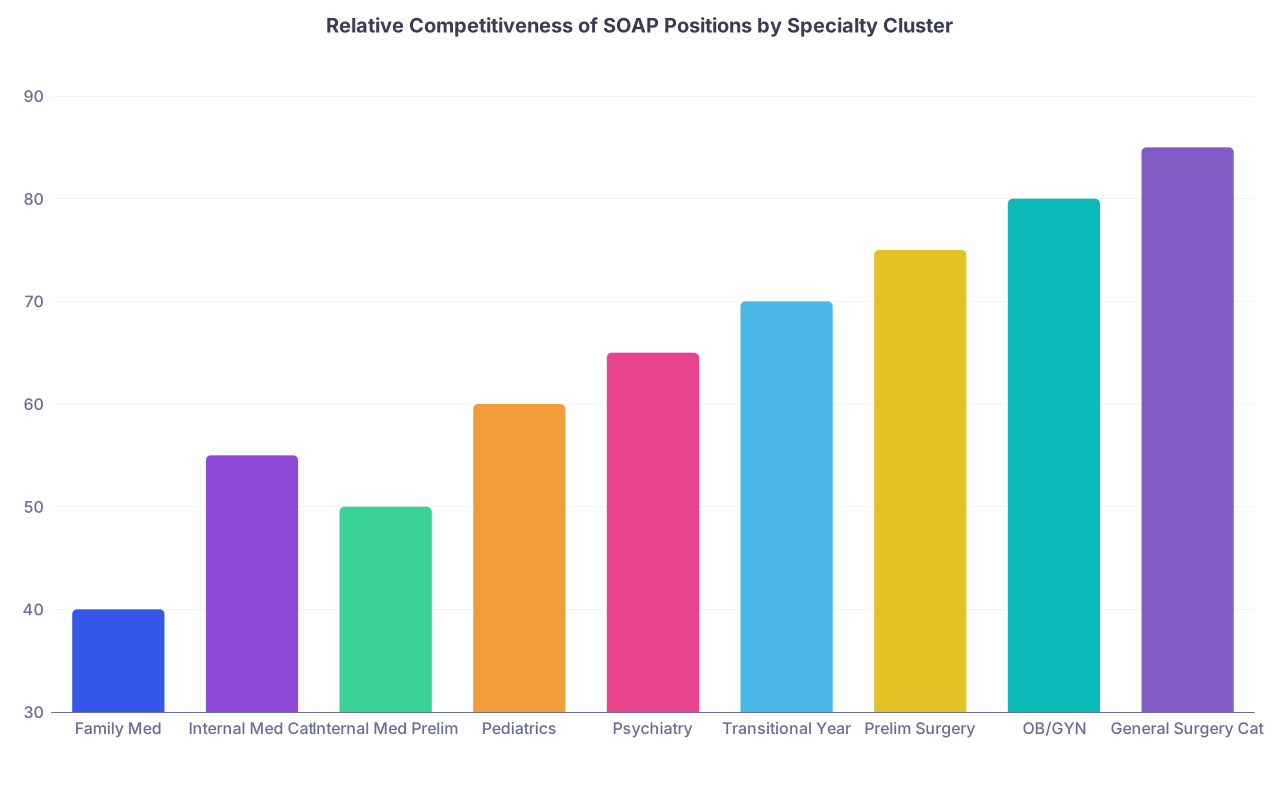
| Category | Value |
|---|---|
| Family Med | 40 |
| Internal Med Cat | 55 |
| Internal Med Prelim | 50 |
| Pediatrics | 60 |
| Psychiatry | 65 |
| Transitional Year | 70 |
| Prelim Surgery | 75 |
| OB/GYN | 80 |
| General Surgery Cat | 85 |
Scale: 0 = easiest, 100 = hardest among SOAP-available fields.
Interpretation:
- FM and lower‑tier IM categorical: still the most accessible.
- IM prelim: more accessible by score threshold, but some programs want stronger applicants planning subspecialties or advanced training.
- Pediatrics and Psychiatry: moderate to high competitiveness among SOAP vacancies; many applicants pivot in.
- TY and Prelim Surgery: more intense competition because many strong unmatched applicants target them.
- OB/GYN and General Surgery categorical: few vacancies, high competition even in SOAP.
The takeaway: “There are SOAP vacancies” does not mean “They will take anyone.” Many programs use SOAP to salvage their quality bar, not to lower it.
6. Building a Rational SOAP Strategy from the Numbers
Data only matters if you act on it. Here is the practical translation.
1. Align your backup with high-SOAP specialties
Your SOAP list should be dominated by fields that actually use SOAP at scale:
- Internal Medicine (cat + prelim)
- Family Medicine
- Pediatrics
- Psychiatry
- TY and prelim surgery (if you are ok with a 1‑year plan)
If your primary specialty is competitive (Derm, Ortho, etc.), you need to decide now—before Match Week—whether you would genuinely accept a career in IM/FM/Peds/Psych. The data show that is where your real backup lives.
2. Understand your profile relative to SOAP norms
Blunt reality:
- US MD with Step 2 CK 225–235 and no major red flags: competitive for many FM and IM SOAP spots, possibly some Peds and Psych depending on region.
- US DO or IMG with similar scores: still viable, but you likely need to cast a wider geographic net and emphasize FM, community IM, prelim medicine.
- Significant red flags (multiple exam failures, professionalism issues): probably restricted mostly to the most understaffed IM/FM/prelim positions.
Do not waste SOAP applications on a cluster of medium- or low‑SOAP specialties where your profile is marginal. You have 45 applications. Treat them like a scarce resource.
3. Use geography as a force multiplier
Vacancy patterns are not random:
- Rural Midwest, Deep South, and certain interior states often have more FM and IM vacancies.
- Major coastal cities and “name brand” university centers almost never appear in SOAP.
Strategically:
- Weight your SOAP list toward regions with historical underfill patterns.
- De‑prioritize ultra‑desirable metro areas unless your profile is excellent.
A mediocre applicant applying only to SOAP vacancies in Boston, SF, and NYC is not “optimistic.” They are ignoring what the data show.
4. Treat prelim and TY separately in your plan
Decide upfront:
- Are you willing to take a prelim/TY spot if you do not get a categorical?
- If yes, where are you willing to live and what conditions (call load, support) are acceptable?
Prelim/TY can be a powerful rescue route, but they are not equivalent to categorical positions. The data say many people who take them successfully re‑match—but a nontrivial fraction struggle or burn out.
7. The Misconceptions That Hurt Applicants Most
I will call out the three most common data‑blind errors I see every year.
Mistake 1: Assuming your specialty “will have SOAP spots”
Applicants in EM, OB/GYN, or General Surgery often say this. “I know some will go unfilled; I’ll just SOAP there.”
The actual numbers usually look like:
- 5–20 scattered vacancies, heavily fought over.
- Many at programs that have very specific needs or concerns.
Yes, there might be a slot. No, it is not a realistic primary fallback if your application is already below average.
Mistake 2: Refusing to list FM/IM “because I don’t really want to do that”
Honest statement: if you are not willing to practice as an internist or family physician, you should not list those specialties in SOAP.
But the data interpretation must be consistent:
- If you will not list IM/FM, and your original specialty is high‑competitiveness with low SOAP volume, your true probability of matching in SOAP may be near zero.
That is your right. Just do not pretend you “have a good backup” when the vacancy distributions say otherwise.
Mistake 3: Overestimating how much SOAP lowers the bar
Programs that enter SOAP are not automatically desperate. Reasons include:
- New program with low visibility.
- Geography that many applicants avoid.
- Internal ranking issues or late accreditation changes.
Most SOAP‑using programs still reject the majority of applicants who hit their queue. The bar drops slightly. It does not disappear.
8. Putting It All Together
Here is the blunt summary the data support:
SOAP is structurally concentrated. Most real opportunities are in Internal Medicine, Family Medicine, Pediatrics, Psychiatry, and prelim/TY tracks. Plan as if that is where you will land if you SOAP at all.
Competitive fields stay competitive, even in SOAP. OB/GYN, General Surgery, and some neurology/path/PM&R spots do appear, but in small numbers and with intense competition. Prestige specialties (Derm, Ortho, Plastics, etc.) are effectively non‑SOAP options.
Your best SOAP strategy is specific, not hopeful. Decide now what you are truly willing to do, in which regions, and at what training intensity. Then build a SOAP list anchored in high‑volume specialties and realistic geographic targets.
If you respect what the numbers say instead of what you wish were true, your odds of walking out of Match Week with a contract in hand go up. Dramatically.