
The biggest misunderstanding about SOAP is simple: people think it is national and uniform. It is not. The data shows SOAP is regional first, specialty second.
If you ignore geography in SOAP strategy, you waste applications on positions that will never be realistically available to you, while missing the pockets that reliably go unfilled every year.
Let’s break this down the way program directors quietly do it: by regions, fill patterns, and risk.
1. The Macro Picture: How “National” SOAP Actually Breaks Down
The Supplemental Offer and Acceptance Program exists because some programs cannot reliably fill through the main Match. Those programs are not randomly scattered. They cluster.
Think of SOAP positions as a distorted heat map:
- More in:
- Deep South
- Rural Midwest and Great Plains
- Rust Belt community hospitals
- Fewer in:
- West Coast
- Major Northeast academic hubs
- High-cost urban cores with big-name brands
You rarely see official “SOAP by region” charts in NRMP PDFs, but you can reconstruct it from three sources:
- NRMP’s “Results and Data” and “Charting Outcomes” reports
- Program fill rates by state and specialty
- Specialty competitiveness vs regional location
Consistently, three patterns show up:
- The coasts (especially West Coast) have high primary Match fill rates and relatively few SOAP positions per capita.
- The South and some central states have chronic unfilled positions, mostly in primary care and prelim categories.
- Prestigious metros (Boston, NYC, Seattle, SF Bay Area) are almost “SOAP deserts” for anything categorical.
To visualize this skew, think conceptually like this:
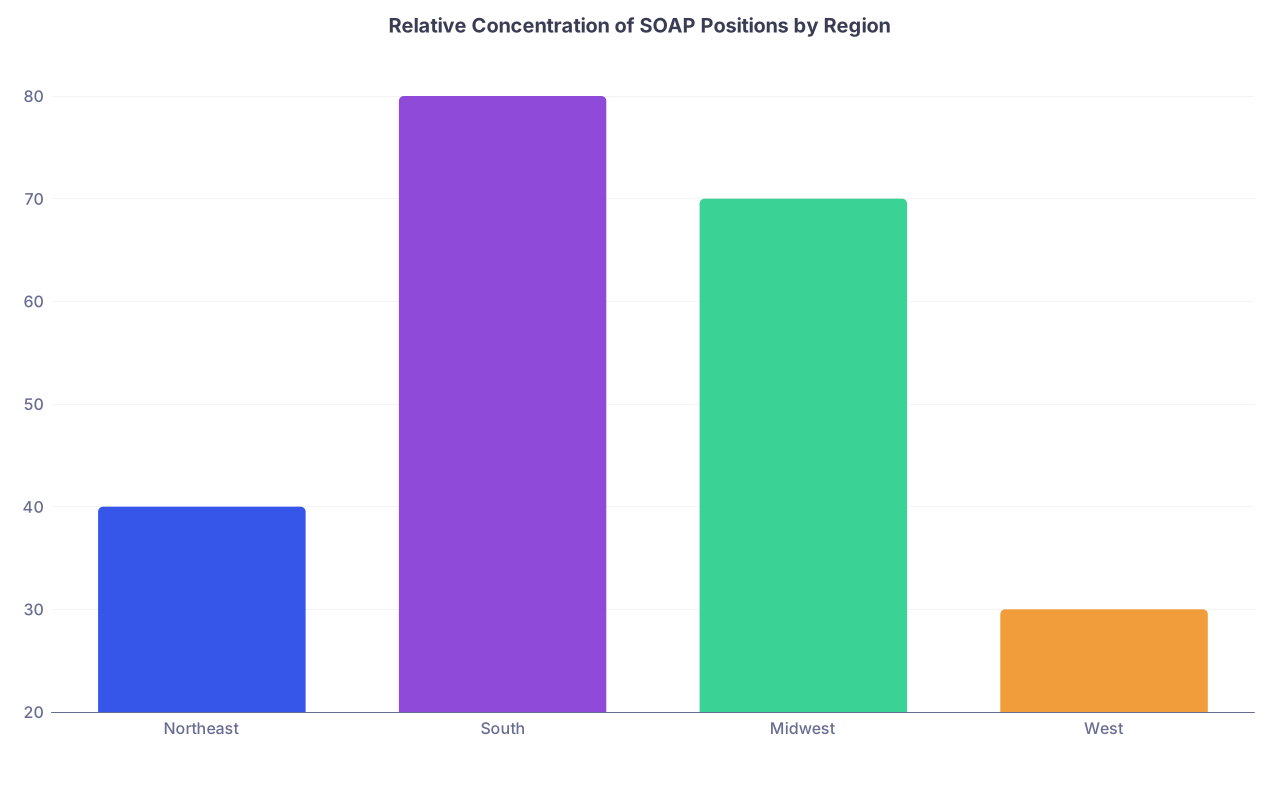
| Category | Value |
|---|---|
| Northeast | 40 |
| South | 80 |
| Midwest | 70 |
| West | 30 |
Not absolute numbers, but relative opportunity. If you are laser-focused on Boston/NYC/California during SOAP, you are playing in the lowest-yield sandbox.
2. Regions That Fill Early And Leave Little For SOAP
Let me be blunt: some regions are effectively “closed” for SOAP unless you are willing to take very specific, often less desirable prelim spots. These regions attract enough applicants in the main Match that SOAP is mostly a formality.
A. West Coast (Pacific) – The Chronic Shortage of SOAP Seats
California, Washington, Oregon, and to a lesser degree Colorado, function like this:
- High main Match demand
- High desirability (lifestyle, location, family, visa clusters)
- Many programs fill completely or miss by 1–2 spots at most
The data pattern is consistent:
When you dig through historical SOAP lists (people save them; I have seen enough), you see:
- Very few categorical IM/FP/psych in California during SOAP
- Mostly:
- Prelim medicine
- Prelim surgery
- Transitional year (in more peripheral locations)
- Occasional categorical positions in:
- Central Valley
- Inland, non-coastal hospitals
- Newer or less-known community programs
If you go into SOAP thinking you will land a categorical IM in LA or SF, you are misreading the market. The West Coast overfills on desirability.
B. Northeast Academic Hubs – Brand Names Fill, Community Scraps Remain
Boston, NYC, Philadelphia, DC metro – the usual suspects.
Academic flagships (Mass General, Brigham, Columbia, Penn, Hopkins, etc.) almost never have categorical SOAP spots in core specialties. Their fill rates in the primary Match hover near 100% year after year.
What tends to be left in this region, if anything:
- Prelim IM or surgery slots in community or safety-net hospitals
- A few categorical IM/FM at smaller hospitals in:
- Upstate NY
- Western Pennsylvania
- Rural New England
The important distinction: “Northeast” is not equal to “Boston and Manhattan.”
New York State is bifurcated. NYC major academics usually fill. Some community programs in Queens, Brooklyn, Bronx, Staten Island do end up in SOAP, especially in primary care and prelim tracks. Upstate New York has a more Midwest-like pattern: more open seats, less applicant density.
So if you insist on “Northeast” but really mean “top 10 hospitals on the US News list,” SOAP will almost certainly not get you there.
3. Regions That Routinely Leave Seats Unfilled
Here is where SOAP actually works in your favor: regions where the demand–supply ratio flips and programs struggle to attract enough ranked candidates.
Three consistent clusters emerge:
A. Deep South and Gulf States
Think: Alabama, Mississippi, Louisiana, Arkansas, parts of Georgia and South Carolina, sometimes Texas away from the big cities.
The data shows:
- Higher baseline number of unfilled positions per capita, mainly:
- Family Medicine
- Internal Medicine
- Pediatrics (less so, but still present)
- Psychiatry in smaller centers
- Mix of:
- Rural training sites
- Safety-net hospitals
- Lower cost-of-living cities that are not “destination” locations
Why? Combination of:
- Perceived lifestyle or cultural mismatch for some applicants
- Lower name recognition of many hospitals
- Geographic distance from applicant home regions
If you pull old SOAP lists (I have seen 2018–2023 snapshots), these states appear with a disproportionate number of categorical primary care positions. They may not be big-name institutions, but they are real accredited programs, often with solid hands-on clinical volume.
B. Midwest and Great Plains
Iowa, Nebraska, Kansas, Oklahoma, the Dakotas, parts of Missouri, Ohio, Indiana, Michigan outside Detroit/Ann Arbor.
Pattern:
- Strong primary Match fill at major academic centers (Mayo, Michigan, WashU, etc.)
- Persistent unfilled positions in:
- Community IM/FM
- Some prelim medicine and surgery
- Transitional years in mid-size cities or smaller towns
Look closely at the per-state data, and you see a stark contrast:
- Ohio: Cleveland/Columbus/Cincinnati largely fill solidly. Northwestern Ohio or smaller cities? Regular SOAP availability.
- Michigan: UMich and Henry Ford fill; smaller community programs in Flint, Saginaw, etc., show up more in SOAP.
This region is what I would call “high-yield SOAP” if your primary constraint is “I must start residency this year” rather than “I must live in a top-10 metro.”
C. Rust Belt and Older Industrial Cities
Western PA, parts of upstate NY, parts of Illinois outside Chicago, northern Indiana and Ohio, some of New Jersey away from NYC/Philly.
You see:
- Aging populations, heavy chronic disease burden, strong need for primary care
- Hospitals that are busy but not glamorous
- Stable accreditation but lower applicant interest
Many of these programs:
- Offer solid real-world training
- Have fewer research resources
- Attract mainly regional or IMG-heavy cohorts
That translates to unfilled categorical IM/FM/psych positions that repeatedly appear in SOAP lists.
4. Specialty vs Region: Where Geography Matters Most
SOAP is not just “more IM spots somewhere.” It is a cross-product of specialty competitiveness and regional desirability.
Different specialties react differently to geography.
A. Internal Medicine (Categorical)
Historically, IM has the largest number of unfilled spots (by raw count), but location is everything.
- Coastal academic IM: nearly zero SOAP
- Mid-Atlantic community IM: a trickle of spots
- Midwest/South community IM: consistent supply
A rough conceptual breakdown looks like this:
| Region | Typical Categorical IM SOAP Availability | Notes |
|---|---|---|
| West Coast | Very Low | Mainly prelim, few categorical |
| Northeast Academics | Very Low | Occasionally small community programs |
| Broader Northeast | Low–Moderate | Upstate NY, PA community programs |
| South | High | Multiple programs, both urban and rural |
| Midwest/Plains | High | Consistent unfilled positions each year |
If your specialty target is categorical IM, widening your geographic preference to the South and Midwest dramatically increases your SOAP opportunity set.
B. Family Medicine
Family Medicine is even more geographically skewed.
FM in:
- California, Colorado, Pacific Northwest → Mostly full by main Match
- Texas, the Carolinas, Georgia, the Plains → Chronic vacancies in certain programs
The paradox: FM is essential workforce training, but many candidates still treat it as a “plan B” against more competitive fields, so the distribution of applicants is uneven. In SOAP, the open FM seats end up clustering away from big coastal cities.
C. Psychiatry, Pediatrics, Neurology
These are moderately competitive now, with rising interest.
They show this pattern:
- Large coastal academic and urban programs → filled, almost no SOAP
- Community and regional centers in Midwest/South → occasional SOAP spots, but fewer than IM/FM
If you are pivoting from, say, neurology or psych dreams into SOAP reality, expecting to find those categorical spots in Boston or San Diego is fantasy. Your realistic chances shift to mid-size cities and regional centers.
D. Surgery and Prelim Spots
General surgery categorical SOAP seats are scarce. The ones that exist tend to be:
- Smaller community hospitals
- Less desirable geographic areas
- Occasionally newer or lower-volume programs
But prelim medicine and surgery are a different story:
- They appear all over the map, including coasts and big cities
- Many tertiary/quaternary centers post prelim slots in SOAP
- These are often used as service workhorses, not long-term training pipelines
This explains the mental whiplash some applicants experience:
“Yes, there are SOAP positions in my dream city… but they are all prelim.”
5. How Program Behavior Creates Geographic SOAP Patterns
Programs are not passive actors. Their choices shape SOAP geography.
You see three recurring behaviors:
Aggressive ranking by highly desirable programs
Coastal academics rank deep. They can afford to. Result: nearly full, minimal SOAP participation.Conservative ranking by smaller/rural programs
Some community and rural programs under-rank to preserve “fit” or fear high attrition. Outcome: unfilled spots, recurring SOAP entries in certain regions.Chronic recruitment challenges
Programs in regions with:- Perceived lower quality-of-life
- Harsh climate
- Less urban infrastructure often under-attract in the main Match. SOAP becomes their second main recruitment cycle.
From the applicant side, the same pattern reinforces itself:
- Applicants oversaturate big coastal cities with rank lists 20–30 deep.
- Many leave community programs in lower-density states off their lists entirely.
- Those “ignored” programs then show up together in SOAP.
You can literally see this in NRMP fill-rate by state data. States like California, Massachusetts, Washington have high primary fill rates across many specialties. States like Arkansas, Mississippi, and some Plains states show lower fill rates and higher SOAP-reported participation.
6. Practical SOAP Strategy: Aligning Your List With The Data
This is where you either use the geography patterns… or you fight them and lose.
Step 1: Be Honest About Your Constraints
You need to answer two non-negotiable questions, statistically, not emotionally:
- Is geography or matching this year my top constraint?
- Am I willing to move to a South/Midwest/Rust Belt city for training?
The data is unforgiving:
- If you insist on staying on the West Coast or in the Boston–NYC corridor, your probability of landing a categorical SOAP spot drops sharply.
- If you open your map to include the South and Midwest, the opportunity set expands by a factor of 2–4 depending on specialty.
Step 2: Pre-Build a Regionally Diverse SOAP Target List
Before Match Week, you should have a working list of:
- 10–15 programs per key region (South, Midwest, selected Northeast outside major hubs)
- A mix of:
- Categorical IM/FM (if that is your realistic target)
- A few psych/peds/neurology options in secondary regions
- Prelim medicine/surgery as a backup if categorical is not available
Structure it something like this:
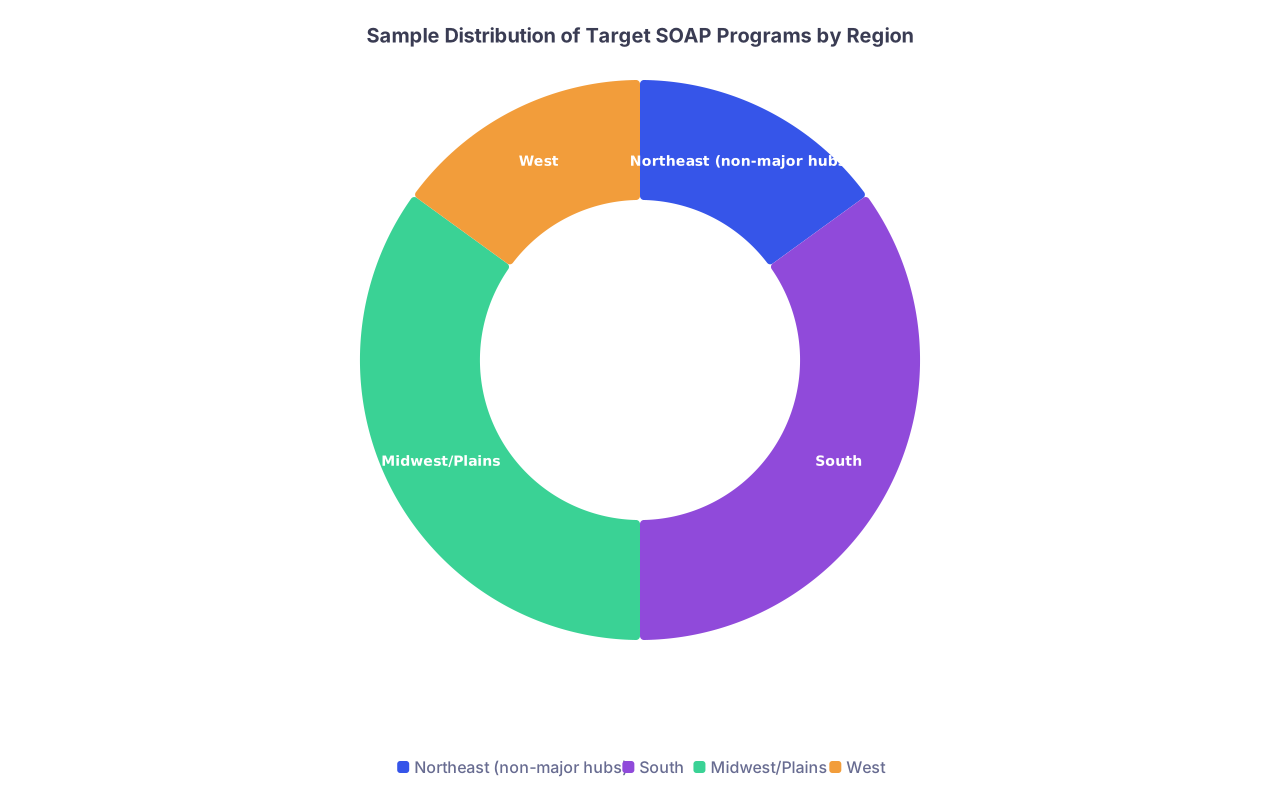
| Category | Value |
|---|---|
| Northeast (non-major hubs) | 15 |
| South | 35 |
| Midwest/Plains | 35 |
| West | 15 |
In plain English: concentrate most of your realistic SOAP hopes in the South and Midwest, with some options elsewhere, not the other way around.
Step 3: Understand That “Community” Does Not Mean “Bad”
I have watched applicants turn their nose up at community programs in the Midwest during SOAP, then fail to match altogether. The usual line is: “I do not want to be stuck in the middle of nowhere.”
But data on board pass rates and fellowship placements from many of these so-called “nowhere” IM programs looks absolutely fine. Some send graduates to solid cardiology, GI, and pulm/crit fellowships routinely.
What you are trading off:
- Possibly less research infrastructure
- Fewer big-name mentors
- Less urban nightlife
What you are gaining:
- A job, a visa path (for some), and a chance to prove yourself
- High-volume exposure to bread-and-butter medicine
- Time to build a CV for a future lateral move or fellowship
Step 4: Use Region As A First Filter During SOAP Chaos
When the SOAP list goes live, the mistake I see every year is panic-clicking:
- Applying to 45 programs in the same metro area that have essentially identical applicant preferences
- Ignoring higher-yield geographies because they are not familiar or “fun”
Instead, work region-first:
- Quickly scan for categorical IM/FM/psych/peds in:
- South
- Midwest
- Non-major Northeast (PA, upstate NY, etc.)
- Tag those as “high-yield” – they should get the bulk of your max 45 applications.
- Then fill remaining slots with:
- Prelim spots in high-desire cities if you are open to the prelim path
- A few targeted community programs on the coasts if they genuinely match your background
7. Special Situations: IMGs, DOs, and Red-Flag Applicants
The geographic SOAP map matters even more if you are not a “clean” US MD candidate.
IMGs (US and non-US)
Look at historical match data for IMGs by state and region. You will see:
- Higher IMG proportions in:
- New York (especially community hospitals)
- New Jersey
- Michigan
- Ohio
- Texas
- Several Southern states
During SOAP, IMGs who match are disproportionately landing in:
- Community IM/FM in Midwest/South
- New York/New Jersey community hospitals
- Certain Texas programs outside Austin/Dallas/Houston cores
So your SOAP list, as an IMG, should be even more aggressively skewed toward those IMG-friendly regions.
DO Applicants
DOs do better than IMGs but still face a tiered landscape.
- Midwest and South ACGME programs with prior DO residents → higher yield
- Some historically MD-dominated coastal programs → lower yield
Again, the state-level data shows DO concentration:
- Strong DO presence and acceptance in Ohio, Michigan, Pennsylvania, Missouri, Texas
- Less so in some high-status coastal programs
Mirror your SOAP strategy to those acceptance patterns.
Red-Flag Applicants (Fails, Gaps, Low Scores)
For you, location tolerance becomes your biggest lever. If you restrict to high-demand cities, your risk of going 0/45 is very high.
I have seen low-score or failed-Step applicants salvage a career by:
- Accepting a spot in a mid-size Southern or Midwestern city
- Completing residency, building a strong work record
- Then lateral-moving as an attending or pursuing fellowship
Geography is not permanent. Unmatched is.
8. The Bottom Line: Regions That Fill vs Regions That Do Not
If we distill everything into a simple decision lens, it looks like this:
| Region / Area | Likelihood of Categorical SOAP Spots | Typical Positions Available |
|---|---|---|
| Major West Coast metros | Very Low | Prelim IM/GS, rare categorical |
| Boston/NYC/DC top academics | Near Zero | Occasional prelim, almost no categorical |
| Broader Northeast (non-major) | Low–Moderate | Community IM/FM, some prelim |
| South (urban + rural) | High | Categorical IM/FM, some psych/peds |
| Midwest/Plains | High | Categorical IM/FM, prelims, some others |
| Rust Belt cities | Moderate–High | Community IM/FM, occasionally psych |
Use this as your mental model:
- Coasts and prestige hubs: Regions that fill. SOAP adds almost no categorical volume.
- South, Midwest, non-glam Northeast/Rust Belt: Regions that do not fully fill. This is where SOAP actually lives.
Final Takeaways
- SOAP is not a level national marketplace. The data shows clear geographic clusters of unfilled positions: the South, Midwest, and certain Rust Belt areas carry most of the real categorical opportunity.
- If you insist on tight geographic constraints in the most desirable metros, your categorical SOAP odds drop to near zero. Flexibility on location is the single strongest lever you control.
- A serious SOAP strategy starts weeks before Match: pre-identify high-yield regions and community programs, then allocate the bulk of your 45 applications there instead of chasing a handful of coastal prelim scraps.