
The biggest mistake applicants make in SOAP is guessing instead of calculating.
If you want to survive SOAP, you stop asking, “How many programs feels right?” and start asking, “What does the data say my risk-adjusted target number should be?”
Below is exactly that: a quantitative framework for deciding how many programs to target in SOAP, grounded in probabilities, constraints, and trade-offs.
1. The Reality Check: SOAP Is Not ERAS 2.0
SOAP is a compressed, high-pressure, supply–demand problem. You cannot just “apply broad” the way you did in the main ERAS cycle.
Key structural facts you are up against:
- SOAP application window is very short (usually a few hours).
- Applications are submitted in rounds, not all at once.
- Programs are filling vacancies with extreme time pressure.
- You cannot meaningfully customize 80+ applications in this window.
- Many unfilled positions cluster in a few specialties (IM, FM, psych, peds, prelim medicine/surgery).
The data from recent NRMP cycles show:
- Unfilled positions are overwhelmingly in less competitive specialties.
- Many SOAP applicants over-concentrate on 1–2 specialties and under-target volume.
- A meaningful proportion of SOAP-eligible applicants end the week without a position.
The conclusion is straightforward: you must balance three competing constraints:
- Probability of at least one interview and offer.
- Time and cognitive load to complete applications that are not garbage.
- Realistic specialty/program fit so that, if you match, you can live with the outcome.
That balance is where the “how many programs?” question lives.
2. A Probabilistic Framework: Stop Guessing, Start Modeling
Let me quantify the problem the way an analyst would.
Define:
- ( N ) = number of programs you apply to in SOAP
- ( p ) = independent probability that any one program leads to a real shot (interview + offer potential)
Assuming independence (not perfectly true, but directionally useful):
Probability of no viable opportunity from all ( N ) programs:
[ P(\text{zero}) = (1 - p)^N ]
Probability of at least one opportunity:
[ P(\geq 1) = 1 - (1 - p)^N ]
You care about ( P(\geq 1) ). Most applicants should target 80–95% confidence of at least one serious bite.
Now plug in realistic numbers.
For a typical SOAP candidate (unmatched, but US MD/DO, reasonable Step/COMLEX, applying to common SOAP specialties), a conservative per-program “real shot” rate might be:
- Stronger candidate: ( p \approx 0.10–0.15 )
- Average SOAP candidate: ( p \approx 0.05–0.10 )
- Weaker profile / multiple prior failures: ( p \approx 0.02–0.05 )
You will not know the exact ( p ). But you can choose a band based on your risk profile.
What the probabilities actually look like
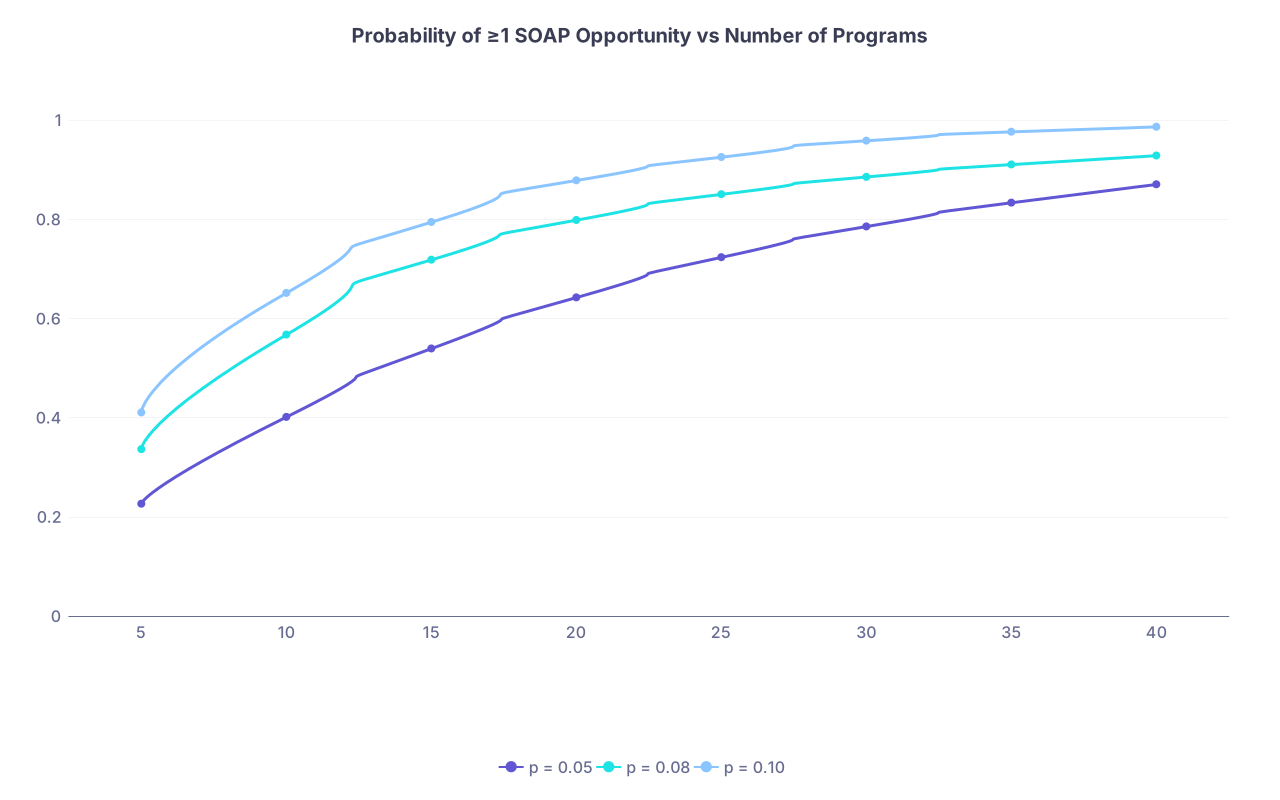
Let us fix three example p-values and see how many programs you need for 80–95% confidence of at least one viable opportunity.
| Category | p = 0.05 | p = 0.08 | p = 0.10 |
|---|---|---|---|
| 5 | 0.226 | 0.336 | 0.41 |
| 10 | 0.401 | 0.567 | 0.651 |
| 15 | 0.539 | 0.718 | 0.794 |
| 20 | 0.642 | 0.798 | 0.878 |
| 25 | 0.723 | 0.85 | 0.925 |
| 30 | 0.785 | 0.885 | 0.958 |
| 35 | 0.833 | 0.91 | 0.976 |
| 40 | 0.87 | 0.928 | 0.986 |
Interpreting this chart:
- If ( p = 0.05 ):
- 20 programs → ~64% chance of at least one shot
- 40 programs → ~87%
- If ( p = 0.08 ):
- 20 programs → ~80%
- 30 programs → ~89%
- If ( p = 0.10 ):
- 20 programs → ~88%
- 30 programs → ~96%
The math says something very clear:
For a typical SOAP candidate, the “right” number of programs is rarely below 20 and often in the 25–40 range, if you can handle it logistically.
That is the statistical anchor. Now we layer real-world constraints.
3. The Three Key Constraints: Time, Fit, and Supply
You do not operate in a vacuum. You operate in a 48–72 hour chaos window where everyone is panicking.
3.1 Time and cognitive bandwidth
SOAP weeks I have watched up close look like this:
- You get the list of unfilled positions. Dozens to hundreds of potentially relevant programs.
- You scramble to shortlist, check websites, confirm visa policies, read faculty pages.
- You draft or tweak multiple versions of your personal statement.
- You answer program-specific questions in portals or ERAS variations.
- You coordinate with advisors, update CVs, request last-minute letters or uploads.
If you target 50+ programs, the probability your application quality tanks is high. Generic, sloppy, misaligned applications lower your per-program p dramatically.
Rough practical capacity (for one reasonably efficient person, with some prep done in advance):
- 10–15 programs: high customization possible.
- 20–30 programs: moderate customization, targeted but not perfect.
- 35–45 programs: light tailoring, substantial copy-paste, risk of errors.
- 50+ programs: mostly generic, increased error rate, often counterproductive.
So there is a clear non-linear trade-off:
- More programs ↑ → nominal probability coverage ↑
- But per-program p ↓ if quality drops
Optimal zone for most: 25–40 applications, with pre-work done before Match Week.
3.2 Specialty and program fit
You are also constrained by what is actually available.
Unfilled positions concentrate in a few buckets:
- Categorical IM, FM, peds, psych (mid-tier community programs, rural or underserved areas)
- Prelim medicine and surgery
- Transitional year (variable)
- A small handful of other specialties each year, often with specific quirks
You might want 50 programs in categorical psychiatry. The SOAP list might give you 11 that fit your visa status and geography. The universe itself caps N.
So you often end up assembling a composite list:
- Your target categorical specialty (e.g., psych, IM): maybe 10–25 programs
- Secondary categorical backup (e.g., FM, peds): 5–15 programs
- Prelim / transitional options: 5–15 programs
3.3 Supply/demand reality across specialties
Certain specialties in SOAP have very different per-program p values. Roughly:
- FM, IM (community, underserved, rural): higher p for most SOAP applicants.
- Peds, psych: moderate p, but still better than main cycle.
- Prelim medicine/surgery: reasonable p, but less secure long-term.
- Highly competitive categorical fields (derm, ortho, ophtho): p is close to zero for SOAP if you went unmatched.
If you stubbornly restrict yourself to one semi-competitive specialty in SOAP, your p might be 0.02–0.03 instead of 0.05–0.10. That dramatically changes how many programs you need.
4. Translating Data into Actual Targets
Let us make this concrete. Here is a structured way to choose N.
Step 1: Estimate your personal p-band
Use your profile honestly:
- US MD, strong scores (Step 1 pass + Step 2 CK ≥ 240), no professionalism issues, good letters → ( p \approx 0.10–0.15 ) in common SOAP specialties.
- US DO or US MD with some red flags, average scores, but reasonable application → ( p \approx 0.05–0.10 ).
- US-IMG/Non-US IMG, lower scores, repeated attempts, or major red flags → ( p \approx 0.02–0.06 ).
You do not need precision. You need to know: am I in the 0.03 range or the 0.10 range?
Step 2: Choose your target confidence level
You decide how risk-averse you are:
- Aggressively risk-averse: aim for ≥ 95% chance of at least one bite.
- Moderately risk-averse: aim for 85–90%.
- Very limited bandwidth or late prep: you may be forced into 70–80%.
Step 3: Solve approximately for N
You can do the math explicitly:
[ N = \frac{\ln(1 - P_{\text{target}})}{\ln(1 - p)} ]
Or just use the approximations from the earlier chart. Let’s summarize as a table.
| Estimated p per program | 80% confidence | 90% confidence | 95% confidence |
|---|---|---|---|
| 0.03 | ~54 | ~76 | ~99 |
| 0.05 | ~32 | ~45 | ~59 |
| 0.08 | ~20 | ~28 | ~37 |
| 0.10 | ~16 | ~22 | ~29 |
You can see why many applicants feel like they are drowning in SOAP. If your realistic p is 0.03, the math says you would “want” 75–100 programs for 90–95% confidence.
But time and quality constraints make that impossible.
Therefore you must:
- Move your p up (better targeting, better fit, stronger materials).
- Accept lower confidence than you would mathematically like.
- Or dramatically broaden to prelim/transitional/categorical in other fields with higher p.
5. Recommended Ranges by Profile and Strategy
Let me give you practical bands, not hand-waving.
These assume you have at least some prep done before Match Week (updated CV, several personal statement variants, a spreadsheet of candidate programs).
5.1 Strong but unlucky applicant
Profile:
- US MD or DO
- Step 2 CK ≥ 240 (or COMLEX equivalent)
- No major red flags
- Unmatched possibly due to: over-competitive specialty, geographic restriction, or bad interview season
Your likely ( p ) in common SOAP specialties (IM, FM, peds, psych) is closer to 0.10.
Reasonable target:
- Total programs: 20–30
- Structure something like:
- 10–15 in your top realistic categorical field (e.g., psych, IM)
- 5–10 in a second categorical field (FM, peds, IM)
- 3–7 prelim/transitional if applicable
With ( p \approx 0.10 ):
- 20 programs → ~88% chance
- 25 programs → ~93%
- 30 programs → ~96%
That is an excellent risk profile without drowning yourself.
| Category | Value |
|---|---|
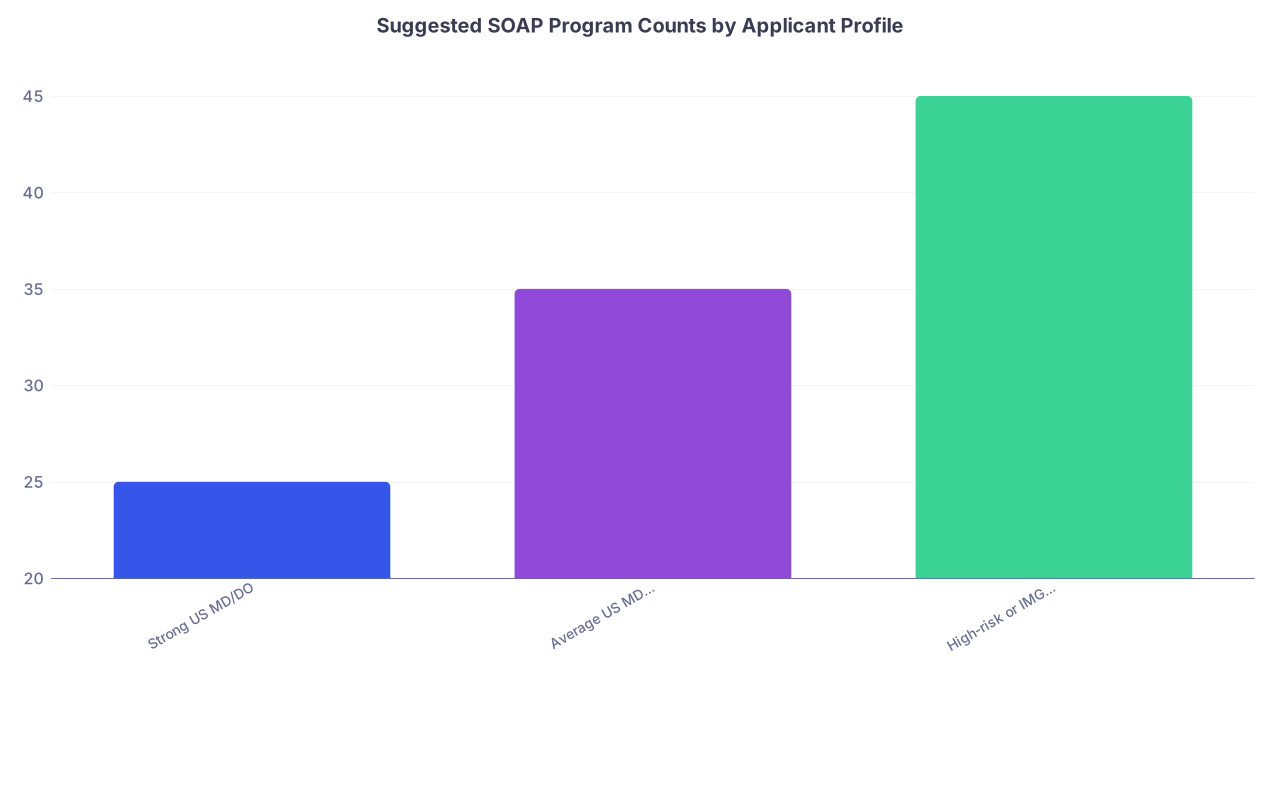
| Strong US MD/DO | 25 |
| Average US MD/DO or US-IMG | 35 |
| High-risk or IMG with red flags | 45 |
5.2 Average SOAP applicant
Profile:
- US MD/DO or US-IMG with decent scores
- Step 2 CK roughly 225–240
- No catastrophic red flags, but application not obviously stellar
- Applied to moderately competitive fields and struck out
Your operational ( p ) is probably 0.05–0.08.
Recommended:
- Total programs: 30–40
- Example mix:
- 10–15 in your preferred categorical (if still realistic)
- 10–15 in high-need categorical (FM, IM community, peds, psych)
- 10–15 in prelim/transitional where you would actually be willing to go
At ( p = 0.06–0.07 ):
- 30 programs → ~84–88% chance
- 35 programs → ~89–92%
- 40 programs → ~92–95%
This is the range where the data and real-world constraints actually line up decently if you prepared.
5.3 High-risk or low p applicant
Profile:
- Non-US IMG, low scores, or prior attempts
- Significant red flags (repeated fails, professionalism issues)
- Or extremely narrow specialty/geography constraints
Your p may be 0.02–0.05 even for “friendly” programs.
The blunt truth: the math-driven answer (60–90 applications) is not logistically realistic to do well.
What to do:
- Target range: 35–50 programs, but not 80+.
- Aggressively pursue:
- FM, IM, peds in rural/underserved communities
- Prelim medicine/surgery where your background fits
- Accept lower target confidence, maybe 70–85% at best.
- Invest heavily in raising p rather than just raising N:
Tailored emails (when allowed), very program-specific PS, strong advisor calls if possible.
6. Portfolio Construction: How to Distribute Those Programs
You are not just choosing N. You are deciding what those N programs are.
A useful framework is to treat SOAP like an investment portfolio:
- “Safer” options (higher p, maybe less ideal location/setting).
- “Stretch” options (lower p, more desirable).
- “Backup structure” options (prelim/transitional vs categorical).
I have seen effective lists follow something like this 50/30/20 model:
- 50%: High-yield, high-need categorical (FM, IM, peds, psych).
- 30%: Your first-choice realistic categorical specialty.
- 20%: Prelim/transitional or other logically coherent plan B.

| Step | Description |
|---|---|
| Step 1 | Start SOAP Planning |
| Step 2 | Emphasize FM/IM/Peds/Psych |
| Step 3 | Include target specialty plus backups |
| Step 4 | 50 percent high yield categorical |
| Step 5 | 30 percent preferred specialty |
| Step 6 | 20 percent prelim or transitional |
| Step 7 | Total 25-40 programs for most |
| Step 8 | Primary Goal |
The point is simple: if you burn 30 applications on long-shot, brand-name academic programs that rarely take SOAP candidates, you artificially lower your effective p and all the prior math collapses.
7. Execution Strategy: How to Actually Handle 25–40 Programs
It is one thing to say “Apply to 35 programs.” It is another to survive the process.
Here is the operational playbook I have seen work.
7.1 Pre-SOAP prep (before Match Week)
By early February, you should have:
- A spreadsheet with:
- All programs in your realistic SOAP specialties
- Columns for “geography OK?”, “visa status compatible?”, “mission fit?”, “would I actually go?”
- 2–3 variants of your personal statement:
- Internal medicine–focused
- FM/peds/psych–focused
- Prelim/transitional–focused
- Updated CV and ERAS info polished and tightly edited
- Document templates for quick, light customization
That prep raises p and lets you scale N without chaos.
7.2 SOAP week triage
When the unfilled list drops:
Filter your spreadsheet fast for:
- Open positions
- Your visa/sponsorship requirements
- Dealbreaker geography (if any)
Score each potential program (1–5) for:
- Fit
- Likelihood of them considering you
- Your genuine willingness to go
Start building your list:
- Top tier: likely 10–15 programs, high fit and high willingness
- Middle tier: another 10–20 programs, acceptable compromise
- Backstop tier: 5–10 prelim/transitional or less ideal, but still acceptable

This triage process keeps you from wasting N on programs that will not actually move your probability needle.
7.3 Application quality control
As you scale up to 30–40:
- Use modular paragraphs in your PS that can be swapped to mention:
- Community focus vs academic interest
- Specific interest in underserved populations
- Continuity of care vs hospital-based medicine
- Double-check:
- Program names and locations in any customized segments
- Specialty alignment (do not send psych-focused PS to FM programs)
- No obvious copy-paste errors
You are maximizing expected value: N × p. Sloppy applications tank p and quietly destroy the whole model.
8. How Many Programs to Target in SOAP: Condensed Recommendations
Let me stop dancing around and state it cleanly.
For most SOAP applicants:
- Below 15 programs: statistically fragile unless your p is very high.
- 20–25 programs: reasonable for strong US MD/DO with good p.
- 25–35 programs: the sweet spot for average SOAP candidates who have prepped.
- 35–45 programs: appropriate for higher-risk applicants if you have robust pre-work and can maintain quality.
50 programs: usually a sign of panic, not strategy, and often lowers your effective p.

One more layer of reality: the available programs list might cap you. If there are only 22 programs that meet your minimum constraints and you have already stretched on geography, you may simply stop at N = 22 and aim to drive p as high as possible through tight fit and customization.
9. Common Bad Strategies (By the Numbers)
A quick list of things the data — and outcomes — show are bad bets.
“All or nothing in my dream specialty.”
If that dream specialty has a tiny number of SOAP spots and historically takes very few SOAP candidates, your p is near zero. Eight beautifully crafted applications with p ≈ 0.01–0.02 is mathematically suicidal.“Spray 70+ generic apps everywhere.”
Your initial thought: “N is huge, so my odds are great.”
Reality: quality cratered, p dropped from maybe 0.06 to 0.01–0.02. Effective expected value barely improves, and you burn yourself out.“Only programs in three cities I like.”
Geography constraints can easily cut the candidate pool in half or worse. You might drop from N = 30 to N = 9 and pretend your chances are unchanged. They are not. You slashed N without raising p.“Avoiding prelim/TY entirely when categorical options are thin.”
For some candidates, prelim/TY spots are where p is actually non-trivial. Ignoring them can slash your total “probability mass” even if N stays similar.

The pattern is consistent: ignoring either N or p — treating one as fixed and the other as irrelevant — leads to predictable failure.
10. Final Synthesis
Here is the distilled version of everything above.
- The data and simple probability models show that, for most SOAP applicants, a target of 25–40 programs gives a sensible balance between risk reduction and application quality.
- Your personal target should scale with your estimated per-program success probability p: the lower your p, the higher your N, within the limits of what you can do well.
- Maximizing your chance of success is not just about applying to more programs; it is about optimizing N × p through smart specialty mix, realistic targeting, and pre-SOAP preparation that lets you move fast without sending garbage.