
The usual SOAP advice about “just grab any prelim and figure it out later” is statistically reckless.
If you are deciding between a categorical and a prelim position in SOAP, you are not making a philosophical choice. You are making a probability tradeoff with very different 3–5 year outcome curves. And the data are not subtle.
I am going to walk through what the numbers actually show: fill rates, re-match chances, specialty competitiveness, and realistic risk–benefit profiles. Then I will translate that into concrete rules: when you should prioritize a categorical spot even if the specialty is not your dream, and when a prelim year is a rational gamble instead of self-sabotage.
1. The Ground Reality: What SOAP Positions Actually Look Like
Strip away the comforting stories; look at the distributions.
Each year in the NRMP Main Residency Match:
- Roughly 48,000 applicants compete for about 41,000 PGY-1 positions.
- Nearly all U.S. MD seniors match somewhere (around 93–94 percent).
- The vast majority of SOAP participants are:
- Unmatched U.S. MD/DO seniors
- Previous-year grads and IMGs
- Applicants to highly competitive specialties who did not rank enough backup programs
By the time SOAP opens:
- Most categorical positions in competitive and mid-competitive specialties are gone.
- The SOAP pool skews toward:
- Internal Medicine (categorical)
- Family Medicine (categorical)
- Pediatrics (categorical, limited)
- Psychiatry (fewer but present)
- Transitional Year (TY) / Prelim Medicine / Prelim Surgery
- Occasional prelims tied to advanced spots, but many free-standing prelims
Here is a stylized but representative breakdown of SOAP-available slots by type, using typical NRMP supplemental data patterns:
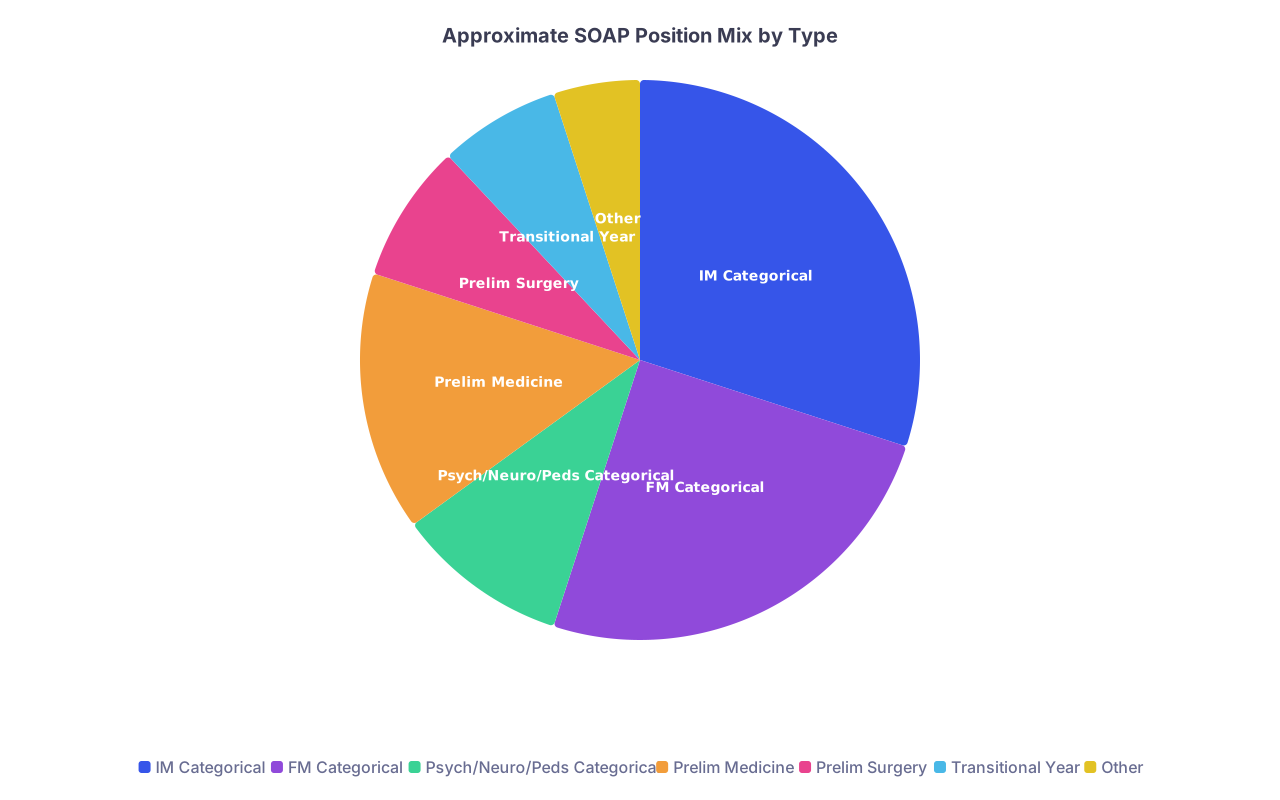
| Category | Value |
|---|---|
| IM Categorical | 30 |
| FM Categorical | 25 |
| Psych/Neuro/Peds Categorical | 10 |
| Prelim Medicine | 15 |
| Prelim Surgery | 8 |
| Transitional Year | 7 |
| Other | 5 |
The exact numbers shift annually, but the pattern is stable: SOAP is dominated by primary care categorical and medicine/surgery prelim.
That baseline matters. Because your decision is rarely “Derm categorical vs Derm prelim.” It is usually “Primary care categorical vs prelim year to re-attack a competitive (or even moderately competitive) specialty.”
2. Categorical vs Prelim: What You Are Actually Buying
Categorical position = you have a full training pathway to board eligibility in that specialty at that program (e.g., IM categorical 3 years, FM 3 years, Psych 4 years).
Prelim position = 1 year only, usually:
- Prelim Medicine
- Prelim Surgery
- Transitional Year (TY)
Unless this prelim is explicitly linked to an advanced position you already matched (e.g., matched Radiology but SOAPing a prelim because your original prelim fell through), you are betting on your ability to secure a PGY-2+ position later.
Data reality: postgraduate re-applicants to the Match have lower match rates than first-time seniors in almost all specialties. So a prelim + re-match pathway is not neutrally “delayed”; it is probabilistically worse.
To make this concrete, compare general match probabilities (approximate, aggregated from recent NRMP data):
| Specialty | US MD Senior Match % | Independent Applicant Match %* |
|---|---|---|
| Internal Medicine | 96–98 | 55–70 |
| Family Medicine | 94–97 | 60–75 |
| Psychiatry | 90–95 | 45–65 |
| General Surgery (Cat) | 80–85 | 25–40 |
| Anesthesiology | 85–90 | 45–65 |
| Radiology (DX) | 80–85 | 40–55 |
*Independent applicants = everyone not a current US MD senior: prior grads, IMGs, re-applicants, prelim/TY grads, etc.
When you SOAP into a prelim and try again next year, you move from the “US MD senior” group into the “independent” group. That is the biggest structural penalty in this entire discussion.
3. The Risk Profile of Prelim SOAP Positions
3.1 The real probability tree
People talk about prelim years like a temporary inconvenience. The data say otherwise.
For a US MD/DO SOAPing into a free-standing prelim spot to later get categorical in a competitive or even moderately competitive specialty, your path looks like this:
- Year 0: You fail to match.
- SOAP: You grab a prelim (often Medicine or Surgery).
- Year 1:
- Work 60–80 hours/week
- Try to repair your application (research, letters, Step 3, etc.)
- Re-apply as an independent applicant.
- Year 2 Match Outcome:
- Best case: Match into desired specialty (PGY-2 advanced or categorical).
- Middle case: Match into a different categorical than you intended.
- Worst case: Do not match again → now a prelim grad with no slot.
Let us put crude but realistic probabilities on this for someone who:
- Was a borderline candidate
- Failed to match once
- Does a solid but not superstar prelim year
These are broad estimates derived from NRMP outcomes for independent applicants, filtered through what I have seen repeatedly:
- P(match into original competitive specialty) after prelim: 20–40%
- P(match into some categorical spot at all, even if different specialty): 50–70%
- P(remain unmatched or forced into another prelim/re-search year): 20–40%
Even if we take generous midpoints:
- 30% → dream specialty
- 30% → different but acceptable categorical
- 40% → still in limbo
Those are not casino odds you would take lightly.
3.2 The time and burnout cost
The workload during prelim/TY years is not theoretical.
Surveys and program schedules show:
- Many prelim Medicine and Surgery programs run:
- 60–80 hours/week typical
- 6 days/week
- Often heavier call and scut than categorical peers, because:
- Prelims are “one-year-only” and often used as service workhorses.
- Programs know you are not staying. They invest less in your long-term development and more in “get the work done.”
You are trying to rebuild your CV in that context—research, re-taking exams, networking, interviewing (if you get invites). I have watched prelim interns scrambling to answer ERAS messages between pages about GI bleeds. It is not hypothetical.
There is also an opportunity cost: each year not in a categorical trajectory delays your attending income by at least one year and may reduce your eventual career earnings in subtle ways.
4. The Stability Advantage of Categorical SOAP Positions
Now flip the frame.
If you take a categorical SOAP position in a less competitive specialty (often IM/FM/Psych), your outcome tree looks very different.
For most US MD/DO grads who enter a primary care categorical program in SOAP:
- P(completing residency and becoming board-eligible) is exceedingly high: 90%+ in most programs that are not absolute disasters.
- P(being left without a path to board certification) is extremely low unless you choose to leave or have severe recurring performance issues.
The advantage is binary: once you are in a categorical program, the default is success unless you actively derail.
And that is before counting the upside flexibility, which people consistently underestimate.
4.1 Internal Medicine categorical: the most underrated SOAP win
Internal Medicine categorical is statistically your most flexible SOAP “safety net.”
Program length: 3 years.
Post-residency options (data-driven highlights):
- Hospitalist positions: abundant regardless of fellowship.
- Outpatient primary care: stable demand, especially community/rural.
- Fellowships with realistic chances for mid-range candidates:
- Cardiology, GI, Heme/Onc are highly competitive.
- But Pulm/CC, Endocrine, Nephrology, ID, Geriatrics, Palliative, Hospital Medicine fellowships often have reasonable fill rates and accept a wide range of applicants.
- Academic paths: easier to build modest research portfolio during residency than as a prelim.
Once you complete IM residency:
- Your floor income as a hospitalist/primary care physician in most U.S. markets is solidly in the six figures.
- You are not re-applying to the Match again. You are job-hunting, which has a much higher ceiling on “second chances.”
4.2 Family Medicine and Psychiatry categorical
These have slightly different profiles but similar stability:
- High match rates
- Strong community demand
- Multiple practice models (outpatient, integrated systems, telehealth, etc.)
Again: once you are in and progressing, the risk of “no career” drops sharply.
5. When a Prelim SOAP Position Is Rational
Prelim is not always a mistake. But the situations where it is a rational strategy are narrower than students like to believe.
Here are the scenarios where the data and lived outcomes align in favor of prelim:
5.1 You already have an advanced position secured
Example: You matched into Diagnostic Radiology or Anesthesiology (advanced), but your assumed prelim year did not materialize (rare but can happen). Or you scrambled for a different prelim after changes.
In this case:
- You are not gambling on a second Match.
- The prelim is simply a required year to bridge you to a guaranteed PGY-2+.
- Rational choice: grab a prelim (or TY) that is survivable and ideally supportive.
Risk: mostly limited to burnout, not career annihilation.
5.2 You are dead set on a specific competitive field and accept serious risk
Classics: Dermatology, Plastic Surgery (integrated), Neurosurgery, Ortho, ENT.
Here, data clarity:
- These specialties have:
- Very high average scores.
- Heavy research expectations.
- Low fill rates for independent applicants.
- After failing once, your re-match odds—even with a prelim year—are not comforting.
But if your utility curve is extreme (“I would honestly rather risk no residency than do FM”), then a prelim might be your rational, self-aware gamble.
You should go into this with eyes open:
- Expect at least:
- 1 year prelim + 1 year re-application cycle
- Non-trivial chance of still failing → multiple turns in the Match
- Financial and emotional cost escalates quickly after one failed second attempt.
In raw decision terms: this is a high-variance, high-risk, high-reward bet. It is not data-driven “smart”; it is values-driven persistence.
5.3 You have very strong objective metrics but strategic failure
Sometimes I see this pattern:
- Step 1/2: outstanding.
- Solid research in a competitive specialty.
- But catastrophic strategy:
- Applied to far too few programs.
- Strong geographic limitation.
- Personal emergency that disrupted interviews.
For that narrow slice, a prelim year plus a corrected application strategy can actually produce very high re-match odds, even into the original field.
Still, even in this group, a SOAP categorical in IM/Psych with later fellowship might get you to a very similar career endpoint with less volatility.
6. Quantifying the Tradeoff: A Simple Expected-Outcome Frame
Let us formalize.
Assume you are SOAPing with these two realistic offers:
- Option A: Categorical Internal Medicine at a mid-tier community program.
- Option B: Prelim Medicine at a large academic center, hoping to match Anesthesia or Radiology later.
Key variables:
- P_cat_IM = probability of successfully completing IM residency once you start.
- P_Remapch_desired = probability of eventually matching desired specialty after prelim.
- P_Remapch_any = probability of eventually matching any categorical specialty after prelim.
- U_IM = your utility (satisfaction + income + lifestyle) for being an IM-trained physician.
- U_desired = your utility for being in your dream specialty.
- U_none = your utility for “no residency / delayed and uncertain career” (this is very negative).
From data plus experience, we can plug approximate ranges:
- P_cat_IM ≈ 0.9–0.95 (most people who start finish).
- P_Remapch_desired after prelim in a competitive field ≈ 0.2–0.4.
- P_Remapch_any after prelim ≈ 0.6–0.7 total probability (meaning 30–40% never stabilize).
You do not need precise numbers. The shape is obvious:
- Option A (IM categorical) has probability mass concentrated in “stable attending career.”
- Option B (prelim) spreads mass across “dream specialty,” “different but fine,” and “nothing.”
If you weight outcomes:
- For a risk-averse applicant who sees U_none as catastrophic, Option A dominates.
- For a risk-seeking applicant who values U_desired enormously higher than U_IM and tolerates catastrophic downside, Option B may feel justified.
The point: you are not comparing IM vs Anesthesia in a vacuum. You are comparing:
- 90%+ chance of IM attending vs.
- 20–40% chance of dream / 20–40% chance of okay / 20–40% chance of long-term trouble
Once you see it in that structure, “grab any prelim” looks less like gritty persistence and more like hidden risk tolerance posing as optimism.
7. Year-by-Year Dynamics: What Actually Happens After Each Path
To make this less abstract, lay out a 3–5 year timeline.

| Step | Description |
|---|---|
| Step 1 | SOAP - Unmatched |
| Step 2 | Accept Categorical IM/FM/Psych |
| Step 3 | Accept Prelim Med/Surg/TY |
| Step 4 | PGY1 Categorical |
| Step 5 | PGY2 Categorical |
| Step 6 | PGY3 Categorical |
| Step 7 | Board Eligible Attending or Fellowship |
| Step 8 | Prelim Year Work |
| Step 9 | Reapply as Independent |
| Step 10 | PGY2 Desired Field |
| Step 11 | PGY1 or PGY2 Different Specialty |
| Step 12 | Unmatched Again |
| Step 13 | Residency Completion |
| Step 14 | Residency Completion |
| Step 15 | Research/Gap/Reapply Again |
Two key observations from watching these trees play out in real people:
- The categorical path compounds stability. Every year you progress, your risk of career collapse falls.
- The prelim path compounds stress. If you do not match on the second try, your application becomes harder to “explain,” not easier.
8. Strategic Rules: How to Decide in SOAP Under Time Pressure
SOAP is chaotic. Phones ringing, advisors half-available, emotions running hot. You need simple, data-consistent rules.
Here is the distilled strategy I would use for most US MD/DO seniors without an advanced spot already lined up:
If you receive any reasonably solid categorical offer in IM, FM, or Psych at a non-toxic program → that is your default choice.
- Especially true if your scores and CV are not clearly competitive for your dream field on national medians.
- “Non-toxic” here means: not notorious for 30–40% attrition, not chronically on probation, not with universally terrible resident feedback.
Use a pure prelim strategy only if you can honestly say:
- “I am willing to accept a 20–40% chance of never landing my dream or any residency,”
- and
- “I have metrics and experiences that put me solidly in the competitive band for my desired field, and my failure to match was clearly strategic, not academic.”
If you land both a categorical in a non-dream field and a prelim in a Top X academic center → do not overvalue the logo.
- I see this mistake constantly: picking a big-name prelim over a mid-tier categorical “just for prestige.”
- Brand prestige does not compensate for a 2–3x higher risk of long-term instability.
If you already matched an advanced position → take the prelim / TY that best balances survivable workload and decent training.
- Your risk is much lower; now you are optimizing for quality of life and skill-building, not survival.
To put hierarchy visually:
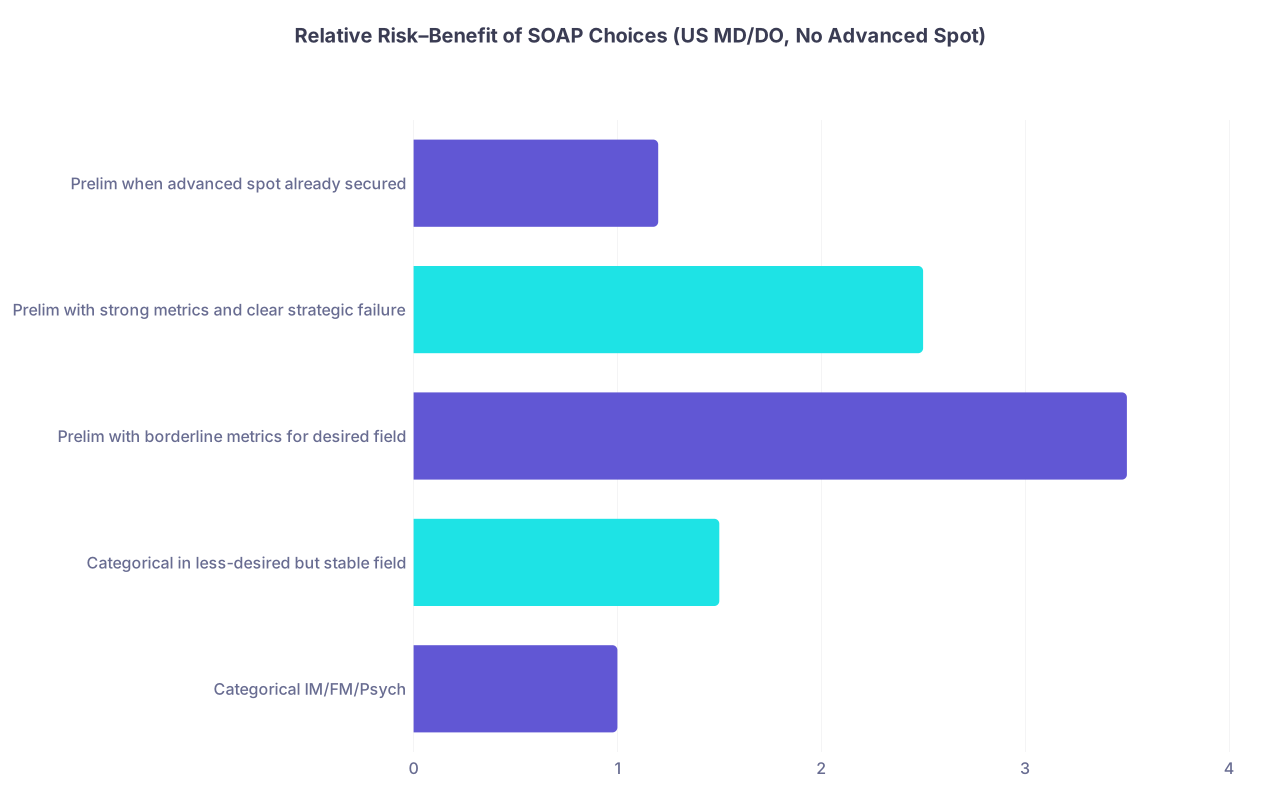
| Category | Value |
|---|---|
| Categorical IM/FM/Psych | 1 |
| Categorical in less-desired but stable field | 1.5 |
| Prelim with borderline metrics for desired field | 3.5 |
| Prelim with strong metrics and clear strategic failure | 2.5 |
| Prelim when advanced spot already secured | 1.2 |
Interpretation:
- Lower numbers = better risk–benefit profile (less overall risk adjusted for benefit).
- A straight categorical in a stable field is almost always lower risk than a free-standing prelim when you do not already hold an advanced position.
9. A Few Myth Busts You Need to Ignore During SOAP
You will hear confident statements in group chats and from panicked classmates. Some are just wrong on the data.
“Any prelim at a big-name place is better than a categorical at a small community program.”
False in most survival calculations. Unless the big-name prelim almost guarantees a direct line into your dream specialty (rare), the community categorical usually wins long-term.
“If I do well in prelim, programs will line up to take me.”
Not backed by numbers. Programs have limited categorical spots and their own feeder pipelines. A glowing prelim evaluation is helpful, but it is not a magic key. You are still in the independent applicant pool, competing with fresh seniors and other re-applicants.
“I can always switch from categorical FM/IM into my dream specialty later.”
Switching from one filled categorical to another is non-trivial. Open PGY-2+ spots in competitive fields are rare. It happens, but counting on it is like counting on lateral hires into FAANG without a clear track record. Possible—yes. Baseline strategy—no.
10. Bottom Line: What the Data Say You Should Do
If you strip away the narratives, this is what the numbers and actual outcomes converge on:
Categorical SOAP positions, especially in IM/FM/Psych, massively reduce your probability of long-term career failure compared with free-standing prelim spots when you do not already hold an advanced position.
Prelim SOAP paths are high-variance bets that only make sense if you either:
- Already have an advanced PGY-2+ position secured,
- Or consciously accept a significant probability of never landing your dream or any residency in exchange for a shot at a very specific goal.
If you want to “play the odds,” you go categorical. If you want to “swing for the fences” and live with the possibility of striking out entirely, you go prelim. Just be honest about which game you are actually choosing.