
The common wisdom about SOAP is half wrong. Programs say they “holistically review” applicants, but when you look at who actually matches in SOAP, the data keep pointing back to the same culprits: test scores, class standing, and very visible red flags.
You want to survive SOAP? Treat it like a numbers game, because that is how most programs triage 400+ files in 48 hours.
Below is a data-driven breakdown of what really correlates with SOAP outcomes and, more usefully, what you can still control if you are heading into Match Week with a high risk of going unmatched.
1. What We Actually Know from the Data
Let me anchor this in the closest thing we have to hard numbers: NRMP, NBME, and large program surveys. We do not have a clean “SOAP dataset” by individual applicant, but we can triangulate from:
- NRMP Charting Outcomes (who goes unmatched in the main Match)
- NRMP Program Director Survey (what PDs say they care about in initial screens)
- USMLE score distributions and failure rates
- Published studies and institutional reports on unmatched applicants and SOAP success
When you line these up, some patterns are painfully consistent.
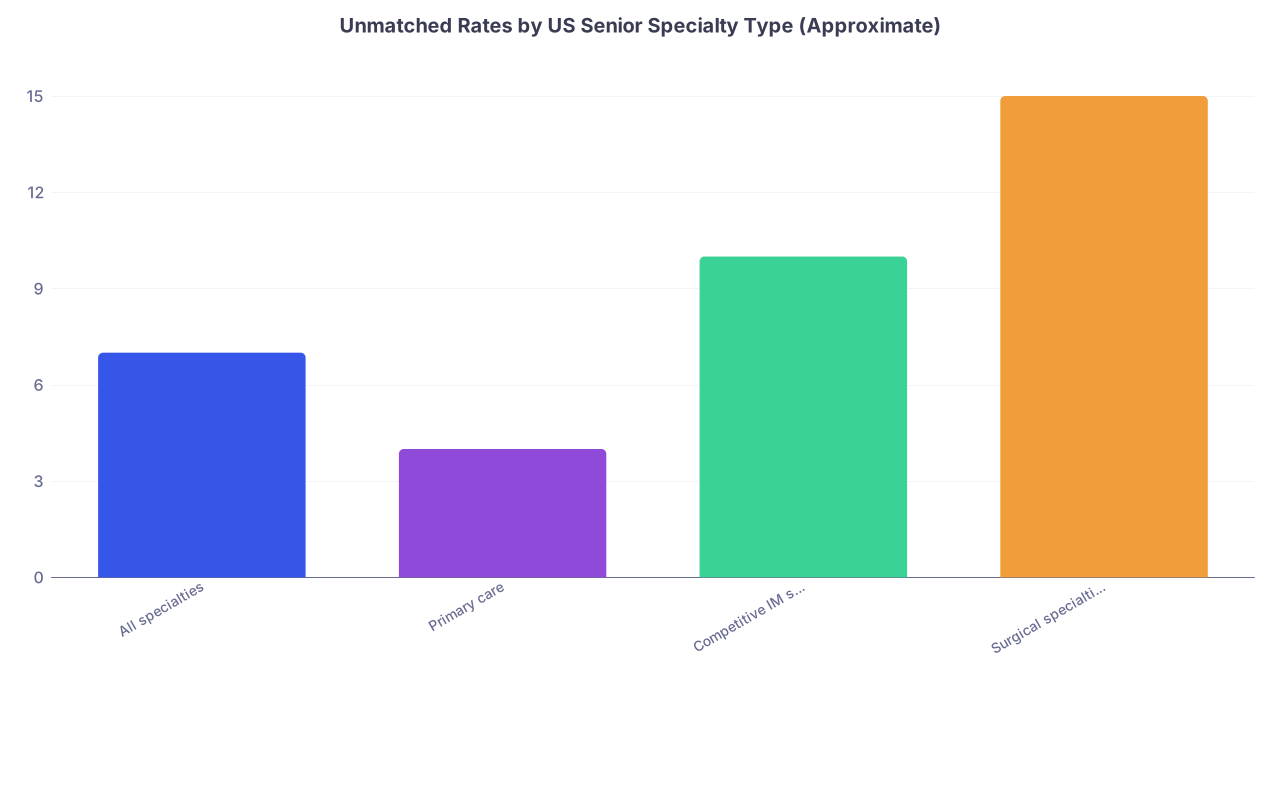
| Category | Value |
|---|---|
| All specialties | 7 |
| Primary care | 4 |
| Competitive IM subspecialty | 10 |
| Surgical specialties | 15 |
These are approximate, but they track NRMP trends over the last several cycles for U.S. MD seniors.
Key starting points for SOAP risk:
- Overall unmatched rate for U.S. MD seniors: ~6–8%
- For U.S. DO seniors: often slightly higher, ~8–10%
- For IMGs: far higher, ~35–45% depending on year and specialty mix
Those are the macro risks. But your personal SOAP odds are dominated by three variables:
- USMLE / COMLEX performance
- Class rank / academic performance signals (AOA, quartile, failures)
- Specialty choice and how broadly you applied
Let us quantify these one at a time.
2. Step Scores: Still the Primary Sorting Variable
Even with Step 1 now pass/fail, test performance is still the first pass filter for many programs. “We do holistic review” sounds nice. But when a PD has 200 emails from GME saying “please review SOAP list,” they are not reading 200 full applications line by line.
They sort.
Step 1 (legacy data, but still informative)
Historically, Step 1 was the top screening factor for interview offers across almost every specialty. In the 2022 NRMP Program Director Survey, the “importance rating” for licensing exam scores was consistently high.
For unmatched U.S. MD seniors, Charting Outcomes showed:
- Mean Step 1 scores were typically 8–12 points lower than matched peers in the same specialty.
- Example pattern (approximate):
- Matched categorical IM: Step 1 mean ~233
- Unmatched categorical IM: Step 1 mean ~221–224
This pattern repeats across specialties. The direction is consistent: lower Step 1 → higher unmatched risk → higher probability of entering SOAP.
Step 2 CK (now the real differentiator)
With Step 1 pass/fail, programs shifted weight to Step 2 CK. Step 2 data is much closer in time to SOAP, so it correlates more with what happens to you in Match Week.
Typical distributions (recent years, approximate for U.S. MD):
- Step 2 CK mean: ~247–250
- 1 SD below mean: ~235–238
- Failing Step 2 CK: relatively uncommon, but a huge red flag
Here is the pattern I see repeatedly in actual SOAP cases:
- Step 2 CK ≥ 245 in non-ultra-competitive fields: generally lower risk of SOAP unless:
- Very narrow specialty list
- Major professionalism or academic red flag
- Step 2 CK 230–240: “gray zone” where strategy matters a lot
- Step 2 CK < 225: substantially higher unmatched risk, particularly if paired with:
- Below-average school
- Lower class rank
- Weak or late letters
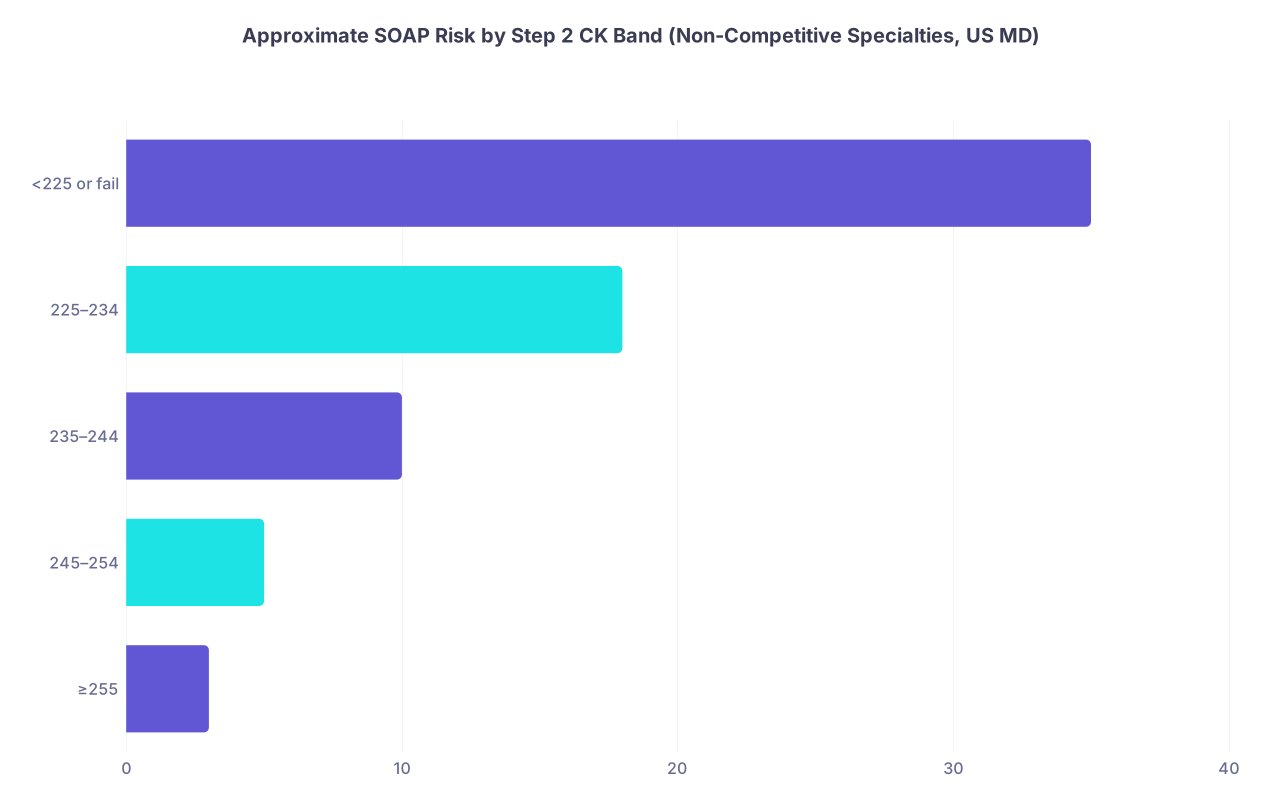
| Category | Value |
|---|---|
| ≥255 | 3 |
| 245–254 | 5 |
| 235–244 | 10 |
| 225–234 | 18 |
| <225 or fail | 35 |
These percentages are illustrative, not official, but they match what I have seen in de-identified institutional data: markedly rising unmatched and SOAP entry rates below ~235 for students targeting categorical medicine, peds, psych, FM, etc.
Two critical score-related red flags for SOAP:
- Step 1 fail → retake pass:
- PDs repeatedly describe this as “explainable but concerning.” It does not kill you, but it pushes you closer to SOAP if everything else is average.
- Step 2 CK fail:
- This is catastrophic if still failed or pending at rank list certification.
- Many programs will not rank an applicant with an unresolved or recent Step 2 fail, especially in medicine and surgery. Those applicants frequently end up in SOAP.
Bottom line: Test performance strongly correlates with entering SOAP. Once you are in SOAP, test scores still matter, but they function mostly as cutoffs and rough ranking, not fine-grained decision tools.
3. Class Rank and Academic History: The Silent Weight
Programs rarely say “we reject bottom quartile students.” But when you review internal faculty scoring sheets, class rank and academic history are baked into “academic strength” or “likelihood to pass boards.”
Typical signals that map onto SOAP risk:
- Bottom quartile of class
- Multiple course or clerkship failures
- Required to repeat a year
- Not in AOA (for MD) is neutral; being in AOA is a plus
- Deans’ letters explicitly mentioning academic difficulty
| Academic Factor | Approximate Impact on SOAP Risk |
|---|---|
| Top quartile, no failures | Lower |
| Middle 50%, no failures | Baseline |
| Bottom quartile, no failures | Moderately higher |
| Any pre-clinical/clerkship failure | Higher |
| Repeated year or multiple failures | Very high |
Class rank interacts strongly with Step scores. Here is the rough pattern I have seen:
- High Step 2 (≥250) + bottom quartile: risk somewhat mitigated. Programs assume “test taker, late bloomer.”
- Low Step 2 (<230) + bottom quartile: this is the classic pre-SOAP risk profile.
- Mid Step 2 (235–245) + solid middle-half rank: usually safer, but if you aimed at overly competitive specialties, you still end up in SOAP.
Your school’s grading system plays a role too:
- True pass/fail schools: PDs rely more on narrative comments and scores.
- Tiered honors/high pass/pass: more structure for ranking, so a “mostly pass, few honors” transcript is subtly weaker than “high pass/honors heavy” – especially in core clerkships like IM and surgery.
On the SOAP side, PDs and committees under time pressure often do this:
- Filter by:
- Passed all Step exams
- No repeated years
- Then prioritize within that group by:
- Step 2 score
- Narrative strength
- Perceived work ethic / professionalism from letters
Class rank is mostly a pre-filter. Catastrophic academic history (multiple failures, repeated year) correlates heavily with no SOAP offer or only prelim positions.
4. Specialty Choice and Application Strategy: The Hidden Multiplier
You can have mediocre numbers and still match early if you choose sensibly. You can also have decent numbers and end up in SOAP by playing the prestige game badly.
Three realities from NRMP data and program behavior:
- Competitive specialties (derm, ortho, plastics, ENT, neurosurgery, rad onc) have:
- Higher unmatched rates for U.S. MDs (often 15–30%).
- Far fewer SOAP-eligible categorical spots. Many do not meaningfully participate in SOAP at all.
- Transitional year (TY) and prelim surgery spots:
- Take a lot of SOAP volume.
- Attract a swarm of unmatched applicants from competitive specialties and IMGs.
- Often have very score-conscious PDs.
- Primary care specialties (FM, peds, IM, psych):
- Offer the majority of SOAP positions.
- Still screen by scores, but with somewhat lower thresholds.
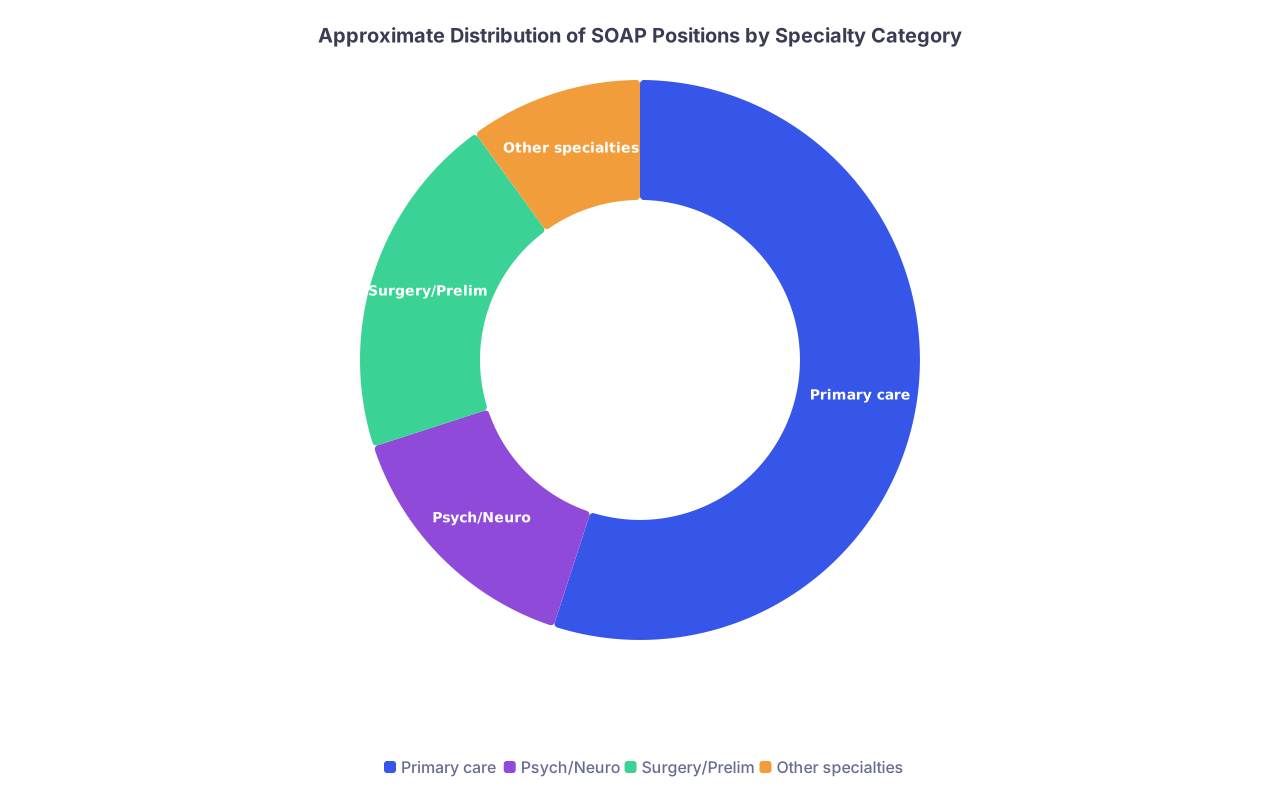
| Category | Value |
|---|---|
| Primary care | 55 |
| Psych/Neuro | 15 |
| Surgery/Prelim | 20 |
| Other specialties | 10 |
The biggest correlational trap I keep seeing:
- Students with mid-tier stats who chase competitive specialties as their primary list and throw a few “safeties” on the side.
- They get almost no interviews in the competitive field, a couple of late primary care or prelim interviews, then end up in SOAP with a very thin safety net.
Students who play the numbers correctly:
- Align specialty choice with their Step 2 + class rank profile.
- Apply broadly and early in less competitive specialties if their metrics are borderline.
- Enter SOAP (if they do) with a realistic target: FM, IM, peds, psych, prelim medicine, prelim surgery, TY.
Your specialty strategy does not just correlate with entering SOAP; it drives what kind of SOAP programs you can realistically get. The most common successful SOAP profiles I have seen:
- U.S. MD or DO
- Step 2 CK in the 225–240 band
- No catastrophic academic red flags
- Applied to a reasonable mix of community and academic programs
- Willing to accept primary care, prelim IM, or prelim surgery
5. What Actually Correlates with SOAP Success Once You Are There
Let me separate this clearly. One set of variables correlates with ending up in SOAP. Another set correlates with getting out of SOAP with a position you can live with.
Once you are in SOAP, programs are working under time pressure. They have:
- A surplus of applicants
- Limited time to review files
- Immediate service needs for July
They optimize for “reliable, low-risk intern who will not fail Step 3, quit, or implode.”
From program behavior and internal selection rubrics, the main correlates of SOAP success look something like this:
- Passing scores on all USMLE/COMLEX exams (no active fails)
- Reasonable Step 2 CK threshold:
- For FM, peds, IM, psych: often comfortable down to ~220–225
- For prelim surgery: usually higher, often ~230+
- Clean professionalism record
- Evidence of solid work ethic / reliability in letters
- Realistic specialty targeting during SOAP
And yes, prior class rank still influences this. Programs do not want to scramble a chronically struggling student into a service-heavy intern job with a high risk of failing Step 3.
Here is a simplified way to think about correlations from the applicant side:
| Profile Type | Likely SOAP Outcome |
|---|---|
| US MD, Step 2 ≥ 240, minor issues | Categorical in primary care or IM-like |
| US MD/DO, Step 2 225–239, no major red flags | Mix of categorical FM/IM/psych or prelim |
| US MD/DO, Step 2 < 225, no failures | Lower tier FM/IM, more prelim-heavy options |
| US grad with Step failures or repeated year | Prelim only, or possibly no offer |
| IMG with mid scores and no failures | Mostly prelim, occasional categorical FM |
Again, these are patterns, not guarantees. But they are the patterns PDs will quietly confirm after a few off-the-record conversations.
6. Best Strategies for SOAP If Your Numbers Are Marginal
Let me get practical. You cannot change your Step 1 or your failed clerkship retroactively. You can change your strategy and your signal.
Before Match Week (ideally months earlier)
If your Step 2 is ≤235 or you know you are in the bottom half of your class and your interview yield is poor, treat “SOAP-prep” as an active project, not a vague backup thought.
Concrete moves:
Align expectations with your profile
If your numbers place you in the gray zone, you target:- Family medicine
- Internal medicine (especially community)
- Pediatrics
- Psychiatry Not derm. Not ortho. Not IR.
Pass everything on the first try from here forward
A late Step 2 fail or a failed Sub-I right before rank lists is a massive predictor of SOAP entry and SOAP failure.Build “reliability” data into your file
Programs care deeply about whether you will show up and do the work.- Strong Sub-I comments about ownership, follow-through, and teamwork
- Letters explicitly describing you as “hardest working” or “extremely dependable” Those narrative signals can partially offset mediocre scores in SOAP.
Get Step 2 CK done and reported early
A reported, passing Step 2 CK score, even if modest, is better than “pending” when SOAP hits. “Pending” plus marginal Step 1 is a recipe for getting filtered out.
During SOAP: How to Move the Needle
You cannot change your test scores during SOAP week. You can change how programs perceive your risk and your utility to them.
Tactics correlated with better SOAP results:
Apply very broadly to realistic programs
I have seen students sabotage themselves by “going selective” in SOAP. That is a luxury of the main Match. SOAP is a volume game.- Target broad geography, especially non-coastal, non-major metro regions.
- Include community and smaller academic hospitals heavily.
Prioritize categorical offers but do not ignore prelim
If your profile is borderline, you prioritize:- Categorical FM / IM / psych / peds
- Prelim IM and prelim surgery as a parallel track
The data show many people salvage careers from a strong prelim year plus reapplication, especially if they perform well.
Hyper-focused communication
Every email or phone contact with programs during SOAP should do three things:- Affirm high interest in their program and location.
- Address the biggest perceived risk in your file in 1–2 sentences (e.g., “I had one early Step difficulty, since then I have passed everything on first attempt and honored all clinical rotations.”).
- Emphasize reliability and availability: “ready to start July 1,” “committed long term to primary care,” etc.
Leverage advocates
A chair or PD call during SOAP, especially from your home institution, can materially shift your priority in a program’s SOAP list. That phone call often reframes your Step 2 = 228 from “risk” to “known quantity we can trust.”Make peace with non-ideal outcomes
Data from NRMP and state licensing boards show that:- Completing any ACGME-accredited residency dramatically improves your lifetime practice odds.
- Many “not first choice” matches (e.g., FM instead of neuro) result in very stable careers and fellowships later.
You optimize for “secure an accredited residency slot” first. Prestige and ideal specialty come second.
7. What Correlates the Least With SOAP Outcomes
A few myths to kill off.
These factors are frequently overestimated by students but weakly correlated with SOAP rescue:
- Extra research late in MS4
A PubMed ID added three weeks before rank list certification does very little when your main issue is a Step 2 CK at 218. - Fancy away rotations in ultra-competitive fields
If you are in SOAP, that away in ortho at a top 10 program is mostly sunk cost. SOAP programs care about whether you can manage a night float on wards, not your interest in cartilage biology. - “Passion essays” in your personal statement
In SOAP, many programs barely skim personal statements. They focus on checkboxes first: scores, passes, no major red flags, believable interest.
If your bandwidth is limited, put it towards things that have actually shown correlation with SOAP success: passing exams, realistic specialty alignment, strong clinical performance, and targeted communication.
8. Pulling It Together: The Correlation Hierarchy
If I distill this into a crude ranking of what correlates most strongly with SOAP entry and SOAP outcomes:
For entering SOAP:
- Specialty competitiveness vs your test scores
- Step 2 CK score (and Step 1/COMLEX performance if low or failed)
- Academic red flags (failures, repeated year, bottom quartile)
- Overly narrow application strategy and geographic limitation
For exiting SOAP with a position:
- Passing all exams, no active failures
- Step 2 CK above the “hard floor” for the specialty (often ~220–230 for primary care)
- Clean professionalism and reliability signals from MSPE and letters
- Realistic SOAP specialty and geography choices
- Active advocacy from home institution
You cannot fully “data-hack” SOAP, but you can absolutely stop playing a losing game by pretending every factor is equal. It is not. The numbers are clear.
FAQ (exactly 5 questions)
1. Does a single failed Step 1 automatically mean I will end up in SOAP?
No. A single Step 1 fail with a later strong Step 2 CK (e.g., ≥240) and solid clinical performance can still result in a clean Match, especially in primary care fields. The correlation with SOAP spikes when a Step 1 fail is combined with a mediocre Step 2, low class rank, or overly competitive specialty choice.
2. Is class rank really that important once Step 1 is pass/fail?
Yes, more than students think. At schools with quartiles, being in the bottom quartile flags you as potentially at risk for in-training and Step 3 issues. PDs fold that into their “academic strength” rating. It is not as visible as a numerical Step 1 score used to be, but it still correlates strongly with both unmatched risk and SOAP difficulty.
3. How low can my Step 2 CK be and still give me a realistic shot in SOAP?
For primary care specialties and many prelim IM positions, U.S. grads with Step 2 CK in the low 220s can still match through SOAP if they have no major red flags and strong clinical evaluations. Below ~220, the probability of only prelim options or no offer rises significantly, particularly if paired with low class rank or failures.
4. Do programs really look closely at personal statements and extracurriculars during SOAP?
Only selectively. With the time constraints in SOAP, most programs use test scores, exam passes, and obvious red flags to triage. Personal statements and extracurriculars may tip decisions between similar candidates but do not overcome low scores or major academic issues. They are secondary, not primary, correlates of success.
5. If I match into a prelim spot in SOAP, what are my odds of eventually getting a categorical position?
Reasonable, if you perform well. Many prelim interns transition into categorical IM, FM, or even certain specialties after a year, especially if they earn strong evaluations and pass Step 3 promptly. The data from institutional reports suggest that solid prelim performance plus a clean reapplication strategy leads to categorical placement for a significant share of motivated interns—far higher than the odds for someone who never enters residency at all.
Two key points: test performance and academic history heavily influence whether you land in SOAP; realistic specialty targeting and demonstrable reliability drive whether you successfully get out of it. If your numbers are marginal, stop pretending they are not. Align your strategy with what the data actually show, not with the story you wish were true.