
The biggest mistake applicants make in SOAP is emotional decision-making in a numbers-driven process. The Match is feelings; SOAP is math.
If you treat SOAP like a second personal statement contest, you are dead on arrival. If you treat it like constrained optimization under uncertainty, your odds improve dramatically.
Let me walk through what the data actually says about fill rates, offer probabilities, and how aggressively you should target different program types.
1. The Big Picture: How SOAP Really Behaves
First, zoom out. SOAP is not a gentle safety net. It is a compressed, brutal market.
Recent NRMP data (the exact year-to-year numbers vary slightly, but the pattern is stable) show a few consistent realities:
- Total unfilled positions on Monday: roughly 2,500–3,500
- Total SOAP-eligible unmatched applicants: typically 10,000+
- Overall probability of any one applicant obtaining a position in SOAP: substantially below 50%
- Many specialties have near-zero usable SOAP volume for U.S. grads
In other words, on average you are competing against at least 3–4 serious candidates per spot, often more in popular regions or specialties.
To make this concrete, let us look at approximate SOAP fill rates by broad specialty category. These are illustrative but representative patterns from recent cycles.
| Program Category | Typical SOAP Fill Rate | Notes |
|---|---|---|
| Categorical Internal Medicine | 90–98% | Most unfilled spots disappear |
| Preliminary Internal Medicine | 85–95% | Variable by region |
| Categorical Family Medicine | 75–90% | Some rural spots remain unfilled |
| Categorical Pediatrics | 85–95% | Fewer positions than IM/FM |
| Transitional Year | 95–100% | Extremely competitive in SOAP |
| Surgery Preliminary | 80–95% | Many applicants, many reapplications |
Two immediate conclusions:
- The vast majority of SOAP-available positions are in primary care–oriented fields (IM, FM, peds, psych, prelim IM).
- Most positions that show up on the list will fill. Your goal is not to “find the one program that is desperate,” but to become a credible candidate at as many realistic programs as possible.
2. Supply vs Demand by Program Type: Where the Positions Actually Are
You cannot strategize without understanding the supply. Here’s how the position mix usually looks when SOAP opens on Monday.
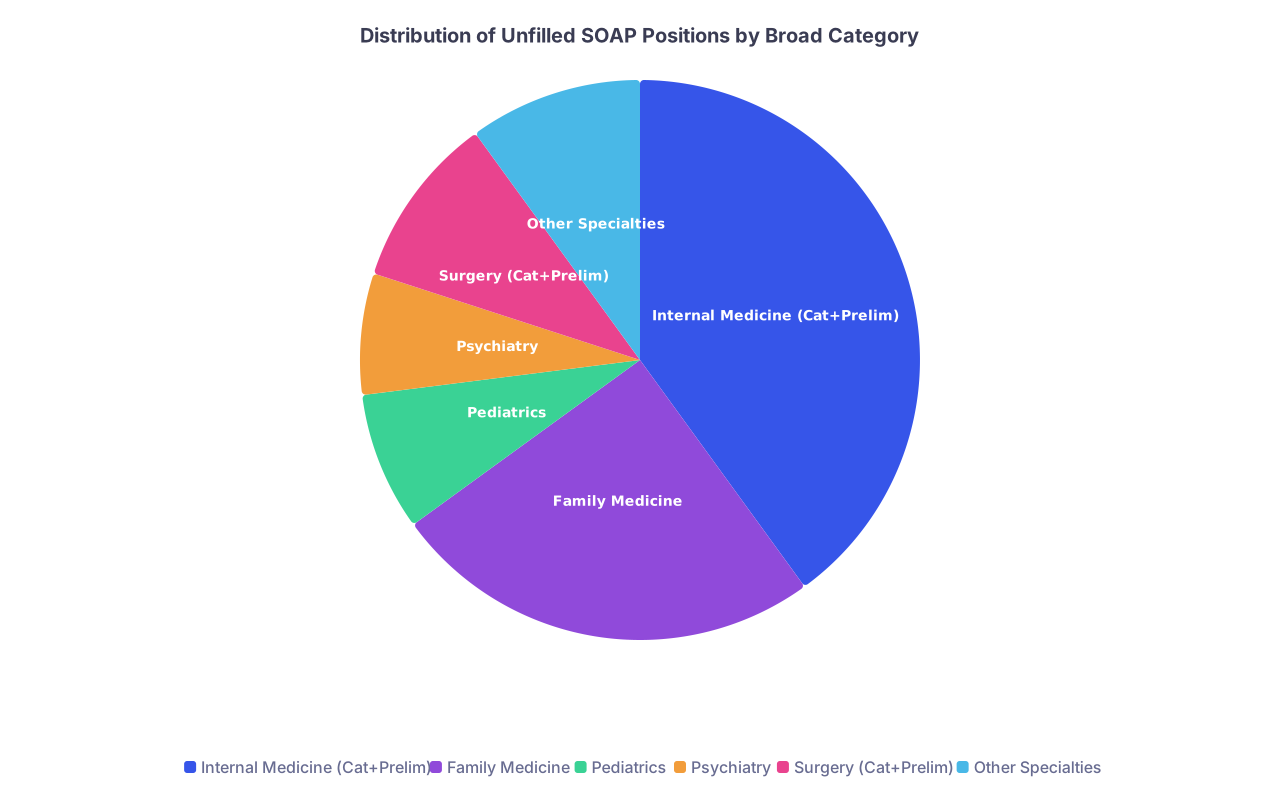
| Category | Value |
|---|---|
| Internal Medicine (Cat+Prelim) | 40 |
| Family Medicine | 25 |
| Pediatrics | 8 |
| Psychiatry | 7 |
| Surgery (Cat+Prelim) | 10 |
| Other Specialties | 10 |
So roughly:
- 40% IM (categorical and prelim)
- 25% FM
- 8% Peds
- 7% Psych
- 10% Surgery (mostly prelim)
- 10% “other”: OB/GYN, neuro, pathology, EM prelim, etc.
What the data shows:
- If you are SOAPing into IM, FM, or prelim IM, you have significantly more options numerically.
- If you are trying to SOAP into EM, ortho, derm, radiology, anesthesia, etc., you are largely in fantasy land. A handful of programs may appear with 1–3 spots, and they usually fill quickly with a very specific profile.
This is why the most successful SOAP strategies are brutally honest about:
- US vs IMG status
- Step scores or pass/fail timing
- Number and type of prior attempts
- Geographic flexibility (or lack thereof)
The narrower you are on any of these, the harsher the math becomes.
3. Offer Odds Per Application: What Actually Happens When You Click “Apply”
You do not control interviews. You control applications. So the key question is:
What is the probability that a single SOAP application turns into an offer?
You will not get a published number from NRMP, but we can approximate from patterns programs report and what I have seen from applicant tracking spreadsheets.
Reasonable ballpark ranges for per-application offer probabilities, by program type, assuming you are a somewhat plausible candidate for that field:
- Categorical IM: 1–4% per application
- Prelim IM: 1–3% per application
- Family Medicine: 2–6% per application
- Pediatrics: 1–3% per application
- Psychiatry: 1–3% per application
- Transitional Year: <1% per application for most applicants
- Surgery prelim: 1–3% per application (but very CV-dependent)
Two implications:
- Any plan that uses fewer than ~25–30 realistic applications is mathematically weak.
- You do not have enough “slots” (45 maximum SOAP applications across all rounds) to waste on vanity targets.
Let us formalize this a bit.
If the probability that one application yields an offer is p, and you submit n independent applications (they are not truly independent, but this is directionally useful), then the probability you get at least one offer from that batch is:
P(≥1 offer) = 1 − (1 − p)ⁿ
Run a few numbers.
Assume p = 2% (0.02) per application — conservative but realistic for many:
- n = 10 apps → P(≥1 offer) ≈ 1 − (0.98)¹⁰ ≈ 18.3%
- n = 20 apps → ≈ 1 − (0.98)²⁰ ≈ 33.3%
- n = 30 apps → ≈ 1 − (0.98)³⁰ ≈ 45.5%
- n = 40 apps → ≈ 1 − (0.98)⁴⁰ ≈ 55.3%
At p = 4%:
- n = 20 → 1 − (0.96)²⁰ ≈ 55.1%
- n = 30 → ≈ 70.0%
- n = 40 → ≈ 80.0%
You can see why strong, broad applicants in FM who apply to 35–40 programs often walk away with something, while narrow applicants sending 12 apps into “nice places only” frequently walk away with nothing.
4. Program Fill Behavior by Type: Who Is Desperate and Who Is Picky
Not all SOAP programs behave the same. Fill rate is not just “how many unfilled positions exist,” but also “how fast and how selectively” programs offer them.
Here is how different program types behave, in practice.
Internal Medicine (Categorical)
- High supply, high demand.
- Many university-affiliated community hospitals. Some >50% IMGs historically.
- Fill rate in SOAP: typically >90% by the end of Round 2.
Odds dynamics:
- U.S. MD/DO with passing Step 1/2, no catastrophic red flags, broad geography: decent per-application odds (~3–5% at some community IM programs).
- IMG with multiple attempts or older graduation: p drops sharply unless targeting IMG-heavy programs.
Internal Medicine (Preliminary)
- Supply is large but highly clustered at big teaching hospitals.
- Used as entry points for advanced specialties (neuro, rads, etc.), so many applicants treat them as a “rescue” option.
Fill dynamics:
- Programs sometimes hold prelim positions for internal candidates, SOAP only the leftovers.
- If you have clear interest in IM (not just “I need a prelim”), that can help you stand out.
Translation: prelim IM is useful but not a guaranteed safe harbor.
Family Medicine
Family medicine might be the only field where, for some profiles, the math is actually in your favor.
Patterns:
- Some FM programs go underfilled through the main Match year after year.
- Rural or smaller community FM programs sometimes struggle to hit quota, even after SOAP.
That leads to a statistically real phenomenon:
- For a U.S. MD/DO with reasonable scores and a coherent narrative for FM, per-application offer probability can climb into 5–8% at some programs.
Do not over-romanticize this. The desirable urban FM programs in dense coastal cities still fill nearly everything. But if you are willing to go rural Midwest or Deep South, the numbers shift significantly.
Pediatrics
Smaller absolute SOAP volume, but similar patterns to IM:
- Children’s hospitals and big academic centers mostly fill in the main Match.
- Community pediatrics and smaller regional programs make up most SOAP peds spots.
For many applicants, pediatrics behaves like a slightly scarcer, slightly more selective IM in SOAP. That is all.
Psychiatry
Psych is in demand. The main Match has seen rising competitiveness, and SOAP reflects that.
- Spots that appear in SOAP are relatively few.
- Fill rates are high, and per-application odds are often lower than FM or IM for generic applicants.
Psych can absolutely be part of a SOAP strategy, but it cannot be the only leg the stool stands on unless you are unusually strong for psych (research, rotations, letters).
Transitional Year (TY)
If you are still thinking TY is a “cushion” in SOAP, you are locked in 2008.
Reality:
- TY is among the most competitive SOAP options.
- Many TY slots are effectively spoken for by internal candidates or “near favorites” even before SOAP formally opens.
- Per-application odds for an average applicant can be well under 1%.
Unless you have very specific ties, you should treat TY as optional upside, not as a plan.
Surgery Preliminary
Surgery prelim SOAP is noisy:
- Some programs genuinely need service bodies and are more open.
- Others are screening heavily for potential to convert to categorical or for strong exam performance.
Average pattern:
- You will see a number of prelim surgery spots on the list.
- But they attract a high volume of both categorical-hopeful reapplicants and unmatched surgery hopefuls.
Per-application p is modest at best for most.
5. Strategy by Applicant Profile: How to Allocate Your 45 Applications
You do not need a perfect model. You do need a disciplined one. The core question is always:
Given my profile, what is the highest expected probability of at least one offer, subject to my constraints?
Let me split this by broad applicant categories and translate it into numbers.
Scenario A: U.S. MD, decent record, unmatched in a competitive specialty
Example: You are a U.S. MD, Step 2 = 235, no failures, solid clinical evaluations, but you failed to match into EM or ortho.
Your realistic SOAP “market”:
- Categorical IM
- FM
- Peds
- Psych at some community programs
- Prelim IM
- Maybe a couple of prelim surgery or TY at institutions where you have direct ties
A rational allocation could look like:
- 15–20 FM (especially underserved/rural programs, community programs)
- 10–15 Categorical IM (community-focused, IMG-friendly, non-coastal)
- 5–8 Peds/Psych where your application is at least somewhat competitive
- 2–4 prelim IM or TY where you have connections
You are aiming for:
- p ≈ 4–6% on FM apps
- p ≈ 2–3% on IM apps
- p ≈ 1–2% on peds/psych
- p ≈ 1% or less on TY/prelim unless strong tie
Rough expected probability of ≥1 offer across 35–40 realistic, well-targeted apps: easily surpasses 60–70%, often more.
What kills applicants in this category is pride: sending 25 applications to “mid-to-upper-tier” IM and psych in coastal cities and ignoring rural FM completely. The numbers punish that behavior.
Scenario B: U.S. DO, average scores, some red flags
Red flags might mean a Step failure, delayed graduation, or marginal clerkship narratives.
Your best statistical strategy:
- Lean harder into FM and prelim IM.
- Use psych and peds only if your CV is clearly aligned.
Allocation idea (out of 40–45):
- 20–25 FM
- 10–15 IM categorical (community-heavy, DO-friendly, often in Midwest/South)
- 5–10 prelim IM and surgery prelim (depending on surgical interest and viability)
Because of the red flags, you should discount p by 25–50% vs the earlier numbers.
So instead of 4–6% per FM app, maybe more like 2–4%. That makes volume even more critical.
Running the math quickly:
Say “effective” p across 35 realistic apps is about 3%.
P(≥1 offer) ≈ 1 − (0.97)³⁵ ≈ 66%.
Not guaranteed. But far better than the 20–30% territory you get if you send only 15–20 applications.
Scenario C: IMG, average scores, no U.S. clinical experience
This is where the data gets brutal.
For many IMG applicants without U.S. experience or with older graduation dates, the per-application probability of an offer in SOAP is often below 1–2% except in very IMG-heavy programs.
Your only rational strategy:
- Identify and prioritize programs with a >50–70% IMG rate historically.
- Emphasize community FM and IM that regularly rank IMGs high.
- Be geographically agnostic.
If, even with aggressive targeting, you estimate p ≈ 1% per application, then:
- 20 apps → P(≥1 offer) ≈ 18.2%
- 40 apps → P(≥1 offer) ≈ 33.1%
Those are not numbers you “beat” with clever wording in your SOAP letter. They are structural.
Which brings us to the next key concept.
6. Rounds, Timing, and Conditional Probabilities
SOAP is not one single contest, but multiple rounds with dynamic probabilities.
Structure (simplified):
- Monday: List of unfilled positions released. You submit preferences.
- Programs review and issue offers in multiple rounds between Wednesday and Thursday.
- After each round, unaccepted positions re-enter the pool; new offers may go out.
The statistical behavior:
- Round 1: Programs have maximum choice. Strongest candidates get snapped up quickly.
- Later rounds: Remaining positions may be either very selective programs that have not found what they want yet, or less competitive positions that still have trouble filling.
From the applicant’s point of view:
- If you get zero interviews or very few early pings, your conditional probability of success in SOAP drops.
- Interview volume is a strong leading indicator. If you have 6–8 SOAP interviews, odds of an eventual offer become quite reasonable. If you have 0–1, the curve looks ugly.
This is why:
- Your initial preference list must be broad and realistic from the start. You do not get enough feedback loops to “adjust” mid-SOAP meaningfully.
- Playing “hard to get” with rankings or turning down early offers hoping for something better is usually a mathematically bad move unless your existing offer is truly untenable for personal reasons.
7. Putting It Together: A Quantitative Playbook for SOAP
Strip away the noise. Here is the data-backed skeleton of how to approach SOAP as a numbers problem.
Define your realistic program set by type.
Based on your profile, create categories:- High-probability targets (e.g., IMG-heavy FM, rural FM, some community IM)
- Medium-probability targets (community IM, peds, psych)
- Low-probability “lottery” targets (TY, prelim surgery at big names, competitive specialties)
Estimate per-application p by category.
Use rough priors:- High-probability: 4–8%
- Medium: 2–4%
- Low: 0.5–2%
Constrain by total application budget (45 max).
Your goal is to maximize:
1 − Π(1 − pᵢ) across all submitted apps.That means you should:
- Maximize the number of applications in your highest p bracket.
- Use medium p if you run out of high-p options.
- Reserve only a small number of slots for lotto tickets.
Check emotional bias against the math.
If you find yourself allocating >30% of applications to <2% p targets, you are making an emotional decision, not a rational one.Lock in geography as a late constraint, not an initial filter.
For SOAP, geography is often the difference between 60% odds of something and 20% odds of nothing. The data is brutal on people who refuse to leave one region.
8. Visualizing a Rational Allocation
Let me show you a very simple comparison of two SOAP strategies for a hypothetical U.S. DO with okay scores, open to primary care.
Strategy A (emotional):
- 10 urban IM in coastal cities
- 10 psych in popular locations
- 10 TY/prelim at name-brand hospitals
- 10 FM in urban or suburban areas only
Strategy B (quantitative):
- 20 FM including rural/underserved
- 15 community IM including non-coastal, DO-friendly
- 5 psych where CV fits
- 5 prelim IM/TY where there are real ties
Assign rough p-values:
- Urban IM/psych/TY: 1–2%
- Urban FM: 3–4%
- Rural FM: 5–7%
- Community IM (non-coastal, DO-friendly): 3–5%
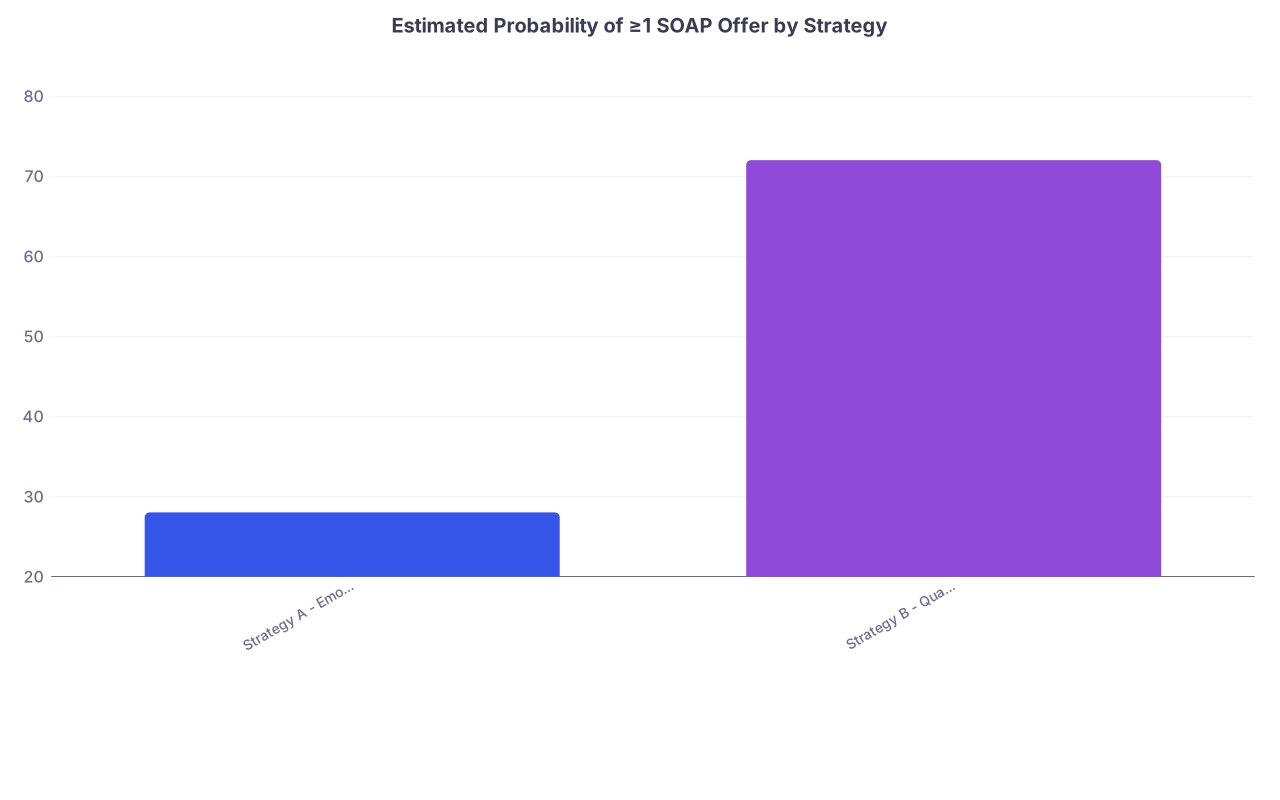
| Category | Value |
|---|---|
| Strategy A - Emotional | 28 |
| Strategy B - Quantitative | 72 |
The numbers tell the story:
- Strategy A yields maybe ~25–30% chance of one offer.
- Strategy B can push into the 60–70%+ territory.
Same applicant. Same total number of applications. Different allocation. Different future.
With these numbers internalized, you are not just “hoping SOAP works out.” You are actively engineering the best odds the system will give you. The next step is executing under time pressure—building a spreadsheet, ranking programs ruthlessly, and coordinating with your dean’s office in real time. But that is another layer of strategy, and another conversation.