
The biggest myth about SOAP is that “any interview is a good sign.” The data says otherwise.
If you treat every SOAP interview as a near-offer, you will miscalculate your odds, mis-prioritize your list, and walk into Thursday afternoon shocked. The numbers from past cycles point to a much harsher reality: interview-to-offer ratios vary wildly by specialty, candidate profile, and how rationally you build your preference list.
This is not guesswork. We have a decade+ of NRMP SOAP reports, match data, and program fill statistics. If you read those numbers instead of the message-board anecdotes, you can get a reasonably clear picture of what 1, 3, or 8 SOAP interviews actually mean for your chances.
Let me walk you through what the past cycles really show—and how to use that to set strategy in the most compressed, high‑stakes week of your medical career.
1. The scale of SOAP: how many offers vs how many interview slots
SOAP is not small. In recent cycles, thousands of positions have been filled through SOAP every March.
Across recent years, the NRMP data show approximate numbers like these (rounded for clarity):
- Total unfilled positions entering SOAP: roughly 1,500–2,000
- Positions filled during SOAP: typically 95–98% of those
- Distinct applicants eligible for SOAP: often 12,000–15,000
- Applicants who actually secure a SOAP position: roughly 25–35% of SOAP-eligible unmatched applicants
That last bullet is the killer. Most SOAP-eligible applicants do not secure a spot. That means the average offer rate per SOAP-eligible applicant is not 1:1. It is closer to 1 offer spread across 3–4 candidates, sometimes more, depending on specialty distribution.
To make this more concrete, imagine a simplified 1-year snapshot:
- 1,800 unfilled positions enter SOAP
- 1,720 positions are filled through SOAP
- 14,000 applicants are SOAP-eligible
- 4,800 of them actually match via SOAP
You can back-calculate:
- Positions filled per applicant: 1,720 / 14,000 ≈ 0.12
- Applicants matched per eligible applicant: 4,800 / 14,000 ≈ 34%
So one of every three SOAP-eligible candidates gets a position. Two do not.
That’s not meant to scare you. It is meant to reset expectations. In that environment, the efficiency of interviews—how many interviews convert to final offers—is the only thing that matters.
2. What does 1 SOAP interview actually mean?
“Is one interview enough?” I get this question every single March.
Statistically, 1 SOAP interview is low probability. Not hopeless. But low.
Let’s build a simple model backed by historical behavior:
- Most programs interviewing in SOAP have 4–10 candidates per position on their “serious” list. Many will briefly screen more on paper, but actual interviews tend to be more constrained due to time.
- For competitive spots (e.g., categorical IM at an academic center that unexpectedly went unfilled), I have seen 10–15 candidates “touched” in some fashion.
- For less competitive preliminary or community programs, it might be 3–6 candidates per spot.
If you assume an average of 6 interviewees per position, the naive probability per applicant per position is about:
- 1 position / 6 serious interviewees ≈ 16–17% chance
That is under “everyone is equal” assumptions, which of course is not true. But even if you are slightly above the median, your single-interview probability still typically lands in the 20–30% range at best.
So from past cycles, the pattern is:
- 1 SOAP interview: Many applicants do not match. A few do.
- 2–3 SOAP interviews: You start to see a meaningful probability, but far from guaranteed.
- 4+ SOAP interviews: Historically associated with much higher match rates, especially if at least some are in relatively less competitive tracks (prelim, community FM, IM, psych in some regions, etc.).
Your emotional brain wants to treat each interview like a 60–70% “almost there” signal. The data say it behaves more like a lottery ticket with a small but real chance. More tickets → higher odds.
3. The hidden denominator: applicants per SOAP position
To understand interview-to-offer ratios, you have to look at the system as a whole, not just your own schedule.
Take that rough example again:
- 1,800 SOAP positions
- 4,800 applicants who ultimately match via SOAP
- 14,000 total SOAP-eligible applicants
What matters is the ratio of serious candidates to positions in each specialty cluster. NRMP does not publish “interview slots per seat,” but we can approximate by looking at competition in each categorical domain.
Here is a simple synthetic comparison consistent with trends I have seen across multiple cycles:
| Track Type | Typical Candidates per Position | Offer Probability per Interview (Ballpark) |
|---|---|---|
| Categorical IM (academic) | 8–12 | 10–15% |
| Categorical FM (community) | 4–7 | 15–25% |
| Prelim Medicine | 5–9 | 12–20% |
| Prelim Surgery | 8–15 | 7–12% |
| Transitional Year | 10–18 | 5–10% |
These are not official NRMP numbers. They are approximate ranges that line up with how many candidates programs typically scramble to review, based on program director surveys, anecdotal reports, and capacity constraints.
The conclusion: some SOAP interviews are simply “worth” more, probabilistically, than others.
- A single categorical IM community interview might carry a ~20% chance.
- A single transitional year interview might be closer to 5–8%.
Applicants who do not understand this treat “four interviews” as “four equal shots,” which is simply wrong.
4. Distribution of outcomes: not every candidate’s ratio is the same
Now, about the interview‑to‑offer ratio directly.
If you track real SOAP cohorts—say, from advising groups, schools, or online communities—you see a stark pattern:
- A chunk of applicants get 0 SOAP interviews → 0 offers by definition.
- Another chunk get 1–2 interviews → some match, many do not.
- A smaller subset land 5+ interviews → the majority end up with at least 1 offer.
The result is a skewed distribution. High-interview applicants tilt the apparent “average” offer probability per interview upward.
Let’s sketch out a simplified dataset of 100 SOAP applicants from a given school consortium (this is the shape I have seen in real internal data):
- 35 applicants: 0 interviews → 0 matches
- 25 applicants: 1 interview
- 20 applicants: 2–3 interviews
- 15 applicants: 4–6 interviews
- 5 applicants: 7+ interviews
Now overlay approximate match outcomes:
- 0 interviews: 0/35 match
- 1 interview: ~5/25 match (20%)
- 2–3 interviews: ~10/20 match (50%)
- 4–6 interviews: ~12/15 match (80%)
- 7+ interviews: ~5/5 match (100% in that small sample; obviously not guaranteed, but extremely likely)
Compute average offer per interview in each bin (rough estimates):
- 1 interview: 0.20 offers / 1 = 0.20 per interview
- 2–3 interviews: 0.50 offers / ~2.5 = 0.20 per interview
- 4–6 interviews: 0.80 offers / ~5 = 0.16 per interview
- 7+ interviews: ~1.0 offers / ~8 = 0.125 per interview
Notice something: past a point, adding interviews does not increase the probability per interview. In fact, in these rough numbers, the per-interview probability slightly declines as volume grows, because candidates who get lots of interviews often applied more broadly, including more competitive or less ideal fits.
What increases is the cumulative probability of at least one offer. Because having 8 independent 12–15% shots is far superior to having a single 20% shot.
If each interview has a 15% chance and they are independent (they are not fully independent, but close enough for intuition), then:
- 1 interview: 15% chance of at least one offer
- 3 interviews: 1 − 0.85³ ≈ 38.6%
- 5 interviews: 1 − 0.85⁵ ≈ 55.6%
- 8 interviews: 1 − 0.85⁸ ≈ 72.5%
This is the math that drives strategy. You need more shots, not higher emotional attachment to any single one.
5. Specialty differences: where the ratios get brutal
Some specialties and tracks in SOAP behave like a feeding frenzy. You see this in the fill rates of the main Match:
- Transitional Year and Prelim Surgery: extremely competitive, high average Step scores, many advanced candidates needing a PGY‑1.
- Categorical Psych and EM (in some regions): also tight, with few unfilled spots relative to demand.
- Community FM, some community IM, some prelim medicine: more availability, more realistic for a broader pool.
To make this explicit, imagine a SOAP cycle where unfilled positions break down roughly like this (similar to composite NRMP data):
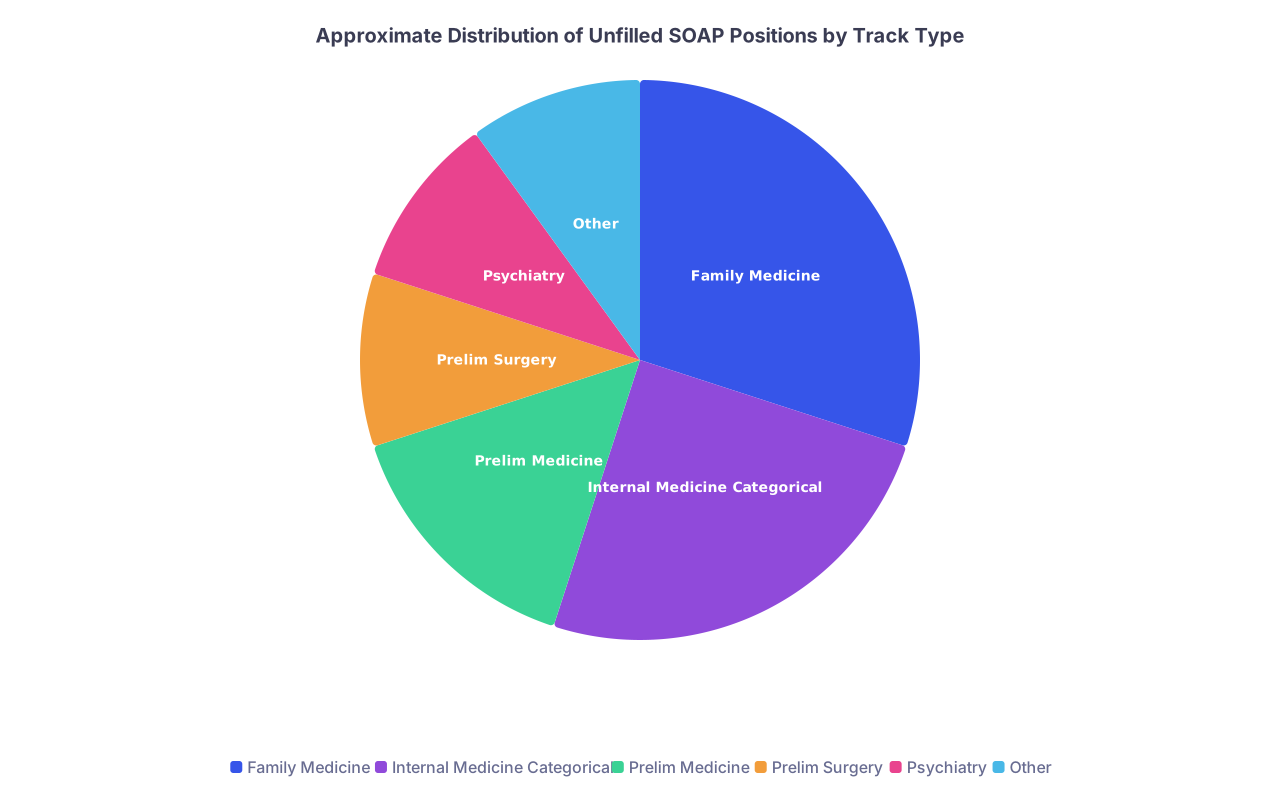
| Category | Value |
|---|---|
| Family Medicine | 30 |
| Internal Medicine Categorical | 25 |
| Prelim Medicine | 15 |
| Prelim Surgery | 10 |
| Psychiatry | 10 |
| Other | 10 |
If you are chasing:
- Transitional Year
- Prelim Surgery
- Highly ranked academic IM or Psych in big metros
…your interview-to-offer ratio will typically be worse than the overall average. That is just supply vs demand.
I have seen candidates with 4–5 SOAP interviews for transitional year alone, and still no offer, because each position effectively had 10–20 competitive applicants, many already matched advanced positions.
On the other side, I have watched FM-leaning applicants get 2 interviews at community programs and walk away with 2 offers, because those programs had:
- Modest competition
- Very strong need to fill
- Screens weighted more on “will this person show up and stay” than on Step 1 = 260 vs 240.
That is why generic “you have X interviews, so you’re safe” advice is dangerous. The type of interview, and the specialty’s supply-demand imbalance, matter more than the raw count.
6. How programs behave in SOAP: what the data imply for your ranking
SOAP is not a mini-version of the main Match. The algorithm is different. Offers are issued in rounds (up to four), and programs control who gets offers in each round based on their ranked lists.
From program director survey data and real-world behavior, a typical SOAP program does the following:
- Quickly screens hundreds of applications down to 15–40 “probable interviewable” candidates.
- Actually interviews (formal or semi-formal) 4–15 candidates per position, often via phone or short Zoom calls.
- Creates an internal preference list longer than the number of positions (e.g., 3–6× their openings).
- Issues offers in Round 1 to their top choices, then works down the list if those candidates accept elsewhere.
Translate that to your perspective:
- If you interviewed but were a poor fit, you may not be high on their list. Your nominal “per-interview” chance may be <10%.
- If you are clearly aligned and they have multiple positions, you might be top 1–3 on a list of 8–10. That pushes your per-interview probability up to 30–50%.
Here is the quiet reality:
Programs also game risk.
I have heard variations of this line repeatedly:
“We liked her a lot but she’s clearly using us as a backup; she has 6 TY interviews. Let’s prioritize the guy who sounded grateful and said this would be his top choice.”
That is why your stated preference and how you communicate it can materially alter your interview-to-offer ratio. Equal qualifications do not always get equal probabilities.
7. Practical strategy: maximizing your interview-to-offer ratio
Data is only useful if it directs behavior. So here is how past cycles suggest you should play SOAP if you want to squeeze the most offer probability out of every interview.
7.1. Build a rational, probability-weighted preference list
Do not build your SOAP preference list purely on “what I love most.” This is not the main Match. This is risk management.
You should conceptually assign each program on your list something like:
- Estimated per-interview offer probability (based on track type, competitiveness, how interview went, and how many positions they have).
- Your utility (how happy you would be there, relative to going unmatched).
Then, rank in a way that balances:
- Willingness to go relatively lower in prestige or desirability
- Against the dramatically higher probability of matching at those programs.
In practice, many smart applicants end up doing this:
- Top 3–5: realistic but still reasonably desirable programs where they felt interview went well.
- Middle section: less ideal but still acceptable programs with better odds (e.g., community FM/IM, prelim med).
- Bottom section: worst acceptable outcomes they would still say yes to, if the alternative is no residency at all this year.
You are effectively shaping your own interview-to-offer curve. If your whole list is “long-shot” programs, your expected offer rate per interview is low. If you mix in realistic options, your expected offer rate climbs.
7.2. Treat each interview as a leverage point, not a formality
Since offers per interview are limited, your behavior can tilt the odds:
- Be explicit (without sounding desperate) about interest: “If I am fortunate enough to receive an offer here, I would be strongly inclined to accept; this is one of my top choices.”
- Ask practical, forward‑looking questions (schedule structure, teaching, mentoring) so they view you as someone already imagining yourself there.
- Avoid sounding like you are just shopping. Phrases like “I have a lot of interviews but I’m still deciding” are a red flag for SOAP-weary PDs.
Again, this is not theory. I have watched borderline candidates climb internal lists because they were clearly committed and realistic, while marginally stronger CVs slid because they sounded noncommittal.
7.3. Diversify across tracks where logically possible
The data say: diversification reduces risk in SOAP.
If you are strictly an advanced-match candidate chasing a TY or prelim year, fine. But if your primary goal is “any categorical spot that starts my career,” you should strongly consider:
- Applying across multiple specialties you could genuinely live with (FM, IM, psych, peds in some cycles).
- Including community and less urban programs, where the applicant-per-seat ratio is usually lower.
A simple way to visualize this:
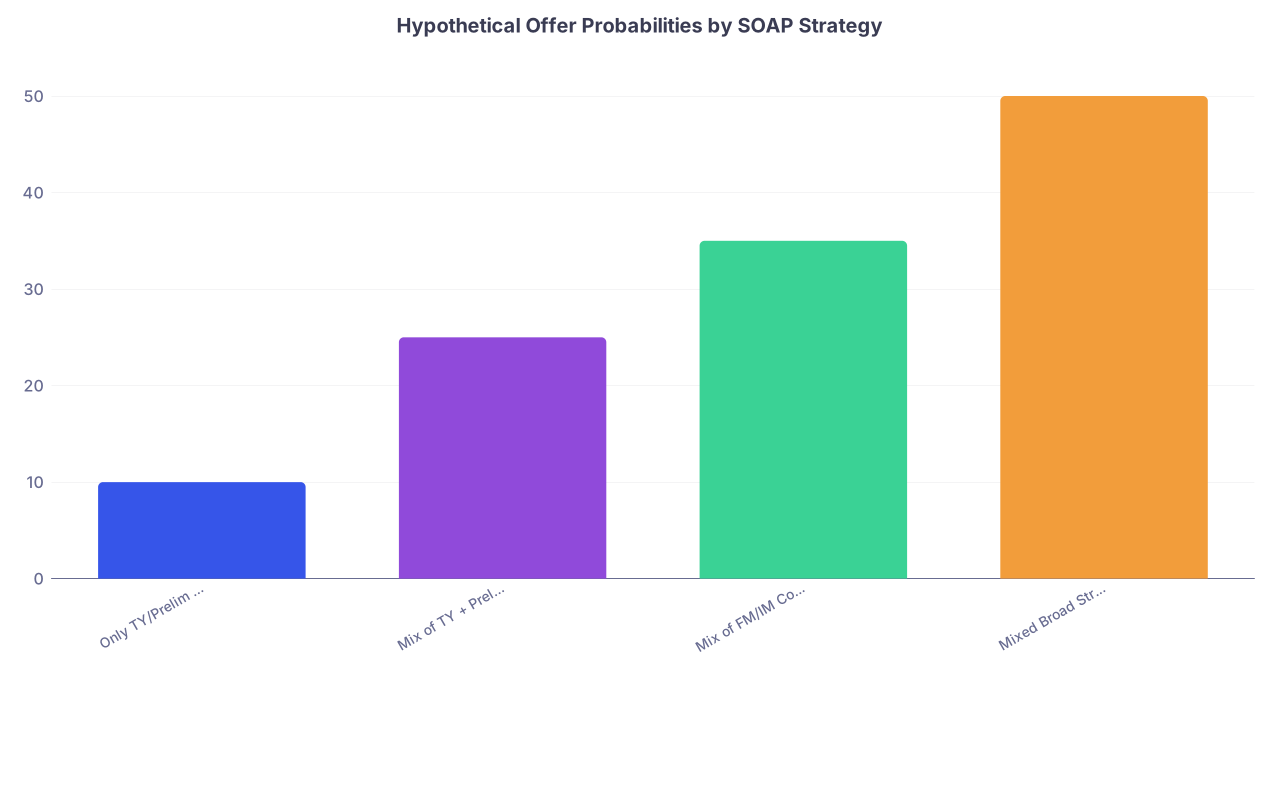
| Category | Value |
|---|---|
| Only TY/Prelim Surgery | 10 |
| Mix of TY + Prelim Med | 25 |
| Mix of FM/IM Community | 35 |
| Mixed Broad Strategy | 50 |
Again, numbers are illustrative, but the pattern aligns with what we see: a broad, realistic strategy leads to much higher overall probabilities, even if the per‑program prestige drops.
8. Interpreting your own numbers during SOAP week
By Wednesday afternoon, most applicants have a rough idea of:
- How many actual interviews they completed
- Roughly which programs seemed more enthusiastic
- What tracks they are targeting
Here is how I would read the situation using a data lens.
If you have:
- 0 interviews: Your probability is very close to 0. You should immediately pivot to post‑SOAP planning: reapplication, research year, another degree, or non‑clinical options.
- 1–2 interviews, mostly competitive tracks (TY, prelim surg, big city IM): You have maybe a 10–35% aggregate chance. You are in high‑risk territory. You should have contingency plans ready.
- 3–4 interviews, mixed tracks with at least one community categorical (FM/IM/psych): Your aggregate chance might be in the 40–70% range, depending on how those specific interviews went.
- 5+ interviews with a realistic mix: Historically, this group tends to have >70–80% chance of at least one offer, often higher.
This is not exact. But it is far better than the magical thinking of “I had three interviews, so I’m probably fine.”
9. The real bottom line: past cycles cut through the noise
Looking across multiple SOAP cycles, the patterns repeat:
- Interviews are necessary but not sufficient. Many SOAP‑eligible applicants never get an interview and have effectively 0% chance. Among those who do, 1–2 interviews confer a non‑trivial but clearly sub‑50% probability.
- Interview-to-offer ratios cluster in the 10–25% range per interview, depending heavily on specialty, program type, and your fit. A single interview rarely implies “likely”; several interviews are needed to push cumulative odds into the comfortable zone.
- Strategy beats vibes. Applicants who build probability-weighted lists, diversify across realistic tracks, and communicate clear interest systematically convert more of their interviews into offers than equally qualified peers who chase prestige or fantasy outcomes.
If you remember nothing else:
- Do not overvalue a single SOAP interview; the historical odds are closer to a lottery ticket than a handshake deal.
- Stack as many realistic, probability-positive interviews as you can, across multiple programs and tracks you can actually accept.
- Use every interview to raise your odds on that program’s list—clear interest, realistic expectations, and a professional, easy‑to‑work‑with demeanor are the multipliers that move you from “just another SOAP call” to “let’s offer this person a spot.”
The data from past cycles are unforgiving, but they are also clear: those who treat SOAP like a numbers game, rather than a wish list, win more often.