
27% of unmatched applicants entering SOAP each year walk away still unmatched by Friday.
That single number should reframe how you think about SOAP. It is not a consolation prize or a guaranteed safety net. It is a constrained, data-driven optimization problem under extreme time pressure.
You do not control the market. But you do control your strategy. And the gap between people who treat SOAP like an emotional scramble and those who treat it like a probability model is massive.
Let’s quantify it.
1. What The SOAP Numbers Actually Look Like
First, anchor yourself in reality. Not the “someone on Reddit matched 4 times through SOAP” fantasy. The data.
The exact percentages shift year to year, but the structure is stable:
- Total PGY-1 positions in NRMP: roughly 38,000–40,000
- Positions unfilled after the main Match: typically 1,500–2,000
- Unmatched SOAP-eligible applicants: often 8,000–10,000
So your basic supply–demand ratio entering SOAP is something like:
- About 4–6 applicants per unfilled position. Across all specialties.
- Much worse in “desirable” specialties and regions.
- Much better in prelim/transitional and less popular locations.
Here is a simplified, representative picture of how positions and applicants stack up.
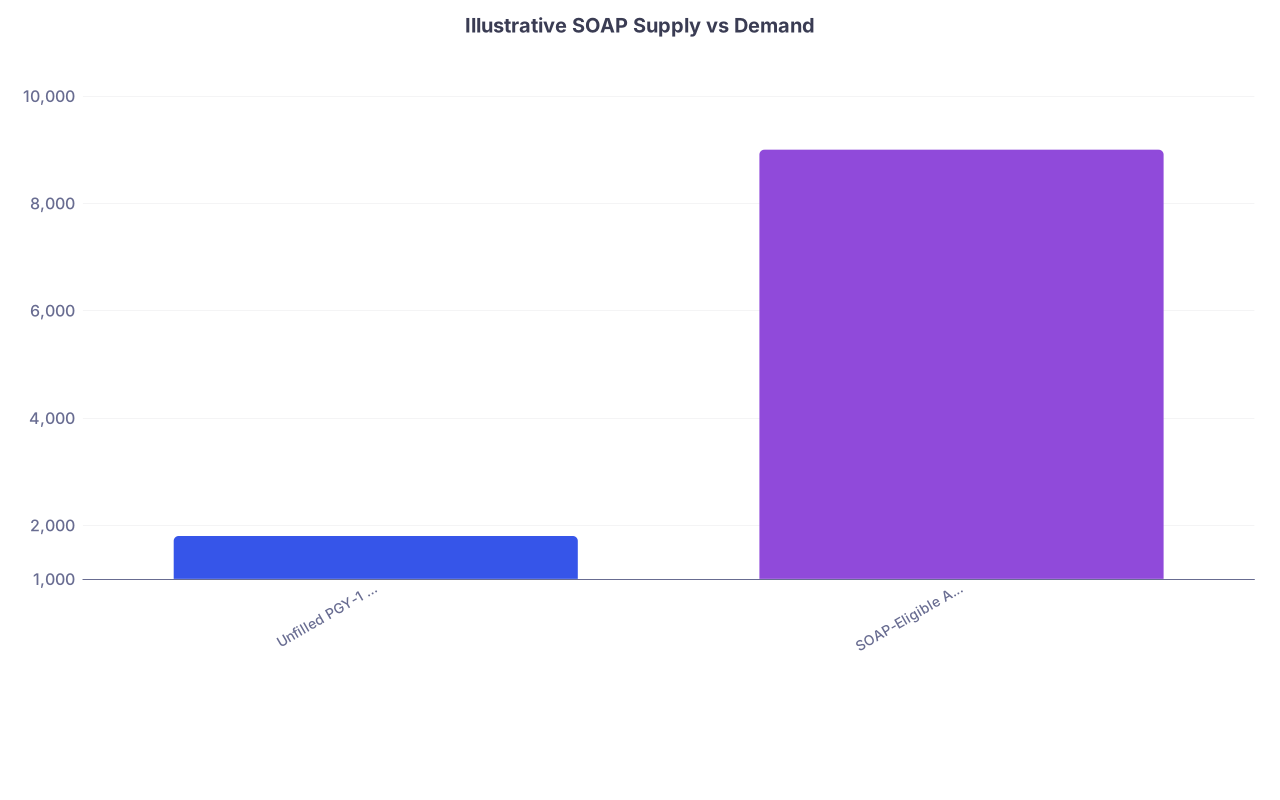
| Category | Value |
|---|---|
| Unfilled PGY-1 Positions | 1800 |
| SOAP-Eligible Applicants | 9000 |
That is a 1:5 ratio. On average.
The odds get worse if you:
- Restrict geography hard (e.g., “only coasts”, “must be in big cities”)
- Avoid prelim or transitional years
- Only apply to 1–2 specialties
They improve if you:
- Are flexible on region
- Are open to prelim, transitional, and lower-demand specialties
- Have Step scores and transcript that clear basic screens
SOAP is not random chaos. Programs screen applications using basic filters: exam scores, attempts, graduation year, visa, red flags. Your first job is to estimate realistically where you sit relative to those filters.
2. The Core Probability Model: Slots, Competition, and Fit
Let us simplify SOAP into a quantitative model you can think clearly with.
For each potential program you might apply to in SOAP, three main variables matter:
- Number of unfilled positions at that program (S)
- Number of SOAP applications that program will receive (A)
- Your competitiveness relative to that applicant pool (C)
You do not know these exactly. But you can approximate.
Think in terms of your per-program match probability (p). For a given program:
- If S is large, A is moderate, and your C is average → p might be 3–7%
- If S is small, A is huge, and you are below median → p might be under 1%
- If S is moderate, A is small, and you are strong → p might be 10–20% or more
Even a crude estimate changes how you should allocate your 45–application cap.
Why the “independent trials” mindset matters
Suppose you estimate you have a 5% chance (p = 0.05) of being selected at any individual program you apply to, and each decision is roughly independent.
If you submit N SOAP applications, the probability you match at at least one program is:
P(match at least one) = 1 − (1 − p)^N
If p = 0.05 and N = 20:
- P = 1 − (0.95)^20 ≈ 1 − 0.358 = 0.642 → about 64%
If p = 0.05 and N = 45:
- P = 1 − (0.95)^45 ≈ 1 − 0.105 = 0.895 → about 90%
This is why “spray and pray” kind of works—up to a point—but only if:
- Your p is not near zero for most of your list
- You are not wasting applications on longshot specialty/region combos where you are clearly below the usual floor
The people who end up unmatched after SOAP often did two things:
- Overestimated their p (they thought they had “good chances” at programs where they were actually filtered out instantly), and
- Underused their N (did not hit the 45 cap with realistic options).
3. Realistic SOAP Scenarios: Good, Moderate, and Hard Cases
You are not entering SOAP with the same hand everyone else has. The data show three broad applicant profiles.
Scenario A: Strong Unmatched Applicant (High Probability with Strategy)
Profile:
- US MD or strong US DO
- Step 2 CK ≥ 240, no exam failures
- Fewer interview offers than expected, but no major red flags
- Applied to a competitive specialty with limited backup
In SOAP, this person:
- Expands to more community programs
- Shifts slightly less competitive than their original target
- Is open geographically and to prelim or transitional years
For this profile, realistic per-program p might be:
- 10–20% in community IM/FM, certain prelim IM/surgery
- 5–10% in mid-range categorical positions
- Under 5% in any still-available competitive specialty
If they use 40–45 targeted applications, distributing mostly to the 10–20% p bucket, the math looks like this:
Say:
- 30 programs at p = 0.15
- 15 programs at p = 0.07
Approximate “at least one” probability, conservatively treating them as independent:
First group:
P(no offer from group 1) ≈ (1 − 0.15)^{30} ≈ (0.85)^{30} ≈ 0.007
Second group:
P(no offer from group 2) ≈ (1 − 0.07)^{15} ≈ (0.93)^{15} ≈ 0.35
Overall: P(unmatched) ≈ 0.007 × 0.35 ≈ 0.00245 → about 0.25%
So P(matching somewhere) ≈ 99.75%.
Is that reality? Not exactly, because offers are not independent and the same competitive profile gets filtered similarly across many programs. But the direction is right: strong unmatched applicants who pivot intelligently almost always land something.
Scenario B: Middle-of-the-pack Applicant (Real but Conditional Probability)
Profile:
- US MD or DO, or strong US-IMG
- Step 2 CK ~225–240; maybe 1–2 weak rotations but no major professionalism issues
- Decent clinical experiences but nothing extraordinary
- Applied reasonably, but got squeezed in a crowded specialty or region
For this profile, p is lower and more sensitive to specialty and region.
Approximate p buckets:
- 8–12%: community FM, IM in less popular regions, prelim IM
- 3–6%: transitional years, mid-range community programs in popular states
- <3%: any still-open categorical position in competitive specialties or popular metros
If they apply:
- 25 programs in the 8–12% region
- 15–20 programs in the 3–6% region
Let’s model a middle case:
25 programs at p = 0.10
15 programs at p = 0.04
Group 1:
P(no offer) ≈ (0.90)^{25} ≈ 0.07
Group 2:
P(no offer) ≈ (0.96)^{15} ≈ 0.54
Combined:
P(unmatched) ≈ 0.07 × 0.54 ≈ 0.0378 → about 3.8%
P(matching somewhere) ≈ 96.2%
Again, reality is sloppier, but the signal is: for mid-range applicants, SOAP outcomes are highly sensitive to whether you concentrate your list in the 8–12% bucket or waste slots in the <3% fantasy bucket.
Scenario C: High-risk Applicant (Low, But Non-zero Probability)
Profile:
- Older graduation year, or multiple exam attempts, or Step 2 CK <215
- IMG with weak or generic US clinical experience
- Red flags (failed rotations, professionalism concerns, etc.)
This group makes up a disproportionate share of those who remain unmatched after SOAP. The data from previous NRMP reports are brutal here.
They often have per-program p values like:
- 1–3% for less popular community FM/IM
- <1% for prelim positions in competitive departments
- Essentially 0% for any still-open categorical high-demand specialty
Imagine a realistic SOAP strategy:
- 35 applications at p = 0.02
- 10 applications at p = 0.05 (best-fit, more IMG-friendly programs)
Group 1:
P(no offer) ≈ (0.98)^{35} ≈ 0.50
Group 2:
P(no offer) ≈ (0.95)^{10} ≈ 0.60
Combined:
P(unmatched) ≈ 0.50 × 0.60 = 0.30 → 30%
P(matching somewhere) ≈ 70%
Those are not comforting odds. But they are way better than the 0–10% range you drift into if you insist on applying mainly to regions and specialties that historically do not touch your profile.
For this group, SOAP success is not impossible. It is just extremely sensitive to:
- Applying to every single truly realistic slot
- Having documentation that clearly addresses and contextualizes your red flags
- Being open to places and roles you might not have considered a year ago
4. Specialty and Program Tier: Where Your Probability Actually Lives
You do not have equal p across specialties. Not close.
Here is a stylized but directionally correct snapshot of how SOAP “friendliness” tends to distribute across specialties in a given year.
| Specialty | Typical Unfilled Slots | Relative Competition | SOAP-Friendly Tier |
|---|---|---|---|
| Family Medicine | High | Low–Moderate | Very High |
| Internal Medicine | Moderate–High | Moderate | High |
| Pediatrics | Low–Moderate | Moderate | Medium |
| Psychiatry | Low | High | Low |
| General Surgery | Very Low | Very High | Very Low |
| Transitional/Prelim | Moderate | High | Medium–High |
Numbers change by year, but the pattern is consistent:
- FM and IM have the bulk of SOAP opportunities, especially in community and rural settings.
- Pediatrics and psychiatry may have some, but demand often exceeds supply even in SOAP.
- Surgery, ortho, derm, etc. are essentially closed doors at this point, unless you are already extremely competitive and there happens to be a rare SOAP opening.
Add geography:
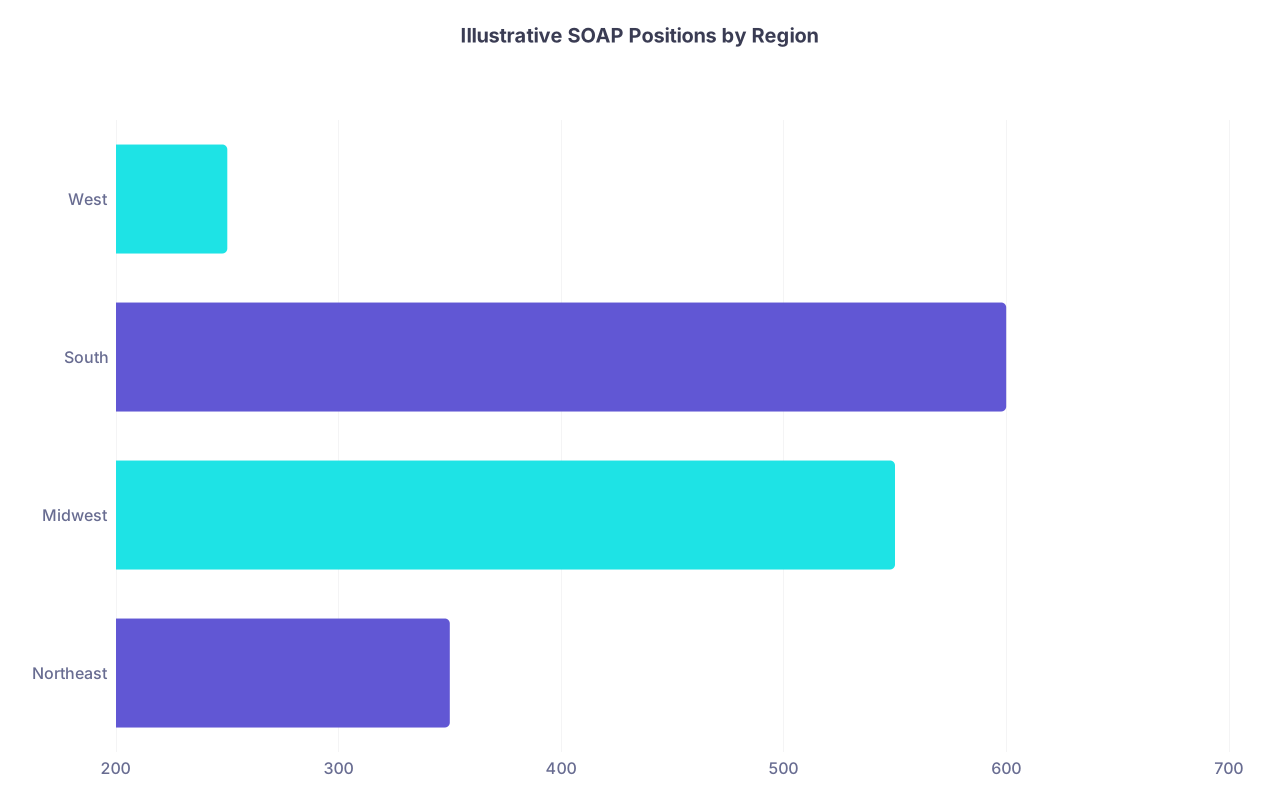
| Category | Value |
|---|---|
| Northeast | 350 |
| Midwest | 550 |
| South | 600 |
| West | 250 |
More positions often show up in the South and Midwest in community programs and less popular locations. The coasts are tighter, more competitive, and more likely to be filled in the main Match.
A simple rule:
- Every geographic or specialty restriction you add, you are shrinking your denominator (S) and sometimes increasing A at the same time.
- That crushes your per-program p.
5. Building a Rational SOAP List: A Step-by-Step Strategy
You get 45 applications. That is your budget. Treat it like a constrained optimization problem.
Here is a structured way to model and build your list.
Step 1: Define your realistic specialty universe
Ask two data-driven questions:
- In which specialties do SOAP positions reliably exist (last 3–5 years)?
- In those specialties, does my profile clear likely screening cutoffs?
If you are an average US grad with Step 2 CK = 230 and no failures:
- You are likely above water in FM, many IM programs, and some prelim IM/TY.
- You are borderline for peds and psych depending on year and region.
- You are effectively out of the running for SOAP surgery, ortho, etc.
If you are an IMG with Step 2 CK = 215 and one fail:
- Your real shot is going to be FM and a subset of IMG-friendly IM programs. That is it.
Step 2: Assign rough p-buckets by program type
You will not get perfect probabilities, but you can group programs:
Bucket 1 (p ~10–20%):
Community FM/IM in less popular regions, IMG-friendly, your profile ≥ typical matched stats.Bucket 2 (p ~5–10%):
Community IM/FM in moderately popular regions, transitional years, prelim IM where you just meet floors.Bucket 3 (p ~1–5%):
More competitive regions, borderline profile, or slightly higher-tier programs.Bucket 4 (p ~0–1%):
Still-open slots in specialties/regions that typically fill with much stronger applicants.
You want most of your 45 applications in Bucket 1 and 2.
Step 3: Allocate your 45 slots
Here is a rational example for a mid-range US grad who originally applied internal medicine:
- 20–25 apps: community IM, Midwest/South, known to be IMG-friendly or mid-range
- 10–15 apps: FM in regions you could live with, community-based
- 5–10 apps: prelim IM or transitional years at programs that match your stats
Avoid the trap:
“I will throw 10 apps at peds and psych just in case.”
If your peds/psych p is realistically <3% at most SOAP options, those 10 applications might lower your overall probability, because you are diverting capacity from 8–10% IM/FM targets to long shots.
6. Timeline and Execution: SOAP as an Optimization Process
SOAP week itself is a brutal Gantt chart of micro-deadlines.
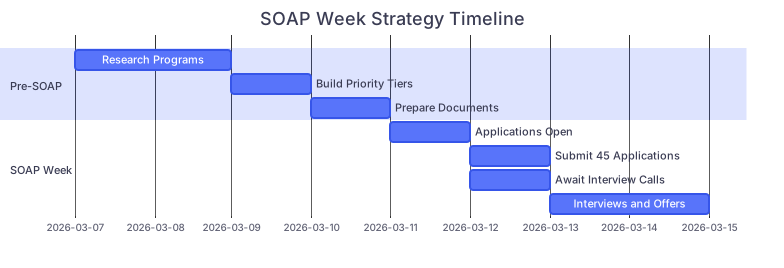
| Task | Details |
|---|---|
| Pre-SOAP: Research Programs | a1, 2026-03-07, 2d |
| Pre-SOAP: Build Priority Tiers | a2, after a1, 1d |
| Pre-SOAP: Prepare Documents | a3, after a2, 1d |
| SOAP Week: Applications Open | b1, 2026-03-11, 0.5d |
| SOAP Week: Submit 45 Applications | b2, after b1, 0.5d |
| SOAP Week: Await Interview Calls | b3, 2026-03-12, 1d |
| SOAP Week: Interviews and Offers | b4, 2026-03-13, 2d |
You do not have time during SOAP to think from scratch. You preload the model.
Pre-SOAP (before Match Week)
- Build a master list of potential programs in FM, IM, prelim IM, TY, and any truly realistic categorical options.
- Tag each with: region, specialty, IMG-friendliness, approximate competitiveness.
- Pre-assign them to Bucket 1–4 based on your profile.
- Draft short, specialty-specific letters and update your personal statement where needed.
Your goal: When the SOAP list drops, you are slotting real programs into prebaked buckets, not making emotional guesses at 8 a.m.
SOAP Week
When the unfilled list is released:
- Rapidly filter for your viable specialties and regions.
- Apply the bucket model:
- Fill Bucket 1 first.
- Then Bucket 2.
- Add a few calculated Bucket 3 shots if you have remaining capacity.
- Hit 45. Do not stop at 25 because “these are the ones I really like.” You are playing probability, not romance.
Then you pivot to execution: answer calls, schedule interviews, be ready to accept offers quickly. But the heavy lifting for your probability has already been done in how you constructed that list.
7. Using Data to Decide Whether to Push or Pause
Here is the uncomfortable reality: for some applicants, SOAP odds are low enough that the smarter strategic move might be to partially de-risk and plan for next cycle.
That decision should be data-based, not ego-based.
Key questions:
- How many programs exist that will realistically consider my profile in SOAP?
- Of those, how many are actually unfilled this year?
- If I apply to nearly all of them, what is my rough p across that pool?
If you look at your filtered universe and find:
- Only 5–10 realistic programs
- Most in very high-demand locations
- Past match lists from those programs show almost all US MD/DO with strong scores
Then your effective N is not 45. It might be 8. And your p at each might be 1–3%. That is:
P(matching somewhere) ≈ 1 − (1 − 0.03)^8 ≈ 1 − 0.78 ≈ 22%
Now you are in one-in-five territory. That is not hopeless, but it is not something you should bet your entire career on without a parallel plan: research year, another degree, or a complete re-application strategy with more interviews next time.
8. Visualizing Where You Stand
To pull this together, here is an illustrative distribution of per-program probabilities across three archetypes in SOAP.
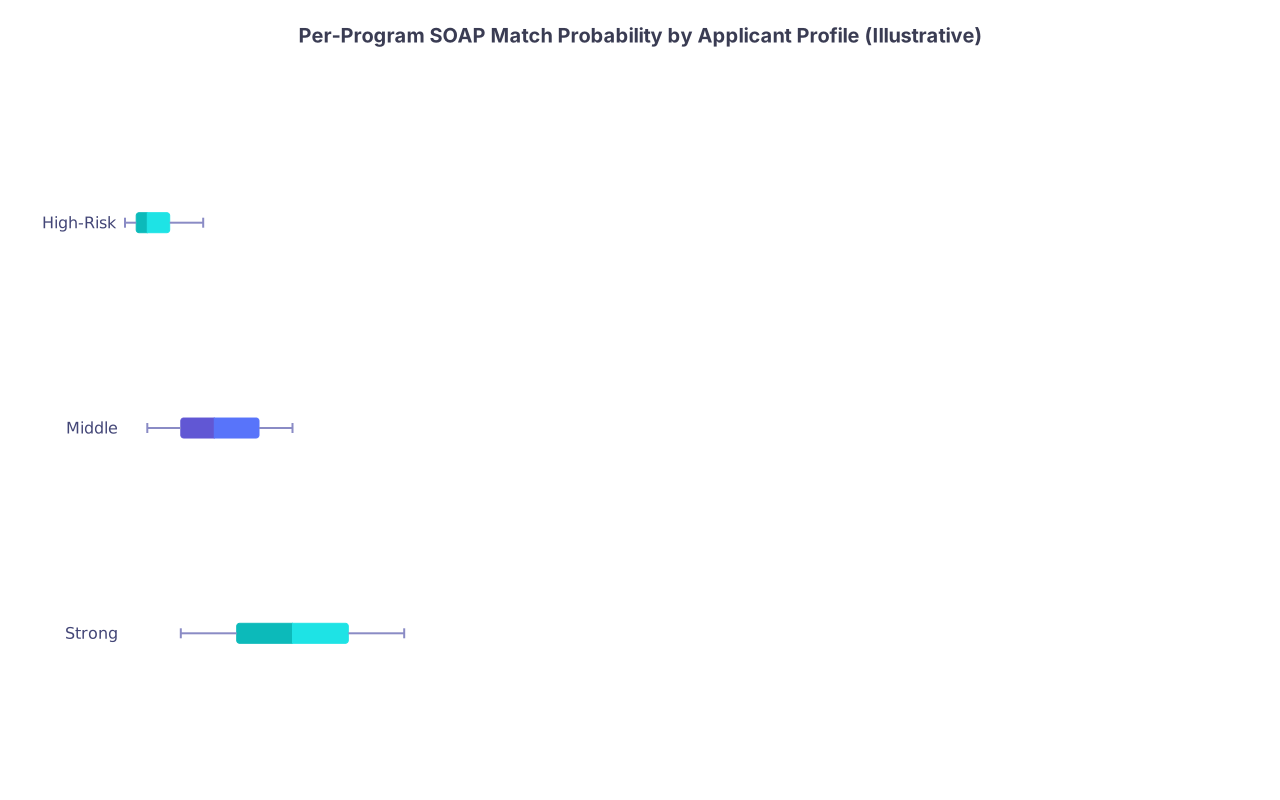
| Category | Min | Q1 | Median | Q3 | Max |
|---|---|---|---|---|---|
| Strong | 0.05 | 0.1 | 0.15 | 0.2 | 0.25 |
| Middle | 0.02 | 0.05 | 0.08 | 0.12 | 0.15 |
| High-Risk | 0 | 0.01 | 0.02 | 0.04 | 0.07 |
- Strong applicants: median per-program p around 15%, sometimes higher
- Middle: median around 8%
- High-risk: median around 2%
Your strategic job is to push as much of your application list as possible into your personal upper half of that distribution.
And if your “upper half” is still in the 1–3% range, you need a backup plan for next year. Not denial. A plan.

FAQ (4 Questions)
1. How many SOAP applications should I submit to maximize my chances?
If you are serious about matching through SOAP, you should usually use all 45. The probability math is unforgiving. Even with a modest per-program probability (5–10%), the cumulative chance of at least one match rises sharply as you approach 40–45 targeted applications. Stopping at 15–20 because “those are my favorites” is typically a mistake. The key is not just the number, but that most of those 45 go to programs where your profile actually meets or exceeds historical norms.
2. Is it ever smart to include long-shot specialties in my SOAP list?
It can be, but only after you have saturated your realistic options. If you are a borderline internal medicine candidate, it is mathematically irrational to burn 10 applications on SOAP psychiatry or pediatrics programs where you are below their typical floor and the specialty is still highly competitive. A handful of calculated long shots (maybe 3–5) is reasonable if you have already filled your strongest buckets. More than that, and you are quietly trading real probability for wishful thinking.
3. I am an IMG with one exam failure. Do I have any realistic SOAP shot?
Yes, but your realistic universe is narrow. Historically, that profile can still match into SOAP, but almost exclusively into family medicine and a subset of internal medicine programs that have a track record of considering IMGs with bumps in their record. In a probability sense, your per-program p might sit in the 1–5% range at best-fit programs and near zero elsewhere. You must identify every truly IMG-friendly, exam-flexible program on the unfilled list and apply to all of them. If that pool is very small in a given year, you should mentally prepare for a re-application strategy even as you push hard in SOAP.
4. How do I estimate if a program is “SOAP-friendly” to someone like me?
Look at three data sources: past NRMP Charting Outcomes for your applicant type (US MD, DO, IMG), the program’s historical match lists (do they routinely take IMGs or mid-range scores?), and previous unfilled lists (do they show up in SOAP regularly?). Programs that repeatedly appear with unfilled positions, have a history of taking applicants with your background, and are located in less competitive regions are where your p is highest. That is where your SOAP strategy should focus.
Key takeaways:
- SOAP is a probability problem under hard constraints, not a hail Mary. Treat it that way.
- Your match odds depend heavily on how many of your 45 applications land in programs where you are at or above their usual profile.
- If your realistic per-program probabilities stay very low even in best-fit programs, push hard in SOAP but also commit to a structured plan for the next application cycle.