
The idea that “it’s better to go unfilled than take a SOAP spot” is mostly wrong—and in many cases, dangerously so.
Not always. But most of the time, the data back the opposite: if you can SOAP into a reasonably fit program, you are usually better off taking it than rolling the dice on a future match.
Let’s walk through what actually happens to people who decline SOAP, what the numbers show about reapplicants, and when—very specifically—it might make sense to walk away.
What actually happens to people who go unmatched?
First myth: “If I go unmatched, I’ll just make my application stronger and crush it next year.”
Sometimes that works. More often, it doesn’t.
Here’s the reality from NRMP and related data:
- Overall match rate for first-time US MD seniors is usually around 92–94%. You already know that.
- For previously unmatched reapplicants, the match rate drops substantially. Multiple analyses put it in the 50–60% range depending on specialty and applicant type.
- Once you become a reapplicant, you’re marked as such. Programs can see you tried and failed before.
You go from being “normal applicant in this cycle” to “person who already didn’t match once.” That is not a neutral status. I’ve sat in meetings where the moment someone on the committee says, “Reapplicant, unmatched last year,” eyes narrow and people scrutinize much harder.
Now add this: each year you’re clinically inactive, your skills decay. PDs worry about that. A “fresh” M4 is easier to sell than someone 2 years post-grad doing odd research jobs with no current bedside work.
So when you say, “I’ll just get stronger and reapply,” what you’re really saying is, “I’m okay accepting a lower probability of ever training, and increasing scrutiny, in exchange for the possibility of a better program or specialty later.”
That’s not inherently irrational. But it is a much bigger gamble than most people admit to themselves.
SOAP vs. going unfilled: the hard tradeoff
Let me compare what your next 1–2 years often look like under each path.
| Path | Typical Next 1–2 Years |
|---|---|
| Take SOAP spot | Start residency, earn PGY-1 salary, build US clinical experience, develop PD and faculty advocates, potentially reapply or transfer from a position of strength |
| Go unmatched | Find research/clinical jobs, try to secure letters, reapply as a marked reapplicant with lower odds, risk multiple unmatched cycles and progressive CV decay |
Here’s the non-sugarcoated version.
If you take a SOAP spot (even in a less desirable location or specialty):
- You’re in the system. Credentialed, working, getting paid.
- You’re building relationships with people who can actually pick up the phone and call other PDs.
- You have real, recent evaluations in a US residency context.
- You have the option—note: not guarantee, but option—to pivot later (within or between specialties in some cases).
If you go unmatched:
- You need to find something that looks like growth: research fellow, prelim year, observership-heavy job, etc.
- You compete against a fresh wave of students next cycle who don’t carry the “unmatched” label.
- You may run into specialty doors that quietly close to you after one failed attempt (some competitive fields are ruthless about this).
The narrative that “being in the wrong residency kills your future” is overblown. Being chronically unmatched is what really kills it.
What does the data say about reapplicants?
Let’s talk numbers instead of vibes.
From NRMP reapplicant data and multiple published analyses:
- Reapplicants match at much lower rates than first-time applicants, even after doing “all the right things” (research, extra degrees, etc.).
- Specialty switching has mixed outcomes. Yes, people successfully move from one field to another. But rates vary widely by specialty and by individual profile.
- The further out from graduation you are, the worse your odds generally get, especially beyond 3–5 years.
Programs are explicit about this. Many have silent filters like “YOG ≤ 3 years” or “no more than 1 previous application to our specialty.” They may not write it on the website, but you’ll hear it in PD Q&As and alumni conversations.
So when someone online tells you, “Just reapply next year, you’ll be fine,” ask them this: “Show me the data that reapplicants reliably do better than SOAPed PGY-1s who pivot.”
They cannot. Because that data does not exist.
The mythology around “taking a SOAP spot locks you in forever”
The next myth is that if you SOAP into a less desirable specialty or weaker program, you’re stuck for life.
That’s not how the real world works.
Residency pathways are more flexible than students think, but less flexible than Reddit promises. There’s a middle ground.
You can sometimes change specialty from a SOAP spot
Examples I’ve personally seen:
- A SOAPed prelim internal medicine resident who later matched categorical neurology after a strong PGY-1 year and a PD who went to bat for them.
- Someone who took a SOAP FM spot, did a stellar PGY-1, then later matched into anesthesia at a different institution.
- A prelim surgery SOAP resident who pivoted into radiology via a second match with their PD actively supporting the plan.
Is it common? No. Is it possible? Absolutely. But there’s a catch: you need to be excellent where you land. Mediocre performance in a SOAP position plus “I want to leave” is a terrible combination.
When is it usually better to take a SOAP spot?
Let me be crystal clear: I am not saying “always take any SOAP spot no matter what.” Blanket rules are lazy.
But in many scenarios, taking a SOAP offer is the rational, evidence-aligned move. Here are the patterns where that’s true.
You do not have a realistic plan to substantially change your application in 12 months.
If your “plan” is vague—“I’ll do some research, maybe an observership”—you’re mostly hoping the universe will be nicer next time. Programs rarely reward the same personal statement plus one extra poster.You’re an average or slightly below-average applicant in a competitive specialty.
If you struck out in derm, ortho, plastics, etc., and SOAP offers you prelim/internal med/FM at a solid community or university program, taking that path often keeps your options alive far more than a research limbo year.You’re an IMG or DO with moderate board scores and no strong home program support.
The brutal truth: reapplicants from these categories often face steep odds. A SOAP categorical or prelim internal medicine spot is usually a lifeline, not a consolation prize.The SOAP program is decent but not your dream geography/branding.
Location snobbery quietly kills careers. A non-glamorous program where you can shine beats a glamorous unmatched status every time.
When might it actually be better to go unfilled?
There are real situations where turning down a SOAP spot is rational. The problem is people expand this narrow set of exceptions into a universal rule.
Here are the genuine exceptions.
1. The SOAP offer is a clearly toxic or unstable program
You know the type:
- Massive unexplained resident attrition.
- Chronic accreditation issues.
- Longstanding reputation as malignant that’s confirmed by multiple current or recent residents, not just anonymous online reviews.
If you SOAP into a place where residents are actively telling you, “Do not come here, we’re all trying to leave,” walking away might be smart. But you better distinguish between “this program is malignant” and “this program isn’t prestigious and is in a city I don’t love.”
Those are not the same.
2. You have a very strong reapplicant plan with real institutional backing
This is rare but real.
Example: You’re a US MD who narrowly missed matching into a moderately competitive specialty like EM or anesthesia. Your department chair sits you down and says, “Stay here for a funded research year, we’ll get you clinical time, and I will personally make calls for you next year. You should not take a SOAP spot in a different specialty.”
That’s a completely different calculus. There you have:
- A clear job or fellowship.
- Guaranteed strong mentorship.
- A specific, realistic plan to address weaknesses.
- Honest feedback that you were close and are still competitive.
Another variant: You matched a prelim year but not categorical in, say, surgery, and your PD is highly confident they can help you secure a categorical spot the following cycle with a strong letter and active networking. That’s closer to a calculated risk than blind hope.
3. You have rigid, non-negotiable specialty goals and are prepared to accept permanent non-clinical work if it fails
This is where values come in. A small minority of people would rather do something entirely outside of clinical medicine than practice in a field they don’t love.
If that’s honestly you—if you would rather be a full-time data scientist, policy researcher, or entrepreneur than a practicing family medicine or internal medicine doc—then turning down a SOAP primary care spot to reattempt your dream specialty can be consistent with your values.
But be honest with yourself. Not the fantasy of “I’ll obviously match next year,” but a cold acceptance that you may never match and will need to build a completely different life.
The salary and opportunity cost angle (which people conveniently ignore)
People love to talk about “fit” and “happiness,” then ignore math.
Let’s do simple numbers. A PGY-1 salary is roughly $60–$70k depending on region. If you turn down SOAP and instead take a $40–50k research job for a year:
- You’re losing $10–30k in immediate income.
- You’re delaying future attending-level earnings by a full year.
- If you still don’t match next year, that delay compounds.
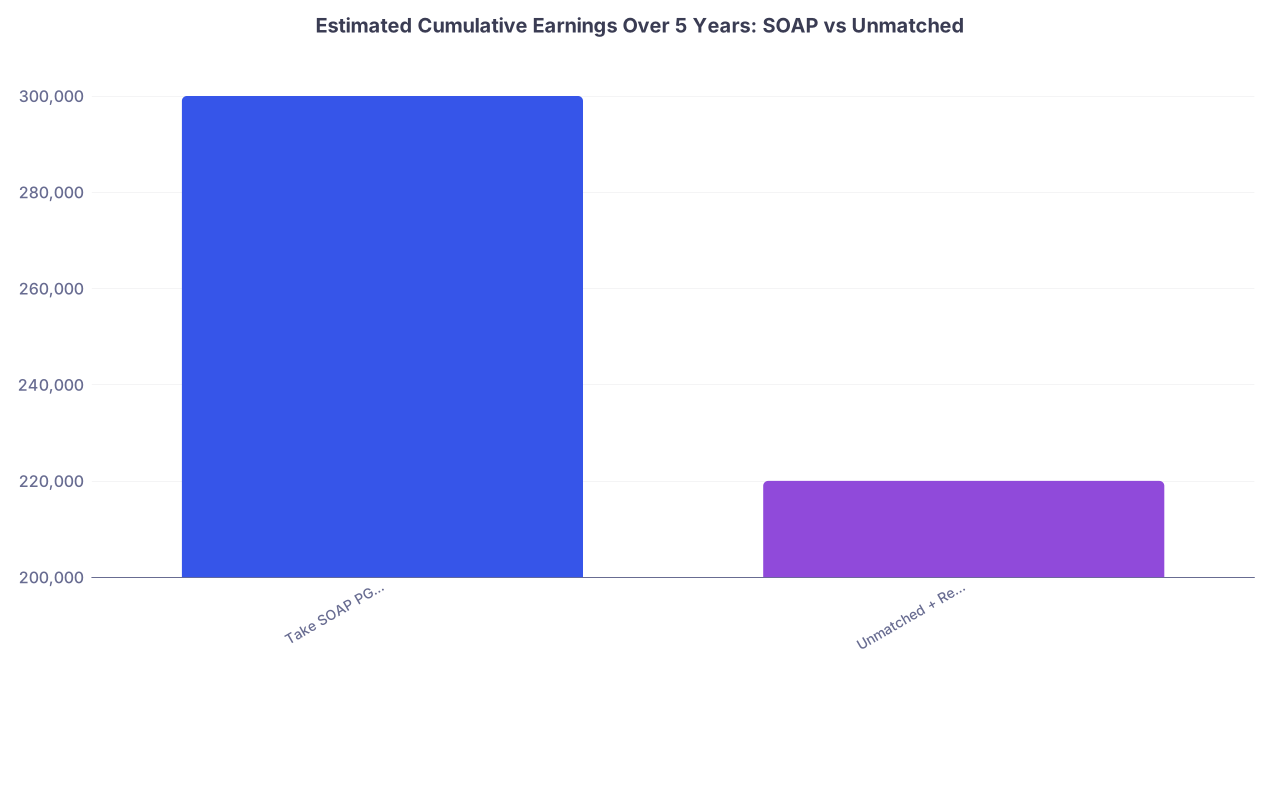
| Category | Value |
|---|---|
| Take SOAP PGY-1 | 300000 |
| Unmatched + Research Year | 220000 |
The exact numbers vary, but the relative gap doesn’t. Starting residency earlier has huge long-term financial impact. Declining SOAP is not just an emotional or professional decision; it’s a six-figure financial bet over your career.
If you’re going to make that bet, do it with your eyes open.
How PDs actually think about SOAPed residents
Let me kill one more myth: “Programs will always see me as lower tier if I came through SOAP.”
Most PDs care about three things once you’re in their system:
- Do you show up and work hard?
- Are you competent, teachable, and not a disaster to work with?
- Do you take care of patients and get along with the team?
Your method of entry matters less over time than your actual performance. Yes, there are programs that sneer at SOAP, but they’re also the ones that overvalue Step scores and pedigree. Those are often the least forgiving environments for any kind of non-linear career.
A SOAP resident who crushes it on the wards will get better fellowship and transfer calls than a “matched on day one” resident who’s half-engaged and average.
Practical decision framework for you, right now
You’re in SOAP week or staring down an unmatched screen. Emotions are running high. Here’s a stripped-down mental checklist.

| Step | Description |
|---|---|
| Step 1 | SOAP Offer Received |
| Step 2 | Consider Declining SOAP |
| Step 3 | Take SOAP Spot |
| Step 4 | Program toxic or unstable? |
| Step 5 | Strong reapp plan with backing? |
| Step 6 | Specialty acceptable long term or as bridge? |
| Step 7 | Willing to accept never matching? |
If you cannot confidently answer “yes” to “I have a strong, supported reapplication plan” or “I can accept never matching,” then the safer, evidence-aligned answer is usually: take the SOAP spot.
FAQ (exactly 5 questions)
1. If I SOAP into a prelim year, am I basically doomed if I don’t get a categorical spot during that year?
No, but it’s tight. A strong prelim year can open doors, especially in IM, anesthesia, neuro, and sometimes rads. You’ll need aggressive networking, early applications, and a PD willing to advocate. Going into a prelim without a concrete plan and mentorship is where people get stuck. But many have successfully converted prelim to categorical or switched fields entirely.
2. Do fellowship programs care if you came in via SOAP?
Almost always: they care far more about your residency performance, letters, and board passage than your method of entry. I’ve seen SOAPed residents match competitive fellowships because they excelled once in training. If your SOAP program is solid and your evaluations are strong, fellowship directors won’t spend much time dissecting how you got your PGY-1.
3. I only want one specific specialty. Isn’t any other field a waste of time?
Only if you’re truly willing to walk away from clinical medicine entirely. For many people, actually working as a doctor (even in a “non-dream” field) ends up far more satisfying than they imagined when they were obsessing over specialty hierarchies as an MS4. If your priority is being a practicing physician at all, not just a specific type, then no—other fields are not a waste. They’re the goal.
4. Will going unmatched once permanently ruin my chances, even if I don’t take a SOAP spot?
It doesn’t “ruin” them, but it absolutely hurts. You become a reapplicant with lower average match rates and higher scrutiny. Some programs and specialties will quietly filter you out. Each additional year out of school makes things worse. That’s why the idea that “going unfilled preserves your options” is largely false; in many ways it constrains them.
5. Should I ever rank programs lower in the Match because I’d rather SOAP than match there?
Almost never. If you would rather go unmatched than attend a given program, that program should not be on your rank list at all. Ranking a program means “I will accept this outcome.” Using low-ranked programs as “insurance” while secretly planning to decline them or prefer SOAP is a misunderstanding of how the Match is designed and usually backfires psychologically if you end up there.
Key points:
Most of the time, taking a reasonable SOAP spot keeps more doors open—financially and professionally—than going unfilled and hoping next year is kinder. Declining SOAP only makes sense when the program is truly toxic, you have a serious, supported reapplication plan, or you’re genuinely prepared to accept never matching if your second shot fails.