
The most damaging decisions in your career often happen in the 2–4 weeks after SOAP ends.
Not during SOAP. After. When you are exhausted, embarrassed, angry, and everyone around you is giving you rushed, half-baked advice.
Let me be blunt: plenty of smart, capable applicants destroy their next Match chances because they panic after a failed SOAP and make impulsive choices. I have watched it happen. More than once.
You are not just managing a bad week. You are protecting your entire next application cycle.
This is where you cannot afford unforced errors.
1. Pretending “Nothing Went Wrong” And Reapplying Blind
The worst thing you can do post-SOAP is treat it like a bad coin flip and just “try again next year” without serious analysis.
That is not resilience. That is denial.
Here is the mistake pattern:
- You did not match or SOAP.
- You feel ashamed and exhausted.
- You tell yourself: “I’ll just cast a wider net next year.”
- You change almost nothing about your application.
- You hope “more programs” fixes a systemic problem.
Next March looks identical. Or worse.
The harsh truth you must face
If you went through:
- Full main Match
- Then SOAP
- And still ended unmatched
…there is at least one significant problem in your application or strategy. Often several.
Common root issues I keep seeing:
- Step/COMLEX scores below program cutoffs (that you never checked)
- Late Step 2 CK or failure without strong recovery
- Multiple red flags: LOA, professionalism concern, repeated failures
- Weak or generic letters with no strong advocates
- No recent clinical experience (especially for IMGs and reapplicants)
- Horrible specialty targeting (e.g., 220 Step 1 US grad applying only to Derm/Plastics)
- Under-applied: 20–30 programs in a competitive specialty and “surprised” by no interviews
If you do not identify which of these (or which combination) killed you this year, you are setting yourself up to repeat the same story.
What to do instead
Within 2 weeks of SOAP ending, before you make any big commitments:
Do a brutal post-mortem of your file. Alone first. Then with help.
- Scores: exact numbers, failures, timing.
- Clerkship grades and narrative comments.
- MSPE wording (especially any mentioned concerns).
- LORs: who wrote them, how well they know you, how recent.
- Specialty competitiveness vs your metrics.
Get at least two independent reads on your application.
- Not just a friend and your favorite attending.
- Aim for:
- A dean or advisor who sees a lot of match data.
- A program director or APD if you can get one to look (yes, some will).
Force them to be honest. Ask directly:
- “If I reapply with this exact file next year, what is the realistic outcome?”
- “If you were me, what must change before I submit another ERAS?”
Do not let anyone placate you with “You’re great, it’ll work out next time.” That kind of comfort is poison right now.
2. Panicking Into Any Non-Strategic Job “Just To Do Something”
The next trap: career panic.
I see graduates:
- Grabbing random non-clinical jobs (“utilization review,” “medical assistant,” “clinic scribe”) with zero thought about how it reads on ERAS.
- Taking long non-clinical gaps and calling it a “research year” when there is no true research, no mentor, no productivity.
- Working full-time in something completely unrelated and assuming “I was busy” will excuse a totally empty CV.
Programs read those gaps harshly. They assume:
- Loss of clinical skills
- Questionable commitment to medicine
- Potential professionalism or performance problems hidden behind “job hopping”
The key distinction: survival vs strategy
You may need money. You may need insurance. I understand. But there is a difference between:
- Job chosen to survive that also strengthens your next application
vs - Job chosen to survive that quietly sabotages your next application
The mistake is believing “anything in healthcare is fine.” It is not.
Here is how programs roughly rank “what you did this year”:
| Activity Type | Typical Program Perception |
|---|---|
| Accredited prelim / transition year | Strongly positive |
| Structured research with output | Positive to strong |
| US clinical experience with responsibility | Positive |
| Teaching or academic role | Mildly positive |
| Random admin/scribe with no growth | Neutral to mildly negative |
| Non-medical job with long gap | Negative |
If you have to work, fine. But make it defensible on your CV and in an interview.
What to do instead
Before signing anything:
Ask yourself: can I clearly explain how this year makes me a better intern in my chosen specialty?
- If you cannot articulate that in 2–3 sentences, the position is likely a mistake.
Prioritize in this order (for most people):
- Accredited prelim year (IM, surgery, transitional) if it is realistic and you actually plan to pivot or strengthen.
- True research year with a defined mentor, projects, and realistic chance for posters/pubs.
- Hands-on clinical role: paid hospitalist extender, clinical fellow, supervised USCE / observerships that are structured and documented.
- Teaching/education: anatomy TA, OSCE instructor, structured tutoring with institutional backing.
Avoid dead-end roles labeled as “research” with no output.
- If after 3 months you still do not have:
- A clear abstract planned, or
- A poster deadline, or
- Regular mentor meetings
You are not in a true research year. You are cheap labor.
- If after 3 months you still do not have:
3. Clinging Stubbornly to an Unrealistic Specialty
Another post-SOAP self-sabotage: doubling down on a specialty that already told you “no” very clearly.
I am not saying you must give up your dream. I am saying you cannot ignore the data.
Bad pattern:
- You applied to Ortho with a 220 Step 1, 232 Step 2 CK, no home program, and minimal research.
- You got 0 interviews.
- You SOAPed unsuccessfully.
- You decide: “I just need more research” and plan to apply only Ortho again.
That is not determination. That is career Russian roulette.
You risk:
- Burning another entire year.
- Ending up chronically unmatched.
- Backing yourself into a corner where even prelim IM or Family Medicine becomes harder due to distance from graduation.
How to know if your dream specialty is now a fantasy
Hard questions you must answer:
- Did I get any interviews in this specialty?
- Did I have any advocates in this field truly willing to call PDs for me?
- Do my scores land at or above the current interviewed ranges for this specialty?
- Do I have a realistic, structural way to fix the weaknesses? (e.g., Step 3, new letters in the field, meaningful research with a recognized name)
If the answer to all of those is “no,” reapplying unchanged to the same super-competitive specialty is not grit. It is denial.
When a pivot is actually the smarter, safer move
For many unmatched applicants, the wiser choice is:
Pivot to:
- Internal Medicine
- Family Medicine
- Psych
- Pediatrics
- Pathology
depending on your profile and interest.
Or pivot from ultra-competitive subspecialty (e.g., Ortho, Derm) to:
- A broader specialty now
- With a genuine plan for fellowship later if appropriate.
You do not have to love this decision right away. You just have to recognize that “hold out for another 3 failed cycles” is not a brave strategy.
4. Mismanaging Program Communication (Burning Bridges Quietly)
Post-SOAP, many applicants either shut down communication entirely or flood programs with poorly thought-out messages.
Both hurt you.
Common communication mistakes I see:
- Vanishing without a word from programs that interviewed you but did not rank you high enough.
- Sending angry / passive-aggressive emails to PDs or coordinators.
- Begging emails: “I’ll do anything, please consider me for next year.”
- Over-sharing your distress on social media in ways that are easily traceable.
Programs remember unprofessional behavior. They document it.
How to communicate like a future colleague, not a rejected applicant
For programs where you had:
- An interview, or
- A real relationship (rotation, research, mentorship)
You should consider a short, composed message after Match Week dust settles (1–2 weeks later), something like:
- Thank them for their time and consideration.
- Acknowledge you did not match.
- Express continued interest in the specialty.
- Ask if they have any feedback or suggestions for strengthening your application for next year.
Key points:
- No entitlement. You were not owed a spot.
- No desperation language. Do not make them uncomfortable.
- No long explanations or self-defense. Just calm, professional curiosity.
Will everyone respond? No. But a few will. And sometimes those few will give you the critical insight your med school advisor did not.
And stop posting real-time despair or program-bashing on public platforms. PDs have Google. Residents have Reddit. Screenshots travel.
5. Wasting the “Golden Window” Right After SOAP
There is a short stretch—about 4–6 weeks after SOAP—where your situation is:
- Still fresh in your mind.
- Still visible to advisors.
- Still emotionally raw enough to motivate real change.
Most people waste it.
Instead, they:
- Numb out for months.
- Avoid looking at ERAS or NRMP reports.
- Tell themselves they will “start planning in the fall.”
By the time they finally wake up, deadlines for:
- Visiting rotations
- Away electives
- Strong letters
- Research abstracts
…have already passed or are basically impossible to hit.
You cannot treat this like a simple “gap year”
You are not just on a break. You are on a 12-month remediation plan whether you like it or not.
There are time-sensitive moves you must not delay:
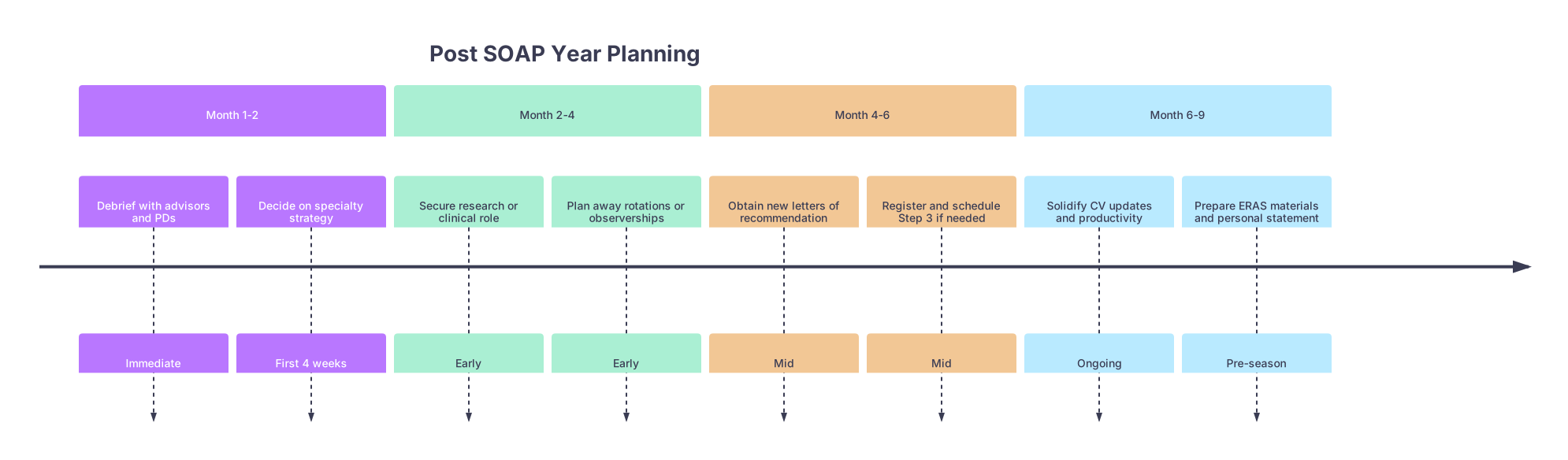
| Period | Event |
|---|---|
| Month 1-2 - Debrief with advisors and PDs | Immediate |
| Month 1-2 - Decide on specialty strategy | First 4 weeks |
| Month 2-4 - Secure research or clinical role | Early |
| Month 2-4 - Plan away rotations or observerships | Early |
| Month 4-6 - Obtain new letters of recommendation | Mid |
| Month 4-6 - Register and schedule Step 3 if needed | Mid |
| Month 6-9 - Solidify CV updates and productivity | Ongoing |
| Month 6-9 - Prepare ERAS materials and personal statement | Pre-season |
If you wait until September to fix things, you are already submitting another weak application.
What you should lock in by 6–8 weeks post-SOAP
Aim to have:
- Specialty decision made (stick or pivot).
- Clear primary advisor (ideally in that specialty).
- Concrete plan for:
- Where you will be physically.
- What your main activity is (research, clinical, prelim).
- How it will produce:
- At least 1–2 strong new letters.
- CV entries that scream “I used this year well.”
6. Misunderstanding How Programs View Prelim and SOAP History
After an unsuccessful SOAP, some applicants treat a prelim year as a magical reset button.
Reality: programs read your history carefully. They see:
- Unmatched main Match + SOAP
- Then prelim
- Then reapply
This is not automatically bad. But it raises questions:
- Why did they not match categorical originally?
- How did they perform as a prelim?
- Did they receive a categorical offer from their prelim institution?
- Are they leaving on good terms?
The misjudgment is assuming:
- “Any prelim is good”
or - “I can coast through prelim; it is just a placeholder”
Both are dangerous.
How a prelim can help—or hurt—you
A prelim year helps when:
- You perform well clinically.
- You leave with strong letters from attendings and PD.
- There are no professionalism incidents.
- You can clearly explain why you are reapplying (specialty change, better fit, location).
A prelim year hurts when:
- Your evaluations are lukewarm or poor.
- You develop a reputation as unreliable or difficult.
- You abruptly quit or request major schedule changes constantly.
- You do not improve any application weaknesses (no new letters, no Step 3, no clear narrative).
In other words, a prelim year is a high-stakes audition. Treat it like that.
7. Ignoring the Data: Not Using NRMP and Specialty Reports
Another post-SOAP mistake: making decisions based only on anecdotes and Reddit threads.
People say things like:
- “My friend with a 215 got IM, so I should be fine in Ortho with a 225.”
- “I know an IMG who matched Derm, so anything is possible if you believe.”
- “Programs say they are holistic, so scores don’t matter that much anymore.”
This is how people waste entire years chasing statistically ridiculous targets.
You have actual data. Use it. NRMP and specialty organizations publish:
- Charting Outcomes in the Match
- Program Director surveys
- Specialty-specific match data (e.g., for EM, Psych, Peds, Pathology)
These tell you:
- Average scores for matched vs unmatched.
- The importance PDs place on various factors.
- Typical number of programs applied to and interviews received.
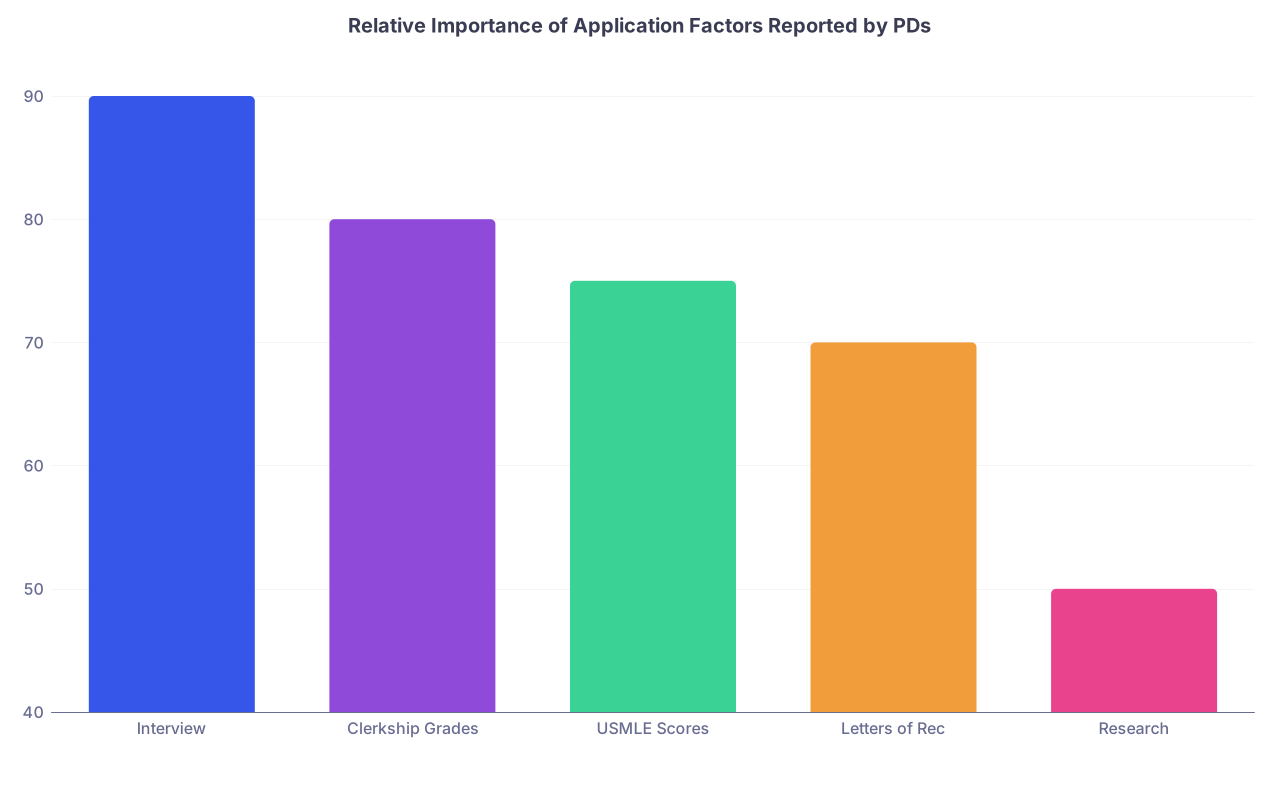
| Category | Value |
|---|---|
| Interview | 90 |
| Clerkship Grades | 80 |
| USMLE Scores | 75 |
| Letters of Rec | 70 |
| Research | 50 |
If your profile is significantly below the matched cohort for a given specialty, and you have no realistic way to compensate (research, connections, new scores), reapplying the same way is a bad bet.
8. Writing the Same Personal Statement and Using the Same Narrative
One more subtle but serious error: recycling your old story like nothing changed.
If your previous narrative was:
- “I have always wanted specialty X”
- “Rotations confirmed specialty X is my perfect fit”
- “My journey has been smooth and linear”
Then you did not match and did not SOAP. You cannot repeat that same, untouched story.
Programs know what happened. ERAS will show:
- Gap year(s)
- Prelim positions
- New experiences
If your narrative does not acknowledge the reality of last year, you come off as:
- Out of touch
- Lacking insight
- Possibly hiding something
How to adjust your narrative without oversharing or self-sabotage
The mistake is either:
- Saying nothing; pretending the failure did not happen.
Or - Over-disclosing every painful detail and turning your PS into a confessional.
You need a middle path:
- Briefly acknowledge:
- That you went unmatched.
- That this was difficult and humbling.
- Emphasize:
- What you did about it.
- How this year sharpened your goals.
- How it made you more prepared for residency.
One or two concise sentences. Then back to who you are now and what you bring.
Your letters and experiences must match that story. If your PS says you grew tremendously, but:
- No new letters
- No new roles
- No evidence of effort
Programs will not buy it.
9. Letting Shame Drive You Into Isolation
The last, and maybe most quietly destructive, misjudgment: going completely dark.
I have watched good applicants:
- Disappear from faculty mentors.
- Stop responding to emails.
- Avoid their med school.
- Hide from peers and former attendings out of embarrassment.
Then six months later, they suddenly need:
- Letters of recommendation.
- A PD to call a program.
- Someone to explain their year in a positive light.
Those relationships atrophy if you vanish.
You do not have to wear a sign that says “I did not match.” But you also cannot ghost everyone who could help you.
Protect yourself from this by doing three things:
Identify 2–3 “core people” you will keep updated.
- A dean or advisor.
- A faculty member in your target specialty.
- Possibly a prior mentor or research PI.
- Email them a short update every 2–3 months.
Stay in the professional ecosystem.
- Go to at least one regional or national conference if you can.
- Present something if possible (even a poster).
- Show your face. Remind people you exist.
Practice a neutral, professional one-sentence explanation:
- “I did not match this cycle, so I am spending this year doing X and Y to strengthen my application for next year.”
- Say it until it feels routine, not shameful.
The more you shrink your world out of embarrassment, the fewer options you will have when it really matters.
Your Next Step Today
Do not put this off until “after I feel better.” You can feel awful and protect your future at the same time.
Today—before you lose momentum—do one concrete thing:
Pull up your ERAS application, your score reports, and your program list. Then open a blank document and write, in brutal detail, your best guess at why you did not match or SOAP this year. List at least three specific, fixable problems.
Tomorrow or the next day, take that document to someone who sees a lot of applicants—an advisor, PD, or trusted faculty member—and ask them to rip it apart and add what you are missing.
Do not let the worst week of your career also become the reason you sabotage next year’s Match.