
The worst SOAP mistake isn’t rejecting the “wrong” offer. It’s panicking so hard you stop thinking like a rational human being.
You’re not crazy for worrying about this. The idea of multiple SOAP offers sounds like a dream… until you realize you might have minutes to decide, thousands of dollars of debt on the line, and no attending, advisor, or parent who really understands ERAS rules sitting next to you.
So your brain goes straight to:
- What if I accept something too fast and miss a better offer 5 minutes later?
- What if I wait for something better and end up with nothing?
- What if I accept, and then my actual dream program calls, and I’m stuck?
Let’s walk through what actually happens, what’s possible, and how to not melt down if your phone starts lighting up.
The Reality: Multiple SOAP Offers = Controlled Chaos, Not Pure Disaster
First, some grounding.
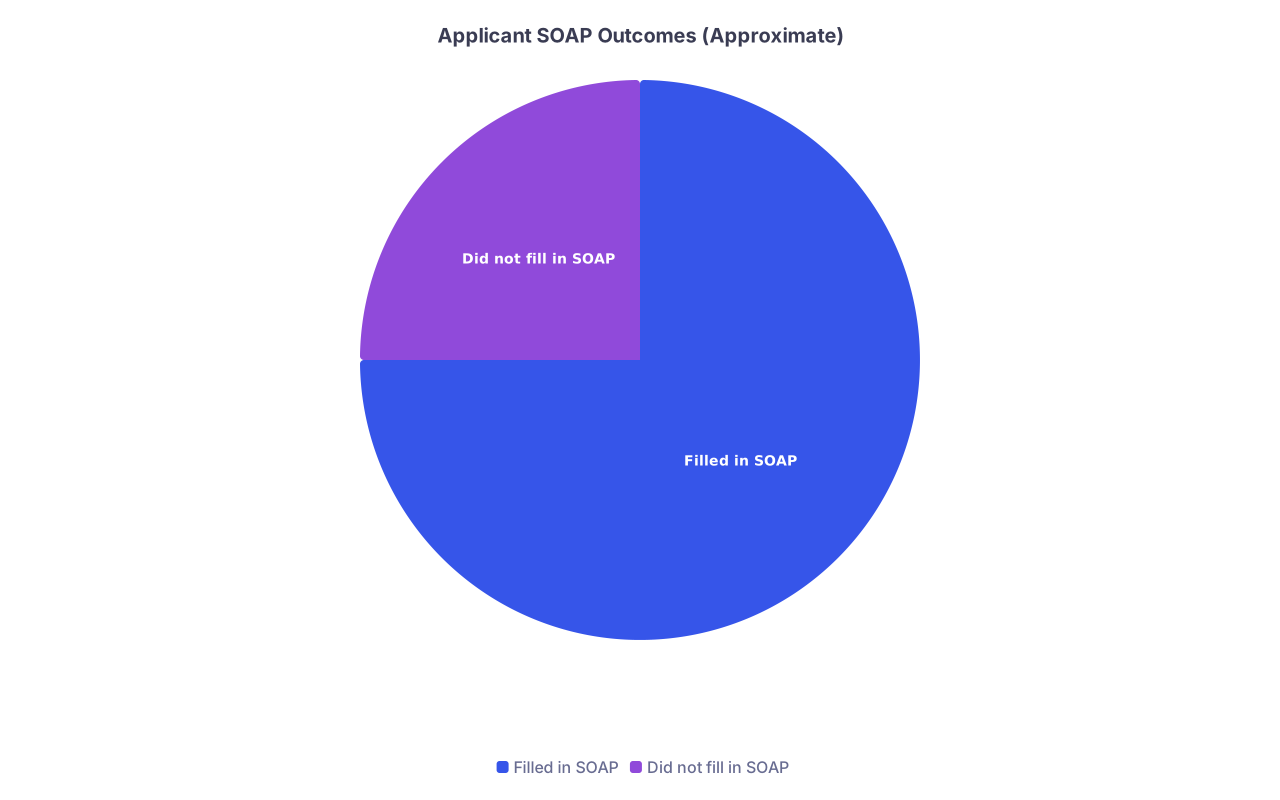
| Category | Value |
|---|---|
| Filled in SOAP | 75 |
| Did not fill in SOAP | 25 |
Most unmatched applicants who are realistic about their lists end up somewhere through SOAP. Not always their #1. But not “no job at all.”
The nightmare scenario in your head is:
You get three offers at once. From totally different specialties. In different states. With different vibes. One wants an answer now. You freeze, overthink, click something, and then spend the next six months wondering if you just wrecked your career.
Here’s what’s actually true:
- You can get multiple offers in the same SOAP round.
- You do not have to answer instantly in under 5 seconds.
- You cannot “hold” multiple offers. You can only accept one at a time.
- If you accept one, all your other pending offers disappear. Gone.
That last part is where the panic comes from. It feels like a permanent, life-defining decision made while shaking and sweating over your laptop during a random weekday in March.
So the only way to not lose your mind in that moment is to have your framework decided before offers arrive.
Step 1: Understand the SOAP Offer Mechanics (So You Don’t Invent Rules in Your Head)
The worst time to learn how SOAP works is during SOAP.
Here’s the stripped-down version of the SOAP offer process:

| Step | Description |
|---|---|
| Step 1 | Unmatched on Monday |
| Step 2 | Apply to SOAP programs |
| Step 3 | Program reviews |
| Step 4 | Offer rounds start |
| Step 5 | Wait for next round |
| Step 6 | Accept or Reject |
| Step 7 | Match to program |
| Step 8 | Receive offer? |
Key points that matter in the “multiple offers” panic scenario:
- Offers come in rounds, not random chaos 24/7
- Each round has a fixed response window (usually around 2 hours), not 20 seconds
- You can receive more than one offer during a round
- You can only accept one; once you accept, other offers vanish and you’re done with SOAP
- Rejecting an offer sends it back into the pool to be offered to someone else in the next round
So the actual decision-moment anxiety looks like this:
You open your screen and see:
- 1 prelim medicine offer in a city you could live in,
- 1 categorical FM offer in a rural area,
- 1 transitional year in a location you hate but with a big-name academic hospital.
And the timer is ticking.
The rules are rigid. But you’re not helpless if you’ve prepared.
Step 2: Build Your “If X, Then Y” Rules Before SOAP Starts
If you wait until the offers are in front of you to decide your priorities, you will absolutely spiral.
You need pre-decided rules. As in, literally written down. Something like:
“If I get a categorical offer in any of these specialties → I accept immediately, regardless of location.”
Or:
“If I get more than one prelim vs TY offer → I choose TY first, unless it’s in [deal-breaker region].”
Sit down (ideally before Match Week) and write three ranked lists:
Specialty/Type priority list
Example:- Tier 1: Categorical IM, FM, Peds (long-term careers I can see myself in)
- Tier 2: TY, prelim IM (paths to reapply or pivot)
- Tier 3: Prelim surgery, prelim anything else (only if I’m desperate not to sit out)
Location priority list
Not just “places I like,” but:
- Places I’d be happy
- Places I can tolerate for 1 year
- Places I only accept if I’m cornered and it’s that or no residency
Non-negotiables
Things where you’d rather reapply than go:
- Absolute no-go geographic regions (family, safety, immigration, etc.)
- Programs with historically abusive reputations (talk to upperclassmen, not Reddit rumors only)
- Deal-breaker personal situation conflicts (child custody, spouse job, visa)
When the offers come, you don’t think from scratch. You just map each offer to your pre-written lists.
“Oh, this is Tier 1 specialty + mid-tier location I can tolerate = this is a yes.”
That’s how you avoid staring at the screen wondering if you should gamble on “maybe something better later.”
Step 3: Choose Between Multiple Offers Without Emotionally Self-Destructing
Let’s say it’s offer round 2. You have three offers. Your heart is pounding. You feel like every residency director is watching your keyboard.
Pull out your rules and do this in order:
Check specialty/type tier first
Example scenario:
- Offer A: Categorical Family Med, small town
- Offer B: TY at big academic center in a city you like
- Offer C: Prelim Surgery at a malignant program everyone warns about
If your pre-written rule was “any categorical in FM/IM/Peds > any TY > any prelim surgery” — the answer is already clear: Offer A.
Then compare location among offers in the same tier
If you somehow get:
- Two categorical IM offers
- One FM offer
All in your Tier 1 specialty category — now location and program vibe decide.
Use:
- Proximity to support system
- Cost of living
- Known program reputation (from real people, not just online noise)
Ask this unfair but clarifying question:
“If SOAP ended right now and this was the only offer I ever got, would I be truly devastated that I accepted it?”
If the answer is no — it’s acceptable — you don’t reject it just to chase fantasies.
Decide in 10–15 minutes, not the full window
You do not need the full 2 hours to overthink every future fellowship possibility. When you start imagining your hypothetical GI fellowship chances from each of these prelim spots, you’re already over-optimizing and under-living.
You are not choosing your entire destiny. You’re choosing your next step that keeps you moving forward.
Step 4: Handling the “But What If Something Better Comes Later?” Spiral
This is the loudest thought in SOAP: “If I accept now, I might miss a better offer later this afternoon.”
Let me be blunt: that’s how people end up with nothing.
The programs that are truly excited about you don’t usually wait until the last nanosecond. They move early. If all you’re getting in rounds 1–3 are prelims you deeply hate, and you know you applied broadly and realistically, that’s data.
| Situation | Recommended Response |
|---|---|
| Categorical in your preferred specialty | Accept immediately |
| Categorical in backup but acceptable specialty | Strongly consider accepting |
| TY in decent location, no categoricals yet | Usually accept by mid-rounds |
| Prelim only, very early rounds, realistic app | Consider waiting one more round |
There is a place where it’s reasonable to wait:
- You got a low-priority prelim offer in round 1,
- You applied to a bunch of categorical spots you’re qualified for,
- Your advisors think you’re competitive there,
- You’re in early rounds, not the last.
Then fine. Maybe you wait a round.
But waiting when you already have:
- A categorical in a solid but not sexy location?
- A TY at a real hospital with real teaching?
…just because there might be a “better vibe” coming? That’s not strategy. That’s gambling with your career because you hate feeling boxed in.
SOAP doesn’t reward gamblers. It rewards people who know when “good enough” is actually good.
Step 5: How Not to Emotionally Implode in the Actual Moment
You can know all the rules and still feel like your soul is trying to escape through your ribcage when the offers appear.
Here’s how to keep functioning:
Don’t do SOAP alone, if humanly possible
Have:
- A trusted friend or partner
- A classmate who also understands SOAP timing
- An advisor/Dean on Zoom or phone if they’re actually helpful and not just “stay positive” people
Your brain will want to catastrophize. Someone else can say, “Okay, your rules say categorical > TY > prelim. You have a categorical. You already decided this last week.”
Control your screen and environment
- Close socials. Reddit will absolutely make you question your decision mid-offer window.
- Open only: NRMP/ERAS, your written SOAP rules, maybe a notes doc.
- Put your phone face down unless you need it for a call.
Pre-write acceptance thresholds
Literally write:
- “If Categorical IM OR FM OR Peds appears anywhere that’s not on my no-go list → I accept on the spot.”
- “If only TY and prelim offers show up, I will accept a TY by round X if nothing categorical has come.”
Give yourself permission to feel like crap — later
You don’t need to feel good about this choice right now. You just need it to be defensible.
Meaning: Past-you, who was calm and had time, would agree this was a reasonable option. That’s the bar.
Step 6: Worst-Case Scenarios (And What Actually Happens If You “Mess Up”)
Let’s play out your brain’s worst fears.
Scenario 1: You accept a prelim/TY, then a categorical you wanted more appears later
Yeah. That sucks. You will be mad. You will stalk that program online. You will imagine your alternate timeline life.
But here’s the key:
You still have a residency spot. You’re still in the system, training, getting paid, and opening doors.
Plenty of people:
- Start prelim/TY
- Make connections
- Reapply
- Move into a categorical spot the next year
It’s not ideal. But it’s not “career over.” It’s “career detour.”
Scenario 2: You wait for something better, reject lower-tier offers… and nothing else comes
This is the true nightmare.
You’ll tell yourself: “I should have just taken that prelim IM in [random state] when I had the chance.”
Maybe. But also — even in that scenario — your life isn’t over.
You can:
- Do a research year
- Work as a hospitalist scribe, MA, or in QI
- Strengthen your app and reapply
Would that path be harder? Yes. More uncertainty? Yes. But I’ve seen people match on second or third cycles after being unmatched. They don’t glow on Instagram about it, but they exist.
The thing you don’t want is to end up in that spot when you actually had an offer you could have lived with but refused because you were chasing fantasy.
Quick Mental Checklist When Multiple Offers Hit
You see multiple offers. You feel sick. Do this:
- Which specialty/type tier is each offer in?
- Which ones clearly violate my non-negotiables? Cross those out.
- Among what’s left, which is the highest-tier specialty/type?
- Among those, which location can I function in best for 1–3 years?
- Would future-me say this was a reasonable, defensible choice?
- If yes → accept. Close the tab. Do not look back.
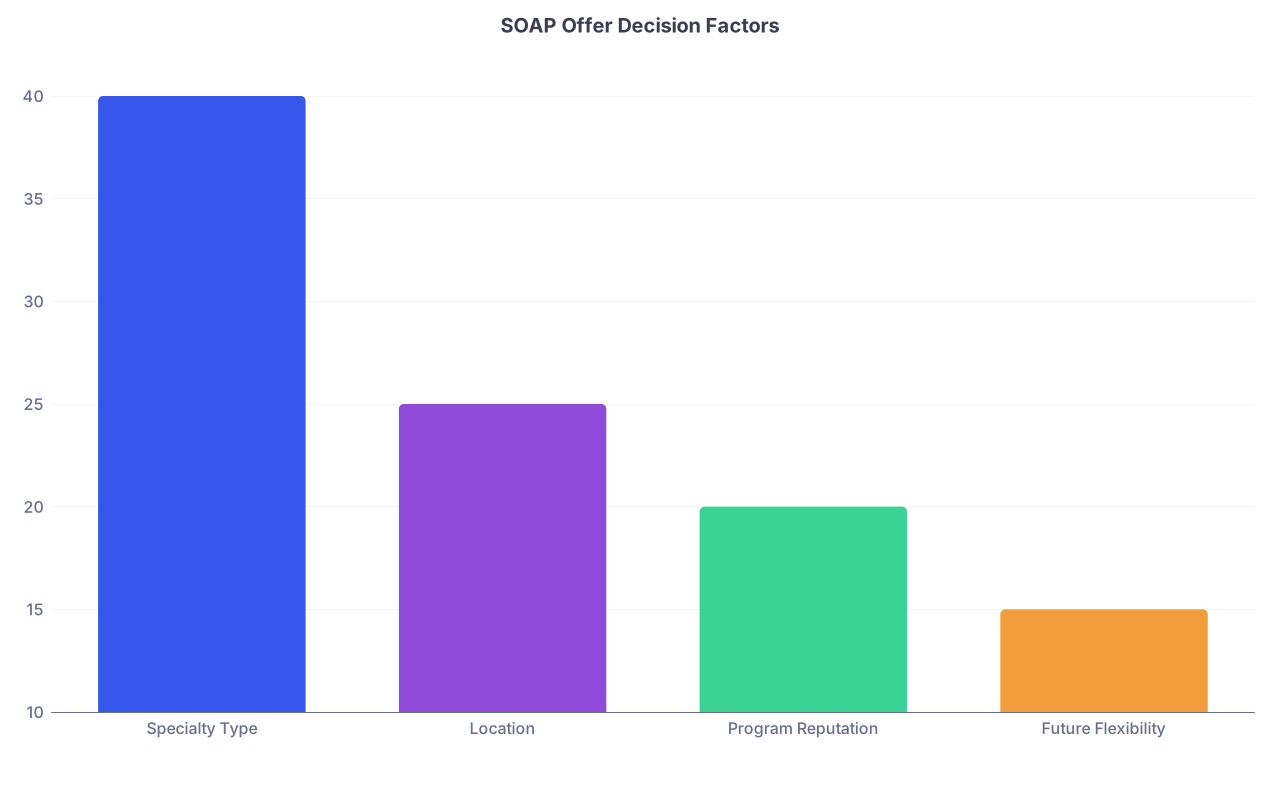
| Category | Value |
|---|---|
| Specialty Type | 40 |
| Location | 25 |
| Program Reputation | 20 |
| Future Flexibility | 15 |
You are not supposed to feel 100% sure. You’re choosing under pressure with incomplete information. There is no perfect answer. There are just “good enough to move forward” answers.
FAQ (Exactly 4 Questions)
1. What if I accept a SOAP offer and then deeply regret it a week later? Can I back out?
Technically you can try to back out of a contract, but it’s messy, unprofessional, and can burn bridges faster than you think. Programs talk. Your school has to sign off. The NRMP takes commitments seriously. Most of the time, if you accept in SOAP, you should treat it as binding. Regret is normal, by the way. A lot of people second-guess for months and then end up fine once they start residency and realize every program has problems and perks.
2. What if I get multiple offers at the exact same time — do they expire instantly?
No. You get a defined window (usually a couple hours) for that round. The pressure is real, but you’re not on a 30‑second timer. Use 10–20 minutes to apply your pre-written rules, maybe call someone if you’ve planned that ahead of time, and then decide. Waiting the full window just to ruminate won’t magically make the choice clearer; it usually just makes you more anxious.
3. Should I ever reject all offers in hopes of something better in later rounds?
Only if what you’re being offered is below your own minimum line — the “I’d rather reapply than do this” level. That bar should be very low, by the way. If an offer is acceptable but not dreamy, you usually take it rather than roll the dice. Waiting makes sense early in SOAP if you’re only seeing very low-tier prelims and you’re reasonably competitive for categoricals you applied to. But rejecting decent offers because you’re holding out for perfection? That’s how people end up unmatched with no job.
4. How do I stop obsessing about “what if I’d chosen the other offer” after SOAP ends?
You probably won’t stop immediately. Your brain will run the alternate universe for a while. What helps is reframing: you made the best decision you could with the information and time you had. That’s all anyone can do in SOAP. Then, once residency starts, focus hard on being excellent where you are — good evaluations, strong relationships, maybe research or QI. The better you perform, the less the specific SOAP choice matters in the long run. Years from now, the big story won’t be which SOAP offer you picked. It’ll be who you became while dealing with all of this.