The most dangerous thing you can do with zero SOAP offers by Thursday is panic. The second most dangerous is to do nothing.
You are in a crisis window, but you are not done. Not by a long shot. What you do over the next 24–72 hours will heavily influence whether you recover for this year (rare but possible), set yourself up for a strong re-application, or let the situation control you.
I am going to give you a concrete, hour-by-hour style game plan: what to do today, this week, this month, and over the next cycle. No fluff. No platitudes. Just moves.
1. First 2–4 Hours: Stabilize, Assess, and Tell the Truth
You checked your email / NRMP portal. No SOAP offers. It feels like a punch to the throat.
You have two problems:
- Emotional shock.
- Strategic blindness.
You cannot fix #2 if you ignore #1.
Step 1: 30–60 minutes to get your head above water
You are not expected to be stoic. But you are expected to be functional.
Do this immediately:
- Get away from your screen for 30–60 minutes.
- Walk outside. No phone, no email.
- Call exactly one person you trust (mentor/family/friend who does not panic easily) and say:
“I got zero SOAP offers. I am upset, but I am going to make a plan in the next few hours. I may not want advice right now; I just need you to know what is happening.”
Notice what I did not say: post on social media, blast a group chat, tell 12 people. You need clear signals, not 20 conflicting opinions.
Step 2: Get the hard data in front of you
Sit down at your computer with:
- Your ERAS application PDF
- Your full program list
- USMLE/COMLEX transcript
- Medical school transcript/MSPE
- Any SOAP communications (emails, interview invites that did not convert, etc.)
Ask and answer these blunt questions on paper (not just in your head):
What is my specialty profile?
- Specialty applied to:
- Categorical vs prelim vs transitional:
- Number of programs applied to:
- Number of interviews before Match:
- Number of SOAP programs applied to:
What are my hard stats?
- Step 1: ___ (Pass/Fail + if numeric, write it)
- Step 2 CK: ___
- COMLEX scores if DO:
- Any failures/attempts:
- Class rank/quartile if known:
- Gaps in training? Y/N (explain on paper in 1 line)
What obvious red flags do I have? Check all that apply:
- Failed Step/COMLEX attempt
- No US clinical experience (for IMGs)
- Significant professionalism issue in MSPE
- Major gap (1+ year) with weak explanation
- Very low interview count (0–3)
- Applied to extremely competitive specialty with mediocre stats
If you do not write it down, you will keep telling yourself a vague story like “the match is broken” instead of “I applied to 18 EM programs with 1 SLOE and a 232 Step 2.”
2. Same Day: Rapid Triage with Someone Who Knows What They’re Doing
You should not make your entire recovery plan alone.
Step 3: Activate a small, specific advisory team
Today, contact 2–4 people max:
- Your Dean of Students / Student Affairs
- A trusted faculty advisor in your specialty or in Internal Medicine/Family Medicine as a “generalist fixer”
- If you are an IMG: director of your prep program or an experienced advisor who has actually placed IMGs into residency
- One honest peer who matched and knows you well (optional, but not to drive strategy—just perspective)
Your email should be short and clear:
Subject: URGENT: No SOAP Offers – Requesting Brief Debrief and Next Steps
Dear Dr. [Name],
I wanted to let you know that I did not receive any SOAP offers this week. I am disappointed but motivated to address whatever gaps exist in my application.Could we schedule a brief 20–30 minute meeting in the next few days to review my application profile and outline a concrete plan for the next 6–12 months?
I have my ERAS, board scores, and program list ready to share.
Thank you for your time and guidance,
[Your Name, MS4/IMG, etc.]
Do not send a three-page emotional essay. You are asking for a tactical consult, not therapy.
3. The 72-Hour Review: Forensic Autopsy of This Match Cycle
You did not fail randomly. There is a pattern. Find it.
Step 4: Identify which problem set you belong to
Most zero-offer SOAP situations fall into 1–2 of these buckets:
| Profile Type | Primary Problems |
|---|---|
| Undersubscribed applicant | Too few programs, late applications |
| Overreach specialty choice | Specialty too competitive for stats |
| Red-flag candidate | Exams, professionalism, gaps |
| IMG with weak strategy | No USCE, poor targeting, poor docs |
| Interview-issue candidate | Poor interview skills or behavior |
Be honest about which two fit you best. If you say “none,” you are lying to yourself or you do not understand the landscape.
Step 5: Build a one-page “failure map”
On a single page, make four columns:
- Category (Applications, Scores, Experiences, Interviews, Timing)
- What I Did This Cycle
- What Likely Hurt Me
- What I Will Do Differently
Example (abbreviated):
Category: Applications
- Did: Applied to 32 EM categorical only, no IM/FM backup
- Hurt: EM is highly competitive; no Step 2 > 245; no dual-apply
- Different: Next cycle, switch to IM or FM primary, EM only if dramatic improvement + strong advising
Category: Scores
- Did: Step 1 pass, Step 2 CK 219, failed COMLEX Level 2 once
- Hurt: Below many program cutoffs; fail is a major red flag
- Different: Dedicated 3-month CK retake prep, aim 235+ if allowed / if not, create strong narrative + concrete remediation
Do not skip or sugarcoat. This sheet is the blueprint for everything that follows.
4. Immediate Logistics: Money, Visas, Timing, Life
Before talking strategy, you must know your constraints.
Step 6: Clarify your non-negotiables
Ask and write:
- Financial runway: How many months can you afford dedicated prep or unpaid research/observerships without income?
- Visa issues (IMGs):
- When does current visa expire?
- Can you stay in the country to do observerships or research?
- Licensing/exam deadlines:
- Any approaching Step/COMLEX eligibility cutoffs?
- School graduation deadline?
If you are an international grad who must leave the U.S. within 30 days of finishing an observership, that changes the plan. You might need remote research + clinical work in your home country instead of trying to hold out in the U.S. with no legal status.
Be brutally clear about what is possible.
5. Next 2 Weeks: Build a Concrete 12-Month Recovery Plan
Now we design the actual comeback. This is the part almost everyone does badly. They say “I will strengthen my application” and then wander.
You need a calendar, not a wish.
Step 7: Choose your target strategy for the next Match
Your options, realistically:
Reapply to the same specialty with a stronger version of yourself
Works if:- You were borderline competitive and just misplayed strategy/timing
- You can meaningfully improve one or two anchor points (Step 2, USCE, LORs, continuity clinical work)
Pivot to a less competitive specialty
Common pivots:- From Surgery → IM / FM / Psych
- From EM → IM / FM
- From Derm/Rad Onc/ENT → IM / Path / prelim + research year (very case-by-case)
Delay reapplication by a full year to do a structured year
- Research fellowship with clear deliverables
- Formal post-graduate clinical program (non-ACGME but structured)
- MPH/other degree only if it directly supports your story and you have a plan, not as a hiding spot
Do not make this decision purely on “what I like.” You already tried that. Make it on “where I can realistically match with my profile in one year.”
6. Core Pillars to Fix Before the Next Application
We are going to hit the five main levers you can actually move.
Pillar 1: Exam performance and signal
If you have:
- Step/COMLEX failure(s), or
- CK score at or below many program cutoffs (e.g., < 220–225 for IM/FM, < 230 for competitive specialties)
Your exam story must change from:
- “I struggled and then repeated the same patterns”
to - “I struggled, then completed clear remediation and now perform at or above expectations.”
Concrete steps:
- Enroll in a structured review course or tutoring program where you will:
- Do weekly NBME/UWorld-style assessments
- Have written performance logs
- Get a letter or documentation of remediation if possible
- Make a written exam remediation plan:
- Daily Qbank goal (e.g., 40–60 timed questions)
- Weekly full-length or mini-assessment
- Content review schedule
Ask your dean or advisor if your school can formally document your remediation in an addendum to the MSPE or a dean’s letter next cycle. Many overlook this.
Pillar 2: Clinical recency and continuity
Programs hate gaps without clinical exposure, especially:
- IMGs with no recent USCE
- Graduates >1 year out of school with no patient contact
You want to be able to say at ERAS submission:
“For the last 6–12 months, I have been continuously involved in [patient care / clinical environment] in [X setting], working with [Y attendings] who can speak to my performance.”
Options:
USCE (for IMGs):
- Prioritize hands-on experiences if you can get them (sub-internships, externships) over passive observerships
- Line them up now; the best spots fill months in advance
Home-country clinical work (if you must leave the U.S.):
- Hospitalist assistant role
- General practice clinic with real patient contact and supervisory letters
Non-training clinical roles (for US grads):
- Clinical research coordinator where you are physically on the unit, in clinics
- Scribe in ED/IM/FM with strong mentoring
Do not sit at home “studying” for 12 months with zero clinical contact. That is death to your application.
Pillar 3: Letters of recommendation that actually move the needle
Your current LORs did not get the job done. Either:
- Weak content
- Wrong people
- Too generic
- Too old
You need 2–3 fresh, specific letters from:
- Faculty in your target specialty
- Who have observed you for at least 4–6 weeks
- Who know your story and are willing to address your growth directly
Your script to potential letter writers:
“I am reapplying to [specialty] after an unsuccessful Match and SOAP this year. I want to be candid about that and also show programs the progress I am making. I would be very grateful if you could write a letter commenting specifically on my clinical performance, reliability, and how I responded to feedback during my time working with you.”
If their response is lukewarm or hesitant, do not push. That is code for “my letter will not help you.”
Pillar 4: Your personal narrative and red-flag framing
Your personal statement, experiences, and any explanation boxes need a full rewrite. Not minor edits. A rewrite.
The worst pattern I see: people either ignore their red flags or overshare them emotionally.
You want:
- One to two sentences that acknowledge the problem factually
- One to three sentences demonstrating:
- What you did about it
- What changed since
- Evidence of improved performance
Example for an exam failure:
During my third year, I underperformed on Step 2 CK and required a second attempt. My initial study plan relied too heavily on passive review and I underestimated the value of timed questions and structured feedback. After working closely with my school’s learning specialist, I adopted a new system of daily timed question blocks, weekly self-assessments, and focused review of weak content areas. Using this approach, I improved my score by 24 points on my second attempt and have maintained those study habits in my ongoing clinical work and board preparation.
Direct. No excuses. Concrete.
Pillar 5: Application breadth, targeting, and timing
You will not get another shot at a poorly structured application list. Next time, it needs to be professional-level.
Use your advisor + NRMP / specialty data to build:
A spreadsheet of programs with:
- Specialty
- Location
- Program type (community vs academic)
- Approximate Step cutoffs if known
- IMG friendliness (if relevant)
- Prior acceptance of reapplicants/older grads
A tiered strategy such as:
- 20–30 “reach but possible”
- 40–60 “realistic”
- 20–30 “safety” (community, IMG-heavy, less desirable locations but solid training)
For many IMGs or red-flag applicants, 80–120 well-chosen programs is normal, not overkill.
And you submit early. As in, day one or very close to it. No more “I was still editing my personal statement on October 5.”
7. Month-by-Month: Simple Timeline for the Next Year
You need a concrete structure. Here is a generic but realistic template you can adapt.
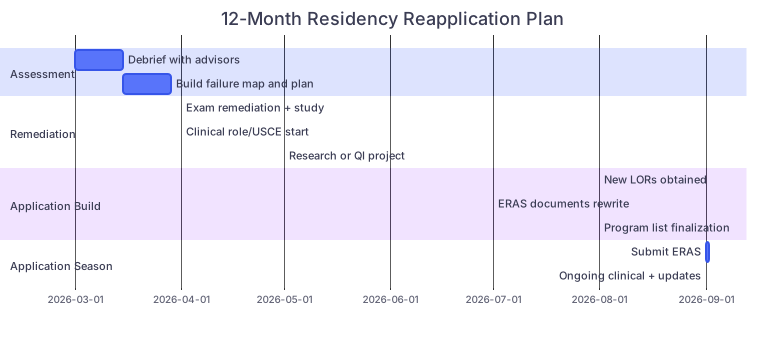
| Task | Details |
|---|---|
| Assessment: Debrief with advisors | a1, 2026-03, 2w |
| Assessment: Build failure map and plan | a2, after a1, 2w |
| Remediation: Exam remediation + study | b1, 2026-04, 3m |
| Remediation: Clinical role/USCE start | b2, 2026-04, 9m |
| Remediation: Research or QI project | b3, 2026-05, 7m |
| Application Build: New LORs obtained | c1, 2026-08, 2m |
| Application Build: ERAS documents rewrite | c2, 2026-07, 3m |
| Application Build: Program list finalization | c3, 2026-08, 1m |
| Application Season: Submit ERAS | d1, 2026-09, 1d |
| Application Season: Ongoing clinical + updates | d2, 2026-09, 6m |
Adjust months depending on your current date, but keep the structure:
- First month: analysis + planning
- Next 3–6 months: heavy remediation + clinical work
- Summer: letters + document rebuild
- Fall: strategic application + ongoing updates
8. If You Are an IMG: Extra Reality Layer
IMGs get hit harder by a failed Match/SOAP, but the playbook is the same—just more intense.
Key add-ons:
USCE is non-negotiable.
You should be actively pursuing:- 2–3 rotations in IM/FM/Psych (for primary care–type targets)
- In hospitals that actually take IMGs
Geographic strategy matters more.
Target states and programs that traditionally accept IMGs:- New York, New Jersey, Michigan, Pennsylvania, Texas, Florida, etc.
Look for large community hospitals with many IMGs on their current roster.
- New York, New Jersey, Michigan, Pennsylvania, Texas, Florida, etc.
Visa clarity:
On every program spreadsheet, track:- H1B supported Y/N
- J1 supported Y/N
And you must tighten your documents. IMG personal statements and CVs are often bloated. You need:
- Clean, US-style CV
- Concise, focused PS that makes it crystal clear:
- Why this specialty
- Why you are trainable now
- What you have done in US systems
9. Interview Skills: If You Got SOAP Interviews but Zero Offers
Different problem. If you had multiple SOAP interviews and none converted, assume your interview performance is a major limiting factor.
Fixes:
- Record 3–4 mock interviews (Zoom is fine)
- Ask 2–3 harsh reviewers to critique:
- A faculty advisor
- A brutally honest peer
- Possibly a professional coach if you can afford it
Common problems I see:
- Overly negative or defensive when asked about failures
- Long, rambling answers with no structure
- Coming across as desperate or bitter about previous failures
- Poor understanding of the specialty’s reality
You want:
- 60–90 second answers to most questions
- A clear, practiced, but not robotic answer to:
- “Why did you not match last cycle?”
- “What did you do in the year since then?”
- “Why this specialty, now, given this history?”
Write them. Practice them. Out loud. Several times a week before interview season.
10. Emotional Maintenance: Avoid the Two Classic Traps
You are vulnerable to two bad moves:
Shame spiral and isolation.
You tell no one, you avoid classmates, you disconnect from mentors. You pretend you are “figuring it out” while actually doing very little because you feel crushed.Denial and magical thinking.
You change almost nothing, apply to the same rank of programs in the same specialty, and “hope it works out this time.”
Both are fatal.
Instead:
- Schedule a recurring check-in with one advisor every 4–6 weeks.
- Join or create a small group of 2–4 reapplicants/peers where you:
- Share monthly progress
- Call each other out when someone is drifting
You are not the first person to miss out on SOAP. You will not be the last. What differentiates the ones who match on the rebound is execution, not luck.
11. A Quick Reality Check: What You Can Stop Worrying About
There are things you absolutely should care about. And some things people obsess over that do not move the needle.
Stop wasting energy on:
Online forums telling you “you’ll never match.”
They are wrong often. They also do not know your full story.Comparing yourself to the top of your class who matched Derm at UCSF.
Different game. Different league. Not relevant.Endless minor formatting tweaks to your CV or PS while ignoring the fact that you have not touched a hospital in 9 months.
Focus your energy on:
- Clinical continuity
- Exam story improvement
- Strong, recent letters
- Clear, honest narrative
- Broad, intelligent program targeting
- Practice communicating all of the above like an adult professional
12. If You Are Considering Giving Up Completely
Say it out loud: “I am thinking about not reapplying.”
That is not cowardice. That is data. Residency is not the only path for a medical graduate. But if you are going to walk away, do it with eyes open.
Ask yourself:
- Am I truly done with clinical medicine, or am I reacting to shame and fatigue?
- Have I had at least one blunt conversation with a knowledgeable advisor who has seen many reapplicants?
- Can I tolerate 1–2 more years of uncertainty while executing a serious plan?
If the honest answer is that you still want to be a physician but you are scared, that is normal. Fear is not a reason to quit. Lack of a viable path is. Make sure you are clear which one you are dealing with.
FAQ (Exactly 4 Questions)
1. Is it realistic to match next year after getting zero SOAP offers this year?
Yes, it is realistic for a significant number of applicants, but only if you make material changes. That means:
- Broadening or changing your specialty where appropriate.
- Fixing major issues (exam remediation, clinical gaps, weak letters).
- Applying earlier and more widely, with a targeted program list.
If you repeat essentially the same application with cosmetic edits, your odds are low. If you overhaul the weak pillars in a focused way, I have seen people go from zero SOAP offers to matching into solid community IM/FM/Psych programs and even occasional mid-tier academic spots.
2. Should I do a research year, an MPH, or some other degree to improve my chances?
A generic degree is one of the most overused and overrated “solutions.” It helps only if:
- It is directly aligned with your target specialty or narrative (e.g., epidemiology for ID-focused IM).
- You can produce concrete outputs: papers, posters, strong letters.
- You are not using it to hide from clinical work or exam remediation.
If you have serious exam issues or no recent clinical experience, a research-only or MPH year without fixing those problems will not save your application.
3. I am an IMG with no USCE and no SOAP offers. What is my top priority now?
Your top priority is turning yourself into someone U.S. programs can imagine on their wards tomorrow. That means:
- Securing USCE that is as hands-on as possible, ideally in your target specialty or closely related.
- Obtaining strong U.S. letters from those rotations.
- Demonstrating exam readiness or improvement if your scores are borderline.
You should be aggressively emailing and applying for observerships/externships, especially at community programs that already have many IMGs. Do not spend the next year solely doing online courses at home.
4. How do I explain failing to match and getting no SOAP offers in future interviews without sounding defensive?
You acknowledge it clearly, own your role, and pivot to growth. A good structure:
- One sentence stating the fact (“I did not match or receive a SOAP offer in 2026.”)
- One to two sentences identifying what was missing (“My application was limited by X and Y.”)
- Two to three sentences describing what you did differently since then (“Over the past year, I have done…”).
Deliver it calmly, without self-pity or excuses. Programs are not looking for perfection; they are looking for resilience, insight, and evidence that you respond to setbacks with mature, organized action.
Open your calendar for the next 12 months and block time this week for three things: a 30-minute meeting with an advisor, a written one-page failure map of this cycle, and concrete steps to secure your next clinical role. Do those three, and you have already started your comeback.