
It is Monday of Match Week. You just opened your NRMP email. “We are sorry to inform you…”
Your phone is silent. No PDs. No faculty. No “call me asap.”
And you are thinking the same thing a lot of unmatched applicants think:
“I have no contacts anywhere. I am dead in the water for SOAP.”
You are not.
You are behind. You are under pressure. But you are not done.
Here is the fix: if you do not have connections, you need a system. SOAP rewards speed, clarity, and professionalism more than networking. I have watched applicants with zero contacts SOAP into surgery, psych, IM. They did it because they had a disciplined plan while everyone else was spiraling.
This is that plan.
1. Ground Reality: What You’re Up Against in SOAP
First, you need to understand the battlefield. Then we will get tactical.
How SOAP actually works (the parts that matter)
You already know the basics, so I will cut to what drives outcomes:
- You see the list of unfilled positions at 11 AM ET Monday.
- You can apply to up to 45 programs total through SOAP.
- You submit applications in rounds. Programs can only view them in defined windows.
- Programs can only contact you (no cold-calling PDs to pitch yourself).
- You must be ready to answer phone calls and emails instantly during active rounds.
The people who win SOAP are not the most connected. They are:
- The fastest to get targeted applications in.
- The most reachable and responsive.
- The ones who look easy to onboard for July 1.
You do not need mentors calling PDs if your application screams: “I can show up day one and function.”
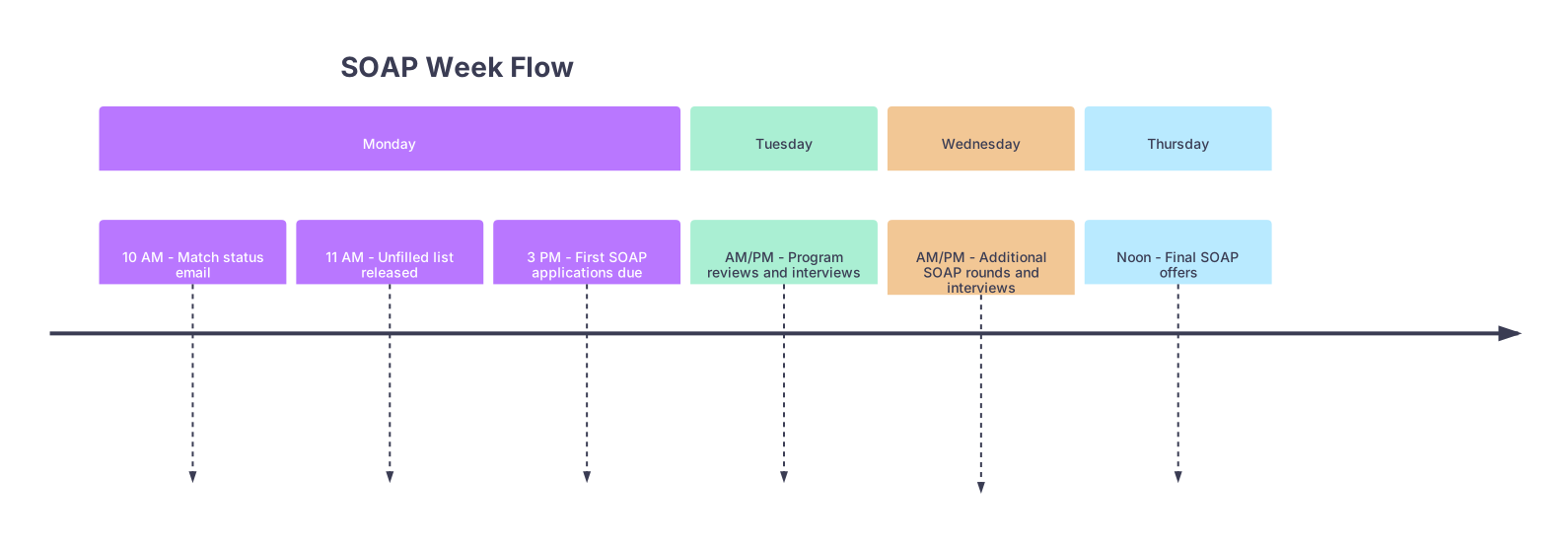
2. Immediate Stabilization: First 2–3 Hours After the Email
You have limited time before applications open. Panic wastes it. Here is what you do from 10 AM to ~1 PM Monday.
Step 1: Accept what happened, then lock into “operator mode”
Give yourself 15–20 minutes to feel angry, numb, whatever. Then switch.
Practical actions:
Text or email:
- Your dean’s office / student affairs
- Any core advisor you have (even if they were not that helpful earlier)
- Subject line: “Unmatched – Need SOAP Guidance Today”
One sentence you can send:
- “I did not match in [specialty]. I plan to pursue SOAP aggressively and would appreciate any help reviewing my materials and generating a realistic SOAP list today.”
Then forget about “why I did not match” for now. Autopsy comes after SOAP, not during.
Step 2: Set up your operations environment
You are now running a one-person command center. Make it functional.
Tech
- Laptop + charger, stable internet.
- Phone plugged in, ringer on max, voicemail greeting updated and professional.
- Email notifications on for:
- ERAS/Thalamus/VSLO messages
- Your main email
- Calendar cleared for Monday–Thursday.
Documents open (editable)
- CV (updated)
- Personal statements (one per major target specialty if possible)
- Short “SOAP introduction script” (we will build this later)
- Word/Google doc titled: “SOAP Tracker”
People
- Ask 1–2 friends/family to handle:
- Food / coffee
- Basic logistics so you do not leave your seat to cook or run errands.
- Ask 1–2 friends/family to handle:
You are building a bubble. You will live in it for 3–4 days.
3. Targeting Without Contacts: How to Build a Smart SOAP List
You cannot spray-and-pray 45 random applications and expect magic. Without connections, your list quality is your leverage.
When the unfilled list drops at 11 AM, your first job is triage.
Step 1: Define your realistic target zones
Be brutally honest. Look at:
- USMD vs DO vs IMG
- Step 1 (P/F but note any fails)
- Step 2 CK score and any failures
- Number of red flags (gaps, professionalism issues, multiple attempts, etc.)
Then sort programs in 3 buckets:
- Green zone – You are at or above their typical profile.
- Community IM/FM/Peds/Neuro/Path/PM&R in non-coastal areas.
- DO-heavy programs if you are DO or IMG-friendly if you are IMG.
- Yellow zone – You are borderline but plausible.
- Slightly higher Step 2 than you, or previously filled with some IMGs/DOs.
- Red zone – Unrealistic.
- Historically hyper-competitive academic programs.
- Programs that seldom take your category (e.g., almost no IMGs if you are IMG).
You will live mostly in green and some yellow. Contacts might help you in red; you do not have them, so ignore fantasy.
Step 2: Research fast and dirty
You do not have hours per program. You have minutes.
For each program that looks vaguely plausible from the unfilled list:
Open:
- Program website.
- FREIDA or ACGME page.
- Any recent resident list you can find.
Scan for:
- Types of grads:
- USMD-heavy? DO-heavy? Many IMGs?
- Step 2 expectations:
- Any mention of minimum score?
- Visa status (if relevant):
- “We sponsor J1 only” vs “No visa sponsorship.”
- Types of grads:
Decide:
- Yes – Add to list.
- No – Close tab, move on.
- Do not dwell. You are sorting, not writing a thesis.
Document everything in your tracker.
| Program | Specialty | Region | My Fit (Green/Yellow/Red) | Visa OK? | IMG/DO Friendly? | Apply? (Y/N) |
|---|---|---|---|---|---|---|
| Example A | IM | Midwest | Green | Yes | Yes | Y |
| Example B | Psych | South | Yellow | No | Some IMGs | N |
| Example C | FM | Midwest | Green | N/A | Many DOs | Y |
| Example D | Neuro | Northeast | Red | No | Rare IMGs | N |
| Example E | Path | South | Yellow | Yes | Mixed | Y |
Step 3: Allocate your 45 applications strategically
No contacts means you win on coverage plus fit.
Basic framework (adjust for your reality):
- 25–30: Strong fit (green zone) in one main specialty
Usually the field you applied to originally or the closest adjacent. - 10–15: Green/yellow in a backup specialty you can tolerate for a career.
- 5–10: True stretch programs in your main or backup specialty.
What you do not do:
- Ten different specialties with 3–4 programs each.
- Random scatter to “see what sticks.”
Programs smell desperation. They also smell chaos. You want them to see focused intent.
4. Fixing Your Application: Rapid, Surgical Edits
No connections means no one is explaining you to the PD behind the scenes. Your ERAS packet has to do all the talking.
You do not have time for a full rewrite. You have time for targeted upgrades.
Step 1: Personal statement triage
You need:
- 1 primary PS for your main SOAP specialty.
- Optional: 1 modified PS for your backup specialty.
Do this:
- Open your current PS.
- Cut:
- Fluff about childhood dreams.
- Long travel stories.
- Generic “I love working with patients” paragraphs.
- Keep and sharpen:
- Concrete clinical experiences in that specialty.
- Evidence you function well on teams.
- Any reason you are low maintenance (resilient, adaptable, worked nights, etc.).
Add a SOAP-aware closing paragraph, about 3–4 sentences:
- Acknowledge where you are indirectly:
- “I am eager to begin residency training this year and am prepared to adapt quickly to your program’s workflow and culture.”
- Emphasize readiness:
- “My clinical experiences in [X] and [Y] have prepared me to contribute from day one.”
- Signal humility and commitment:
- “I understand the demands on residents and faculty and am committed to reliability, professionalism, and hard work over the long term.”
Then build a shortened version (2–3 paragraphs) you can paste as needed for programs that limit length or only skim.
Step 2: Experiences section clean-up
You are not rewriting everything, but you are re-framing:
- Top 3–5 experiences:
- Focus on tasks that show you already operate at an intern-like level:
- Night float responsibilities.
- Acting intern rotations.
- Leadership roles requiring logistics, schedules, or conflict resolution.
- Focus on tasks that show you already operate at an intern-like level:
- Change verbs:
- From “exposed to, observed, interested in”
- To “managed, coordinated, led, followed up, communicated.”
You want PDs thinking: “This person has actually done the work, not just shadowed it.”
Step 3: Addressing obvious red flags (briefly)
If you have:
- Step failure.
- Leave of absence.
- Remediation.
You need a short, controlled explanation in the “Additional Information” section or PS (not both, usually one).
Pattern:
- 1 sentence: What happened.
- 1–2 sentences: What you did about it.
- 1 sentence: How you are performing now.
Example:
- “I failed Step 1 on my first attempt during a period when I underestimated the time required for dedicated study. Since then, I reorganized my study approach, worked closely with faculty mentors, and passed Step 1 and Step 2 CK with improved scores. My performance on clinical rotations and shelf exams since that time has been consistent and strong.”
Then stop. No over-explaining.
5. Executing SOAP Rounds with Zero Contacts
This is where most unmatched applicants without connections either claw their way into a spot or vanish.
Your advantage: you will be hyper-structured.
Step 1: Submitting in the first round
Plan:
- Have your 45 targets finalized before the application window opens.
- Double-check:
- Every program accepts your graduate type / visa status.
- You have the correct specialty-specific PS attached.
- The minute applications open, submit. Do not “tweak one more sentence” while others’ applications are already in PD inboxes.
Speed matters. Early submissions get earlier looks, which get earlier calls.
Step 2: Being reachable like your life depends on it (because it kind of does)
From the moment programs can start contacting you:
- Phone on loud, at your side, not under a pillow.
- Voicemail:
- “Hello, this is [Name]. I am available to talk about residency opportunities and will return your call as soon as possible if I miss you. Thank you.”
- Email open constantly.
- Zoom/Teams install + test microphone and camera before you need them.
You miss one call, fine. You miss three, PDs move on.
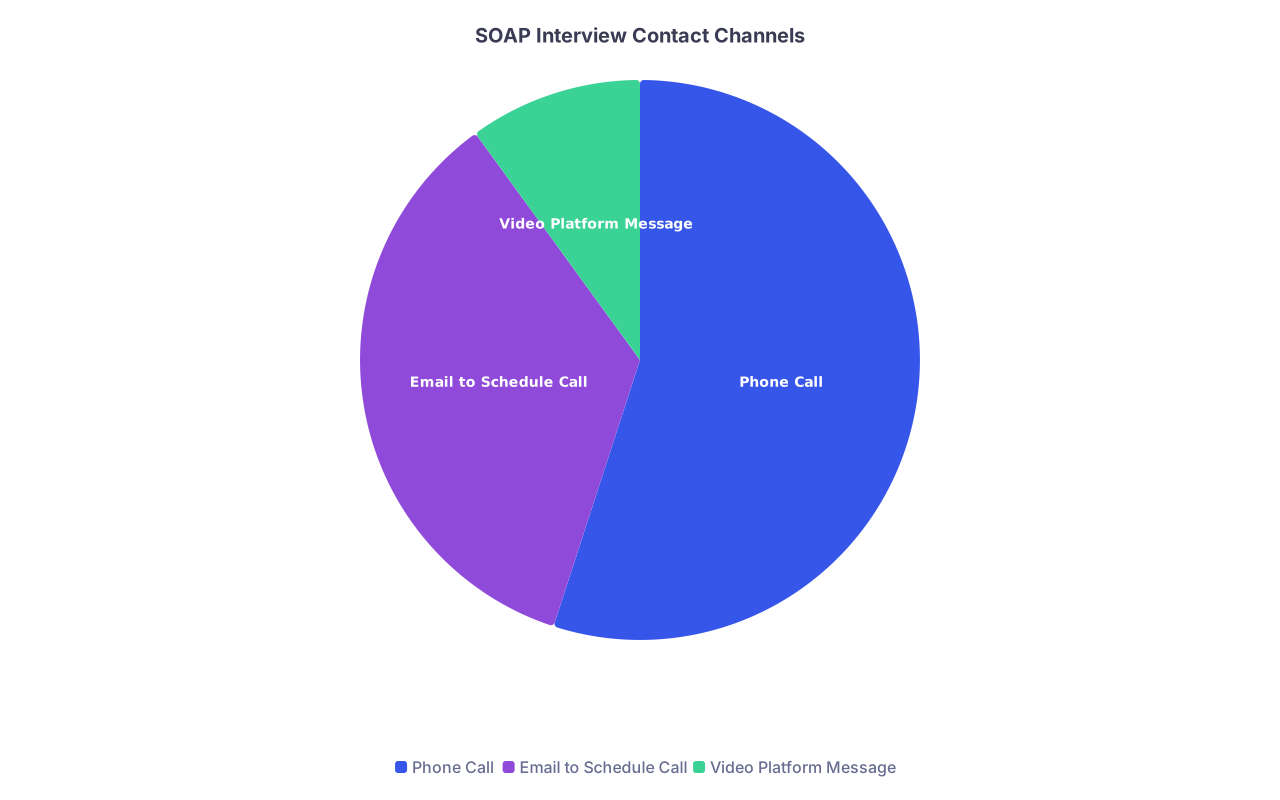
| Category | Value |
|---|---|
| Phone Call | 55 |
| Email to Schedule Call | 35 |
| Video Platform Message | 10 |
Step 3: Your SOAP phone script
No contacts means your first 30 seconds on the phone are your entire network.
Prepare and rehearse a short script:
Opening:
- “Hello, this is [Name].”
- If they introduce themselves:
“Thank you for calling, Dr [LastName]. I appreciate the opportunity to speak with you.”
30–45 second core pitch:
You must cover:
- Who you are.
- Your training background.
- Why this specialty / type of program.
- Why you are ready now.
Template you can customize:
- “I am a [USMD/DO/IMG] graduate from [School] who applied primarily in [original specialty] with strong clinical rotations in [SOAP specialty]. My Step 2 CK is [score], and I have had [X] months of sub-internship or equivalent experience on inpatient [SOAP specialty/medicine] services. I am very interested in community-based training like your program offers and am ready to start intern responsibilities this July. I am looking for a place where I can work hard, be reliable, and grow over the long term.”
Then stop. Let them lead.
Step 4: Common SOAP phone questions and tight answers
You will get some version of:
“Why did you not match?”
- Answer in 2–3 sentences, no drama.
- “I applied to [very competitive field] with [X] interviews and ultimately did not match. In hindsight, my application strategy was too narrow. I am now fully committed to [SOAP specialty] and have already redirected my long-term plans accordingly.”
“Why [this specialty] now?”
- Tie to concrete experiences, not vibes.
- “On my [rotation/sub-I] in [SOAP specialty], I enjoyed the [specifics: longitudinal care, procedural mix, etc.]. I have found that my strengths in [communication, data synthesis, etc.] fit well with this field. The more time I spent on that service, the more I realized this is where I see my long-term career.”
“Would you be happy here, or are you just trying to get any spot?”
- You must sound committed without lying.
- “I am absolutely looking for a place I can commit to for full training, not just a placeholder. I have looked at your program’s emphasis on [specific feature from website] and the training environment you offer fits what I am looking for.”
If you sound bitter, vague, or noncommittal, your lack of connections becomes fatal. If you sound calm, specific, and ready to work, they stop caring about your contacts.
6. How to Compete When Others Have PD Calls and You Do Not
You cannot manufacture relationships in 48 hours, but you can compete on professionalism and frictionlessness.
1. Be the easiest applicant to onboard
PDs in SOAP are thinking: “If I offer this person a spot, will they be a headache between now and July 1?”
You counter that directly:
- Have all licensing/credentialing documents ready to mention:
- Degree verification, transcripts, immunizations, vaccine records, etc.
- If asked about logistics, answer specifically:
- “I can relocate within [timeframe]. My current commitments end [date]. I will be available for orientation and any onboarding meetings as needed.”
Mention it once if it fits, do not babble. The goal is to transmit: “No friction here.”
2. Know your weaknesses cold and neutralize them
No defensive monologues. Just pre-decided, simple explanations.
If you struggled on an exam:
- “I initially struggled with standardized tests but implemented a structured study plan, met regularly with faculty mentors, and my subsequent performance on Step 2 CK and clerkship exams reflects that improvement.”
If you took extra time to graduate:
- “I extended my training by [X] months for [brief, factual reason]. During that time I [did clinical research, completed coursework, maintained clinical involvement], and have since performed reliably in my final clinical year.”
You do not need contacts if you own your story like this.
3. Follow-up etiquette: short, respectful, and rare
After an interview (phone or video):
- 1 short thank-you email within 12–24 hours:
- Subject: “Thank you – [Your Name], SOAP applicant”
- 3–4 sentences max:
- Thank them.
- Mention one specific part of the conversation or program that resonated.
- Reaffirm that you would be happy to train there.
- Then stop. No repeated “just checking in” messages.
Your lack of contacts does not mean you compensate by over-emailing. That backfires.

7. If You Strike Out in Early Rounds: Regrouping Fast
SOAP has multiple offer rounds. It is common to get nothing early, especially without contacts. What matters is how you adjust between rounds.
Step 1: Honest micro‑debrief after each non-offer period
Ask yourself (and any advisor you can reach):
- Did I:
- Apply to programs that were realistic?
- Miss any calls or emails?
- Sound bitter or uncertain on the phone?
- Come off as “using” the specialty as a one-year bridge?
Fix what you can before the next wave of calls.
Step 2: Adjust your program list if new spots open
Sometimes:
- Programs drop out.
- New unfilled positions appear.
- Initial SOAP wave clears, leaving a different mix.
Refresh your triage:
- Add any new realistic programs.
- Be willing to pivot specialty only if:
- You can honestly see yourself in that field.
- Your application has at least some alignment.
Do not chase spots in random specialties you will hate. SOAP is not worth wrecking your long-term career satisfaction.
Step 3: Maintain discipline through Thursday
The mental fatigue by Wednesday is brutal. This is where many applicants:
- Start rambling in interviews.
- Sound resigned: “I guess I will take anything.”
- Lose the sharp energy that PDs look for.
You stay structured:
- Sleep 5–7 hours a night (yes, really).
- Eat actual food, not just caffeine.
- Keep your phone script and notes in front of you for every call.
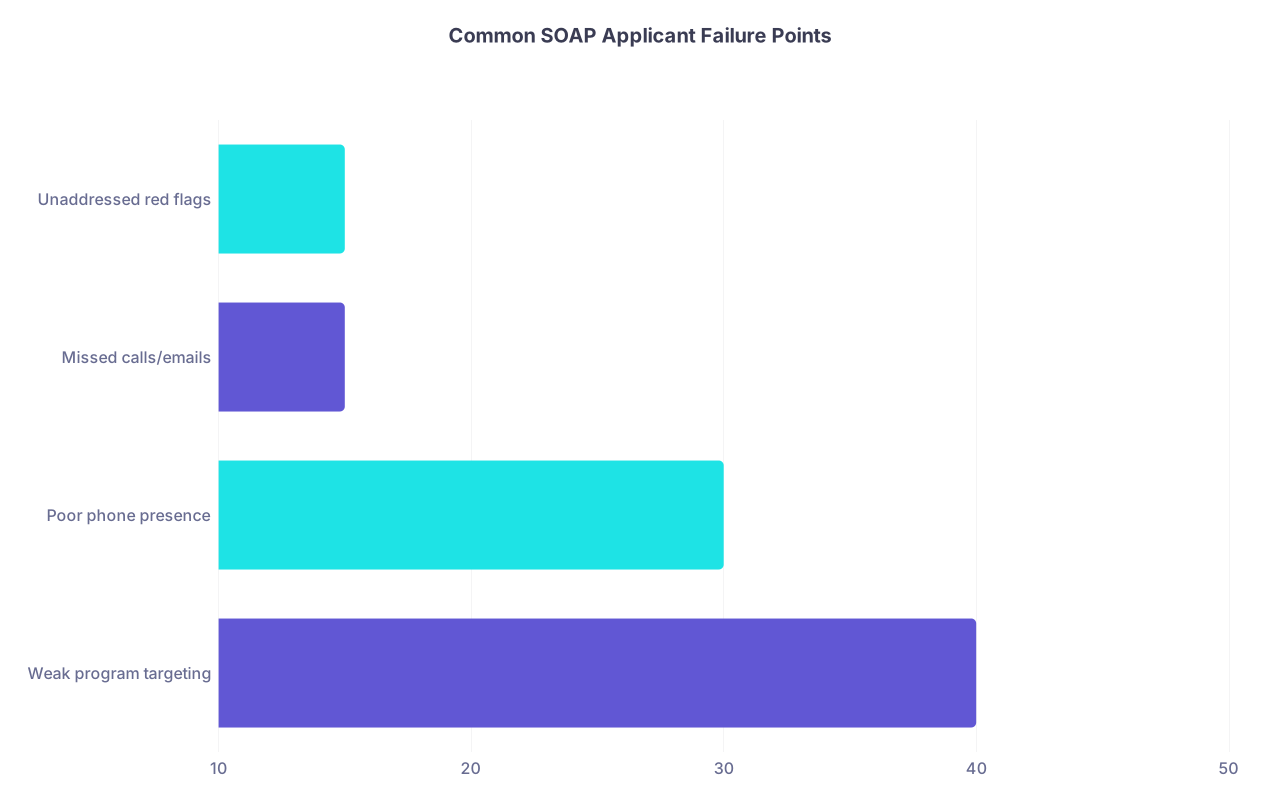
| Category | Value |
|---|---|
| Weak program targeting | 40 |
| Poor phone presence | 30 |
| Missed calls/emails | 15 |
| Unaddressed red flags | 15 |
8. What To Do Right Now If You Truly Have Zero Contacts
You will not build a powerful old‑boys network overnight. You do not need to. But you can do a few smart things today to not be totally alone.
Step 1: Milk your school for every structured resource
Even if you feel they failed you before:
- Ask explicitly:
- “Who is the person at our institution most experienced with SOAP strategy?”
Not “Who can help?” but “Who is best at this?”
- “Who is the person at our institution most experienced with SOAP strategy?”
- Request:
- A 30–45 minute SOAP plan meeting today.
- A quick review of your specialty targeting for realism.
If your school has a dedicated SOAP support team, use them aggressively. If they are weak, at least get them to review obvious errors in your ERAS.
Step 2: Reach out to recent grads, not big-name faculty
You do not have PD-level contacts. Fine. You can still learn from near-peers.
Find:
- Alumni 1–3 years ahead of you who:
- Matched in your SOAP target specialty.
- Or went through SOAP themselves.
Message:
- “Hi [Name], I am [Your Name], [MS4/grad year] from [School]. I did not match this year and will be entering SOAP. Do you have time for a 10–15 minute call today or tomorrow to sanity-check my program list and approach?”
You are not asking them to call PDs for you. You are asking them to upgrade your strategy. That is more realistic and often more impactful.
Step 3: Decide your non-negotiables before offers come
If you get an offer Thursday, you will not have hours to ponder.
Clarify now:
- Geographic constraints that are truly impossible for you (family, visa, etc.).
- Absolute specialty lines you will not cross.
- Whether you are willing to:
- Take a prelim year in one specialty to re-apply.
- Or only accept categorical positions.
Write this down. Under stress, people accept things they regret or reject options they later wish they had taken. You do not need contacts to make good decisions, but you do need clarity.

9. If SOAP Fails Completely: Setting Up the Next Cycle (Briefly)
You are reading this for SOAP, not the long game, so I will keep this short. But you need to know this in case Thursday goes badly.
If you do not secure a spot:
Immediate actions (next 1–2 weeks):
- Obtain a detailed evaluation from:
- Student affairs.
- At least one honest faculty mentor.
- Ask specifically:
- “If you were PD in [specialty], what are the top three reasons you would not interview me as I stand now?”
- Obtain a detailed evaluation from:
Choose one clear priority for the next 12 months:
- If scores are low:
- Strengthen with:
- Research in the target area.
- US clinical experience (for IMGs).
- High-quality letters from people who actually worked with you.
- Strengthen with:
- If professionalism/red flag:
- Demonstrate sustained reliability in a consistent role (clinical or related).
- If scores are low:
Commit to one or two specialties only:
- Do not “shotgun” multiple unrelated fields again.
- Build deep alignment with the one that fits you and your record best.
I have seen unmatched SOAP candidates come back the next year with a tighter story, better letters, and match solidly. Zero contacts. Just better execution.

10. Your Next Concrete Step Today
You do not fix SOAP anxiety by thinking abstractly. You fix it by building a plan you can execute.
Here is what I want you to do right now, before you close this:
- Open a new document titled:
“SOAP – Targets and Scripts” - Create three sections:
- “Target Specialties + Rationale”
- “Program Triage Rules” (what makes a green, yellow, red program for you)
- “30-Second Phone Intro Script”
- Fill them with:
- 1–2 realistic SOAP specialties you are willing to pursue.
- 3–5 clear rules for which programs you will apply to.
- A first draft of your 30-second intro.
Do not overthink. Write the rough version. You can refine it later today.
Once that is on paper, you are no longer “the unmatched applicant with no contacts.” You are the applicant with a defined SOAP system.
And that, in SOAP, beats connections more often than people want to admit.