
It’s September 10th. Your ERAS portal is open on one screen, your email on the other, and your heart rate is way too high for someone just sitting in a chair.
Personal statement still feels half-baked.
One attending hasn’t uploaded your letter.
You’re second-guessing your program list every six minutes.
And that big date—September 15—is just sitting there in your brain like a threat.
The fear loop sounds something like:
“If I don’t have EVERYTHING perfect and submitted by 8:00 a.m. on the 15th, I’m done. They’ll screen me out. Everyone else will be complete. I’ll never match. I should probably just reapply next year.”
Let’s dismantle that.
I’m going to be blunt: some parts really do need to be done on time. And some parts you can absolutely finish after September 15 without destroying your chances. The problem is nobody actually tells you which is which in a clear way. So you feel like every missing comma is a death sentence.
It’s not.
First: What Actually Happens on September 15?
September 15 is when programs can start downloading apps. It’s not the day they magically finish all their screening and lock in their interview list.
Most programs:
- Don’t review everything that exact day.
- Get overwhelmed with the volume and review over days to weeks.
- Have some applicants “incomplete” (missing a letter, pending Step 2, etc.) when they first see apps.
So your real question isn’t “Is my app in by September 15 or not?”
It’s: “What does my application need to look like the first time a program seriously looks at it?”
That’s a different, much more manageable problem.
What MUST Be Ready By September 15 (or As Close As Humanly Possible)
Let’s rip the Band-Aid off. There are pieces that should not be late if you can help it.
1. The Core ERAS Application
The actual ERAS form (demographics, education, experiences, publications, etc.) should be done and submitted by the time programs can see applications.
Why this part matters:
- Many programs run initial screens based on things in the core app: school, exams, graduation year, geography.
- If your app isn’t submitted, you literally don’t exist in their system yet.
- A lot of initial “filters” (like “has Step 1 score” or “within X years of graduation”) don’t care about your personal statement; they care that your app is present and readable.
Translation: the application itself being submitted is more important than the application being “perfect.”
If you’re spiraling about tiny edits to an experience description the night before: stop. Submit.
2. USMLE Scores (At Least Step 1, Probably Step 2 for Some Specialties)
For most applicants applying this cycle, Step 1 is already in. The anxiety is usually around Step 2.
Reality:
- For more competitive fields (derm, ortho, plastics, ENT, ophtho, some IM subspecialty tracks), having Step 2 in early helps a lot.
- For “mid-level competitiveness” specialties (IM, peds, psych, FM, OB, EM), plenty of people are reviewed with Step 2 pending—especially if Step 1 is fine.
- Some programs literally require Step 2 to rank you but not to review you.
If your Step 2 score will come back just a bit after September 15, you are not doomed. But if you haven’t even taken it yet and won’t for weeks or months, that’s where it starts to hurt.
What Can Safely Wait Past September 15 (Within Reason)
Here’s where your shoulders can actually drop a little. There are parts of ERAS that do not need to be fully locked and flawless by September 15 to keep you in the game.
I’m not saying “leave them until November.” But they can be second priority behind getting the core app submitted.
1. Extra Letters of Recommendation (Beyond the First 2–3)
Letters are where most people panic.
You might be thinking:
“I only have two uploaded. That’s it. It’s over. Everyone else has four brilliant, glowing letters from world-famous department chairs who probably write for UpToDate in their free time.”
No.
Here’s the basic rule:
You need enough letters in early. Not every single possible letter.
A simple breakdown:
| Situation | How Urgent Is It? |
|---|---|
| 0 letters uploaded | Critical – this can’t wait |
| 1 letter uploaded | Very urgent – try to get to 2+ ASAP |
| 2 letters uploaded | Acceptable for many programs initially |
| 3 letters uploaded | You’re fine; 4th can come later |
| 4 letters uploaded | You’re more than fine; stop obsessing |
For most fields, 3 strong letters early is perfectly okay. The 4th letter can appear later and still be reviewed.
What’s “later”?
- Within 1–3 weeks after September 15 is generally still safe.
- Beyond that, it can still be read, but by then a lot of screening may already be done, especially at high-volume programs.
So if your fourth letter writer is dragging? That’s annoying, not fatal.
What is more dangerous is having:
- 0 letters uploaded by September 15
- Only 1 letter for a competitive specialty
- No specialty-specific letter at all (e.g., applying IM with no IM letter)
If you’re in that camp, the priority isn’t perfection. It’s hounding the letter writers you already have and maybe adding a backup writer.
2. Final Program List (Especially Low-Yield or “Reach” Programs)
You don’t need your full, final, obsessively curated program list on September 15. You need a solid chunk of realistic programs selected and assigned.
You can absolutely:
- Add extra programs a few days after the 15th.
- Add a few more “reach” programs once you calm down and do a more thoughtful search.
- Adjust your distribution (e.g., more community programs, more in one region) after you talk to advisors.
Will you miss something if you wait until November to add a program? Yes, probably. But adding 5–10 more applications within a week or so after the 15th is not going to destroy your chances.
3. Personal Statement Tweaks (Not Total Rewrites)
Here’s where perfectionism goes to die.
If your personal statement exists, is coherent, and doesn’t say “INSERT STORY HERE” in the middle, you can submit the app and keep lightly revising for programs you haven’t assigned yet.
You cannot change the PS for programs you’ve already sent it to, so don’t submit with absolute garbage. But there’s a huge difference between:
- “It’s decent but not perfect, and I’d like to sharpen a sentence or two” → Submit.
- “I only have half a draft and no conclusion” → This needs to move into high urgency.
Worst-case thinking says: “If the statement doesn’t make them cry, they won’t interview me.” Honestly? 85% of personal statements are fine and deeply unmemorable, and that’s enough. You don’t need to write the next great memoir. You just have to not raise red flags.
4. Extra Experiences / Minor Edits / Tiny CV Polish
That random poster you’re not sure how to list. The babysitting job from 2014. The extra wording in your hobbies.
This stuff doesn’t decide your fate.
If you’re choosing between:
- Submitting September 15 with 90–95% of experiences polished, or
- Waiting several days so you can perfectly rewrite every bullet
Submit. Early-ish and “good enough” beats later and “immaculate but invisible when they already skimmed apps.”
What Definitely Does Not Need to Be Perfect by September 15
Let me be even more specific. Here are things people catastrophize over that really don’t deserve your adrenaline levels.
1. Photo
Yes, you should upload a professional-ish photo. No, the photo does not decide whether you get an interview at 95% of programs.
If you have:
- A decent, neutral, head-and-shoulders photo with a plain-ish background and you look awake → use it.
- No photo yet? Try to get one done within the week, but this isn’t the one thing separating you from matching.
2. Every Single Publication Properly Formatted
If you’re frantically triple-checking whether you used the right citation style for that random abstract? Stop.
Programs aren’t matching you (or rejecting you) based on whether your comma is inside the quotation marks for a conference title.
As long as:
- The work is honestly represented.
- They could roughly understand what you did and where.
You’re done. Move on.
How Bad Is It If I’m “Late” By a Few Days?
Let’s talk about the nightmare scenario in your head: you submit on, say, September 18 or 20.
Is that ideal? No. Programs will already be starting reviews. Some early screeners might have pulled a first batch before you showed up.
Is that automatically game over? Also no.
The reality:
- The VERY early birds (who submit right at the opening) do have a small edge at some programs that batch review by time.
- But most programs don’t finish their entire review within the first 48–72 hours.
- A few days late is annoying, not lethal. A month late is where it becomes seriously damaging.
Where it really hurts to be late:
- Super competitive specialties where they truly are drowning in apps.
- Oversubscribed geographic areas (NYC, California, major academic “name brand” hospitals).
- Programs that explicitly say “apply early” and historically send invites very quickly.
If you’re pushing past September 15 by a few days, treat it like this:
- Get the core app and at least 2–3 letters in ASAP.
- Don’t delay submission just to keep fixing small stuff.
- Accept that you may lose a tiny edge, but you are not erased from existence.
Visualizing What Actually Needs To Be Done By When
Sometimes seeing it laid out helps calm the “everything is on fire” sensation.
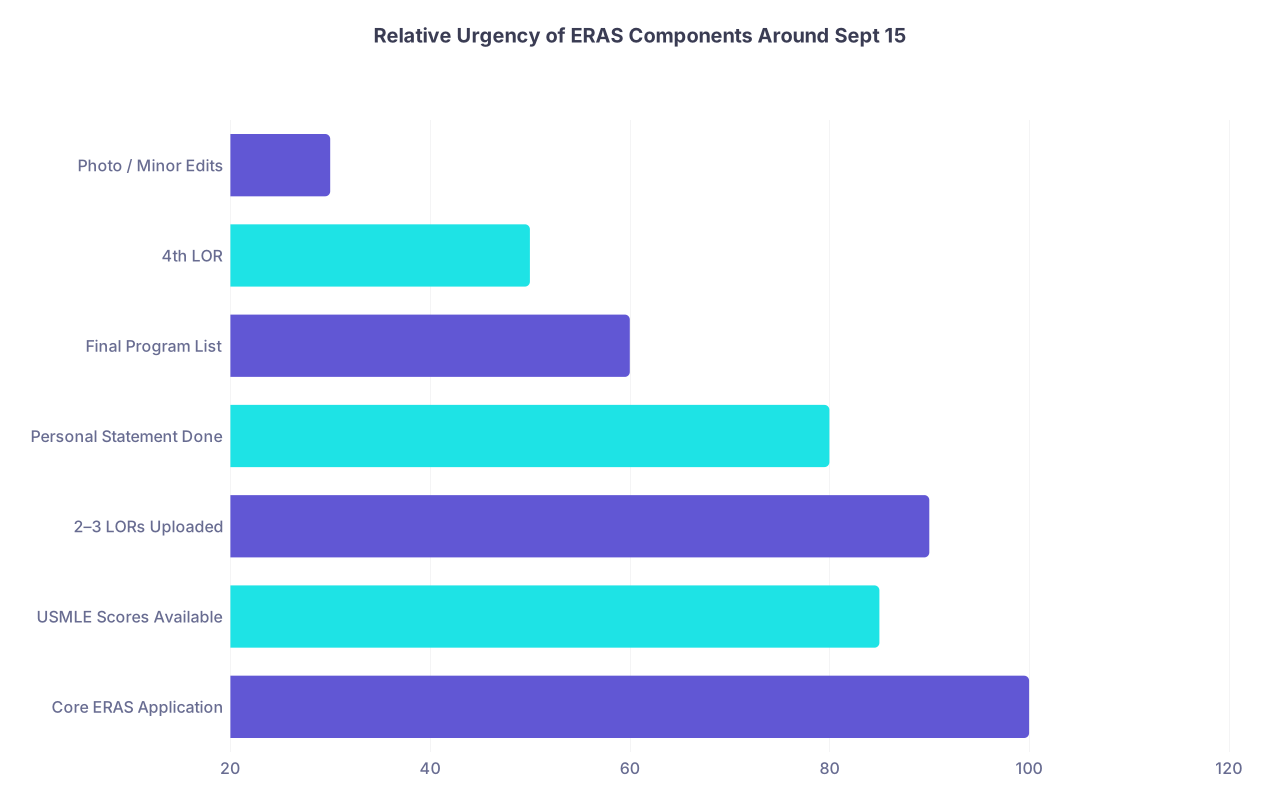
| Category | Value |
|---|---|
| Core ERAS Application | 100 |
| USMLE Scores Available | 85 |
| 2–3 LORs Uploaded | 90 |
| Personal Statement Done | 80 |
| Final Program List | 60 |
| 4th LOR | 50 |
| Photo / Minor Edits | 30 |
Think of anything 80–100 as “should be in by Sept 15 if at all possible.”
60-ish = “nice if it’s ready, but can slip a few days without catastrophe.”
Below that = “stop losing sleep over this before you submit.”
A Rough Priority Order If You’re Behind
If it’s a few days before Sept 15 and you’re staring at too many half-done things, here’s the sequence I’d use, in this order:
- Finish and submit the core ERAS application (experiences, demographics, exams).
- Make sure at least 2–3 letters are requested and realistically going to be uploaded soon.
- Get a functional, not-perfect personal statement for your main specialty.
- Select and assign a reasonable number of programs (especially realistic ones).
- Confirm your USMLE score release is authorized.
- Then worry about:
- 4th letter
- Extra programs
- Fussy edits
- Photo upgrades
- Second specialty PS (if applicable)
Quick Reality Check: What Actually Gets People Hurt, Not Just Anxious
Stuff that truly causes damage:
- Submitting in October “because I wanted everything perfect.”
- Having zero letters uploaded for weeks.
- Forgetting to authorize score release so no one sees your exams.
- Not applying widely enough because you got stuck in indecision.
Stuff that feels catastrophic but usually isn’t:
- One letter coming in a week late.
- A personal statement that is solid but not mind-blowing.
- A small typo in an experience description.
- Submitting on September 17 instead of the 15th.
I’ve seen people with early, polished apps and four letters not match because they only applied to 25 super-elite programs. And I’ve seen people who were a bit late, had some chaos, but cast a smart, realistic net and matched fine.
You’re scared of the wrong monster half the time.
Simple Timeline if You’re Behind and Freaking Out
Here’s a calm, structured way to think about the next couple of weeks:
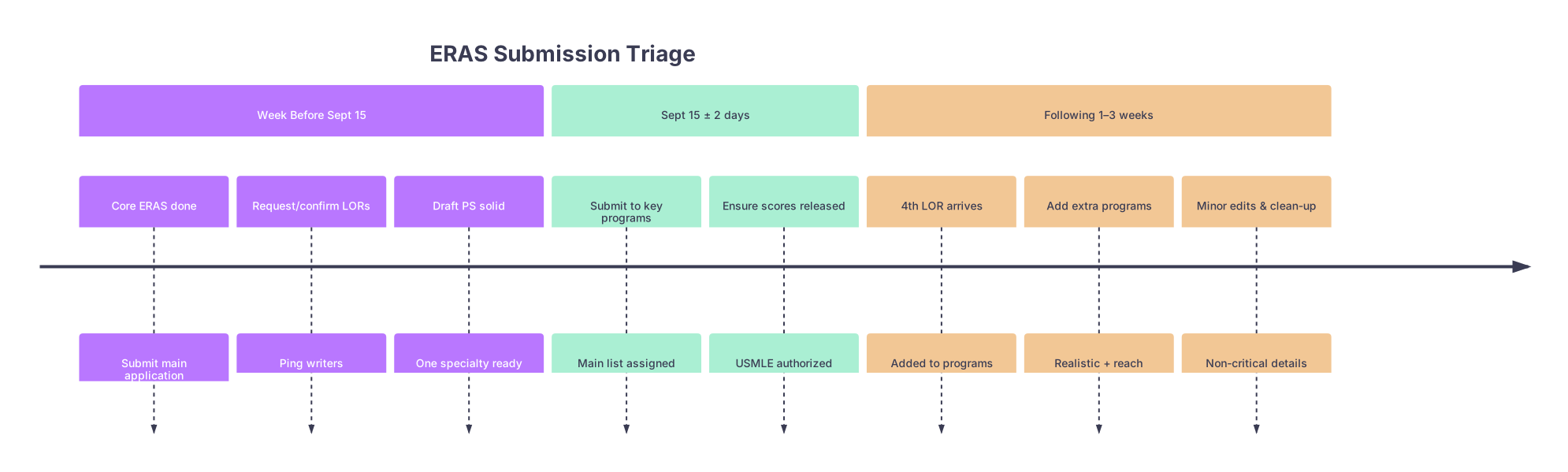
| Period | Event |
|---|---|
| Week Before Sept 15 - Core ERAS done | Submit main application |
| Week Before Sept 15 - Request/confirm LORs | Ping writers |
| Week Before Sept 15 - Draft PS solid | One specialty ready |
| Sept 15 ± 2 days - Submit to key programs | Main list assigned |
| Sept 15 ± 2 days - Ensure scores released | USMLE authorized |
| Following 1–3 weeks - 4th LOR arrives | Added to programs |
| Following 1–3 weeks - Add extra programs | Realistic + reach |
| Following 1–3 weeks - Minor edits & clean-up | Non-critical details |
You’re not trying to cram everything into a single apocalyptic day. You’re trying to avoid being months behind.
FAQ (Exactly 4 Questions)
1. If one of my letters is late, should I wait to submit until it’s uploaded?
No. Submit with what you have once you’re at 2–3 letters (ideally including at least one from your specialty). Waiting to submit the entire app just so it’s “complete” on day one usually hurts more than having a 4th letter come in a little later. Programs can and do see new letters as they arrive.
2. Is it better to submit a weaker personal statement earlier or a stronger one later?
Submit a decent one earlier. Not garbage, not a draft with missing chunks. But if it’s structurally fine, free of anything bizarre or offensive, and clearly expresses why you’re going into the specialty, that’s good enough. The 10% improvement you’d get from tinkering for days is not worth losing early visibility at programs.
3. I’m not ready by September 15 at all. Should I skip this cycle?
Usually, no. If you can get a solid app in by late September, you’re probably still in the game for most fields, especially if your scores/grades are okay and you apply widely. The time where it starts to genuinely become “maybe wait a year” is if you’re talking about submitting in mid-October or later with multiple weaknesses.
4. Do programs actually care if I apply on September 15 vs 16–18?
Some do a little. Many don’t care at all within that small window. Being a month late is a real issue. Being 1–3 days behind is more of a psychological crisis for you than a functional crisis for them. If you can hit the 15th, great. If you land near it, with a strong, mostly complete app, you haven’t torched your chances.
Key points, so you can close this tab and breathe:
- Submit the core ERAS app on time or close to it; don’t delay submission for tiny edits or one late letter.
- You need “enough” in place (scores, 2–3 letters, one decent PS) by mid-September; the rest can trail in over 1–3 weeks.
- Days of delay are annoying but survivable; months of delay or not applying widely enough is what truly hurts.