
You’re sitting at your desk in late September. ERAS is already open, you submitted your application on Day 1 to your top 20 programs… and now you’re staring at three more program names you want to add.
The question running through your head:
“If I add programs later, do they see my original ERAS submission date, or does it look like I applied late?”
Let’s answer that clearly, then I’ll walk you through what it means for strategy.
Short answer: What programs actually see
Let me be blunt:
Programs do not see a big timestamp that says “This applicant submitted ERAS on September 4 at 8:13 AM.”
What they do see, in practical terms, is:
- When your application became available to them
- When your application was downloaded/imported into their system (often in bulk)
- When your documents (LORs, USMLE/COMLEX, MSPE, etc.) became available
But the thing you’re worried about—“Will they know I only just added them?”—is not some obvious red flag on their screen.
Here’s the key point:
When you add a program later, they receive your application when you assign them. They don’t see the original global submission date as a “you were early” vs “you were late” metric in any meaningful, filtering way.
They care about when your application shows up in their queue, not your personal ERAS launch date.
How ERAS timing actually works (without the myths)
Everyone gets spooked by “Submit on Day 1 or you’re dead.” That’s exaggerated.
Here’s what actually matters:
ERAS Opening & Program Download Date
- You submit your primary ERAS application once.
- Programs can’t see anything until the date ERAS releases apps to them (varies by year, but usually late September).
- Before that release date, whether you submitted the minute it opened or two days later doesn’t matter. Everything gets released in one big batch.
Adding programs later
- After the initial release date, any new programs you add get your application as soon as you assign it and pay the fee.
- For that specific program, your “effective” date is when they first receive your file—not when you originally submitted ERAS to someone else.
Documents vs. Application
- Your application (experiences, personal statement, etc.) is global. You submit it once.
- Program choices are modular. You can add or remove programs at any time (within deadlines).
- Letters and personal statements are assigned per program. Assigning something late can delay when they consider you “complete.”
Programs are far more interested in:
- When your application is complete
- Whether they still have interview spots and review bandwidth
…than in your original ERAS timestamp.
So if I add programs late, does it hurt me?
Yes and no. Let’s be precise.
What doesn’t happen
- There is no giant label: “LATE APPLICANT – ADDED THIS PROGRAM 10/15.”
- You don’t look “suspicious” because you added them later. Programs know people build lists in waves.
- They don’t reject you purely because your global ERAS submission wasn’t on Day 1.
I’ve seen applicants add programs in October and still get interviews, especially in less competitive specialties or at community-based programs.
What can hurt you
This is where timing actually matters:
They may already be drowning in applications
By mid-late October, a lot of programs have already:- Screened a first batch
- Sent a chunk of interview invites
- Started building their interview calendar
When you arrive late, you’re coming into a much more crowded, partially picked-over pool.
Filters and rolling review
Many programs review rolling. They go through in waves and invite as they go.
If you show up after their first couple waves, you’re competing for fewer remaining interview spots.“Complete” date > “submitted” date
Some programs won’t review you until:- All your letters are in
- Your MSPE has been released (for MD students, November 1)
- Your Step 2 CK score is posted (for some specialties/programs)
So if you add them on October 10 but your third letter or Step 2 isn’t there until October 30, they’ll treat you as “complete” closer to October 30.
Let me put it cleanly:
Being “late” to a specific program is mostly about when they first get your complete application, not the first day you hit submit anywhere.
What exactly does the program see in their system?
This varies by institution and applicant management software (Thalamus, ERAS PDWS, homegrown tracking). But typical things a program can see:
| Item They See | How It Matters |
|---|---|
| Application received date | When your file first hit their queue |
| Document received dates | When LORs, scores, MSPE came in |
| Complete flag/status | When they consider you review-ready |
| Interview invite status | Tracked internally |
| Notes/tags | Faculty or coordinator comments |
None of this screams “You originally submitted ERAS on September 6, but you only added us October 2.”
They see that your application arrived on X date and your documents trickled in around Y dates. That’s it.
Strategic question: When is it still worth adding programs?
The more honest question you’re asking yourself is: “Is it too late for this to matter?”
Here’s how I’d think about it.
Rough timing guideline
Not a rigid rule, but a decent mental model if you’re applying in a moderately or highly competitive specialty:
- Late September – Early October:
Still very reasonable to add more programs. Many are in early screening. - Mid–Late October:
Diminishing returns. Many interview spots already sent, some waitlists started, but still possible. - November:
Variable. Some community, new, or less competitive programs still reviewing. Bigger academic places often nearly full. - December and beyond:
Mostly low-yield except for:- Newly accredited or unfilled programs
- Programs that have late cancellation waves and scramble for backups
- Less competitive specialties
Are there exceptions? Yes. But don’t build your whole strategy on exceptions.
How to decide whether to add programs later
You don’t need a spreadsheet with 40 columns. You just need a simple decision framework.
Ask yourself these six questions:
How many interviews do you realistically need?
Use your specialty’s data (NRMP Program Director Survey, Charting Outcomes).
Example: For IM, you might be comfortable with 10–12 interviews. For derm, you might still be anxious with 15.Where are you now?
- If you’ve got 0–3 invites by late October in a competitive field → adding programs is very reasonable.
- If you’re sitting on 12 solid interviews in a non-ultra-competitive field → adding 20 more programs is probably panic, not strategy.
Is your profile improving or static?
- Step 2 score just posted and it’s strong? Good time to add.
- New letter from a big-name away rotation just came in? Also good.
- No major updates, same profile that’s been getting crickets from similar programs? Returns may be limited.
Are you adding realistic targets or fantasy options?
Scattering applications to 30 more hyper-competitive academic programs when your stats are below their usual range? Low yield.
Adding more geographically flexible, community, or mid-tier university programs? Much more rational.Can you afford it without hurting yourself financially?
ERAS fees escalate quickly. Don’t blow rent money on hail-mary apps.Are these programs ones you’d actually rank?
If you can honestly say, “Yes, I’d be willing to go here,” they’re worth considering. If not, skip.
Common scenarios: What should you do?
Let’s hit some realistic situations.
Scenario 1: You submitted on time but regret applying “too top heavy”
You applied mostly to big-name academic programs, and now you’re worried. It’s early October, and you’ve got maybe 1–2 interviews.
My advice:
Add a batch of more safety-leaning programs now—community programs, mid-tier regionals, unopposed programs in smaller cities. Don’t wait for more silence.
Scenario 2: You had a late Step 2 score
You submitted ERAS without Step 2. Score just came back and it’s strong.
Adding programs now is absolutely reasonable. For those programs, your “effective application” really starts with that Step 2 score available.
To make this work better:
- Add the programs
- Make sure Step 2 is released to all those programs
- If there’s a clear mismatch between your Step 1 and Step 2 story (e.g., big improvement), consider a brief, targeted email to a few key programs highlighting that improvement
Scenario 3: You’re at 0–1 interview by late October
This is where people panic, and some of that panic is justified.
At this point:
Yes, it’s still worth adding programs—especially:
- Community programs
- States you hadn’t considered but could realistically live in
- Newer or less-known academic programs
No, you can’t expect the same yield as if you’d applied to them in September.
If you’re in a competitive specialty with very weak traction, you should also quietly start building a parallel plan:
- Consider applying to a backup specialty if feasible and appropriate
- Look at SOAP strategy early instead of pretending everything is fine
Scenario 4: You’re thinking of adding programs in November/December
I’m going to be straight with you:
By that point, you’re mostly fishing for outliers.
Still, it might make sense if:
- You have very few interviews
- You’re targeting programs that are:
- New
- Community-based
- Historically less competitive
- You can afford the fees
But do it with clear eyes: this is low-probability salvage, not smart early strategy.
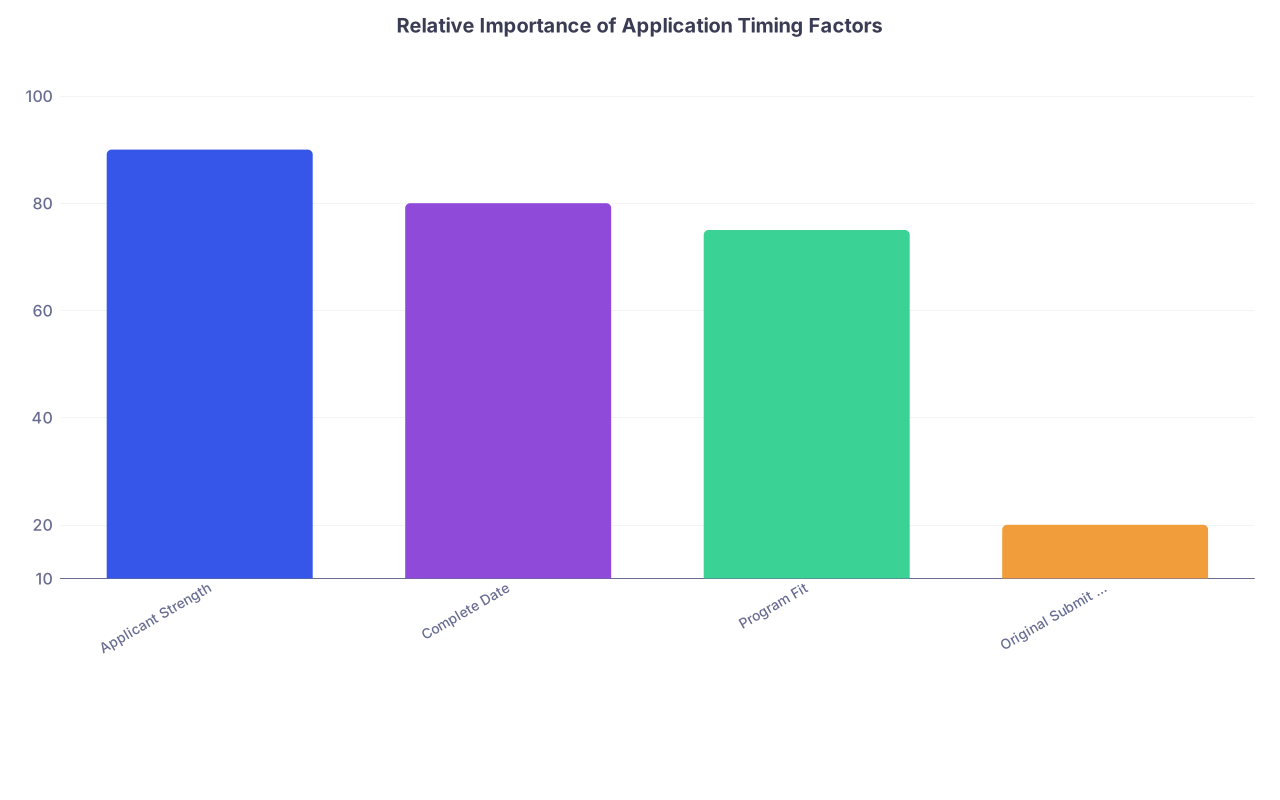
Key takeaway: What actually matters more than the “original date”
Here’s the hierarchy of what matters to programs:
- Your overall competitiveness (scores, grades, letters, fit)
- Whether your application is complete (all required documents in)
- When your complete application hits their system relative to their review timeline
- Everything else
Your original ERAS submission date is not the star of this show.
So:
- If you’re missing solid programs that fit your profile → add them.
- If you’re far above average in invites already → you don’t need to chase more just because you “can.”
- If you’re late but realistic about yield → adding can still be reasonable.
| Category | Value |
|---|---|
| Applicant Strength | 90 |
| Complete Date | 80 |
| Program Fit | 75 |
| Original Submit Date | 20 |

| Step | Description |
|---|---|
| Step 1 | Thinking about adding programs |
| Step 2 | Probably low benefit, be selective |
| Step 3 | Add realistic programs now |
| Step 4 | Add mainly community / less competitive |
| Step 5 | Few interviews? |
| Step 6 | Still early Oct? |
| Step 7 | Late Oct or later? |


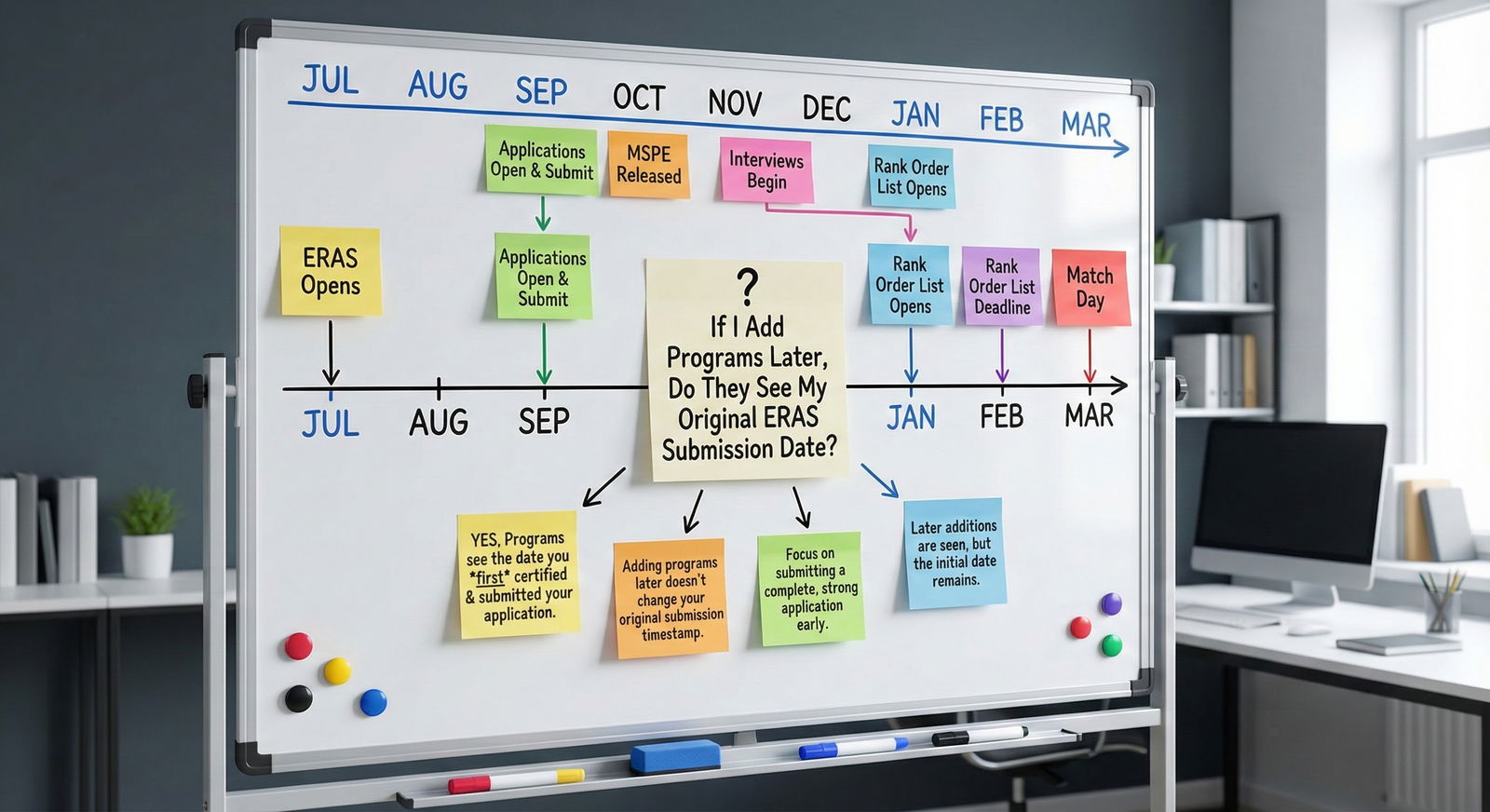
FAQ: If I Add Programs Later, Do They See My Original ERAS Submission Date?
Do programs see the exact date I first submitted my ERAS application?
They see when your application became available to their program, not a big bold “original ERAS submit date” across all programs. For their purposes, your “date” is when your application file first hits their system for that program.If I add a program weeks after ERAS opens, do I look late or desperate?
No, not inherently. Programs are used to applicants adding them in waves. You might be at a disadvantage because they’ve already reviewed a chunk of applicants, but they don’t automatically judge you as desperate just for appearing later.Is it better to add more programs early or wait to see how many interviews I get?
In a competitive specialty, being super conservative up front can backfire. The sweet spot is: apply to a reasonable number early based on your risk level, then be willing to add more in early October if your interview count is low. Waiting until November to adjust is usually too late to change much.Will adding programs after my Step 2 score posts help me?
Often yes. For programs that value Step 2 heavily (or where you improved significantly over Step 1), adding them once your strong Step 2 is available makes sense. For those programs, you’re effectively presenting the “better version” of your application from the start.Do programs see the dates my letters or scores were uploaded?
Yes, they can generally see when documents were received (LORs, scores, MSPE). They care because it affects when your file becomes “complete.” If you assign a program early but your letters trickle in later, your functional review date is often when you’re complete, not when you first showed up.Is it ever completely pointless to add new programs late in the season?
Not completely pointless, but the yield drops hard by November and beyond, especially for competitive specialties. It can still make sense if you have very few interviews, you’re adding realistic programs (often community or less competitive regions), and you can afford the fees. Just don’t expect miracles.
Today’s actionable step:
Open your ERAS and your interview spreadsheet. For every program you’re considering adding, ask: “Would I actually go here, and does it realistically fit my profile?” If the answer is yes and it’s still reasonably early in the season, add 5–10 of those now instead of agonizing for another week.