
Optimizing ERAS Submission Date When You Have a Late Audition Rotation
It is early August. ERAS opens next week. Your classmates are bragging in the workroom: “I’m submitting on Day 1. Done and dusted.”
You are not. Because your only audition rotation at your top-choice specialty is in late September or even October. No letter yet, no final evaluation, and you are staring at an application that feels… unfinished.
You are stuck between two bad-feeling options:
Submit early with a thin specialty story, or submit later hoping that glowing letter from your audition rotation rescues your application.
Let me be blunt: if you handle this wrong, a late audition can quietly tank your season. Not because you are a bad candidate, but because of pure timing mechanics in ERAS and how programs screen.
Let me break this down specifically.
1. How ERAS Timing Actually Works (Not the Myths You Hear on Rounds)
First, you need to understand the real calendar and behavior patterns, not the folklore your classmates repeat.
The real ERAS / program behavior timeline
The exact calendar shifts year to year, but the logic is consistent.
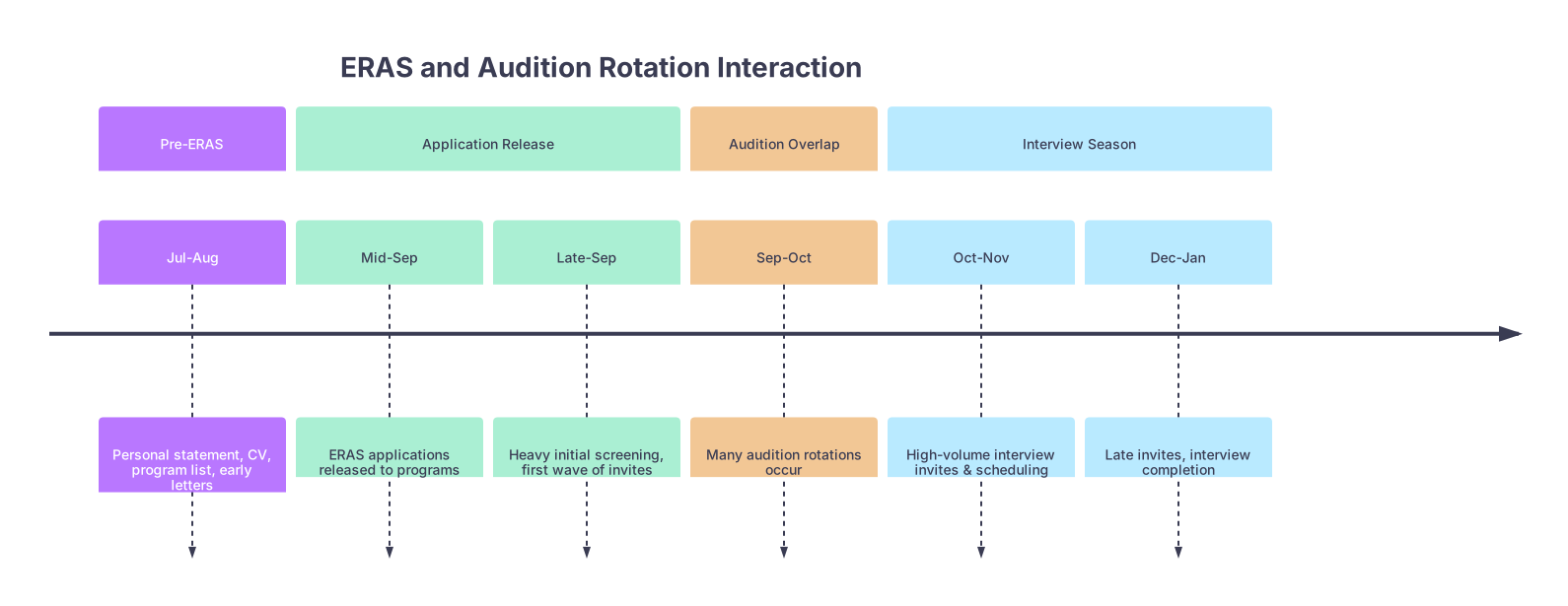
| Period | Event |
|---|---|
| Pre-ERAS - Jul-Aug | Personal statement, CV, program list, early letters |
| Application Release - Mid-Sep | ERAS applications released to programs |
| Application Release - Late-Sep | Heavy initial screening, first wave of invites |
| Audition Overlap - Sep-Oct | Many audition rotations occur |
| Interview Season - Oct-Nov | High-volume interview invites & scheduling |
| Interview Season - Dec-Jan | Late invites, interview completion |
The high-yield points:
- Programs receive applications in one blast (mid-September for MD ERAS). They do not see daily “submission dates” the way you think.
- First screening wave happens roughly in the first 1–3 weeks after applications drop. Many interview spots are filled or at least tentatively reserved from that wave.
- Second pass happens in October–November, often to fill cancellations or probe deeper into mid-tier files.
- Audition rotation letters from September / October often show up after that initial pass.
So the real question is not “Do I submit on the first day?”
The real question is “When will my application be in the pile they actually read, and what will it look like then?”
Where a late audition fits in
If your audition is:
- September: You might complete by end of September or early October. That letter becomes available for the second review pass for many programs.
- October: That letter often does not hit until late October or November, after many programs have already decided on the bulk of their interview list.
This is why your strategy has to be surgical. You cannot afford vague decisions like “I’ll just wait for my letter.”
2. Early vs Late Submission: What Programs Actually See and Care About
You are probably hearing: “Submit on the first second ERAS opens or you are dead.”
Wrong. But also not totally wrong. Let me explain.
What “early submission” really buys you
What matters is being in the initial download batch when ERAS transmits to programs, not the exact minute you click “submit” on your end.
If you:
- Submit before the ERAS transmission date → You are in the first wave. That is enough.
- Submit a few days after transmission → Mild disadvantage at highly competitive programs that batch-screen and mass-send invites quickly.
- Submit weeks after → Real disadvantage at many programs, especially competitive specialties.
What early submission gives you:
- You are in that first screening pass.
- You are more likely to be considered before interview dates are heavily booked.
- You avoid the “we already filled most of our slots; we are now just spot-checking backups” problem.
What programs see about “submission date”
Programs do not get a giant blinking red “THIS APPLICANT SUBMITTED LATE!” banner.
They see:
- Your full application contents as of the date they open your file.
- A list of received letters and their dates.
- Sometimes your “Last updated” timestamp on certain components (but they do not sit there micromanaging this).
What matters to them:
- Is this a complete, coherent application in my specialty?
- Do I have enough evidence (letters, rotations, scores, experiences) to risk an interview spot?
They care far more that your application looks like a legitimate candidate for their specialty than whether you pressed submit on September 5 or September 10.
3. The Core Problem with a Late Audition Rotation
Now let us focus specifically on you: late audition, one of your best chances at a strong specialty-specific letter.
Why this creates friction:
- Many programs want at least one strong letter from their specialty.
- Audition rotations often yield:
- Your strongest specialty letter.
- Concrete comments on your clinical performance.
- A name-recognition advantage when the letter writer is well known or from a respected institution.
If that letter does not exist yet when programs first review your file, two bad things can happen:
- Your application reads as weakly committed to the specialty, especially in competitive fields (derm, ortho, ENT, neurosurgery, urology, plastics, EM in some regions).
- You get soft-passed: not rejected, not invited, just… placed in the “maybe later” pile, which often means nothing happens.
So the central question becomes:
Should you delay submitting ERAS to wait for that audition rotation letter, or submit on time and add it later?
The answer depends on three variables:
- Your specialty competitiveness
- Your current letter strength without the audition
- When exactly that audition ends
Let’s be specific.
4. Specialty-Specific Reality: Who Can Afford to Wait (Almost No One)
Here is a snapshot of how different specialties tolerate “incomplete” early applications.
| Specialty Tier | Examples | Risk of Waiting to Submit | Priority of Early Submission |
|---|---|---|---|
| Ultra-competitive | Derm, Ortho, ENT, Plastics | Very high | Critical |
| Competitive | EM, Anesth, Radiology, Neuro | High | Very important |
| Moderate | IM, Peds, Psych, OB/GYN | Moderate | Important but flexible |
| Less competitive | FM, Path, PM&R (varies) | Lower | Helpful but not absolute |
If you are in an ultra-competitive specialty
Example: Dermatology, Orthopedic Surgery, ENT, Plastic Surgery, Neurosurgery.
You cannot afford to submit significantly late. Period.
Programs in these fields:
- Are flooded with 600–1,000+ applications.
- Often run strict filters (Step scores, AOA, research, home/away rotations).
- Fill interview slots rapidly in the first 2–3 weeks after applications drop.
If you wait:
- You simply never make it into the serious consideration pool at most places.
- That lovely late audition letter becomes a “too little, too late” ornament on an application nobody will re-open.
For these specialties, the default strategy is:
- Submit on time with your best available letters.
- Add the audition letter later as an enhancer, not a foundation.
We will get into how to operationalize that in a minute.
If you are in a moderately competitive field
Example: Internal Medicine, Pediatrics, Psychiatry, OB/GYN (non-extreme programs).
You have slightly more flexibility, but not as much as some advisors pretend.
- Top-tier academic IM at big-name places (MGH, UCSF, Hopkins) behaves more like a competitive specialty.
- Community IM, Peds, Psych, FM are more forgiving of slightly later or evolving applications.
Here, a short delay of a few days after transmission, to get a second decent letter or to clean up the narrative, can sometimes be reasonable.
A delay of weeks is still a mistake in most cases.
5. Concrete Scenarios and What You Should Actually Do
Let me give you specific, realistic patterns and tell you exactly how I would play them.
Scenario 1: Ortho applicant, September audition, no prior ortho letter
- Specialty: Ortho (ultra-competitive)
- Audition: Sept 4 – Sept 29
- ERAS release: mid-September
- Current letters:
- 1 from surgery clerkship
- 1 from research mentor
- 1 from IM attending
No orthopedic letter until October.
What you want: Delay until the ortho letter uploads.
What you should actually do: Submit before ERAS release.
Why:
- Ortho programs will not wait for you. Early screen matters.
- You submit with those 3 letters + maybe a generic department chair/surgery letter if your school does that.
- You label in your ERAS experiences and personal statement that you have an upcoming orthopedic sub-I in September at XYZ.
- Once that ortho letter is uploaded in early October, you:
- Add it to all programs immediately.
- For 5–8 absolute top-choice programs, send a short, non-desperate update email:
- Mention that you recently completed a strong ortho sub-I at XYZ,
- A new letter from Dr. [Name] has been added to ERAS,
- And that you remain highly interested in their program.
Is this ideal? No. But a “late” ortho letter supplementing an already-submitted file is much better than a late application.
Scenario 2: EM applicant, October away rotation, already has 1 SLOE
- Specialty: Emergency Medicine
- Audition: October at a high-yield EM program
- Already has: 1 solid SLOE from home EM rotation, 1 generic EM letter
Here the calculus shifts slightly.
EM programs like to see:
- 1–2 SLOEs
- Clear EM commitment
You already have 1 SLOE. That is enough to be taken seriously at many programs early.
Strategy:
- Submit ERAS with current SLOE before applications release.
- Do not delay submission to wait for the October SLOE.
- When the October SLOE posts:
- Add to programs.
- It will strengthen your position for second-wave invites and for rank decisions at places that already interviewed you.
Common mistake I see: EM applicants cripple themselves waiting for a second SLOE before pushing submit. That is backward. Get in the door first.
Scenario 3: IM applicant, September audition at dream program, already has 2 IM letters
- Specialty: Internal Medicine
- Audition: Late September at your #1-ranked IM program
- Current letters: 2 strong IM letters from home program, 1 from research
You are already letter-complete in IM.
In this scenario, the audition letter is nice-to-have, not must-have.
Strategy:
- Submit before ERAS release with your 2 IM + 1 research letters.
- Use your personal statement and experiences to highlight:
- Longstanding IM interest.
- Why your late sub-I at Program X reflects your alignment, not your indecision.
- After your rotation:
- If the letter is phenomenal and the faculty are well-connected, add the letter in October.
- For your dream program specifically:
- They already know you from the rotation.
- They might not even need the letter to invite you. Your face and performance are the real letter.
Delaying your ERAS for a fourth IM letter here would be pointless.
6. The Right Way to Use a Late Audition Rotation Letter
You cannot time-travel your audition earlier. So you treat that letter as a mid-season power boost, not as your ticket to be read at all.
Step 1: Submit a complete-enough, specialty-coherent application on time
That means:
- Personal statement that clearly commits to the specialty.
- Experiences that are consistent with that narrative, even if not perfect.
- At least one specialty-aligned letter in competitive fields, if humanly possible. If not, then strong evidence of planned specialty rotations.
Your ERAS on release day should not look like “maybe they are doing medicine, maybe surgery, maybe derm.”
It should read like “This person is going for X, and their upcoming audition will deepen that.”
Step 2: Time the letter request and upload correctly
For a September/October audition:
- Tell your attending from day 1:
“I am applying in [specialty] this cycle. I would be honored if you would consider writing a letter based on my performance this month.” - Ask explicitly before the rotation ends if they are comfortable writing a strong letter.
- Get their preferred email and confirm they understand they submit through ERAS / your school’s system.
You want that letter requested and in motion the week your rotation ends.
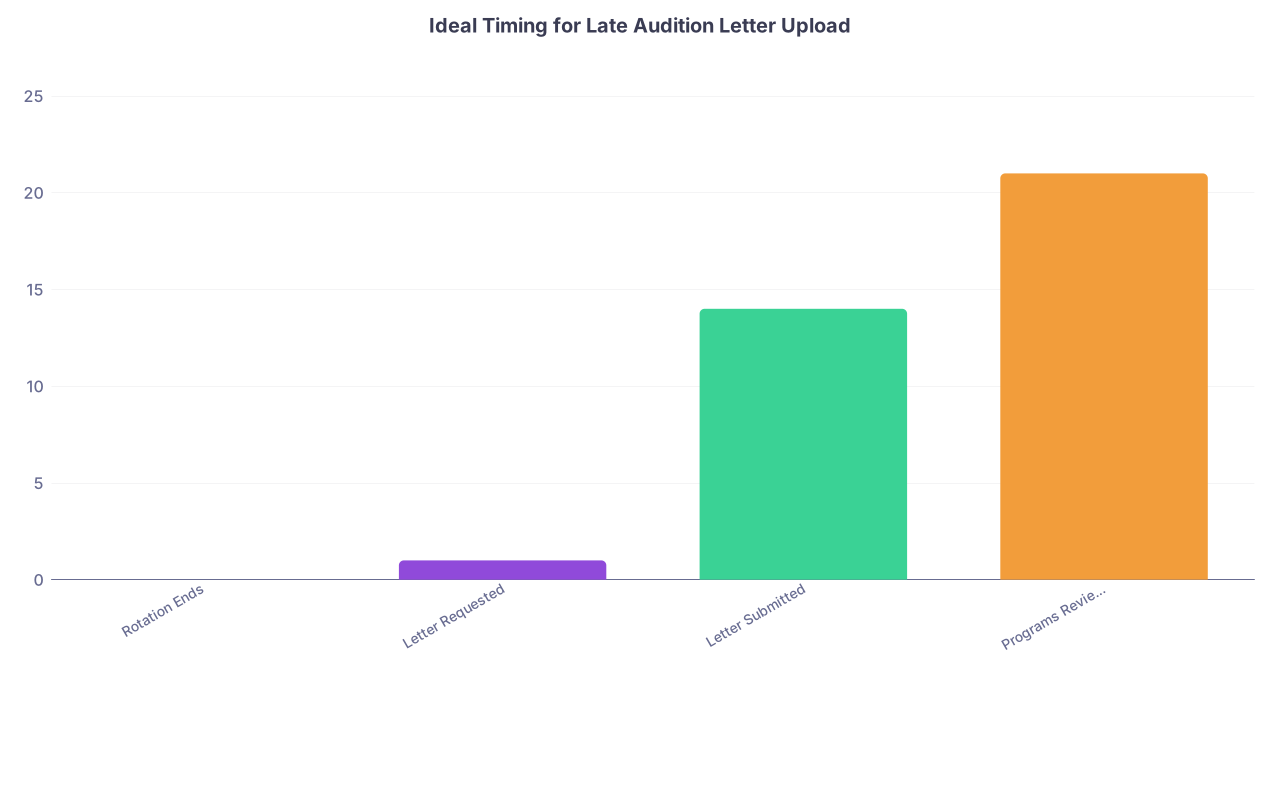
| Category | Value |
|---|---|
| Rotation Ends | 0 |
| Letter Requested | 1 |
| Letter Submitted | 14 |
| Programs Review 2nd Pass | 21 |
(Think in relative days: ~2 weeks from request to submission is reasonable if you push professionally.)
Step 3: Add the letter and strategically update
When the letter hits ERAS:
- Assign it to all programs in that specialty.
- For your top 5–10 programs, send a focused, brief update if:
- You have not yet received an interview invite or rejection.
- The letter is from a respected person or known program.
That email should:
- Be 4–6 sentences.
- Include:
- One sentence reminding them who you are and that your application is on file.
- One sentence that you have just completed a sub-I / audition at [Institution] with Dr. [Name].
- One sentence that a new letter from Dr. [Name] is now uploaded into ERAS and may be of interest.
- One sentence reiterating your strong interest in their program.
No novels. No pleading. Professionals respect concise updates.
7. How Late Is “Too Late” To Submit ERAS Because of a Rotation?
Let me put some boundaries on this, because students always push here.
Reasonable “lateness”
If:
- ERAS transmits on September X
- You submit your application within 3–5 days after that
That is not catastrophic, especially in less-competitive specialties, or if the slight delay meaningfully improves your application completeness (e.g., one more strong letter that is actually ready now, not hypothetical).
But this does not apply to a letter that might be written in mid-October. That is not “slightly late,” that is after the whole first review wave.
Unacceptable “lateness” (unless you have some extreme context)
- Submitting weeks after the release date (late September, October) because you were “waiting on an audition.”
- Submitting in October for a competitive specialty.
- Submitting once “all my letters are in” when that takes you into mid-season.
I have watched applicants with good stats and strong audition performances destroy their cycle because they believed the myth that “a perfect application in October is better than a good one in September.” It is not.
You want to be in the room when programs are making their initial list, even if you plan to bring better evidence later.
8. Special Case: Home Program vs Away Audition Timing
One more nuance people miss.
Home program letter timing
If your home department is writing:
- A department chair letter
- A PD letter
- A “home rotation” letter from July/August
You prioritize having at least one of these uploaded by ERAS release. You nag (politely) your home attendings early, because those letters are foundational.
A late away rotation letter is supplementary.
A missing home letter can look like your own institution did not strongly back you. That is a very different problem.
Away rotation letter timing
Away rotations are often:
- Mid-August
- September
- October
These letters:
- Help for signal: “This person functioned safely and well at a different institution.”
- Matter more if the away site is:
- A prestigious hub
- A common feeder for your desired programs
- In your target geographic region
But again: away letters are almost always boosters, not the skeleton of the file.
9. How to Write Your Application When the Audition Has Not Happened Yet
Last piece: what do you put in your personal statement and experiences when your key audition rotation is still in the future?
Be explicit without overpromising
You do:
- Mention upcoming audition rotations in the Experience descriptions or Additional Information section:
- “Scheduled sub-internship in [Specialty] at [Institution], Sept 2026.”
- Connect it to your narrative:
- “I sought this rotation to deepen exposure to [academic/community/trauma-heavy] practice settings.”
You do not:
- Overhype: “This rotation will prove I belong in X.” It sounds needy and hypothetical.
- Anchor your entire application on something that has not happened yet.
Your story should already stand without that rotation. The audition is then framed as the next logical step in a consistent path.
10. Step-by-Step Game Plan If You Have a Late Audition
Let me put this in one clean, actionable sequence.
8–10 weeks before ERAS release
- Finalize personal statement and experiences.
- Identify which letters you already have or can get before ERAS opens.
- Talk to your dean’s office / specialty advisor (if they are competent; some are not) about what minimum letter set you should have by release.
4–6 weeks before ERAS release
Lock in at least:
- 1 specialty-specific letter (if possible)
- 1 strong clinical letter (medicine/surgery/etc.)
- 1 other credible letter (research, additional clinical, or leadership)
Confirm with your late audition attending that:
- They are aware you will be asking for a letter.
- They know the timeline (targeting letter submission by early–mid October, not December).
0–1 week before ERAS transmits
- Submit ERAS with:
- Completed application
- Available letters
- Personal statement that states your specialty commitment clearly
- Do not hold submission because the late audition has not happened yet.
During the late audition
- Perform like an adult, not a tourist.
- Ask for the letter in person, late in the rotation when they have seen you work:
- “I am applying this cycle in [specialty]. If you feel you know my work well enough, I would be very grateful if you could write a strong letter on my behalf.”
2–3 weeks after the rotation ends
- Confirm the letter has been uploaded.
- As soon as it is visible in ERAS:
- Assign it to all programs.
- Send targeted, short updates to top programs if appropriate.
And then you stop tinkering. Let the application breathe.
Key Takeaways
Early application submission almost always beats waiting for a late audition letter, especially in competitive specialties. Being in the first screening wave matters more than having a “perfect” letter set on day one.
Treat a late audition letter as a mid-season upgrade, not the foundation of your application. Submit on time with a coherent specialty narrative and reasonable letters, then add the audition letter as soon as it is ready.
Only tolerate a very short delay (a few days after ERAS release) if it gets you from “weak/incoherent” to “reasonably complete.” Anything longer, especially into October, quietly kills your chances at many programs—no matter how good that late rotation feels on the wards.