
The biggest mistake couples make in ERAS is thinking “we’ll just both submit early” without actually syncing strategy. That is how you get out‑of‑phase interview seasons and a miserable fall.
Let me break this down specifically.
You are not just applying as two individuals who happen to be dating. You are applying as a coupled system that the NRMP algorithm will treat in a very particular way. Your ERAS submission timing, Step score availability, away rotation dates, and even when you ask for letters all need to be coordinated. Otherwise you end up with one partner flooded with interviews in October while the other is still waiting for programs to download their application.
This is fixable. But you have to be deliberate.
1. The Non‑Negotiables of Couples Match Timing
Before we talk tactics, you need the hard constraints. These do not care about your relationship, your preferences, or your anxiety level.
The hard rules you are playing under
- ERAS opens for applicants: You can start working in the system, uploading documents, entering experiences.
- Programs can start receiving applications (release date): Historically mid‑September. This is the real “deadline” that matters for competitiveness.
- MSPE (Dean’s Letter) release: October 1. Programs expect this but they do not wait to screen your application until then.
- NRMP couples registration: You each register individually with NRMP, then link as a couple inside the NRMP system (not ERAS). This happens after applications are submitted but before rank lists are due.
- Rank list certification deadline: Typically late February / early March.
The “best time to submit ERAS” is really “the best time to have both partners’ applications complete, polished, and ready to transmit on day 1 of application release.”
If one of you is uploaded and certified on release day and the other trails by 1–2 weeks, you have already put tension into the match strategy.
2. What “Early” Actually Means for Couples
“Submit early” is useless advice unless we define it.
For a standard applicant, submitting in the first week after ERAS opens for submission (and before programs can download) is usually fine.
For a couples match, you want something tighter:
- Both applications certified and submitted 2–5 days before the official program download date.
- All letters uploaded and assigned.
- All personal statements finalized.
- All program lists at least 80–90% set.
Why so rigid?
Because a couples match is about correlation. You want:
- Correlated application quality.
- Correlated submission times.
- Correlated interview seasons.
If Partner A looks “organized, early, complete” and Partner B looks “late, incomplete, question mark,” programs subconsciously treat you very differently, even if they never see the couple connection until ranking.
Let’s be concrete.
| Scenario | Impact on Couples Match |
|---|---|
| Both submit before release date | Strong; synchronous interview windows |
| One submits on release, other 2 weeks later | Medium risk; asynchronous invites and logistics |
| One submits before, other a month later | High risk; one partner may have far fewer options |
| Both submit >3 weeks after release | Noticeable disadvantage in competitive specialties |
You are trying to avoid the second and third rows. Those are the scenarios that produce frantic November re‑applications, extra prelim/TY backup talk, and “do we need to decouple?” conversations.
3. Step Scores, Letters, and the “Lagging Partner” Problem
Every couples pair has one of three dynamics:
- Roughly equal applicants.
- One clearly stronger on paper.
- One clearly weaker or delayed by events (leave of absence, exam failure, visa issues, etc.).
You already know which pair you are.
Step scores: when to wait and when not to
Here is the uncomfortable truth: for couples, delaying ERAS for a “hoped‑for” Step 2 CK score can hurt more than a modest score helps, especially if only one partner is waiting.
Basic rule set:
- If both of you already have competitive Step 2 CK scores for your target fields: Submit as early as possible; no reason to delay.
- If one of you lacks a Step 2 CK score and the other already has a solid score:
- If the missing score will be available before programs download ERAS: fine, submit once both scores are in.
- If the missing score will arrive after programs start screening: submit anyway, as long as the missing‑score partner has at least Step 1 and a plausible narrative (e.g., school schedule).
- If one of you failed an exam recently: you are not optimizing timing; you are damage‑controlling. Discuss with your dean’s office and probably submit closer to when the retake score is available, but both partners should align around that same adjusted timeline.
The worst move: one partner submits on day 1, the other waits 3–4 weeks for Step 2 and then submits. Programs see these as two different applicants with two different levels of urgency and organization.
Letters of recommendation: force synchronization
Letters ruin timelines more often than anything else.
You want:
- 3–4 letters uploaded per partner at least 10–14 days before application submission.
- No “we’re waiting on one superstar letter” that holds one partner hostage while the other is ready.
Reality: you do not delay a couple’s entire joint strategy for one maybe‑great letter. If it is not there at your self‑imposed deadline, you go with what you have and add the late letter mid‑season as a bonus.
That is the level of discipline you need.
4. Building a Shared ERAS Calendar (Not Optional)
You cannot “wing” timelines as a couple. You need a shared calendar with non‑negotiable dates.
Make it explicit. Google Calendar, Notion, paper wall calendar — I do not care. But both of you have to see it.
Core milestones to put on there:
- Last date to take Step 2 CK for score to be back before ERAS release.
- Last day to request new letters.
- Internal deadline to finish personal statements.
- Internal deadline to finalize program lists.
- Submission target: 3–5 days before the ERAS release date.
- “No major edits after this date” lock‑in.
Then layer in specialty‑specific stuff.
Example: IM + Dermatology couple
The derm partner’s timeline is more constrained and more competitive.
You might build:
- July: Derm partner finalizes research section; IM partner finishes core clerkship entries.
- Early August: All letters requested; derm faculty warned explicitly about couples match and earlier deadline.
- Late August: Both finalize personal statements; couple reviews each other’s.
- Early–mid September: Both submit ERAS on the same day, before release date.
Notice what did not happen here: the derm partner did not submit early while the IM partner “took a few more weeks” to tweak wording. That is how you fracture interview schedules.
5. Coordinating Specialty Competitiveness and Submission Dates
Here is where couples match strategy actually gets interesting.
When you have two different specialties with very different competitiveness profiles and interview timelines, you cannot just blindly sync everything. You have to decide whose constraints dominate.
Typical pairings and what tends to drive timing
| Pairing | Timing Driver Specialty |
|---|---|
| IM + FM | Neither; fully synchronized, flexible |
| IM + Derm | Dermatology drives; earlier, cleaner submission |
| IM + Ortho | Ortho drives; earlier submission, more aways factored |
| Pediatrics + Anesthesia | Anesthesia usually drives timing |
| EM + Any specialty | Historically EM; now more chaotic, but still earlier is safer |
This does not mean the “less competitive” partner becomes an afterthought. It means:
- You set joint submission timing to fully support the more constrained specialty.
- You build enough program volume for the less constrained specialty to flex around that.
Example: Anesthesia + Pediatrics couple. Anesthesia gets more picky about early applications at some programs. So you time everything such that the anesthesia applicant looks like an early, polished, competitive applicant. The pediatrics partner can thrive just fine under that same timeline.
6. Program Lists: Sync First, Then Optimize
The biggest conceptual error couples make is picking program lists in isolation.
“I want to apply broadly in the Northeast.” “I want to apply to all the top 30 academic IM programs.”
Nice. But useless, unless you map it together.
Step 1: Decide on joint geography tiers
Take a map. Literally draw circles.
You want:
- Tier 1: Places you would both love to be (primary joint cities / regions).
- Tier 2: Places you would both accept but not love.
- Tier 3: Places where one of you is less happy, but still would go to avoid matching apart.
Then translate that into concrete programs:
- For each Tier 1 city, identify every program that exists for each specialty.
- Same for Tier 2 and 3.
Step 2: Build program lists together
Inside ERAS, you will ultimately assign programs separately. But you should have a master spreadsheet with:
- City.
- Program name (Partner A).
- Program name (Partner B).
- Tier (1–3).
- Priority (High/Medium/Low).
- Notes (e.g., “Partner A has home rotation here,” “Program B has weak reputation for Partner’s specialty”).
This is where submission timing bites people. If you have not built this list until the week programs open, someone will panic‑add 40 random programs at the last minute. Typically the weaker or less organized partner. Programs can tell when an application list looks like a last‑minute salvage effort.
The more competitive partner especially must look intentional from day one.
7. ERAS Submission Day: How to Execute as a Couple
You want submission to feel like an organized launch, not two separate panic events.
Here is a clean playbook for the last 7–10 days before submission:
T‑10 days: Freeze content, switch to QA
Both of you:
- Stop writing new experiences. You are not adding anything major now.
- Stop re‑architecting your personal statement. Only minor wording clean‑up allowed.
- Run through the application line‑by‑line for typos, date errors, and redundancy.
Act like this is your last chance. Because practically, it is.
T‑7 to T‑3: Mutual cross‑check
Each partner reviews the other’s ERAS for structure, not for voice:
- Are there obvious date inconsistencies?
- Are there unexplained gaps?
- Are leadership roles buried?
- Does the experience description match reality, or did you oversell in a way that will be obvious on interview day?
You are not editing their writing style into your own. You are reality checking.
T‑3 to T‑1: Final document check
Confirm both of you:
- Have correct photo uploaded.
- Have the right personal statement assigned for each specialty (and for any dual‑application, like IM + prelim).
- Have the full and correct program list attached.
You sit together and do this. Same table, same time. No “I’ll do it later tonight” unless you enjoy discovering unassigned personal statements in November.
T‑0: Submit together
You do not have to hit “submit” in the exact same minute, but same day is ideal.
Psychologically, it locks you in. Logistically, it reduces weirdness where one partner is technically searchable by programs and the other is not.
8. After Submission: Synchronized Communication and Response
Submitting ERAS early and together is only half the coordination problem. The other half is how you respond once the interview invitations start coming.
The email / ERAS message trap
Programs do not communicate with you as “a couple.” They message two independent applicants. Which means:
- One of you may get an invite before the other at the same program.
- One of you may be waitlisted or rejected while the other is invited.
Your job is to keep a synchronized log of:
- Which programs have invited which partner.
- Which programs have both invited you.
- Which programs are single‑sided (only one partner invited so far).
Use a shared spreadsheet or shared note. Update it daily through peak season.
Timing of accepting interviews
Here is the nuance most people mess up:
- If only Partner A is invited to a program in a Tier 3 city, and Partner B has no realistic nearby options, do not auto‑accept. Pause. See if Partner B hears anything within 24–48 hours. For some programs, couples invites are staggered by a day or two.
- For Tier 1 and Tier 2 cities, you generally accept quickly for the invited partner, even if the other has not heard yet. Then, if needed, a carefully crafted couples email can sometimes trigger a second invite.
You will not get this perfect. But you should at least be making deliberate choices, not “accept everything instantly and hope.”
9. The One Partner Who Wants to Submit Later
This comes up every year. One partner wants to wait:
- “I need more time to polish.”
- “My mentor said we should hold off a week.”
- “I am waiting on this big research paper acceptance.”
Here is my blunt take: for couples match, you follow the earliest reasonable timeline that does not obviously harm either partner. You do not let perfectionism in one application drag the other down.
If you are the more meticulous partner, read this carefully:
No program will reject you because your application was 99% polished instead of 100% polished. But they will effectively ignore you if your application shows up after their first wave of serious review.
I have watched this exact scenario:
- Partner A (stronger) submits on the release date.
- Partner B (more anxious, slightly weaker) waits ~3 weeks to “perfect” their experiences.
- Partner A gets 18 interviews across multiple regions.
- Partner B gets 6 scattered invites and 1 true overlap with Partner A.
- December turns into panic about SOAP, prelim/TY backup, and “should we match independently?”
All because one person wanted to wordsmith bullets into oblivion.
For couples, the right balance is good and on time for both of you, not perfect but staggered.
10. Special Situations That Change Submission Timing
Not every couple is clean and straightforward. A few specific patterns force you to tweak timing decisions.
Visa‑dependent applicants
If one partner needs a J‑1/H‑1B‑friendly program list, you must:
- Identify those programs early.
- Build a visa‑aware program list upfront.
- Submit early; visa candidates are scrutinized more and sometimes delay just looks like disorganization.
Do not wait to see who “seems open to visa candidates” from whispers. Build your list beforehand and commit.
Couples with one partner doing a prelim/TY year
If one of you is EM/derm/rads/ophtho and the other is categorical somewhere else:
- Treat the prelim/TY year like its own separate but synchronized application.
- Same submission timing.
- Joint mapping of where prelims exist alongside the advanced programs you are targeting.
If you stagger those, you will create mismatched years and more complexity when you re‑enter the match for the advanced position.
Couples where one partner is re‑applying
If one partner did not match previously and is re‑entering the match:
- Their credibility depends heavily on looking organized and early this time.
- You cannot afford to have the re‑applicant be the later‑submitting partner. That is a terrible look.
- Align both of you to a conservative, earlier submission target, even if the fresh applicant “could afford” to be later.
This is non‑negotiable if you want to be taken seriously.
11. A Visual: How Couples’ Timelines Should Line Up
Here is what a sane schedule looks like for a September ERAS release date (assume Sept 15 as an example):
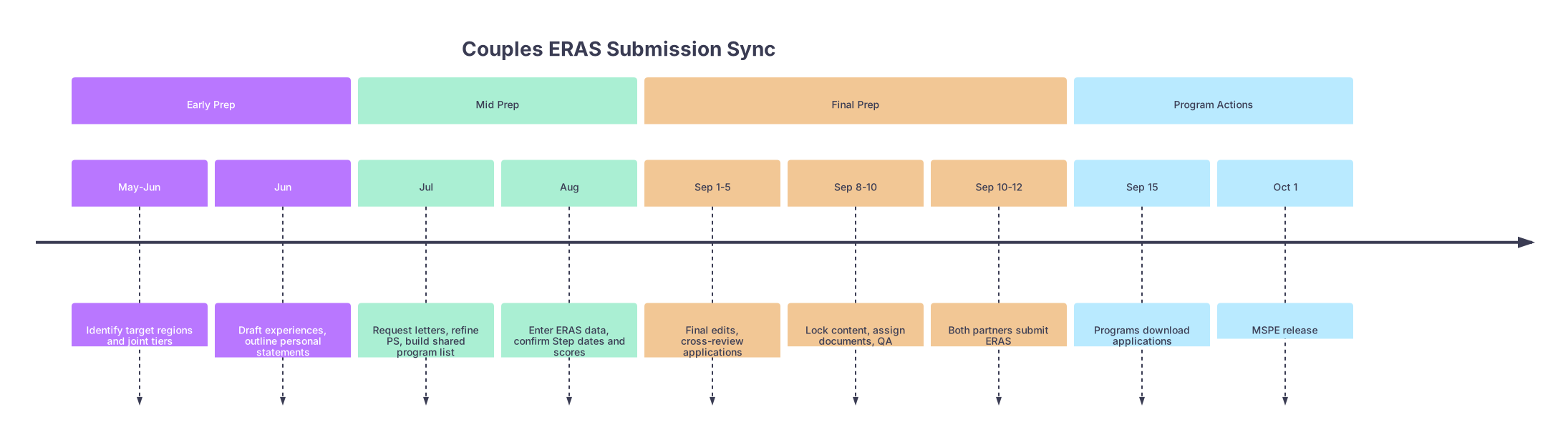
| Period | Event |
|---|---|
| Early Prep - May-Jun | Identify target regions and joint tiers |
| Early Prep - Jun | Draft experiences, outline personal statements |
| Mid Prep - Jul | Request letters, refine PS, build shared program list |
| Mid Prep - Aug | Enter ERAS data, confirm Step dates and scores |
| Final Prep - Sep 1-5 | Final edits, cross-review applications |
| Final Prep - Sep 8-10 | Lock content, assign documents, QA |
| Final Prep - Sep 10-12 | Both partners submit ERAS |
| Program Actions - Sep 15 | Programs download applications |
| Program Actions - Oct 1 | MSPE release |
Both of you ride the same wave. No one is a month behind. That is the goal.
12. Concrete Checklist: Are You Actually Synced?
Run through this list with your partner. If you say “no” to more than 3 of these, your timelines are not really synchronized.
- Do you both know your target ERAS submission date (specific day)?
- Have you both already requested all letters, with faculty aware of that date?
- Are all exams (especially Step 2 CK) scheduled and likely to report before your submission target?
- Do you share a single, merged program list document with city/tiers for both specialties?
- Have you cross‑reviewed each other’s ERAS entries at least once?
- Has each of you confirmed that the other has at least 3 letters already uploaded or promised by a specific date?
- Do you both understand which specialty’s constraints are driving your timeline?
- Is there a contingency plan if one of you suddenly loses a letter writer or has a delayed Step 2 score?
If the answer to that last one is “we’ll figure it out,” you will not. Figure it out now.
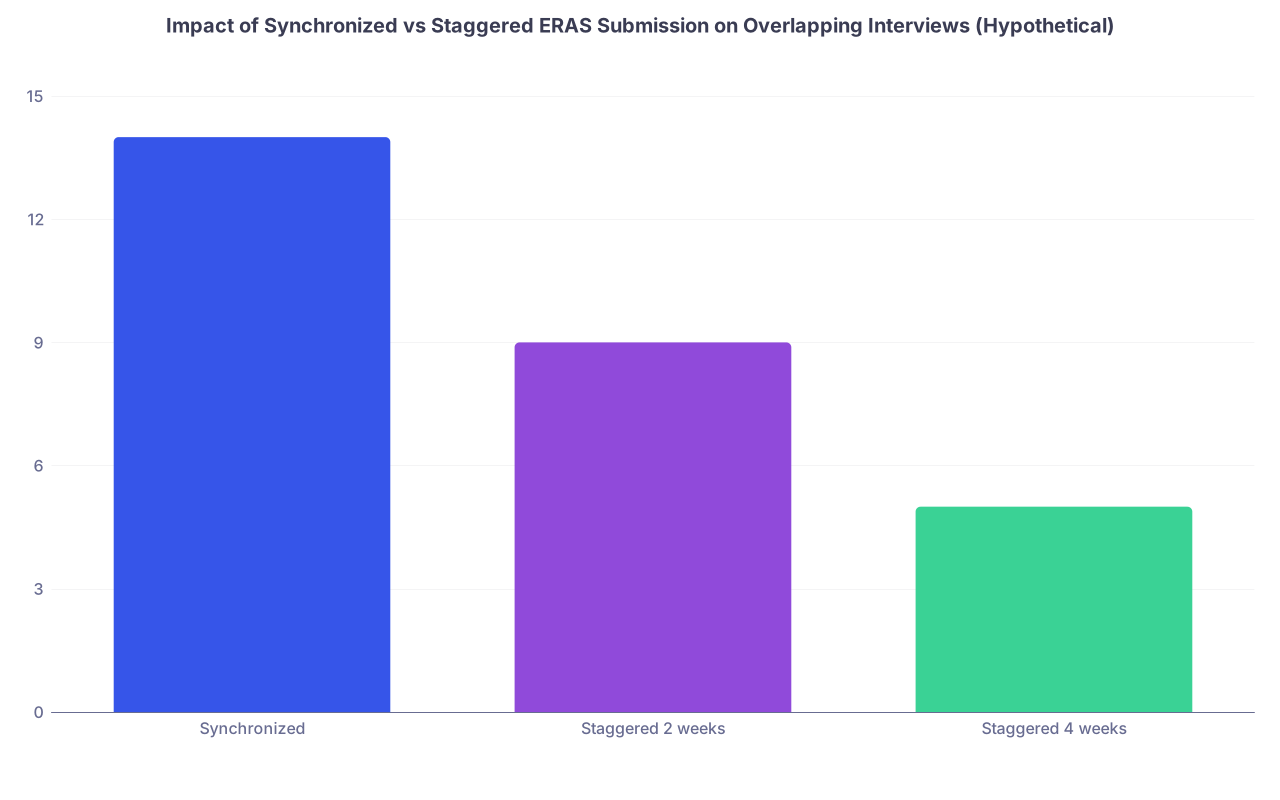
| Category | Value |
|---|---|
| Synchronized | 14 |
| Staggered 2 weeks | 9 |
| Staggered 4 weeks | 5 |
This is what I have seen, informally, year after year: synchronized submission simply yields more overlapping interview options. Which is the whole point of couples match in the first place.
FAQ (Exactly 5 Questions)
1. If one of us is applying in a very competitive specialty (derm, ortho, plastics), should that person submit even earlier than the other?
No. That defeats the couples objective. You set the joint submission date early enough that the competitive‑specialty partner is advantaged and the other partner still submits on the same day. “Extra early” for one and “normal” for the other just creates staggered review, not extra benefit.
2. Can we add more programs after our initial ERAS submission if we realize our geography overlap is weak?
Yes, you can add programs later. But they will see your application later in the cycle, often after many interviews are already offered. That is fine as a salvage move for the weaker partner, but it is not a substitute for doing the geography and overlap planning months earlier. Late add‑ons rarely fix poor initial strategy.
3. Do programs see that we are couples matching at the time of application submission?
No. The “couples” linkage happens in the NRMP rank system, not ERAS. Some programs may infer it if you mention it in your personal statement or if both of you mention each other on interview days, but there is no ERAS flag that says “this applicant is in a couple.” That is why your timing and coordination have to be self‑driven.
4. Should we mention that we are couples matching in our personal statements to help programs coordinate interviews?
Sometimes. If the relationship and joint planning are central to your story (and especially if you are targeting specific regions together), a brief, professional mention can make sense. But do not turn the statement into a relationship essay. And do not rely on this to coordinate interviews; many programs barely read PS before offering invites.
5. What if one of us is not ready by our target submission date? Should the other still submit?
If “not ready” means minor polishing, you both submit anyway on the planned date. If “not ready” means missing Step 2 after a failure, no letters in a specialty, or incomplete application entries, you may need to jointly delay — but then reset to a new, firm deadline. The one thing you should almost never do in couples match is have one partner submit on time and the other lag by several weeks. That destroys the synchronized interview season you are trying to create.
Two final points to keep in your head:
- Couples match is not just about matching to the same city. It is about aligning your entire application and interview ecosystem so you both have real options. That starts with synchronized, intentional ERAS submission.
- Perfect ERAS applications submitted weeks apart are worse, as a couple, than very good applications submitted together on day one. Aim for “good and early together,” not “perfect and staggered.”