
Introduction: Defining a Great Pediatric Surgery Residency
Choosing among surgical residency programs is one of the most consequential decisions in your medical education. For those drawn to caring for children with complex surgical needs, Pediatric Surgery offers a uniquely rewarding—and demanding—career path. Yet figuring out what actually makes a pediatric surgery residency or fellowship “great” can feel overwhelming.
Beyond glossy brochures and website claims, what really matters day-to-day? How do you know whether a program will prepare you for independent practice, support your growth, and help you build a sustainable career with a reasonable work-life balance?
The most reliable answers often come from the people living it right now: current residents and recent graduates.
This article distills insights from residents in pediatric surgery and related surgical fields, and organizes them into practical criteria you can use when evaluating residency programs. We’ll walk through:
- Core elements of excellent Pediatric Surgery training
- How mentorship and culture shape your experience
- What to look for in surgical volume, case mix, and curriculum
- The role of research, fellowship prospects, and career development
- How programs are (and aren’t) supporting wellness and work-life balance
By the end, you’ll have a structured framework to compare pediatric surgery residency programs and ask targeted questions during interviews, sub-internships, and virtual open houses.
Core Components of a High-Quality Pediatric Surgery Residency
1. Strong, Intentional Faculty Mentorship
Across residency programs, one theme is nearly universal: mentorship can make or break your experience.
Residents consistently emphasize that great Pediatric Surgery programs are built on accessible, invested, and diverse faculty mentors.
Accessible and Supportive Mentors
In an intense specialty like Pediatric Surgery, you need more than technically skilled attendings—you need people who will teach, advocate, and support you.
Signs of strong mentorship culture:
- Faculty routinely review cases pre- and post-op with residents
- Attendings invite residents to participate in decision-making, not just retract
- There is a clear system for assigning academic and career mentors early in training
- Residents feel comfortable asking for help, clarification, or feedback
Residents frequently note that programs where attendings know them by name, check in on their progress, and actively encourage questions feel markedly different from those where trainees feel invisible.
“The mentoring I received from day one shaped my entire training experience. My attending surgeons were approachable and willing to invest time in my learning—and that made all the difference.”
— Dr. Sofia Rivera, pediatric surgery resident
Diverse Faculty Expertise
Excellent Pediatric Surgery residency programs expose you to the full spectrum of pediatric surgical care:
- Neonatal and fetal surgery
- Pediatric oncologic surgery
- Thoracic and cardiothoracic procedures
- Minimally invasive and robotic pediatric surgery
- Trauma and emergency pediatric surgery
- Colorectal, urologic, and gastrointestinal surgery in children
Having faculty with varied subspecialty interests gives you:
- Multiple role models for potential career paths
- Exposure to different operative philosophies and techniques
- Opportunities to explore niche interests (e.g., fetal surgery, global pediatric surgery)
When assessing programs, look at faculty profiles: Are there surgeons publishing and leading in areas that interest you? Are there both research-focused and clinically focused mentors?
Career and Professional Development Guidance
Mentorship in Pediatric Surgery goes far beyond the OR.
Strong programs:
- Provide structured guidance on fellowship applications, CV building, and letters of recommendation
- Help residents identify research projects aligned with their long-term goals
- Offer feedback on presentation skills, teaching, and leadership
- Encourage participation in national societies (e.g., APSA, AAP Sections, specialty organizations)
Ask current residents:
- How often do you meet with your mentor(s)?
- Do you have a formal advisor for career planning?
- How involved are attendings in helping with fellowship/job placement?
Programs where faculty actively champion residents’ careers are the ones that consistently place graduates into competitive Pediatric Surgery fellowships and academic positions.
2. Hands-On Surgical Experience and Progressive Responsibility
No matter how strong the curriculum looks on paper, you become a surgeon through doing surgery. Residents repeatedly identify case volume, case variety, and early operative responsibility as defining features of great Pediatric Surgery training.
Adequate Surgical Volume and Diverse Case Mix
You need enough cases to build both technical skill and clinical judgment. Look for:
- High overall pediatric surgical case volume, including both elective and emergency cases
- A balanced mix of:
- Neonatal cases (e.g., NEC, congenital diaphragmatic hernia, intestinal atresias)
- Complex congenital anomalies
- Pediatric oncology cases (Wilms tumor, neuroblastoma, etc.)
- Minimally invasive procedures (laparoscopy, thoracoscopy, robotic)
- Trauma cases and urgent interventions
Residents emphasize how critical it is to see both “bread-and-butter” pediatric cases and rare, high-acuity conditions. Exposure to a broad array of pathology prepares you for independent practice in different settings—academic centers, children’s hospitals, or community environments.
Ask:
- How are cases distributed between residents and fellows?
- What is the average case log at graduation?
- How many index pediatric procedures does a typical resident perform as primary surgeon?
Early and Meaningful Operative Opportunities
Programs differ dramatically in when and how they allow residents to lead in the OR.
Signs of strong operative training:
- Residents begin performing simple cases under close supervision early in training
- There is a graduated responsibility model, where complexity increases as skills develop
- Attendings routinely “back off” appropriately, letting residents perform key portions
- Residents are first-assist or primary surgeon on a meaningful proportion of cases by mid-training
“What I love about my program is the surgical volume. I’ve been fortunate to scrub in on complex cases alongside skilled surgeons early on. It's pushed me to develop my skills much faster than I ever imagined.”
— Dr. Alex Chen, pediatric surgery resident
During interviews and rotations, observe:
- Do residents handle the critical parts of cases?
- Are they trusted to run minor procedures semi-independently?
- Is there a culture of graded autonomy, or are residents mostly assisting?
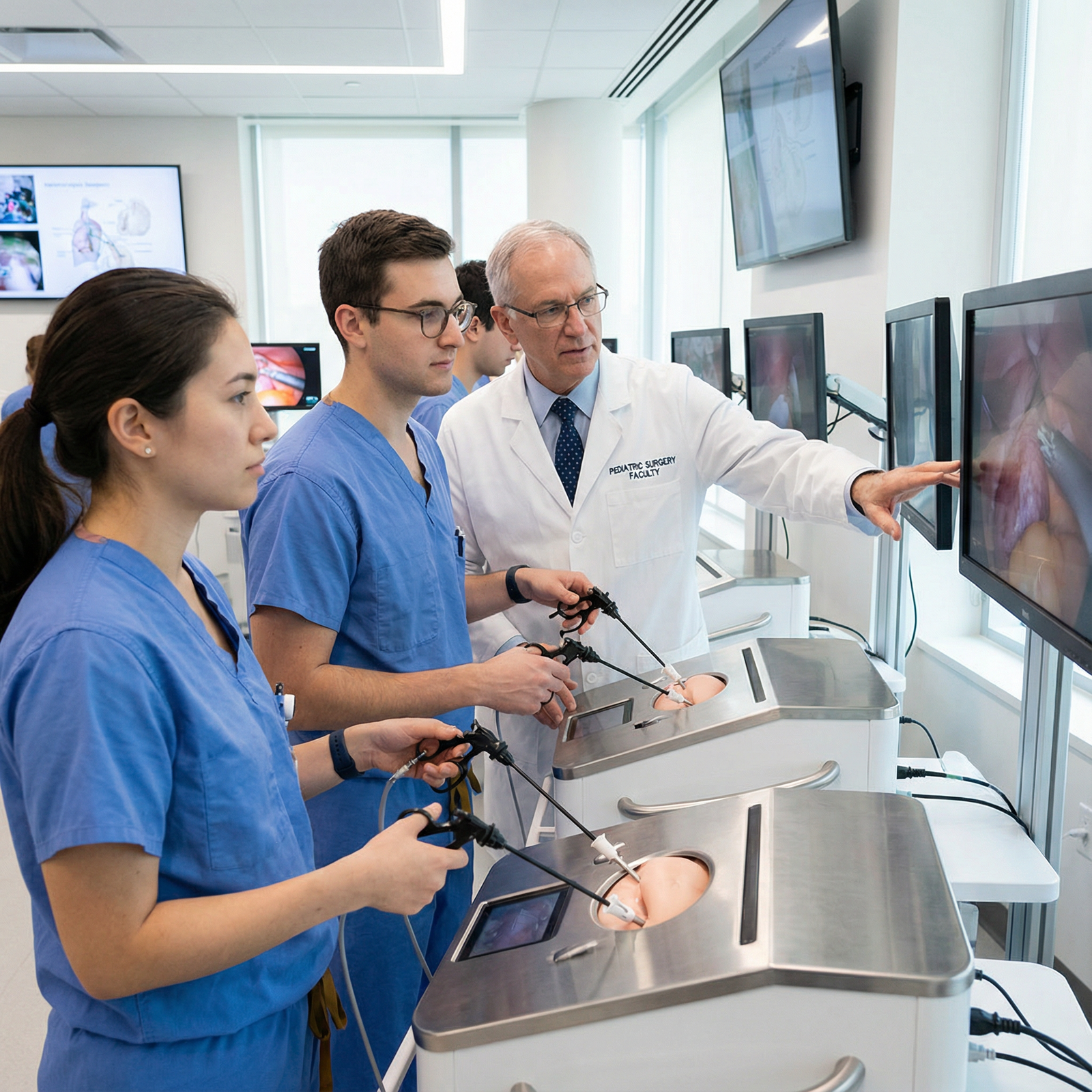
Simulation and Skills Lab Training
Because pediatric operations often involve smaller anatomy and tighter margins for error, simulation training is especially valuable.
High-quality programs invest in:
- Laparoscopic and thoracoscopic simulators with pediatric-sized instruments
- Neonatal intubation and resuscitation mannequins
- Crisis resource management simulations for pediatric trauma and acute decompensation
- Procedure-specific modules (e.g., central line placement in infants, chest tube insertion)
Simulation offers a safe environment to practice technical skills and team communication before—and between—real cases. Programs that schedule protected simulation time send a clear message that deliberate skills development is a priority, not an afterthought.
Educational Structure: Curriculum, Conferences, and Interdisciplinary Training
3. A Comprehensive, Well-Structured Curriculum
Beyond the OR, a great Pediatric Surgery residency ensures you understand the science, evidence base, and multidisciplinary nature of pediatric surgical care.
Organized Didactics and Conferences
High-quality residency programs:
- Provide a structured didactic schedule (e.g., weekly or twice-weekly conferences)
- Cover core Pediatric Surgery topics systematically, often mapped to board exam content
- Include:
- Morbidity and mortality (M&M) conferences
- Tumor boards and multidisciplinary case conferences
- Journal clubs focused on critical appraisal of the literature
- Radiology-pathology-surgery correlation sessions
- Pediatric trauma and critical care rounds
Residents appreciate didactics that are:
- Protected (i.e., clinical duties minimized or cross-covered)
- Interactive, with case-based discussion rather than pure lectures
- Updated regularly to reflect new guidelines, trials, and surgical techniques
Ask:
- How much of your didactic time is truly protected?
- Who leads the teaching—faculty, fellows, or residents?
- Is there a formal curriculum aligned with Pediatric Surgery board requirements?
Research, Quality Improvement, and Academic Development
Many residents pursuing Pediatric Surgery are aiming for academic or hybrid careers. Robust programs create a clear path for scholarly growth:
- Dedicated research blocks or flexible research time
- Access to biostatistical and study design support
- Opportunities to join ongoing clinical trials, outcomes research, or basic science labs
- Funding for presentations at regional, national, or international meetings
“The research opportunities have been phenomenal! I never thought I would get to present at national conferences so early in my career, but my program has supported my work every step of the way.”
— Dr. Jessica Wong, surgical resident with pediatric focus
Ask current residents:
- What proportion of residents present at national meetings?
- Is there financial support for travel and registration?
- How easy is it to find a mentor for a research project you’re passionate about?
Even if you’re not sure about a fully academic career, research and QI projects help you:
- Learn to interpret literature and guidelines critically
- Contribute to improving pediatric surgical care
- Strengthen your fellowship or job applications
Interdisciplinary and Systems-Based Training
Pediatric surgical care rarely happens in isolation. Great programs expose you to the broader ecosystem:
- Pediatric anesthesiology
- Neonatology and pediatric critical care
- Pediatric oncology, radiology, and pathology
- Palliative care, social work, and child life specialists
Look for:
- Regular multidisciplinary rounds on complex patients
- Joint educational conferences with pediatrics, anesthesia, oncology, etc.
- Opportunities to participate in ethics consultations and complex discharge planning
This kind of training prepares you for real-world practice where communication, collaboration, and understanding of healthcare systems are as important as technical skill.
Fellowship Prospects, Career Advancement, and Alumni Support
4. Fellowship Placement and Long-Term Career Trajectories
Pediatric Surgery is highly competitive, and many residents will complete general surgery residency before applying to Pediatric Surgery fellowships. Whether you’re evaluating a Pediatric Surgery fellowship or a general surgery residency with strong pediatric exposure, career outcomes matter.
Fellowship Placement Rates and Program Reputation
When exploring residency programs, ask specifically about:
- Percentage of graduates who match into Pediatric Surgery or related fellowships
- The types of fellowships obtained (e.g., Pediatric Surgery, Pediatric Surgical Oncology, Minimally Invasive Surgery, Pediatric Urology)
- Institutions where graduates have matched or accepted faculty positions
Strong programs:
- Maintain national visibility through faculty and resident presentations
- Have leadership involved in key Pediatric Surgery societies
- Are known by fellowship directors, which can help your application stand out
Residents often review NRMP data, institutional match lists, and alumni profiles to gauge how effectively a program supports graduates’ goals.
Career Support, Networking, and Job Placement
Beyond fellowship, a great program prepares you for the transition to independent practice:
- Workshops on contract negotiation, billing, and coding
- Guidance on choosing between academic, hospital-employed, and private practice models
- Access to networking opportunities at national meetings
- Support in identifying job opportunities and preparing for interviews
Programs with strong administrative and faculty support will help you understand:
- What a sustainable Pediatric Surgery practice looks like in different settings
- How to evaluate call schedules, compensation models, and institutional resources
- Strategies to maintain work-life balance across different career paths
Alumni Network as a Long-Term Asset
A strong alumni network can be invaluable:
- Alumni may serve as mentors, letter writers, or collaborators
- Graduates at other institutions can alert current residents to job opportunities
- A sense of community that extends beyond graduation can help you navigate early career challenges
When you visit or interview:
- Ask how often alumni return for grand rounds or teaching
- Look at where alumni are now—are they leaders, division chiefs, or program directors in Pediatric Surgery or related fields?
Residents frequently cite robust alumni connections as one of the subtle yet powerful benefits of training at a well-established program.
Culture, Wellness, and Sustainable Work-Life Balance
5. Work Environment, Wellness Initiatives, and Resident Support
Pediatric Surgery is demanding, but it should not require sacrificing your health or identity outside of medicine. Residents repeatedly stress that programs with a healthier culture and proactive wellness measures feel very different from those where burnout is ignored.
Realistic Workload and Thoughtful Scheduling
While all surgical residency programs are intense, look for signs that a program respects duty hour guidelines and your need for rest:
- Transparent call schedules and night float systems
- Efforts to minimize unnecessary “scut” work through support staff and EMR optimization
- Flexible scheduling for major life events when possible (e.g., parental leave, family emergencies)
Residents value programs that recognize them as humans first and trainees second.
Mental Health and Wellness Resources
The stigma around mental health in surgery is finally being challenged. Strong programs:
- Offer confidential access to counseling, therapy, and mental health services
- Promote wellness initiatives (e.g., protected wellness days, small group debriefings)
- Encourage open discussion about burnout, imposter syndrome, and secondary trauma
- Have leadership who model healthy behaviors and time away from work
“A great residency isn't just about surgeries; it's about being able to talk openly about struggles. I really appreciate the emphasis on mental wellness in my program. It encourages us to take care of ourselves while we learn to take care of others.”
— Dr. Omar ElSayed, surgical resident
Ask residents privately:
- Do you feel comfortable taking sick or mental health days when needed?
- How does the program respond when people are struggling?
- Are wellness efforts genuine or mainly for accreditation checkboxes?
Inclusion, Diversity, and Psychological Safety
Pediatric Surgery benefits from teams that reflect the diversity of the patients they serve. Look for:
- A diverse resident and faculty cohort in terms of gender, race, ethnicity, and background
- Explicit efforts to support underrepresented groups in medicine
- Clear policies (and real action) regarding harassment, discrimination, and mistreatment
- A culture where questions are welcomed, and errors are treated as learning opportunities, not occasions for shaming
These elements contribute deeply to your sense of belonging and your overall experience of residency.

Applying These Insights: How to Evaluate Pediatric Surgery Residency Programs
Practical Steps for Applicants
To translate these concepts into action during your application year:
Do Sub-Internships/Acting Internships
- Spend time at programs you’re seriously considering
- Observe how residents talk about their training when attendings are not around
- Note how often they are in the OR versus doing non-educational tasks
Ask Targeted Questions on Interview Day
Examples:- “How is operative autonomy assessed and increased over time?”
- “How many residents in the last 5 years have matched into Pediatric Surgery or related fellowships?”
- “What wellness resources do residents actually use, and how are they protected?”
Review Case Logs and Educational Schedules (when available)
- Ask to see anonymized case logs of graduating residents
- Request a sample monthly didactic and call schedule
Talk to Multiple Residents at Different PGY Levels
- Junior residents will show you early training realities
- Senior residents can speak to autonomy, fellowships, and career support
Reflect on Your Priorities
- Is high surgical volume your top priority, or is flexible scheduling more important?
- Are you committed to academic Pediatric Surgery, or open to mixed practice?
- Do you need to be in a specific geographic region or near family?
Your “best” Pediatric Surgery residency program is the one that aligns with your values, learning style, and long-term goals—not just the one with the biggest name.
FAQs: Choosing and Thriving in a Pediatric Surgery Residency
1. What should I prioritize when comparing Pediatric Surgery residency or fellowship programs?
Focus on:
- Mentorship quality and faculty accessibility
- Operative experience (volume, variety, and autonomy)
- Educational structure, including didactics and simulation
- Fellowship and career outcomes for graduates
- Program culture and work-life balance, including wellness and mental health support
Use these areas as a checklist when speaking with residents and faculty.
2. How important is mentorship in Pediatric Surgery training?
Mentorship is central to your development as a pediatric surgeon. Good mentors:
- Accelerate your technical and clinical skills
- Help you avoid common career pitfalls
- Guide you through research, presentations, and leadership roles
- Advocate for you in fellowship and job applications
When mentorship is weak or absent, residents often feel lost, unsupported, and less prepared for the next phase of their careers.
3. Do all Pediatric Surgery–focused programs offer strong research opportunities?
No. Programs vary widely in their research expectations and support:
- Some are highly academic, with required research years and multiple NIH-funded labs
- Others are more clinically oriented, with optional or smaller-scale projects
If scholarship is important to you, ask:
- How many residents publish during training?
- Are there protected research blocks?
- Is there institutional support (biostats, grant offices, etc.)?
Match the program’s research culture to your own goals in academic medicine or clinical practice.
4. Is work-life balance realistic in a surgical residency—especially one focused on Pediatric Surgery?
Work-life balance in residency is relative, but it is absolutely possible to maintain some balance with the right environment and habits:
- Choose programs that respect duty hour limits and support days off
- Use wellness resources (counseling, peer groups, mentorship) early rather than waiting for a crisis
- Set boundaries around limited personal time—family, exercise, hobbies—even if in small doses
- Lean on your co-residents; a supportive cohort significantly improves resilience
Programs that openly value wellness and have tangible systems in place make it much more feasible to sustain a long, fulfilling career in Pediatric Surgery.
5. What career paths are available after Pediatric Surgery-focused training?
After completing a general surgery residency and a Pediatric Surgery fellowship (or related specialty training), possible career paths include:
- Academic Pediatric Surgery at a university-affiliated children’s hospital
- Hospital-employed Pediatric Surgery in regional or community children’s centers
- Subspecialty practice (e.g., pediatric colorectal, pediatric minimally invasive surgery, pediatric surgical oncology)
- Global surgery and humanitarian work, often in partnership with NGOs or academic centers
- Leadership roles in quality improvement, hospital administration, or medical education
Your residency and fellowship experiences—especially mentorship, research, and clinical exposure—will strongly influence which of these paths feels most aligned with your skills and interests.
By examining programs through the lenses of mentorship, operative experience, curriculum, career development, and work-life balance, you can identify Pediatric Surgery residency and fellowship programs that will not only train you to be an excellent surgeon, but also support you as a whole person. Connecting with current residents, asking specific questions, and reflecting on your own priorities will guide you toward a program where you can truly thrive.