You are here
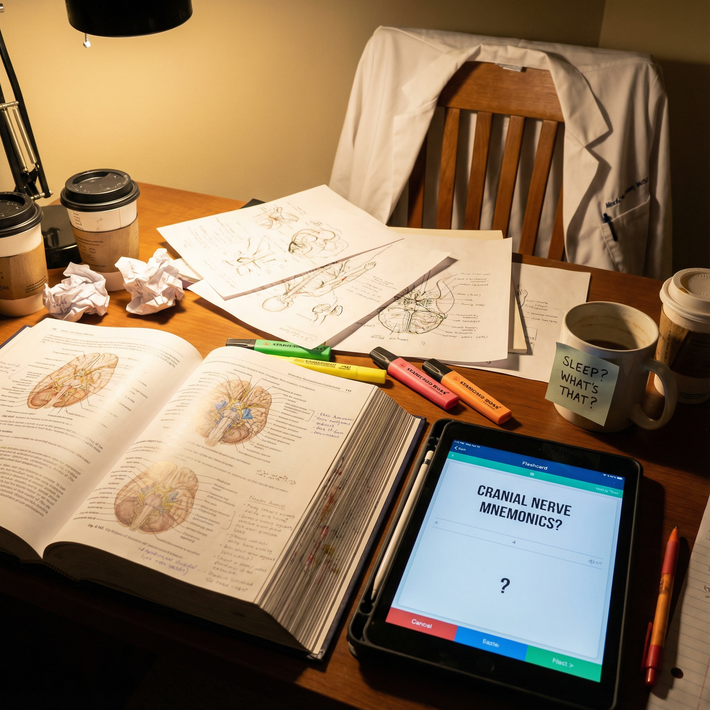
You are on a busy medicine rotation. It is 3:15 p.m., sign-out is at 5, and you just got hit with: “Can you go do a neuro check on the guy in 14B? He’s a little off.”
You walk into the room. He is awake, kind of. Family is watching you. The nurse asks, “So… is he worse? Should we page neuro?”
And you realize: your “full neuro exam” from second year OSCEs is completely useless right now. You do not have 20 minutes. You barely have 3. You need something fast, reproducible, and actually meaningful for the team.
That is what this is about: three structured, focused neuro exam patterns that you can run on autopilot in high-pressure situations:
- The “Is this a stroke?” exam
- The “Is this delirium vs toxic/metabolic vs focal?” exam
- The “Is this a cord vs root vs peripheral nerve problem?” exam
Not the pretty Step 2 CS exam. The real one you will use on wards at 2 a.m.
Core principles before we get fancy
Let me be blunt: most students’ neuro exams fail in two ways.
- They are too long and unfocused – random cranial nerve gymnastics without a clinical question.
- They are too superficial – “strength 5/5 throughout” written on autopilot without actually stressing a single muscle group.
So before the specific patterns, you need three anchor rules.
1. Always answer: “What am I trying to rule in or rule out?”
You do not walk into the room to “do a neuro exam.” You walk in to answer a targeted question:
- “Could this be an acute stroke that needs imaging / code stroke?”
- “Is this primarily a brain problem or something systemic (sepsis, drugs, metabolic)?”
- “Where along the neuraxis is this weakness coming from?”
If you cannot phrase the question, your exam will drift.
2. Fix your default sequence
You need a muscle memory sequence. It cannot change every time. Mine, for a focused neuro check, is:
- Level of consciousness & orientation
- Language (comprehension + output)
- Cranial nerve screen (pupils, eye movements, face, tongue)
- Motor (drift → proximal → distal → tone)
- Sensory (at least light touch in key dermatomes)
- Coordination / gait (or at least truncal/limb ataxia if they cannot walk)
That skeleton stays the same. I just compress or expand pieces depending on the clinical question.
3. Document like someone will read it at 3 a.m.
Your exam is only as valuable as the next person’s ability to compare to it.
“Neuro grossly intact” is trash documentation.
“Strength 5/5” without specifying side or muscle group is almost as bad.
You want:
- Side-to-side comparisons
- Concrete tasks (“no pronator drift,” “cannot maintain shoulder abduction against resistance”)
- Clear language about mental status (“oriented x2 to person and place, not time”)
Those are what allow trending over time.
Approach #1: The 90-Second “Is This a Stroke?” Exam
Use this when:
- New focal deficit
- “Face looks funny”
- New weakness, slurred speech, visual change
- “He’s just not moving his right side as well”
Your goal: quickly screen for large-vessel or significant focal brain pathology and decide if you need to escalate to a code stroke / stat CT / page neurology.
This is essentially a compressed NIHSS-style exam you can do at the bedside without a scoring sheet.
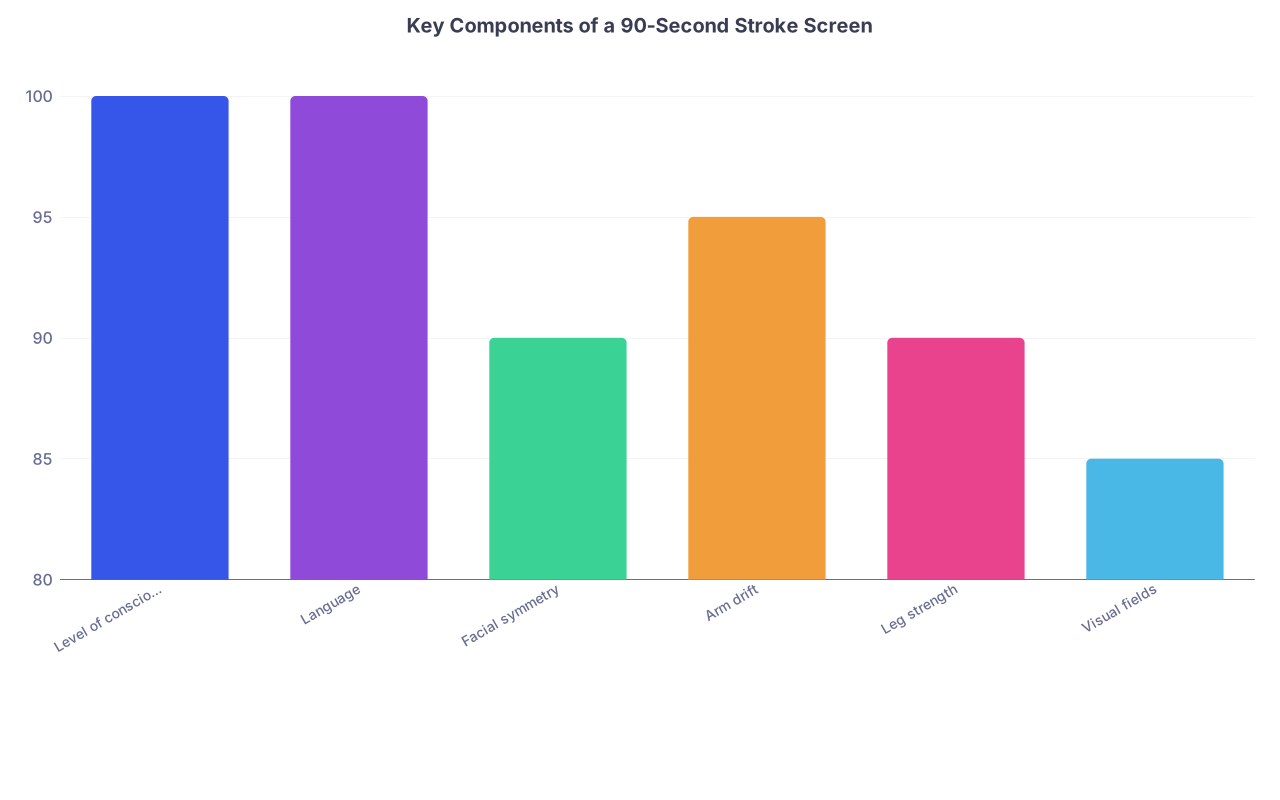
| Category | Value |
|---|---|
| Level of consciousness | 100 |
| Language | 100 |
| Facial symmetry | 90 |
| Arm drift | 95 |
| Leg strength | 90 |
| Visual fields | 85 |
Stepwise structure
Run this in this exact order until it becomes automatic.
Level of consciousness & orientation (10–15 seconds)
- “Can you tell me your full name?”
- “Where are we right now?”
- “What’s today’s date, or at least the month and year?”
You are deciding: awake and participating vs obtunded / comatose vs aphasic vs confused.
Language & speech (15–20 seconds)
You want to separate dysarthria, expressive aphasia, receptive aphasia.- Ask them to follow a simple 1-step command: “Open and close your eyes.”
- Then a 2-step command: “Point to the door, then to the window.”
- Ask them to name simple objects: “What is this?” (watch, pen, bed)
- Brief repetition: “Say: ‘No ifs, ands, or buts.’”
You are looking for:
- Garbled but fluent (dysarthria)
- Word-finding, broken phrases (Broca-type)
- Fluent nonsense with poor comprehension (Wernicke-type)
Facial symmetry (5–10 seconds)
- “Show me your teeth.” Palpable asymmetry?
- “Raise your eyebrows.” Forehead sparing?
- “Squeeze your eyes shut as tight as you can; don’t let me open them.”
Central (UMN) vs peripheral (LMN) facial weakness matters:
- Stroke classically spares the forehead.
- Bell’s palsy wipes out the whole side.
Arm drift (15–20 seconds)
This is your single highest-yield motor screen.- Arms outstretched, palms up, eyes closed, hold for 10 seconds.
- Look for pronation, downward drift, or inability to maintain.
If they cannot cooperate, at least test:
- Shoulder abduction against resistance
- Elbow flexion/extension against resistance
Compare left vs right. Do not accept “weak” without a side.
Leg strength (15–20 seconds)
Quick but specific:- Supine: “Kick out your legs like you’re trying to kick my hands.”
- Or “Lift your leg off the bed and hold it.” Watch for drift back down.
- If sitting: hip flexion and knee extension against resistance.
Visual fields & gaze (10–15 seconds)
- Check for gross gaze preference: “Look at my finger; follow it left and right.”
- Quick confrontation fields: wiggle fingers in each quadrant while they look at your nose.
You want to catch:
- Homonymous hemianopia
- Gaze deviation (suggesting a large hemispheric lesion)
Rapid cerebellar screen if time permits (10–15 seconds)
- Finger-to-nose (one or both sides)
- Heel-to-shin (if able)
- Look for gross ataxia or dysmetria
Total: about 90 seconds if you do not get bogged down.
What you must document
Something like:
A&Ox2 (person, place; not time). Speech fluent, mild dysarthria, follows 2-step commands. Right lower facial droop. RUE with pronator drift, 4/5 shoulder abduction and elbow flexion compared with L 5/5. RLE 4/5 hip flexion; LLE 5/5. No gaze deviation, intact to confrontation in all quadrants. No limb ataxia.
That tells the team: left hemispheric process, motor > language, likely cortical/subcortical.
When you absolutely escalate
If your quick screen shows any of the following in an acute setting:
- New unilateral facial droop
- Clear unilateral drift or weakness (arm or leg)
- New aphasia or severe dysarthria
- New visual field cut or gaze deviation
You do not “watch and wait.” You say, out loud: “This could be a stroke,” and you notify your senior / attending immediately. They can decide code stroke vs urgent CT.
Approach #2: The “Is This Delirium, Global, or Focal?” Mental Status–Weighted Exam
Use this when:
- “Patient seems more confused today.”
- “He was fine this morning, now he is talking weird.”
- “Is this just delirium or something structural?”
Here your job is not to chase every reflex. Your job is to decide:
- Primary encephalopathy / delirium (metabolic, toxic, infectious, meds)
- Versus a superimposed focal lesion (stroke, mass, hemorrhage)
- Versus chronic cognitive baseline (dementia) + something acute
The 3-part structure
Think of this as three stacked layers:
- Consciousness & attention
- Higher cortical function
- Focal neurologic screen
1. Consciousness & attention (this is where most students under-test)
Delirium = inattention + altered awareness.
You must check attention, not just orientation.
Quick tools:
Arousal
- Does the patient open eyes spontaneously? To voice? To pain?
- GCS-style thinking: Eye opening, verbal response, motor response.
Attention tests (pick one, do it consistently)
- Months of the year backwards (“Can you say the months backwards, starting from December?”)
- Digit span: “Repeat these numbers: 7-4-2.” Then longer: “9-3-6-1-8.”
- “Squeeze my hand every time I say the letter A”: read “C A T A R A C T” slowly.
If they cannot sustain simple tasks, you are in delirium/encephalopathy territory.
2. Higher cortical function (60–90 seconds)
You do not need a full MOCA. You need a few probe tasks.
Orientation
- Person, place, time, situation.
- Dementia patients may be chronically poor on time but stable day-to-day. Acute changes are key.
Language and praxis
- Ask for 2-step commands crossing midline: “Take this paper with your right hand, fold it, and put it on the table.”
- Ask them to repeat a phrase.
- Ask them to show how they would use an object (“Show me how you would use a hammer.”) – ideomotor apraxia suggests dominant parietal lesions.
Memory (very brief)
- “I’m going to say three words. Repeat them now, then I’ll ask you again in a minute.” (e.g., apple, table, penny.)
- After your other testing, ask for recall.
Executive function / sequencing (optional but useful)
- “Tell me how you would make a cup of tea.” Look for disorganized thought.
The pattern matters more than the exact tools. Global disturbances with no strict lateralization = think metabolic/toxic/infectious. Focal deficits layered onto confusion = beware structural lesion.
3. Focal neurologic screen
Same skeleton as before, but you streamline.
Must-haves:
- Pupils: size, equality, reactivity
- Extraocular movements: are they conjugate, any gaze preference, nystagmus
- Face: symmetry at rest and with movement
- Arms: pronator drift, gross strength at least proximally
- Legs: at least hip flexion and knee extension against resistance
- Sensation: quick light touch on face, arms, legs (compare left/right)
- Coordination: if they can, finger-to-nose and/or heel-to-shin

| Step | Description |
|---|---|
| Step 1 | Confused patient |
| Step 2 | Assess GCS, consider ICU/neuro consult |
| Step 3 | Check attention |
| Step 4 | Orientation & language |
| Step 5 | Focal neuro screen |
| Step 6 | Think metabolic/toxic/infectious |
| Step 7 | Consider stroke/mass, escalate imaging |
| Step 8 | Arousal adequate? |
| Step 9 | Global vs focal findings |
What to pull out for the team
You want to answer out loud:
- “This looks like global delirium without focal deficits”
- Or “Delirious, but also clear new right-sided weakness”
- Or “Fluctuating attention, but focal findings are unchanged from prior note”
An example note:
Drowsy but arousable to voice. A&Ox1 (self only). Poor attention – unable to recite months backwards beyond ‘December, November, October.’ Follows 1-step commands inconsistently, not 2-step. Speech fluent without aphasia. Pupils 3→2 mm bilaterally, EOMI without gaze deviation. Face symmetric. No pronator drift, strength 5/5 proximally and distally in all extremities. Sensation to light touch intact and symmetric. No limb ataxia. Findings consistent with global encephalopathy without new focal deficit compared with exam from yesterday.
That gives your resident enough to say: probably sepsis/meds/metabolic, not a new stroke, but still needs workup.
Approach #3: The “Where Is the Weakness Coming From?” Localization Exam
Use this when:
- “My legs feel weak.”
- “I can’t walk like I did yesterday.”
- “My hands are tingling.”
- “Back pain with weakness or numbness.”
Your job is not to diagnose “exactly L4-5 herniation.” Your job is to sort central vs peripheral and if central, cord vs brain. And to identify red flags that need urgent imaging.
Think of this as a localization tree
- Is this true weakness or fatigue/pain-limited?
- Is it focal vs diffuse? Symmetric vs asymmetric?
- Are reflexes hyper, hypo, or mixed?
- Is there a sensory level?
- Any sphincter involvement or gait change?
The minimum exam that still localizes
1. Motor testing with intent
Do not write “5/5 throughout” after asking them to barely press against your hand.
Pick specific muscle groups that map to key roots/levels and test them with real resistance.
Upper extremities:
- Shoulder abduction (C5)
- Elbow flexion (C5–6), extension (C7)
- Wrist extension (C6–7)
- Finger abduction or grip (C8–T1)
Lower extremities:
- Hip flexion (L2–3)
- Knee extension (L3–4)
- Dorsiflexion (L4–5)
- Plantarflexion (S1)
Compare left vs right; proximal vs distal.
Patterns:
- Distal > proximal, symmetric → think peripheral neuropathy (e.g., diabetic).
- Proximal > distal → think myopathy or neuromuscular junction.
- Hemibody (face + arm ± leg) → think brain.
- Bilateral legs with a clear cutoff → think spinal cord.
2. Tone and reflexes (this is where you distinguish UMN vs LMN)
Tone:
- Flex and extend the wrist/elbow or ankle/knee passively.
- Spastic “catch” or resistance → upper motor neuron.
- Floppy, low tone → lower motor neuron / acute cord / root.
Reflexes (at least these):
- Biceps (C5–6)
- Triceps (C7–8)
- Patellar (L3–4)
- Achilles (S1)
And yes, Babinski/plantar response in any concerning case.
Patterns:
- Hyperreflexia with Babinski upgoing → UMN lesion (brain or cord).
- Hyporeflexia at a single level → root/nerve lesion at that level.
- Diffusely reduced reflexes → peripheral neuropathy, neuromuscular junction, or myopathy.
| Finding pattern | Likely site of lesion |
|---|---|
| Hyperreflexia + Babinski | Brain or spinal cord (UMN) |
| Asymmetric reflex loss at one level | Nerve root / radiculopathy |
| Distal hyporeflexia, stocking sensory | Peripheral neuropathy |
| Normal reflexes, pure proximal weakness | Myopathy / NMJ |
3. Sensory exam with purpose
You are not doing 20 minutes of pinprick mapping. You are trying to see: Is there a sensory level? Is it length-dependent? Is it dermatomal?
At minimum:
- Light touch (or pinprick if appropriate) on:
- Face (V1/V2/V3)
- Hands (C6–8 region)
- Trunk (check up and down along midline if cord lesion suspected)
- Medial thigh (L2–3), medial leg (L4), lateral leg/foot (L5), sole (S1)
Key concepts:
- “Stocking-glove” pattern → peripheral neuropathy.
- Single dermatome (e.g., lateral thigh + knee only) → radiculopathy.
- Sensory level (everything below umbilicus reduced) → cord lesion at that level or above.
Ask specifically about saddle anesthesia and change in bowel or bladder function if any leg weakness or back pain shows up. Those are not “nice to have” questions; missing them is how you miss cauda equina.
4. Gait and coordination
If they can walk, you learn a huge amount.
- Simple walk across the room: antalgic, spastic (legs stiff, scissoring), ataxic, high-steppage?
- Heel, toe, and tandem walking if safe.
Spastic gait → UMN / cord.
High-steppage, foot drop → peripheral (peroneal neuropathy, L5 root, neuropathy).
Wide-based, staggering → cerebellar or sensory ataxia.
Finger-to-nose and heel-to-shin can help separate cerebellar from weakness.
Pulling it together: a few classic patterns you should recognize instantly
Acute bilateral leg weakness, sensory level at umbilicus, hyperreflexia, Babinski upgoing
→ Think acute spinal cord lesion (e.g., compression, transverse myelitis). Needs urgent MRI and neurosurgery/neuro input.Gradual distal stocking-glove sensory loss, diminished ankle reflexes, preserved strength until late
→ Peripheral neuropathy (e.g., diabetic). Not an emergency, but very different workup.Unilateral arm + leg weakness, spastic tone, hyperreflexic on that side, maybe facial involvement
→ Brain lesion (stroke, mass). Imaging brain, not just spine.Back pain, leg weakness worse with Valsalva, dermatomal sensory loss, reduced reflex at that single level
→ Radiculopathy. Cord probably spared; MRI focused on level, but not as emergent unless red flags.
Example documentation:
Reports difficulty walking for 2 days with numbness from umbilicus down. On exam, strength 5/5 in BUE, 3–4/5 in BLE (hip flexion L 3/5, R 3/5; knee extension 4/5 bilaterally; dorsiflexion 4/5 bilaterally). Increased tone in BLE, mild spasticity with passive movement. Patellar and Achilles reflexes 3+ bilaterally with upgoing plantar responses. Sensation to pinprick intact in upper extremities and trunk to approximately T10, diminished below. Reports decreased perianal sensation and difficulty initiating urination. Gait not assessed due to weakness. Concerning for acute thoracic spinal cord process; recommend urgent MRI T-spine and neurology/neurosurgery consult.
That is an exam your attending will respect. It localizes and it justifies urgency.
How to actually use these on busy rotations
You do not need to invent a new neuro exam each time. You need to pick the right template and run it cleanly.
Use case mapping
“New facial droop,” “weak arm,” “slurred speech”
→ Approach #1 (90-second stroke exam) + page senior if positive.“More confused,” “pulling IVs,” “not making sense”
→ Approach #2 (delirium/global vs focal). Emphasize attention, orientation, global vs focal deficits.“Can’t walk,” “legs feel weak,” “my hands are numb”
→ Approach #3 (localization: brain vs cord vs root vs peripheral).
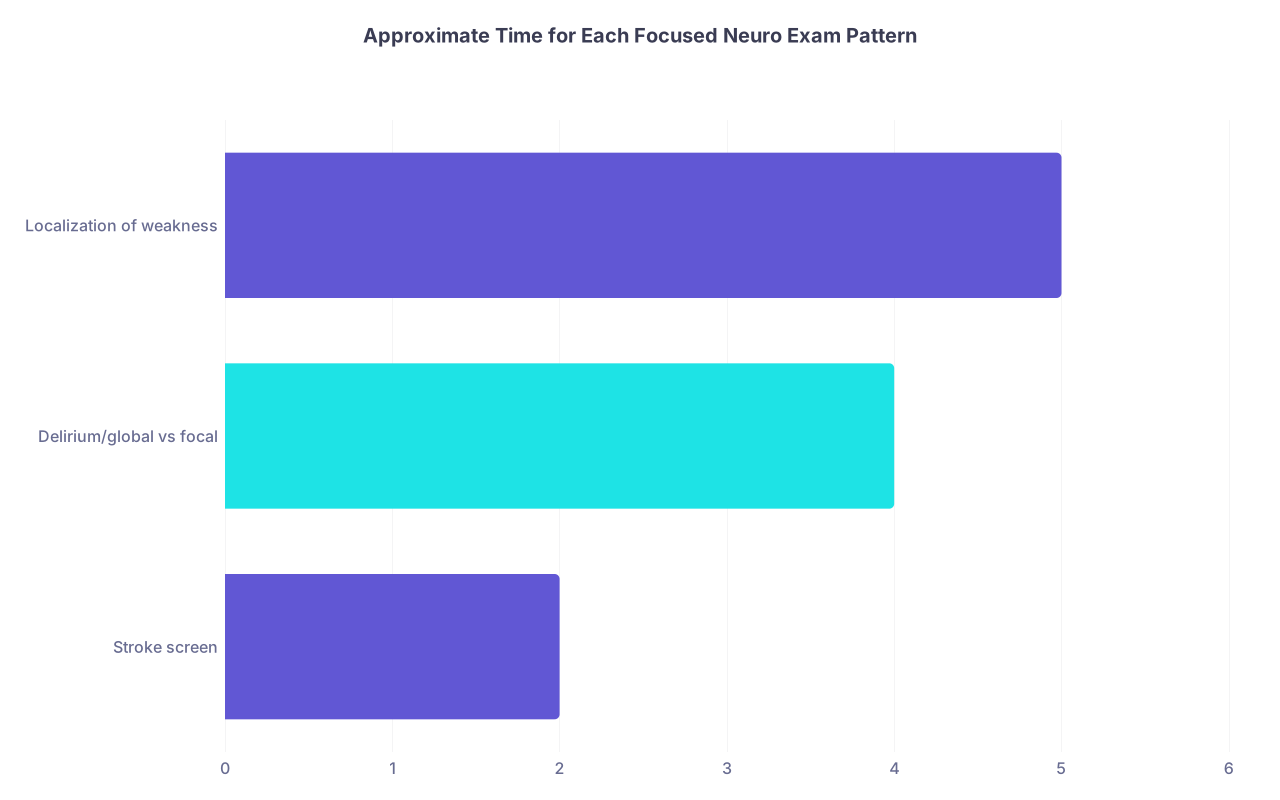
| Category | Value |
|---|---|
| Stroke screen | 2 |
| Delirium/global vs focal | 4 |
| Localization of weakness | 5 |
(Those are minutes, by the way, if you are efficient.)
A few habits that separate competent from forgettable
- Say what you are doing out loud. “I’m going to check your strength and sensation on both sides to see if this is a stroke.” Families like hearing there is a plan.
- Anchor your exam to the chart. Read the last neuro note and consciously confirm or refute each listed deficit.
- Re-exam patients with concerning findings. “Stable neuro exam” every few hours in a suspected stroke or cord patient means something specific, not just “I looked at them from the doorway.”
Two or three things to actually remember
- You do not “do a neuro exam.” You answer a specific neuro question using a consistent skeleton: mental status, cranial nerves, motor, sensory, coordination, gait.
- The three high-yield patterns to drill into muscle memory are:
- A 90-second stroke-oriented screen
- A mental-status–heavy delirium vs focal exam
- A localization-focused weakness exam that separates brain, cord, root, and nerve
- Document like the next person will be comparing your exam at 3 a.m.: side-by-side strength, specific tasks (“no pronator drift”), and clear global vs focal conclusions.