

The old mantra “first in, last out” is outdated—and in some settings, it actively backfires.
There was a time when being the zombie who showed up at 4:30 a.m. and slunk out at 9 p.m. did signal something: commitment, grit, willingness to suffer. Now? Many attendings and residents see it as naïve at best and low-yield performative hustle at worst.
Let me be very clear: clinical grades are not a simple function of hours you spend in the building. The students who crush rotations in 2024 are not just staying the longest. They’re doing something much more specific—and measurable.
You are being evaluated in a system with rubrics, duty-hour awareness, learner wellness initiatives, and residents who are themselves being graded on how they teach you. “Staying late” without purpose is a mythic strategy left over from a different era of medicine.
Let’s dismantle it and replace it with what actually moves your evaluations.
Where “First In, Last Out” Came From (And Why It’s Cracking)
The phrase comes from a pre-duty-hours culture where medicine was a hierarchy of suffering. The longer you stayed, the more serious you looked. Nobody tracked anything; documentation standards were lower; “education” meant “stand in the back and watch.”
Some attendings trained in that era still talk like this:
“If you’re not there early, you don’t care.”
“Students should be the first ones here, last to leave.”
But look at how the environment has actually changed:
- Work-hour reforms for residents → explicit attention to overwork and fatigue
- LCME and ACGME emphasis on “learning environment” → abuse and over-exploitation are taken more seriously
- Grading rubrics → concrete behaviors matter more than vague impressions
- EMR and metrics → your notes, orders, and task completion are timestamped
The culture still talks like it values martyrdom. The systems increasingly do not.
Here’s what the data and real rubrics show: you’re graded on reliability, initiative, teamwork, ownership of patients, communication, professionalism, and clinical reasoning. Hours on the clock modify these—because you can’t show judgment if you never show up—but the relationship is not linear.
After a certain point, more hours stop helping and start making you dull, unfocused, and frankly annoying.
What Evaluation Forms Actually Measure (Not What People Say)
I’ve seen dozens of clerkship evaluation forms across multiple schools. They all sound different, but underneath they’re basically measuring the same domains.
Here’s a simplified snapshot:
| Domain | What Residents/Attendings Actually Notice Most |
|---|---|
| Reliability | On time, present when needed, follows through |
| Initiative | Sees work, volunteers, starts before being told |
| Teamwork | Helps the resident, nurses, other students |
| Clinical Reasoning | Organized presentations, sensible plans |
| Communication | Clear, concise, appropriate escalation |
| Professionalism | Respectful, honest, no drama, no excuses |
Notice what’s missing? “Stays later than everyone else.”
Instead, evaluators look for whether you:
- Are there at the right critical times: pre-rounding, rounds, sign-out, key admissions, OR cases, family meetings.
- Are actually useful when you’re there: writing notes that don’t need to be completely rewritten, calling consults appropriately, updating families, teeing things up for your resident.
If you vanish right after rounds every day, yes, that will hurt you. If you consistently disappear when work ramps up, people will notice. But the high performers aren’t just warm bodies until 9 p.m. They are strategically present when it matters.
This is the piece students often miss. Rotations do not reward maximum presence; they reward timed presence coupled with high-yield contribution.
The Diminishing Returns of Staying Late
Let’s put some numbers to this instead of hand-waving.
Imagine two students on an inpatient medicine rotation:
- Student A: 5:30 a.m.–7:30 p.m. (14 hours)
- Student B: 6:30 a.m.–5:00 p.m. (10.5 hours)
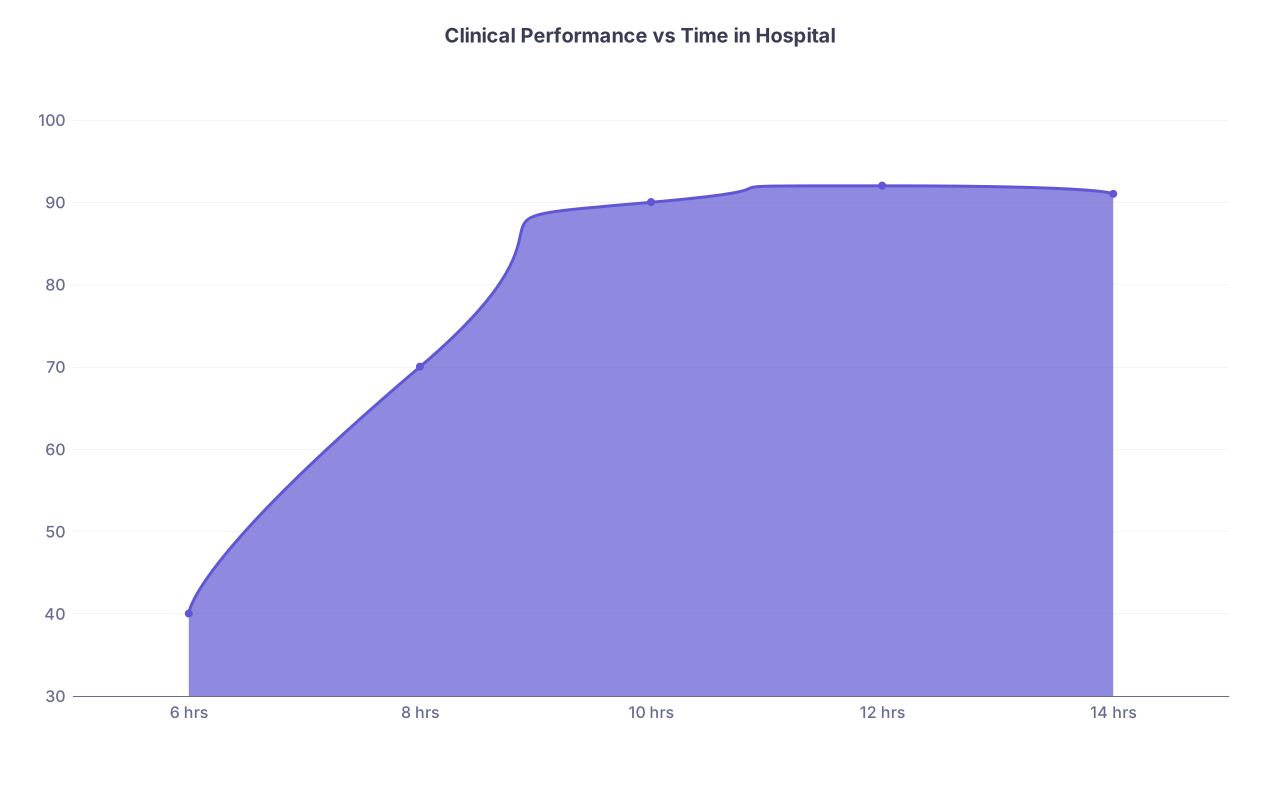
Assume both are present for rounds, new admits, and sign-out. Who gets the honors evaluation? It’s not decided by 3.5 extra hours.
| Category | Value |
|---|---|
| 6 hrs | 40 |
| 8 hrs | 70 |
| 10 hrs | 90 |
| 12 hrs | 92 |
| 14 hrs | 91 |
You see the curve: performance (however you define it—evaluations, trust from the team, actual learning) rockets up once you’re reliably around for key activities. Then it plateaus. Push beyond that, and fatigue chips away at your effectiveness.
When you’re exhausted:
- Your presentations get rambling and disorganized.
- You miss abnormal vitals and labs in the chaos.
- You need your resident to correct you more.
- You look less “eager” and more “checked out.”
Residents pick up on this faster than you think. The classic line: “Yeah, they’re here a lot, but I can’t trust their assessment and plan.” That person does not get honors.
So no, being the last one out every single night does not keep boosting your grade. After a certain point it’s just unpaid, uncredited overtime that degrades your performance.
What Modern Rotations Actually Reward
Let’s talk about what reliably moves your evaluation from “Meets expectations” to “Exceeds expectations” in 2024.
1. Consistent, Predictable Presence at Critical Moments
You don’t need to live in the hospital. You do need to be someone the team can count on being there when they need you.
That means:
- Pre-rounding thoroughly enough that your presentations help your resident, not slow them down.
- Being in the workroom when your resident is triaging new admissions or planning discharges.
- Being at sign-out on services where students are expected to attend.
- Staying if there’s an active, important situation you’re involved in: a sick patient, family meeting, code, or complicated admission you’ve been following.
The question residents subconsciously ask is: “If I assign this task to you, will I find you 20 minutes later when I need the result?” If the answer is yes all the time, you’re already ahead of half your class.
2. Useful Ownership, Not Passive Hanging Around
This is the piece the “first in, last out” myth gets totally wrong. They assume being physically present equals “showing ownership.” It doesn’t.
Ownership looks like:
- Knowing your patients better than anyone else on the team.
- Anticipating what needs to happen before you’re told (med rec, pending labs, consult follow-up).
- Updating the team on changes without being asked.
- Carrying tasks to completion and circling back with results.
I’ve seen students who showed up “late” by old standards—6:45 a.m. instead of 5:30—but by 8:00 they had a full handle on their patients, overnight events, new labs, imaging, and had a preliminary plan drafted. Residents love those students.
I’ve also seen students who clocked 14-hour days and still couldn’t give a tight one-liner.
Guess which one gets the “outstanding ownership of patients” comment.
Specialty Differences: Where Hours Still Signal Something
Now, I’m not going to pretend all specialties have evolved equally. Surgery and some surgical subspecialties still put outsized weight on “face time.” But even there, it’s more nuanced than “stay until the attending leaves every day.”
On surgery, what’s rewarded is often:
- Being ready for early cases: knowing the anatomy, steps, indications, having read the op note from prior cases.
- Helping move the day: seeing consults quickly, helping in PACU, getting post-op orders ready, writing H&Ps.
- Being in the OR for key or complex cases, not just every random hernia at 7 p.m. when your attending has no idea why you’re still in the building.
And crucially, surgical expectations tend to be front-loaded into mornings and OR days. If you’re still standing uselessly in the corner of a near-empty workroom at 8:30 p.m. after your resident has told you “you can go whenever,” you’re not scoring secret bonus points.
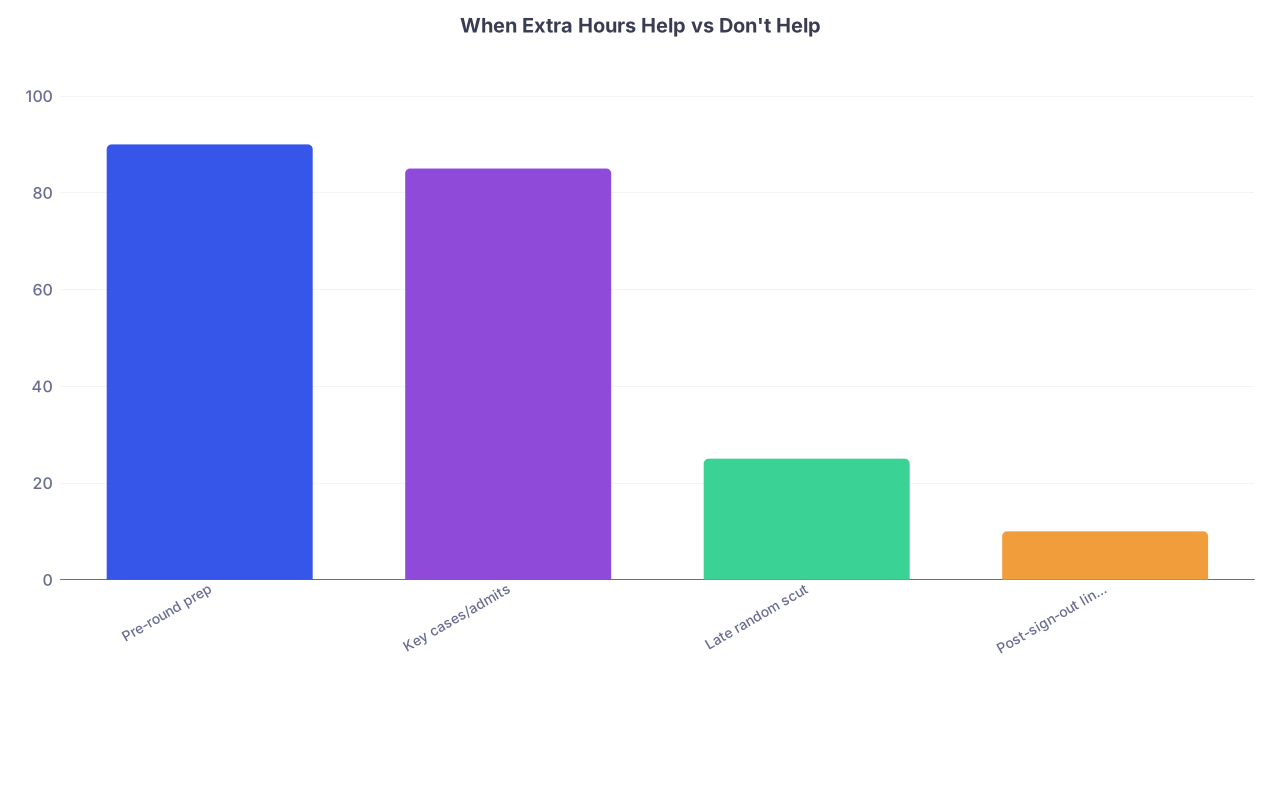
If you want something more concrete, here’s a rough sense of when “extra time” tends to pay off and when it usually doesn’t:
| Category | Value |
|---|---|
| Pre-round prep | 90 |
| Key cases/admits | 85 |
| Late random scut | 25 |
| Post-sign-out lingering | 10 |
The numbers are illustrative, but the pattern is real: front-loaded, focused extra time has massive payoff. End-of-day hanging around barely moves the needle.
How to Be High-Yield Without Burning Yourself Out
So if “first in, last out” is a myth, what should you actually do? Here’s the reality-based version.
Strategically Early, Not Masochistically Early
Arrive early enough to:
- Review overnight events and vitals.
- Look at labs and imaging.
- See and examine your patients.
- Draft your assessment and plan.
For most inpatient rotations, that’s 60–90 minutes before meet time, not 3 hours. If your team meets at 7:00, being there at 4:30 just to impress someone is a terrible trade unless you know what you’re doing with that extra time.
If you routinely show up so early that you’re exhausted by 3 p.m., you’re doing it wrong.
Decide Consciously When to Stay Late
Ask yourself three questions before you reflexively stay:
- Is there meaningful work I can own if I stay?
- Will someone on the team actually notice and benefit from me being here?
- Am I still functioning well enough that this extra time will help, not hurt, my learning and performance tomorrow?
If the answer is “yes” to 1 and 2, and at least a soft yes to 3, stay.
If the answer is “no” to most of them, go home, read, and sleep. That’s not laziness. That’s performance optimization.
How To Signal Commitment Without Worshiping Hours
The hidden fear behind “first in, last out” is: “If I’m not here all the time, they’ll think I don’t care.”
You can crush that fear with clear, simple behaviors that signal commitment without martyrdom.
Things like:
- Tell your resident at the start of the rotation: “I’m trying to learn how to be most useful. If there are times you think it’s high-yield—or not worth me staying—please just tell me directly. I’m here to work hard, but I also don’t want to be in the way.”
- Before leaving each day: “Anything else I can help with before I head out? Any follow-up I should check on tonight or first thing tomorrow?”
- When a big case or family meeting is scheduled late: “If you think it’d be helpful, I’m happy to stay for that.” Then actually stay, take notes, and be ready to discuss.
Those sentences do more to convey seriousness than an extra three hours of silent wall-staring in the workroom.
Where Students Go Wrong With This Myth
I’ve watched a depressingly predictable pattern:
Student clings to “first in, last out” → overextends → sleep-deprived → starts missing details → residents stop trusting their work → eval talks about “hard-working but disorganized” → student is confused because “I was there all the time.”
The problem isn’t that they didn’t work hard. It’s that they optimized for the wrong variable. Time instead of impact.
The students who look like rockstars tend to:
- Be very awake and sharp during the core of the team’s workday.
- Beat tasks’ deadlines by hours, not minutes.
- Handle their patients so well that the intern half-jokes about stealing them as a sub-I.
- Ask targeted questions instead of panicked, vague ones.
- Leave at a reasonable hour most days, and stay late selectively for high-yield events.
They don’t wear their hours like a badge. If anything, they look almost too calm. That’s the punchline: the more skilled and efficient you are, the less you need heroic quantities of time to prove it.
The Bottom Line: Be Measured, Not Martyr’d
The old dogma says: “First in, last out. That’s how you show dedication.”
The modern reality says: “Be reliably there, be truly useful, and know when to go home.”
Evaluations now reward consistency, initiative, teamwork, and ownership far more than mindless presence. Residents and attendings are busy; they remember the student who made their day run smoother, not the one who silently sat in the corner until 9 p.m.
So do not ask, “How long should I stay?” Ask, “What can I do in the time I’m here that actually matters for my patients, my team, and my learning?”
Years from now, you won’t look back proudly on the nights you stayed just to stare at a blank Epic screen; you’ll remember the times you chose to be present for something meaningful—and the discipline to walk out when you’d already done your best work.


