
The idea that you must know every patient on your team “cold” is wrong—and trying to do it will actually make you worse on rotations, not better.
Let me be blunt: the med student who can rattle off every lab from the past 7 days but cannot prioritize problems, communicate clearly, or recognize a crashing patient is not impressive. They’re a liability with a good memory.
You do not need to know every patient cold.
You need to know a few patients very well, most patients well enough, and your role on the team even better.
Let’s tear down the myth and replace it with something that actually makes you a good clinician—and yes, a well-evaluated student.
The Myth: “Real Gunners Know Every Patient Cold”
You’ve heard this on day one of rotations:
- “Know every patient on the team like they’re your own.”
- “Be ready to present anyone if called on.”
- “Good students know the entire list.”
This sounds noble. It’s also impossible on many services and totally disconnected from how real teams function.
On a busy medicine service with 18–25 patients, or an ICU with 12 complex admits, even the attending doesn’t know every single lab and vital trend cold. They know:
- Which patients are unstable
- Who is at a decision point (surgery vs no surgery, transfer vs floor, discharge vs stay)
- What the major active problems are
- What changed overnight
They’re not memorizing yesterday’s phosphate.
What actually happens when students chase this “know-everyone-cold” fantasy?
- They spend hours pre-rounding on patients they are not writing notes on and will never present.
- They stay late for the sake of “coverage” that is already handled by residents.
- They memorize noise instead of understanding signal.
And then they burn out, get slower, and miss the big picture.
What the Data and Evaluations Actually Reward
Let’s talk evidence.
No, there’s not an RCT of “students who memorize every creatinine” vs “students who don’t.” But there is plenty of data and documentation on what actually predicts strong clinical evaluations and eventual performance.
Here’s what multiple studies and clerkship evaluation rubrics consistently emphasize:
- Clinical reasoning and problem prioritization
- Communication with patients, nurses, and team
- Reliability and follow-through
- Ability to synthesize data into an assessment and plan
- Professionalism and teamwork
Notice what’s missing: “Can recite all lab values on all patients without looking.”
A few examples:
- Studies of clerkship evaluations repeatedly show that subjective “global ratings” correlate most with perceived work ethic, communication, and professionalism—not raw knowledge recall.
- A JAMA study on resident performance showed that early clinical reasoning skills and teamwork behaviors predicted later performance better than test scores alone.
- When programs describe “top 10% students,” they talk about ownership, anticipation of next steps, closed-loop communication. Not “never once looked anything up on Epic.”
On top of that, every standardized assessment of clinical skills we actually value (OSCEs, Step 2 CS back in the day, now school-based clinical performance exams) tests:
- Focused data gathering
- Organization
- Clear explanation of next steps
Again, not encyclopedic recall of the entire census.
So the myth that you “have to know everyone cold” is not just stressful. It’s misaligned with how you’re actually graded and how you’ll practice as a doctor.
What You Should Know Cold (And What You Should Not)
Let’s separate reality from bravado.
You should know these patients cold:
Every patient you are:
- Writing notes on
- Presenting on rounds
- Following day-to-day as “your” patients
Any truly sick or high-risk patient on the service where:
- The resident has explicitly told you: “Keep a close eye on this one.”
- There’s a major decision pending (ICU transfer, going to OR, thrombolytics, end-of-life discussions, etc.)
For those patients, yes—know them like you’re about to take Step 2 and get pimped by God.
That means:
- Their chief complaint and why they’re here (in one clear sentence)
- Relevant history and comorbidities that change management
- Current active problems (3–5 max) and your prioritized list
- Today’s key vitals, labs, imaging, and how they changed from yesterday
- The plan for each problem and why
You don’t need 48-hour fluid balances down to the milliliter. You need to know what matters today.
For the rest of the list?
You need a working map, not a detailed atlas:
- Who is here for what (diagnosis-level: “COPD exacerbation,” “DKA resolved now on basal-bolus,” “post-op day 2 after colectomy”)
- Who is unstable or at risk
- Major “don’t-miss” things (anticoagulated trauma patient, neutropenic fever, chest pain rule-out)
Trying to memorize all of it is performative, not productive.
Here’s the difference in practical terms:
| Category | Know Cold | Know Lightly |
|---|---|---|
| Your assigned patients | Yes | N/A |
| Critically ill patients | Yes | N/A |
| Stable floor patients | No | General diagnosis + status |
| Pre-op/post-op others | No | Procedure + basic course |
| Discharges same day | Only if yours | Basic reason and disposition |
What Actually Makes You Look Strong on Rounds
I’ve watched this play out on medicine, surgery, ICU, OB, peds—same pattern every time.
The “knows-everyone-cold” student often:
- Gives long, unfocused presentations loaded with trivia
- Can’t prioritize problems
- Fumbles when asked, “Okay, what’s your plan?”
The high-performing student:
- Knows their patients deeply
- Has a crisp, 1–2 sentence summary for each
- States a clear, prioritized assessment and plan
- Asks targeted, non-dumb questions
Let me give you a realistic template.
For your own patients, you should be able to say—without looking:
- “Mr. X is a 64-year-old with COPD and CAD admitted for a COPD exacerbation, now improving on day 3 of steroids and nebs, still requiring 2 L oxygen but down from 4 L.”
- Active problems:
- COPD exacerbation – trending better: decreased wheezing, improved sats, weaning O2 slowly; on day 3 of steroids and scheduled nebs.
- Possible pneumonia – afebrile, WBC down from 15 to 10, cultures pending, on ceftriaxone and azithro.
- CAD/HTN – home meds resumed, BPs in 120s/70s, no chest pain.
- Plan highlights:
- Wean oxygen as tolerated, goal sats 88–92%.
- Reassess steroid duration tomorrow based on exam and sats.
- De-escalate antibiotics if cultures negative at 48 hours.
No fluff. No lab-dump. You can then pull exact labs from the chart if needed.
The attendings who are actually good at teaching will respect that.
For patients who are not “yours,” you should be able to say:
- “He’s our DKA patient from two days ago, now closed anion gap, transitioned to subQ insulin, stable on the floor.”
- “She’s the post-op day 1 cholecystectomy, doing well, tolerating clears, pain controlled.”
If someone asks, “What were her vitals overnight?” you’re allowed to say:
“I don’t have those memorized, but I can pull them up.”
Then you do. Quickly.
That is how real doctors practice. They don’t pretend to memorize everything; they know what to check.
The Opportunity Cost Problem: What You Lose Chasing “Know Everyone Cold”
You have limited cognitive bandwidth. I don’t care how “gunner” you are.
Every minute you waste memorizing lab minutiae for someone else’s stable diverticulitis admission is a minute you’re not spending on:
- Reading UpToDate on your actual patient’s new diagnosis
- Understanding ventilator settings for the intubated patient you’re following
- Practicing a clean, structured oral presentation
- Reviewing high-yield clinical reasoning topics that actually show up on NBME shelf exams
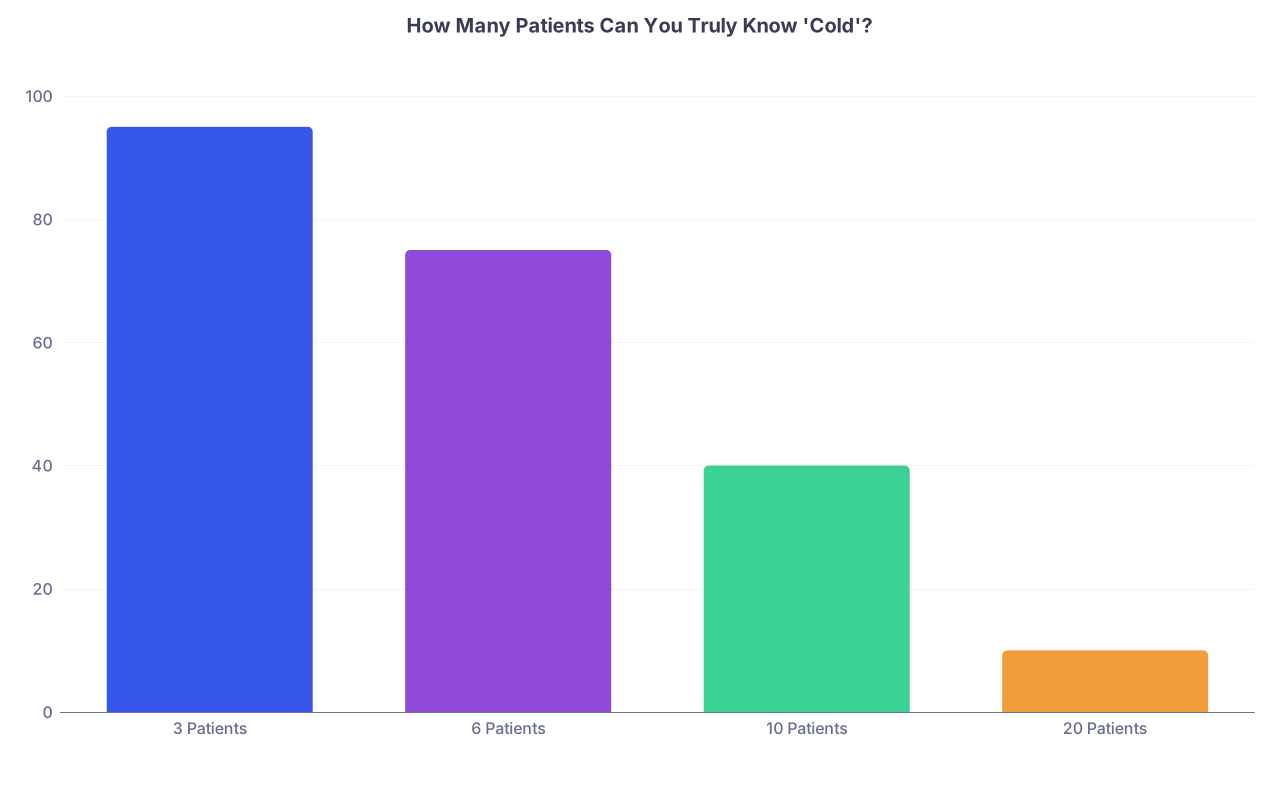
Let me show you this another way:
| Category | Value |
|---|---|
| 3 Patients | 95 |
| 6 Patients | 75 |
| 10 Patients | 40 |
| 20 Patients | 10 |
Interpretation (not statistically perfect, but true in spirit): once you get past 6–8 patients, the probability that you’re actually sharp, analytical, and detailed on each one tanks. You’re just spreading yourself thinner and thinner.
Strong students protect their bandwidth.
They intentionally choose depth over fake breadth: “I’m going to know these 3–5 patients like I’m the intern. Everyone else, I’ll know at a functional level.”
Residents notice this. They trust you more when you handle a few patients with true ownership rather than “kinda-knowing” the whole board.
So What Actually Matters Instead?
Let’s step back and be brutally clear.
On clinical rotations, what matters most (for learning, evaluation, and future competence) is:
- Ownership of your assigned patients
- Clinical reasoning and prioritization
- Communication and teamwork
- Reliability and follow-through
Not omniscience.
1. Ownership of your assigned patients
If your resident ever has to say, “Wait, how did you not know that your patient spiked a fever overnight?”—you’re in trouble.
But if they ask about a random patient not on your list and you honestly say, “That’s not one I’m following, but I can check,” that’s fine.
You show ownership by:
- Knowing overnight events and new results for your patients before rounds
- Updating the team proactively: “By the way, Ms. Y’s creatinine bumped from 1.0 to 1.4 this morning; I’ve held her lisinopril and ordered a bladder scan.”
- Anticipating needs: ordering morning labs, follow-up imaging, PT/OT consults without needing to be chased
That’s what interns do. Do that as a student and your evaluation writes itself.
2. Clinical reasoning and prioritization
Students obsess over recall because it’s visible. But your reasoning is what sets you apart.
On rounds, this sounds like:
- “His white count is up from 9 to 14, and he’s more tachycardic. I’m concerned about worsening sepsis vs steroid effect. I’d like to repeat lactate, broaden cultures, and reassess his exam after a fluid bolus.”
That is infinitely more impressive than:
“He had 2 L of urine output and his potassium is 3.7 and his calcium is 8.6 and…”
Use your brain for thinking, not for being a walking lab sheet.
3. Communication and teamwork
Residents and attendings remember how easy—or painful—it was to work with you.
You stand out by:
- Giving tight, structured presentations that don’t waste everyone’s time
- Communicating with nurses: “We’re planning to start heparin, I’ll put in the order; can you page us if she has any new bleeding?”
- Clarifying expectations: “I’m following these four patients today, and I’ll sign out any major updates before I leave.”
I’ve literally seen students with average medical knowledge get honors purely because teams loved working with them and trusted them.
4. Reliability and follow-through
If you say, “I’ll follow up the CT and let you know,” you’d better follow up the CT and let them know.
This is not glamorous. It’s not “gunner” energy. It is, however, real-doctor energy.
A Smarter Way to Prepare for Rounds
You want a workable system? Here’s one.

| Step | Description |
|---|---|
| Step 1 | Start Pre-rounding |
| Step 2 | Check your patients first |
| Step 3 | Overnight events, vitals, I/O |
| Step 4 | Targeted exam |
| Step 5 | Update assessment & plan |
| Step 6 | Skim rest of census |
| Step 7 | Identify unstable/high-risk patients |
| Step 8 | Have 1-line summary for others |
| Step 9 | Prepare presentations |
| Step 10 | Join Rounds |
Notice the order. Your patients first. Then the global list.
You are not the human backup for Epic.
Also: use the EHR in real time on rounds. This is not a memory contest. It’s normal on most services for students and residents to have the chart open on their phone or workstation-on-wheels checking details.
The key is: have the story and plan in your head. Use the chart for the exact numbers.
Where This Myth Comes From (And Why People Keep Repeating It)
A lot of the “know everyone cold” dogma is cultural, not rational.
It comes from:
- Older training eras with fewer patients and longer stays
- War stories from residents trying to sound hardcore
- Attendings who confuse “suffering” with “learning”
Medicine loves romanticizing overwork. Students absorb the message: the more miserable and overloaded you are, the more dedicated you must be.
That’s not rigor. It’s just inefficiency with a halo.
I’ve seen the same attending complain that “students don’t know all the patients anymore” while they themselves are looking up half the data on their phone during rounds.
So here’s the reality check:
Modern medicine is complex. EHRs exist. Cognitive load is real. Good clinicians know how to manage information, not hoard it in their frontal lobe.
How This Plays With Shelf Exams and Step 2
Quick point, since your phase is “medical school life and exams” and not just “impress the attending.”
Trying to memorize every detail of every hospitalized patient is a terrible strategy for exam prep.
Shelf and Step-style questions reward:
- Pattern recognition (“this is classic CHF exacerbation vs COPD vs pneumonia”)
- Understanding workup and management priorities
- Knowing when to admit, escalate care, or change therapy
Those skills come from:
- Seeing a moderate number of cases in depth
- Reading targeted, high-yield resources on your patients’ conditions
- Reflecting: “If this were a test question, what are they asking? Most likely diagnosis? Best next step? Most appropriate long-term management?”
Not from being a human census database.
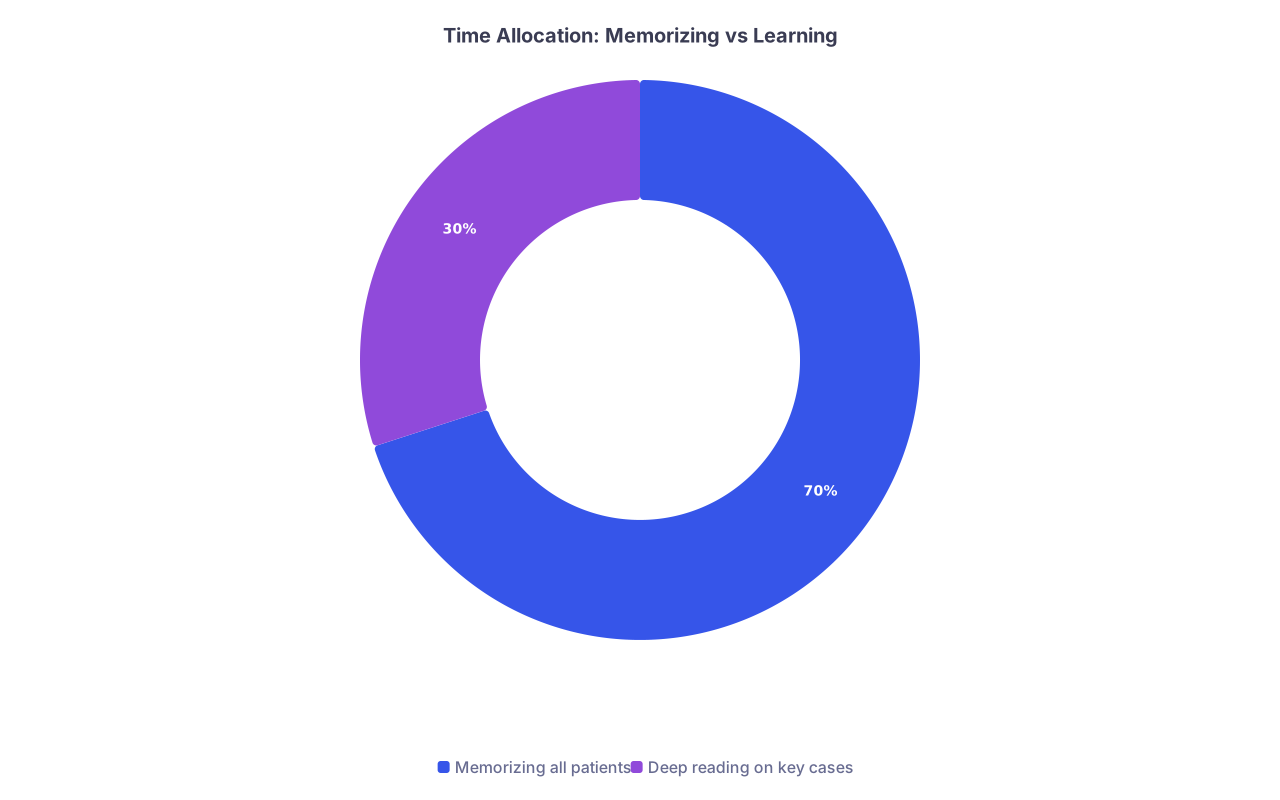
If you reallocated even one hour a day from “extra pre-rounding on everyone” to “focused reading on 1–2 key diagnoses” you would see the difference in your shelf scores.
| Category | Value |
|---|---|
| Memorizing all patients | 70 |
| Deep reading on key cases | 30 |
Most students are in the 70/30 range above during their first clerkship. The strong ones end up closer to 30/70 by the end of third year.
How to Implement This Without Looking Lazy
You might worry: “If I don’t try to know everyone cold, won’t I look disengaged?”
Not if you handle it like an adult.
At the start of the rotation, clarify:
“Which patients would you like me to follow primarily and present on?”Show up prepared on those patients. Every day. No excuses.
When other patients come up, have:
- A 1-line summary ready if they’re on your team’s service
- The chart open and willingness to quickly pull details if asked
Frame your bandwidth properly:
“I’m following these five patients closely and have done some extra reading on their conditions. I’ve also looked over the rest of the census so I have a general idea of their issues.”
This signals: “I’m thoughtful about my workload, not checked out.”
Residents hate two types of students:
- The “I know nothing about anyone” ghost
- The “I’m crushed because I decided to memorize everything” martyr
They like: the reliable, strategically engaged human being.
FAQs
1. What if my attending explicitly says “You should know every patient on the list”?
Then you adapt—but intelligently. Focus on 1–2 sentence summaries and key issues for non-assigned patients, not full H&Ps. And still prioritize depth on your own patients. If they quiz you, say: “I know the overview; I can pull the exact numbers.” Most will accept that.
2. Will not knowing every lab result hurt my evaluation?
No, unless it reflects poor ownership of your patients. Evaluations tank because students don’t know their own patients’ overnight events or can’t explain the plan. Nobody writes, “Student did not have every chloride memorized.”
3. Is it different on smaller services like psych or heme-onc consults?
Yes, somewhat. If there are only 4–6 patients total, the expectation that you know everyone well is more reasonable. But even then, prioritize understanding the reasoning behind diagnoses and management over memorizing raw data.
4. How do I balance helping the team with not overextending myself?
Volunteer for concrete tasks: “I can call the family and update them,” “I’ll follow up the CT and page you with the result,” “I’ll write the discharge summary draft.” That helps the team more than pretending to know every patient cold and doing nothing actionable.
5. What’s one habit I can start tomorrow to improve fast?
Every day after rounds, pick one of your patients and spend 20–30 minutes reading up on their main problem using a reliable source (UpToDate, a solid clerkship book). Tie what you read directly to their labs, imaging, and plan. That single habit will do more for your learning and evaluations than another hour of zombie pre-rounding on people you barely follow.
Key points:
- You do not need to know every patient cold; you must know your patients cold and the rest at a functional level.
- Clinical reasoning, ownership, communication, and reliability drive evaluations and real-world competence—not encyclopedic recall.
- Protect your bandwidth: choose depth on a few patients over fake breadth on everyone, and you’ll learn more, score higher, and look stronger on the wards.