
The “gunner” myth survives because students keep believing the wrong people are winning.
On the wards, it looks like the loudest, most performative student is on top. The one blurting answers on rounds, hoarding procedures, hovering over the attending. You know exactly who I mean. And if you’re not careful, you start thinking: Maybe I have to be like that to get honors. Maybe being a real team player is naïve.
That’s wrong. And not just morally wrong—factually, strategically wrong.
If you look at what actually drives clinical grades, honors rates, and letters, the “gun-gunner” strategy is a losing move in most modern academic hospitals. Programs are explicitly grading you on teamwork, professionalism, and how safe you are to work with. Meanwhile, students keep optimizing for “impressing” in the most superficial, 1990s-television-doctor way possible.
Let’s dismantle this.
What “Gunner” Behavior Really Signals to Residents and Attendings
Let me be blunt: most residents can spot a gunner in under 48 hours. And they roll their eyes.
I’ve heard exact phrases like:
- “I can’t trust them alone with a patient.”
- “They’re more focused on looking smart than being useful.”
- “I wouldn’t want them as an intern.”
Those comments don’t come from jealousy. They come from cognitive load and risk. Residents are drowning in tasks and documentation. Their question is not “Who knows the most rare facts?” It is: “Who makes my life easier, not harder, while being safe?”
Typical “gunner” patterns they’ll recognize:
- Answering questions you clearly looked up 30 seconds ago, pretending it’s long-term knowledge.
- Correcting classmates in front of patients.
- Grabbing the admission H&P or procedure before asking, “Who’s free?”, then vanishing for three hours.
- Presenting like a fellowship-bound subspecialist while missing basic follow-up tasks.
- Volunteering for everything, then half-finishing half of it.
On paper, that sounds like “eager and engaged.” In practice, it reads as:
- Poor situational awareness
- Low reliability
- Threat to team cohesion
- Potential threat to patient safety
Residents won’t say all of that to your face. They’ll say it quietly, on evaluations and in letter-writing season.
Meanwhile, the student you barely notice—who quietly updates the med list, calls the outside pharmacy, and double-checks that the CT is really ordered—is the one they rave about. Because that student is behaving like a safe, low-drama intern.
And that is what they’re actually grading you on.
What the Data and Evaluations Actually Reward
Let’s talk evidence instead of vibes.
Most major schools now use standardized clinical evaluation forms. I have seen many of them: UCSF, Michigan, Penn, Harvard, mid-tier state schools, community programs. They are all converging on the same domains.
Typical domains that appear again and again:
- Clinical reasoning and knowledge
- Reliability / ownership of patient care
- Communication with patients and team
- Professionalism and integrity
- Teamwork and systems-based practice
Notice what’s missing?
“Most likely to interrupt three times on rounds with random journal articles.”
Even more damning for the gunner myth: a lot of schools now have explicit behavior anchors that punish classic gunner behavior.
Things like:
- “Frequently interrupts or dominates team discussions” → below expectations for teamwork.
- “Puts personal recognition above team function” → concern for professionalism.
- “Does not accept feedback or becomes defensive” → concern for growth and safety.
So when you think, “They’re so extra, but somehow they’ll probably get honors,” you’re usually wrong. That student might crush one attending who loves the show, but tank with the resident team and the other attendings. Their evaluations end up wildly variable.
The quiet, reliable team player? Their evaluations tend to be consistently strong across multiple evaluators. And consistency is what pushes you above the honors cutoff.
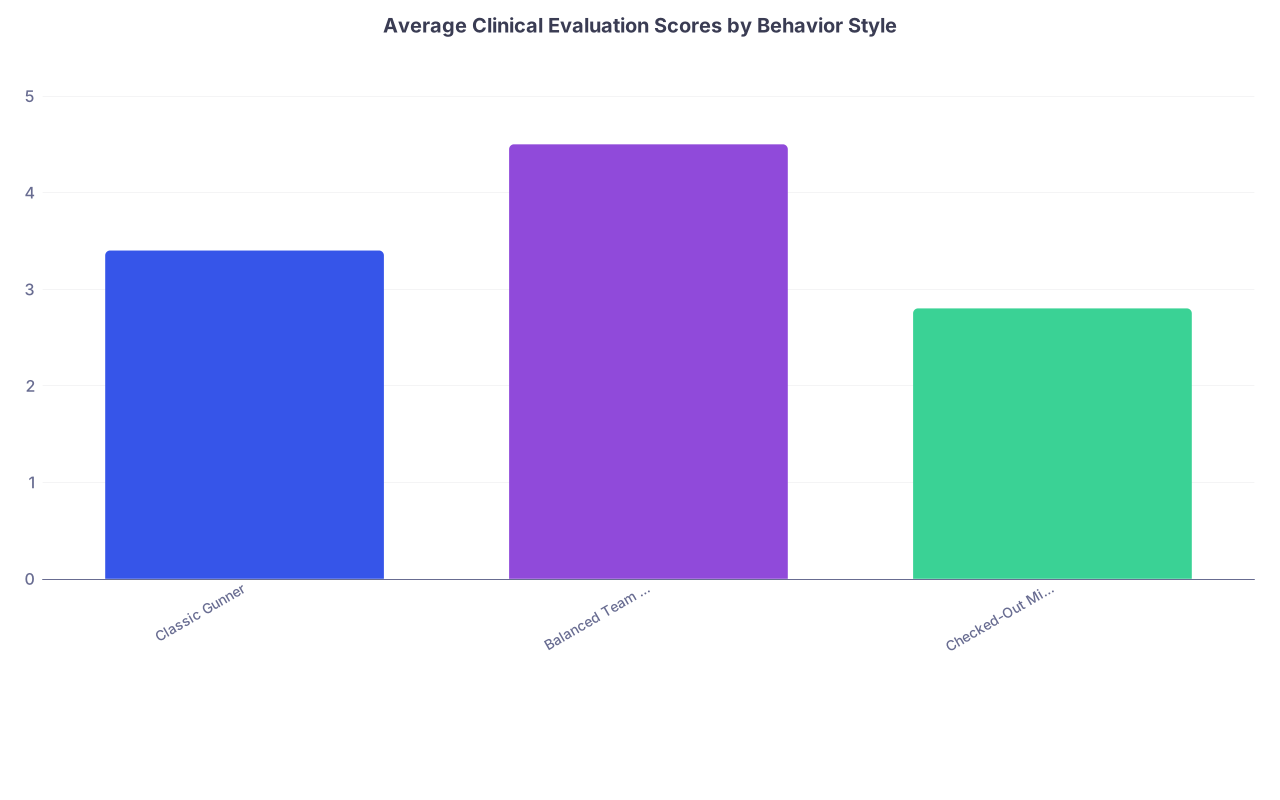
Here’s a simple model of how this plays out in actual grading:
| Category | Value |
|---|---|
| Classic Gunner | 3.4 |
| Balanced Team Player | 4.5 |
| Checked-Out Minimalist | 2.8 |
Is that an oversimplification? Of course. But it reflects a real pattern: the loudest student rarely has the highest average ratings once the whole team weighs in.
The Real “Gun”: Owning the Boring Stuff
There’s a different type of “gun” most students underestimate: the one gunning for competence, not credit.
You want to stand out? Stop chasing moments that make you look impressive. Start chasing patterns that make you indispensable.
Here’s what that looks like on a typical medicine or surgery rotation.
You:
- Know your patients so well you can answer 90% of “What happened with X?” questions without checking the chart.
- Pre-round efficiently, not theatrically. You know vitals, overnight events, pressor changes, new imaging, new labs. You do not need to show off every note you wrote.
- Anticipate next steps. Blood cultures drawn? Then you’re already thinking when to narrow antibiotics. New afib? You’ve already glanced at CHADS2-VASc and the echo history.
- Close loops. If you say, “I’ll call the family,” you actually call, document, and summarize back to the team. No loose ends.
Residents remember that.
I’ve watched a student spend 30 minutes talking on rounds about the nuances of SGLT2 inhibitors in heart failure. The attending loved the mini-lecture. Then that same student forgot to check that the patient’s insulin was resumed after being held for a procedure.
The attending had no idea about that second part. The resident did. Guess which one writes most of the comments that go into your letter?
This is why real team players win. They convert “eagerness” into execution. Not performance.
Team Player ≠ Doormat: How to Stand Out Without Being a Clown
People hear “team player” and imagine being invisible. That’s not what I’m arguing. Being a ghost also tanks your evaluations.
You still need to stand out. But you do it by being high-impact, low-friction.
Let me spell out a realistic pattern I’ve seen from students who consistently honor—without being labeled gunners.
How they behave on Day 1–2
They don’t show up trying to “run the list” on day one. They:
- Ask the resident, “What’s most helpful for students on this team? What’s worked well before?”
- Take 1–2 patients initially and handle those patients well. Not 5 handled badly.
- Learn the workflow: where labs post, who pages radiology, how to request consults, where the discharge coordinator sits.
They ask targeted questions. Not nonstop chatter. More like, “For this kind of patient, what’s your mental checklist?” or “When you discharge someone with cirrhosis, what are the must-not-miss items?”
That quickly marks them as serious, not performative.
How they behave by Week 2–3
Once they’ve shown reliability, they gently level up:
- “If you’re okay with it, I’d like to take on a third patient tomorrow.”
- “Do you mind if I draft the discharge summary for Mrs. X and you can review it?”
- “Could I try calling this consult and then tell you what they said?”
Residents love this because it means less grunt work for them, not more supervision drama.
This is where they start to stand out and cement their reputation as a team player. They don’t steal work. They grow into more responsibility, in plain sight, with consent.

Why the “Gunner” Myth Persists (and Why You Should Ignore It)
If gunners are such a bad strategy, why does every class still have them? Because students watch the wrong metrics.
You see who talks the most on rounds.
You do not see the written evaluations.
You see who attendings call on.
You don’t see who residents rank as “I want this person as my intern.”
You see the day the loud student is invited to present an article or scrub into a flashy case.
You don’t see the day faculty complain privately, “They’re great when they’re on, but I don’t fully trust them.”
Meanwhile, the balanced team players are not viral. They just keep collecting solid, steady “above expectations” boxes and comments like:
- “Functioned at the level of an intern.”
- “Patients and staff trusted this student.”
- “Worked extremely well with the team.”
Those exact phrases are rocket fuel in letters.
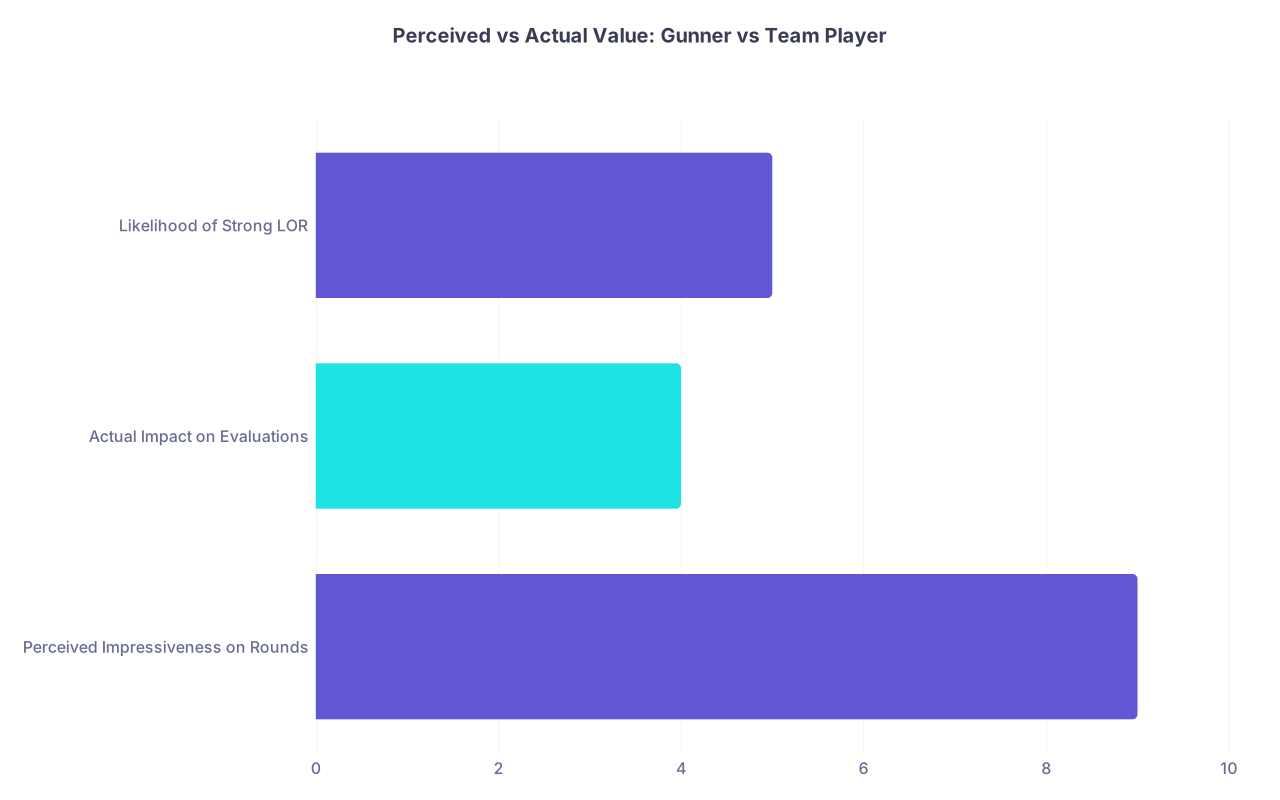
Let’s quantify the mismatch between perception and reality a bit.
| Category | Value |
|---|---|
| Perceived Impressiveness on Rounds | 9 |
| Actual Impact on Evaluations | 4 |
| Likelihood of Strong LOR | 5 |
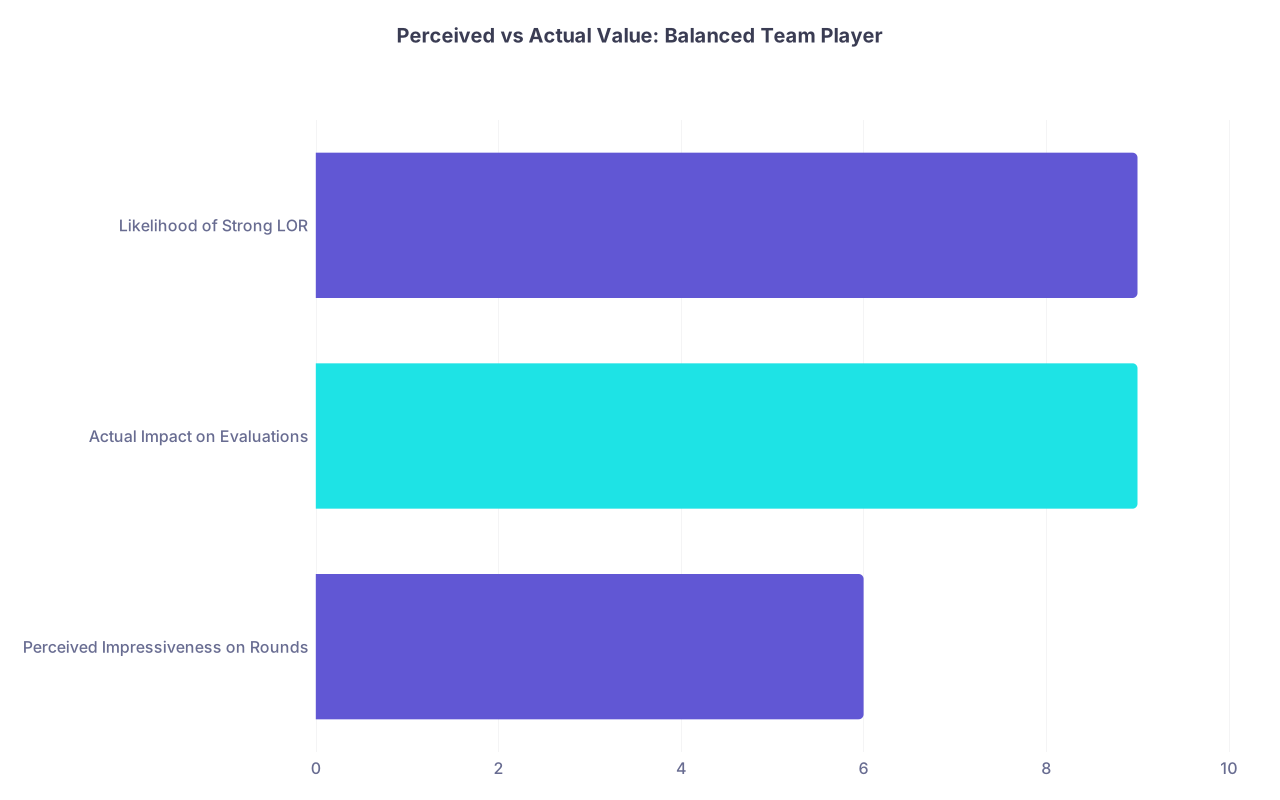
For the gunner. Now compare to the balanced team player:
| Category | Value |
|---|---|
| Perceived Impressiveness on Rounds | 6 |
| Actual Impact on Evaluations | 9 |
| Likelihood of Strong LOR | 9 |
You see the problem. Students overweight what’s visible in public settings and underweight the mundane, private metrics that actually decide their grades and letters.
How True Team Players Turn the System to Their Advantage
Let me make this concrete. Here’s how a real team player differentiates themselves without falling into the gunner trap.
1. They protect the team’s time
Instead of trying to impress with rare knowledge, they:
- Look up common questions patients actually ask (“When can I go home?” “Why am I on blood thinners?”) and prepare clean, simple explanations.
- Pre-chart what labs or imaging will likely be needed the next day so the team can quickly sign the orders.
Residents notice when the day runs smoother because you’re on the team. They may not say it out loud, but you’ll see it in how much they trust you by week two.
2. They communicate like a future intern, not a student on stage
On presentations, they give a clear, structured story. They don’t drown everyone in the last three years of outpatient notes.
They frame their assessment and plan with:
- The key problem
- The relevant evidence
- 1–2 rational options
Then they stop talking and let the team weigh in. They’re not auditioning for “Best Grand Rounds Speaker.” They’re proving they can synthesize and hand off intelligible information.

3. They lift classmates up instead of undercutting them
This one’s huge and underappreciated.
Letters increasingly include language like “supportive of peers,” “excellent collaborator,” and “mentored junior students.” Faculty and residents notice if you:
- Offer to share a template H&P or presentation structure that’s working well.
- Say “That was a great catch by [classmate]” on rounds when it’s true.
- Step back from answering so a quieter student can speak, especially if you’ve already spoken a lot.
Students fear that giving away spotlight points hurts them. Reality: it makes you look secure, mature, and aligned with how medicine actually works. Teams, not soloists.
The One Thing You Should Actually “Gun” For
If you want something to truly gun for, here it is: become the student your residents would hire.
Not just “take as an intern because they’re smart.” Hire. Choose. Fight for.
Those students:
- Are safe. They don’t fake knowledge. They ask for help appropriately.
- Are predictable. If they say they’ll do something, it happens. If it can’t, they say why.
- Are low-drama. They’re not manufacturing conflicts or gossiping about grades in front of staff.
- Are genuinely patient-centered. They don’t use patients as props to show off knowledge.
Everything else—flashy facts, overtalking, peacocking—feels impressive to you because you’re still thinking like a pre-clinical student. Residents and attendings are thinking like people responsible for a service that can actually hurt or help human beings.
You want to stand out? Align with their priorities, not your insecurities.

| Step | Description |
|---|---|
| Step 1 | Start of Rotation |
| Step 2 | Classic Gunner Behaviors |
| Step 3 | True Team Player Behaviors |
| Step 4 | Inconsistent Feedback |
| Step 5 | Mixed Evaluations |
| Step 6 | High Trust from Team |
| Step 7 | Strong, Consistent Evaluations |
| Step 8 | Primary Goal? |

Final Takeaway: Killing the Gunner Myth
Let me compress this down to the essentials.
The “gun-gunner” archetype is strategically dumb. Modern evaluation systems reward consistency, teamwork, reliability, and safety far more than theatrical displays of knowledge.
True team players stand out by owning the boring, high-yield work of patient care—closing loops, knowing their patients cold, supporting the team’s flow—and by communicating like future interns, not pre-clinical students on stage.
If you want to “gun” for something, gun for being the person your residents would gladly work with again. That’s what turns into honors, strong letters, and, down the line, a match into the place you want to be.