
Does Being the “Gun” on Rounds Actually Matter?
You know that one student on rounds who rapid‑fires perfect answers to every pimp question? The resident smirks, the attending nods, and you start wondering: “Am I just worse at this?”
Let me ruin the mystique for you: answering more pimp questions correctly does not reliably mean you’re a better student, and it definitely does not mean you’ll be a better doctor.
It usually means three things, in some combo:
- They’re quick under pressure.
- They’ve seen that exact question before.
- They’re good at performance.
Those are not the same thing as clinical competence, knowledge depth, or long‑term retention. The culture of pimping pretends they are. The data disagree.
Let’s dismantle the myth.
What Pimping Was Supposed to Measure (And What It Actually Does)
The original justification for pimping is simple: “We’re testing your knowledge on the spot to see what you really know.” Sounds reasonable. Reality is messier.
What pimping really tests
On a typical ward round or in the OR, “pimp performance” is influenced heavily by factors that have nothing to do with being a “better” student:
- Working memory under stress
- Speed of recall (not depth of understanding)
- Prior exposure to that specific question
- Hierarchy comfort (are you intimidated by this attending?)
- English fluency and accent perception (yes, bias is real)
- Personality style (assertive vs reserved)
It’s basically oral exam theater layered on top of clinical work.
There are actually education studies on this. While data on “pimping” per se are scattered, there’s plenty on oral questioning, Socratic methods, and high‑stress teaching environments in medicine. Patterns are consistent:
- Students feel like they’re being evaluated on intelligence and worth.
- Faculty think they’re evaluating knowledge and reasoning.
- What’s actually being captured is a loud mixture of anxiety, prior exposure, and test‑taking personality.
That’s not a reliable measure of “better student.”
What the Evidence Says About Questioning and Learning
Let’s separate two things that always get conflated:
- Frequent questioning as a teaching method
- High‑pressure pimping as an evaluation and status game
The first has support. The second is mostly cultural habit dressed up as pedagogy.
Retrieval practice: good. Humiliation theater: not good.
The cognitive science is clear: retrieval practice improves retention. Testing yourself—flashcards, practice questions, oral quizzing—boosts long‑term learning. That’s the testing effect.
But that research comes from:
- Low‑stakes testing
- Controlled environments
- Clear, focused questions
- Psychological safety
It does not come from: being grilled in front of the team post‑call with a beeping pager and a hostile attending who wants the exact phrase from UpToDate.
What happens under those conditions?
- Anxiety goes up.
- Working memory shrinks.
- Performance correlates more with trait anxiety than with underlying knowledge.
In other words, on‑rounds pimp performance is often testing how well you can think while mildly panicking. That’s sometimes relevant (emergencies are stressful). But it is not a clean measure of whether you’re “better” than the student next to you.
Why the “Star Pimper” Rarely Predicts the “Best Doctor”
Watch long enough and you’ll notice something: the student who destroys pimp questions is not always the one residents want on their team, or the one staff trust most with patients.
The traits that actually matter for good clinical performance:
- Reliability: Do you follow through? Are your notes accurate?
- Pattern recognition: Can you spot that the “mildly short of breath” patient is actually circling the drain?
- Clinical reasoning: Can you synthesize, not just recite?
- Team awareness: Do you help the intern, call pharmacy, track down imaging?
- Humility: Do you know when you don’t know?
The traits pimping rewards:
- Confident recall of factoids
- Verbal fluency
- Willingness to speak up quickly
- Familiarity with attendings’ pet topics
I’ve watched students quietly grinding, reading their patients’ charts in depth, actually talking to nurses, learning to write clean orders—while a louder, flashier classmate dominates rounds with factoids about obscure enzyme deficiencies. Guess which one the residents relied on when things got chaotic at 3 am. Not the trivia machine.
How Much Do Pimp Answers Actually Affect Your Grade?
Some honesty about clerkship grading. On many rotations, student perception is that everything rides on how you respond to questions in front of the attending.
The real picture is uglier—and less related to actual learning.
Here’s what commonly influences your final grade far more than your “answer rate” on rounds:
| Factor | Approximate Real-World Impact |
|---|---|
| Attending's global impression | High |
| Resident evaluations | High |
| Perceived enthusiasm/reliability | High |
| Pimp question performance | Low–Moderate |
| Shelf/OSCE scores | Moderate–High (varies) |
Notice “pimp performance” isn’t at the top. It leaks into “global impression,” sure. But most attendings don’t keep a mental tally of correct answers. They remember:
- Are you prepared on your patients?
- Do you read and improve over the week?
- Do you disappear or step up?
The dangerous illusion
The myth is: “If I crush pimp questions, I’ll get Honors. If I don’t, I’m doomed.” That’s not how this usually plays out.
What actually happens:
- A student who answers nothing, looks disinterested, and seems unprepared gets dinged.
- A student who misses some questions but shows thoughtful reasoning and clear effort still lands solid evals.
- The “gunner” who answers everything but is inconsiderate, dismissive of nurses, or unreliable? Residents quietly tank their eval.
Residents are far more irritated by laziness, unreliability, and arrogance than by “not knowing the differential for SIADH on the spot.”
Where Pimping Helps—and Where It Clearly Hurts
Let’s be fair. Oral questioning, done well, can be an excellent teaching tool. I’ve seen attendings who are masters at this.
When questioning actually makes you better
Questioning can genuinely help when it’s:
- Targeted: “You followed this patient all week. What’s your differential for their hyponatremia?”
- Structured: They walk you from basic to advanced, building a chain of reasoning.
- Paired with feedback: “You focused on labs first—try starting from the history pattern next time.”
- Psychologically safe: Getting it wrong is treated as a learning opportunity, not a character flaw.
This does build clinical reasoning and adaptive expertise. You walk away seeing the case differently.
When “pimping” becomes counterproductive
Then there’s the classic toxic version:
- Same three students get all the questions.
- Questions are chosen to stump you (“So what’s the 7th side effect of this obscure med?”).
- Wrong answers are mocked, or mistakes held against you later.
- Questions fire at random students regardless of involvement in the case.
This doesn’t build anything except anxiety and resentment. And the data from learning science back this up: performance‑oriented, high‑shame environments impair deep learning and encourage surface strategies (memorizing lists to survive, not understanding mechanisms).
Fast, Shallow, and Overrated: The “Quick Recall = Smart” Problem
On rounds, the student who can quickly rattle off drug side effects or memorize every murmurs’ radiation pattern looks impressive. But speed impresses way more in public than it does in long‑term outcomes.
Here’s the uncomfortable reality:
- Deep understanding is often slower in the moment.
- Thoughtful, stepwise reasoning can look hesitant.
- “Let me think through that” doesn’t play as well as “The answer is…”
But long‑term, the slower, more deliberate style tends to stick.
There’s also a cultural bias here. Western academic medicine overvalues extroversion and fast talkers. If English isn’t your first language, or you naturally pause before speaking, you can appear less sure even while being more accurate.
That doesn’t make you a worse student. It just makes you less of a performer.
How to Use Pimping to Your Advantage (Without Measuring Your Worth by It)
You’re not going to change the culture during third year. Some attendings will pimp. Some will be good at it. Some will be terrible. Your job is to survive, learn, and not let your self‑assessment get completely hijacked.
A few practical, non‑fluffy strategies.
1. Stop treating every question as a referendum on your intelligence
Reframe the entire exercise like this:
“This is forced retrieval practice under weird conditions. It says something about my readiness today, in this context. It does not define my potential, my future as a physician, or my value.”
You will instantly reduce the shame load when you miss questions. That alone will help you actually learn from them.
2. Focus on “trajectory,” not one‑day performance
If an attending sees you early in the week stumbling over heart failure management, and by the end of the week you’ve clearly read, improved your presentations, and answer a few related questions well—that upward curve is way more powerful than being perfect on day 1.
I’ve seen multiple attendings say versions of:
“I don’t care if they don’t know. I care if they get better.”
You control that.
3. Take control of the follow‑up
Missed a question? Instead of just nodding and moving on, use it:
- Write it down immediately.
- Look it up that day, in context of the patient.
- Bring it back later: “Yesterday you asked me about causes of anion gap metabolic acidosis—I reviewed it last night; here’s how it applies to Ms. X.”
That move does two things:
- Signals work ethic and actual learning.
- Converts a public miss into a concrete gain.
Attendings remember this. Residents especially remember this.
How Much Does Pimping Predict Objective Performance Like Shelf Scores?
This is where the myth collapses outright. If answering more pimp questions correctly really meant “better student,” you’d expect strong correlation with shelf scores, Step scores, and OSCE performance.
There is no robust evidence that “good on‑rounds pimper” cleanly predicts “top shelf score.” What is associated with higher shelf and board performance?
- Consistent question bank use (UWorld, AMBOSS, etc.)
- Time spent in focused, active study
- Quality of feedback and supervision
- Prior academic performance (to a depressing but real degree)
On the flip side, a student may:
- Crush shelves and still be awkward and quiet on rounds.
- Be charismatic and polished orally and then score average on exams.
These are partially related skill sets, not identical ones.
Here’s a rough mapping:
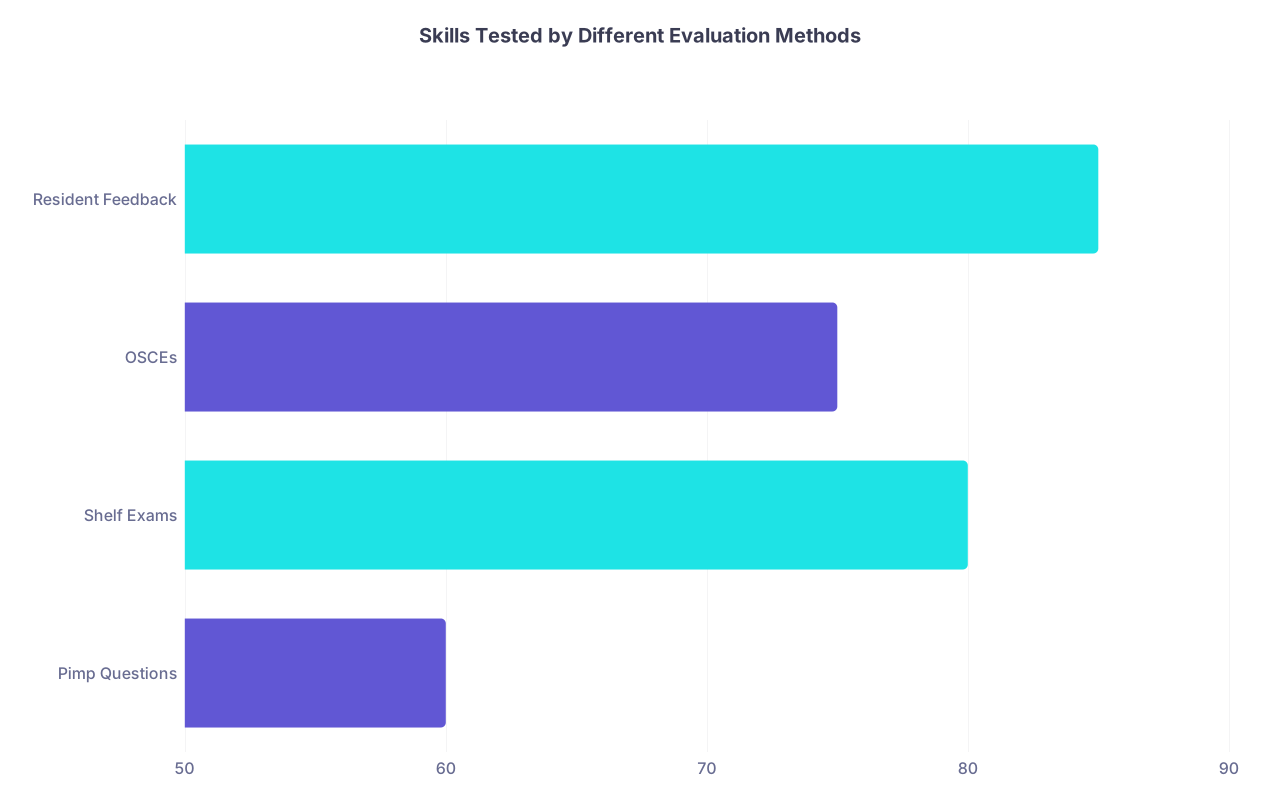
| Category | Value |
|---|---|
| Pimp Questions | 60 |
| Shelf Exams | 80 |
| OSCEs | 75 |
| Resident Feedback | 85 |
Interpretation (simplified): shelf exams and resident feedback tend to capture more of the “real‑world” or durable knowledge/skill than random pimp sessions.
The Dark Side: Bias and Harm in Pimp Culture
We should be blunt about this. Pimp culture doesn’t distribute its harm equally.
Who tends to get hit harder?
- Students from underrepresented backgrounds
- International or IMG students
- Women and quieter personalities
- Non‑native English speakers
- Anyone who doesn’t match the attending’s mental model of “mini‑me”
When pimping shifts from curiosity‑driven to dominance‑driven, it amplifies existing bias. Faculty are more likely to interpret the exact same hesitation as “thoughtful” in students who look like them, and as “unprepared” in students who don’t. There are multiple studies on bias in clinical evaluations showing precisely this skew.
That doesn’t make pimping automatically evil. But it does make the “if you just answer more questions you’re clearly the better student” story laughable.
The playing field is not level. And pretending it is does harm.
So What Actually Makes You a “Better” Student?
Not the myth version. The real one.
Here’s what consistently tracks with both strong evaluations and becoming a competent resident later:
- You understand your patients’ stories, not just their lab values.
- You read about your patients’ problems the same day you see them.
- You build frameworks (algorithms, patterns) rather than random lists.
- You show reliability: pages answered, tasks completed, updates given.
- You ask for feedback before final eval time and then visibly act on it.
None of these require you to win the on‑rounds trivia contest.
If you answer more questions correctly fantastic; that’s evidence of preparation and retrieval. But it’s one small data point—not the metric of your worth.
Key Takeaways
- Answering more pimp questions mostly measures speed, prior exposure, and comfort under pressure—not overall intelligence, potential, or clinical skill.
- Good questioning can build reasoning, but toxic pimp culture is more about hierarchy than education, and it often amplifies bias and anxiety rather than learning.
- Being a “better” student is about growth, reliability, and applied understanding over time—not about being the loudest or fastest voice on rounds.