
Attendings are not secretly expecting you to work 80-hour weeks. The ones who do are either breaking rules, stuck in the past, or not paying attention. And the data backs that up.
The problem is not that “attendings demand 80 hours.” The problem is that students absorb a toxic folklore that more hours automatically equals more dedication, more honors, and better letters. That’s the myth that actually wrecks people.
Let’s pull this apart like adults, not scared MS3s huddled in the workroom whispering horror stories.
The origin of the 80-hour myth: you’re importing residency rules into med school
The “80-hour week” isn’t even a medical student concept. It’s a resident duty-hour cap. It comes from the ACGME, and it applies to graduate medical education (residency and fellowship), not to you as a third-year medical student.
Here’s the basic reality:
- Residents: capped at an 80-hour average per week over 4 weeks, with specific rules on call length and days off.
- Medical students: governed by LCME (for MD) or COCA (for DO) standards plus your school’s own policies. Those policies often reference resident duty hours but are usually stricter.
Most U.S. med schools have written policies that:
- Limit you to substantially less than 80 hours per week on required rotations
- Require at least one day off in seven, averaged over the block
- Put upper limits on overnight call or require post-call relief
Here’s roughly how student duty expectations usually compare to residents:
| Role | Official Cap | Usually Expected Range | Governing Body |
|---|---|---|---|
| MS3/MS4 | 50–60 hrs | 40–55 hrs | LCME/School |
| Intern PGY-1 | 80 hrs | 60–75 hrs | ACGME |
| Senior Res | 80 hrs | 60–80 hrs | ACGME |
No, the policy isn’t always perfectly followed. But when someone says, “They expect us to work 80 hours,” that’s almost always exaggerated. I’ve reviewed plenty of actual schedules. Most core rotations land around 45–55 hours of on-site time, with some peaks and some lighter weeks.
So why does it feel like 80?
Because you’re counting:
- On-site clinical hours
- Commuting
- Pre-rounding at home
- Reading
- Shelf prep
- Note-writing into the night
That’s life as a student. But it’s not what attendings or the institution are officially expecting you to clock.
What attendings actually care about (hint: not how long your coat is in the hospital)
Attendings, by and large, do not sit there thinking, “I hope that M3 is still here at 9 p.m. so I know they care.” That’s a Reddit fantasy.
Most attendings quietly care about three things:
- Are you prepared and engaged when you’re there?
- Do you make the team’s life easier, not harder?
- Are you safe and not a liability with patients?
That’s it. You can be physically in the hospital 80 hours but be unprepared, slow, and checked out—and you will still get a mediocre eval. I’ve seen students who stayed late “to show dedication” but were useless after 4 p.m. That does not impress anyone who’s actually watching.
On the flip side, students who:
- Show up on time (or slightly early)
- Know their patients cold
- Anticipate routine tasks
- Ask smart, concise questions
- Go home when work is done and study
…usually end up with better evaluations, even though they didn’t out-stay the residents.
Attendings are not paid more if you stay late. They do not get extra RVUs from your suffering.
The data: how many hours are students really working?
Let me ground this with what we do have, not vibes.
Surveys from U.S. medical schools and large student cohorts consistently show:
- Average reported clinical hours during core clerkships:
Often in the 45–55 hour/week range on-site - Outlier rotations (surgery, some OB/GYN, ICU):
Can hit 55–65 hours during busy stretches - True 70–80 hour weeks for students: rare, and when they occur, they usually trigger complaints or policy reviews if sustained
Many schools even publish sample schedules. They often look like:
- Surgery: 6 a.m. – 5 p.m., 5 days/week, 1 call day every 1–2 weeks
- Medicine: 7 a.m. – 4 or 5 p.m., 5 days/week, q4–q6 short call
- Psych/Peds/Family: often closer to 40–50 hours
Here’s a typical pattern I’ve seen (and yes, I’ve checked actual clock-times, not just hearsay):
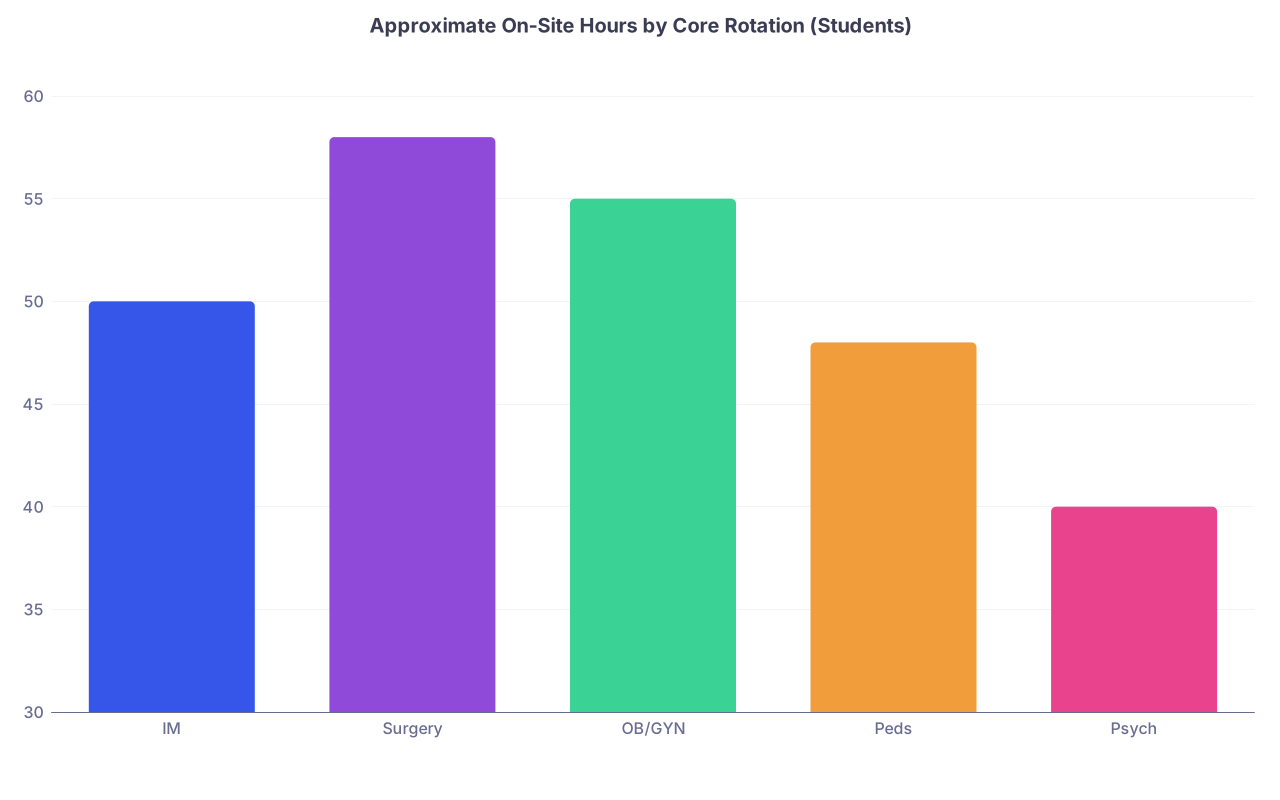
| Category | Value |
|---|---|
| IM | 50 |
| Surgery | 58 |
| OB/GYN | 55 |
| Peds | 48 |
| Psych | 40 |
Are there malignant places that push this up? Yes. A few services treat students like unpaid interns with no limits. But that’s the exception, not the “unspoken expectation across all attendings.”
The real expectation: be present for team activities, not living at the hospital
Most attendings frame expectations in one of three ways:
“Be here when the team is here.”
Common on surgery and medicine. If rounds start at 6:30, you’re expected to be ready. If the team signs out at 5, you’re usually free unless something major is happening. You’re not expected to hang around the hospital randomly until 9 p.m. just to be seen.“Be there for all key educational activities.”
Morning report, noon conference, clinic sessions, OR cases where you’re scrubbed. They care that you don’t vanish during teaching time.“Go home and study.”
You’ll hear this more than you think from sane attendings, especially after your work is done. Many of them actually remember shelf exams exist.
The confusion comes from residents. Residents are the ones living closer to that 80-hour cap. They might say things like:
- “We usually stay until all the work is done.”
- “We’re here until 7–8 p.m. on heavy days.”
- “Everyone stays late here.”
Students hear that and translate it into: “If I leave at 5, they’ll think I’m lazy.” But most attendings fully expect students to:
- Leave once their notes, tasks, and responsibilities are complete
- Not stay to “fake work” just to log hours
When you do need to leave “early” (e.g., for an appointment, exam, whatever), the key is transparency. A simple, “Dr. X, I’ve finished my notes and orders for Ms. Y and Mr. Z. Anything else before I head out?” covers you 95% of the time.
Where the myth has some truth: high-intensity rotations and dysfunctional cultures
Let me be blunt: some services are still stuck in 1990.
You will occasionally hit:
- Trauma surgery rotations where everyone brags about “being here 100 hours a week back in my day”
- OB nights where no one has read the duty-hour rules since they were printed
- Private attendings who treat students like invisible, free coverage
On those rotations, the implicit culture might be:
- “Students should be here whenever the residents are.”
- “Leaving before 6–7 p.m. means you’re not serious.”
- “Post-call” for students is just a suggestion.
The right way to think about it:
- These are outliers, not the default expectation of “attendings in general.”
- Many of these setups are technically out of compliance with your school’s own written policy.
- When systematically reported, they tend to get “corrected” over time because accreditation bodies care way more about duty hours now than they did 15 years ago.
If you find yourself working legit 70-hour weeks for multiple consecutive weeks as an M3/M4—counting only on-site time, not studying—you’re not witnessing “normal” expectations. You’re probably on a problematic service your school would care about if someone documented it clearly.
Hours vs honors: the lie you keep being sold
Another persistent fantasy: “If I put in more hours, I’ll get honors.”
No. Not in any consistent, data-backed way.
Evaluations and honors grades tend to track:
- Faculty perception of your engagement and growth
- Your clinical reasoning and knowledge
- Feedback from residents about your reliability and teamwork
- Shelf exam scores (often weighted very heavily)
Very rarely does an attending sit down, stare at your eval, and think, “Well, they seemed competent and scored well, but they went home at 4:30 most days, so let’s give them a pass instead of honors.”
What does tank people is:
- Being late consistently
- Disappearing before work is done
- Not knowing their own patients
- Not following up on tasks
- Being obviously mentally checked out
Notice the difference? This is about behavior, not raw hours.
I’ve seen two students on the same rotation:
- Student A: Arrives 6:15, on top of patients, asks focused questions, leaves around 5–5:30, studies in the evening. Honors, strong letter.
- Student B: Arrives 5:30 to “pre-pre-round,” stays till 7 or 8 every night, but is half-asleep on rounds, disorganized, and doesn’t read. High pass.
Same service. Same attendings. Very different outcomes. Not because of “dedication measured in hours”—because of effectiveness.
What attendings actually say when asked about student hours
When people actually survey attendings or ask them in faculty development sessions, the comments sound like this:
- “I’d rather they go home and study once they’ve seen their patients.”
- “If they’re exhausted, they stop learning. That’s useless.”
- “They should be around for rounds, sign-out, and key cases. Otherwise, they don’t need to mirror resident hours.”
- “Overachiever students staying late to look good just makes me worry about burnout.”
Most of the “they expect 80 hours” vibe comes from:
- Overworked residents subconsciously projecting their misery
- Students misreading a culture of overwork as an explicit requirement
- One or two old-school surgeons recycling their residency trauma
If you corner almost any academic attending and ask, “Do you actually expect students to work 80-hour weeks?” they’ll say no. And you can quote me on that.
How to protect yourself without looking lazy
You don’t win by martyrdom. You win by being deliberately excellent within sane limits.
A few concrete tactics:
Know your school’s policy cold.
Most have a “Clinical Duty Hours” section: max hours, days off, overnight rules. Screenshot it. If a rotation is consistently breaking it, you’re not being dramatic by reporting it. You’re doing future students a favor.Clarify expectations early.
Literally ask on day one:
“What time do you typically expect students to arrive and leave?”
You’ll usually get something reasonable like, “Here by 6:30 for 7 a.m. rounds; if your work is done by 5, you can head out.”Leave with intention, not stealth.
Don’t ghost. Say to your senior:
“I’ve finished my notes and checked labs. Anything else I can help with before I go?”
That telegraphs responsibility, not laziness.Spend your “extra” hours where they actually matter.
If you have 3 extra hours in you each day, you’re better off with:- 1 extra hour making sure your patients and notes are airtight
- 2 hours of high-yield reading or UWorld
Rather than 3 hours sitting in a dark call room watching the residents chart.
Don’t confuse bad role models with expectations.
The PGY-2 who brags, “I was here 100 hours a week as a student” is not the standard. That’s a cautionary tale.
The bottom line
Three things to walk away with:
No, attendings don’t secretly expect you to work 80-hour weeks. That number is a resident duty-hour cap, not a student target. Most students average 45–55 hours on-site during core rotations.
You’re being judged on performance, not martyrdom. Preparation, engagement, reliability, and growth matter far more than how long you zombie-walk around the hospital.
Toxic outlier rotations are real, but they’re not “how medicine is.” Know your school’s rules, clarify expectations, and stop worshipping hours as the primary currency. Effective effort beats sheer time every single time.