
Honors on Every Rotation: The Obsession Is Misplaced
The belief that you must honor every rotation to match well is wrong—and honestly, a little toxic.
I’ve watched students torture themselves chasing a clean wall of “Honors” on the transcript like it’s a golden ticket. They stay late for optics, say yes to everything, smile until their face hurts, and still end up with… High Pass in medicine. Then they spiral, convinced they just killed their chances at derm, ortho, or whatever “competitive” thing they’re chasing.
You’ve probably heard some version of: “If you’re going for a competitive specialty, you need honors in all your core clerkships.”
Let’s pull that apart with what actually exists: data, program director surveys, and how grading systems really work behind the scenes.
What Program Directors Actually Care About
Forget the myth for a minute and look at how residency programs say they evaluate you.
The best data we have is from the NRMP Program Director Survey (latest versions still follow the same pattern): program directors list and rank which factors they use when deciding who to interview and how to rank them.
Here’s how honors on rotations fits into the bigger picture.
| Factor (Interview/Rank Importance) | Typical Rank in Surveys* |
|---|---|
| Letters of recommendation in specialty | Very high (top 3–5) |
| USMLE Step 2 CK score | Very high (top 3–5) |
| MSPE (Dean's Letter) narrative | High |
| Overall academic performance in required clerkships | Moderate–High |
| Honors in specific key rotations | Moderate |
| Research in specialty | Moderate–High for competitive fields |
*Order varies a bit by specialty and survey year, but the pattern is consistent.
Notice what's not there: “Honors on every rotation” as some standalone, make-or-break metric. They care about:
- How you did in key rotations relative to your chosen specialty.
- Whether your MSPE narrative and letters paint you as a strong, reliable, teachable clinician.
- Whether your scores and application show you’re safe and trainable.
A string of honors looks nice. But it’s more of a cosmetic boost than a structural pillar.
The Grading System Is Way More Arbitrary Than You Think
Here’s the part students don’t like hearing: clerkship grading is noisy, subjective, and heavily dependent on local politics and logistics.
I’ve sat in those grading meetings. It’s not a pure meritocracy.
Why “Honors Everywhere” Is Mostly a Fantasy
On most rotations:
- Each student gets evaluated by a random mix of residents and attendings who vary wildly in how strict they are.
- There is a cap on how many students can get Honors (e.g., top 20–25%).
- Shelf exam cutoff for honors is arbitrary (e.g., ≥ 80th percentile at one school, ≥ 70th at another).
- Some services are notoriously stingy. Others hand out honors like candy.
So your chance of getting honors on a rotation isn’t a clean function of “how good you are.” It’s a function of:
- Who happened to work with you.
- Whether your team was overstaffed and you got fewer chances.
- How your school compresses evaluation scores into bins.
- What group of students you rotated with that block.
That’s before we even talk about shelf exams.
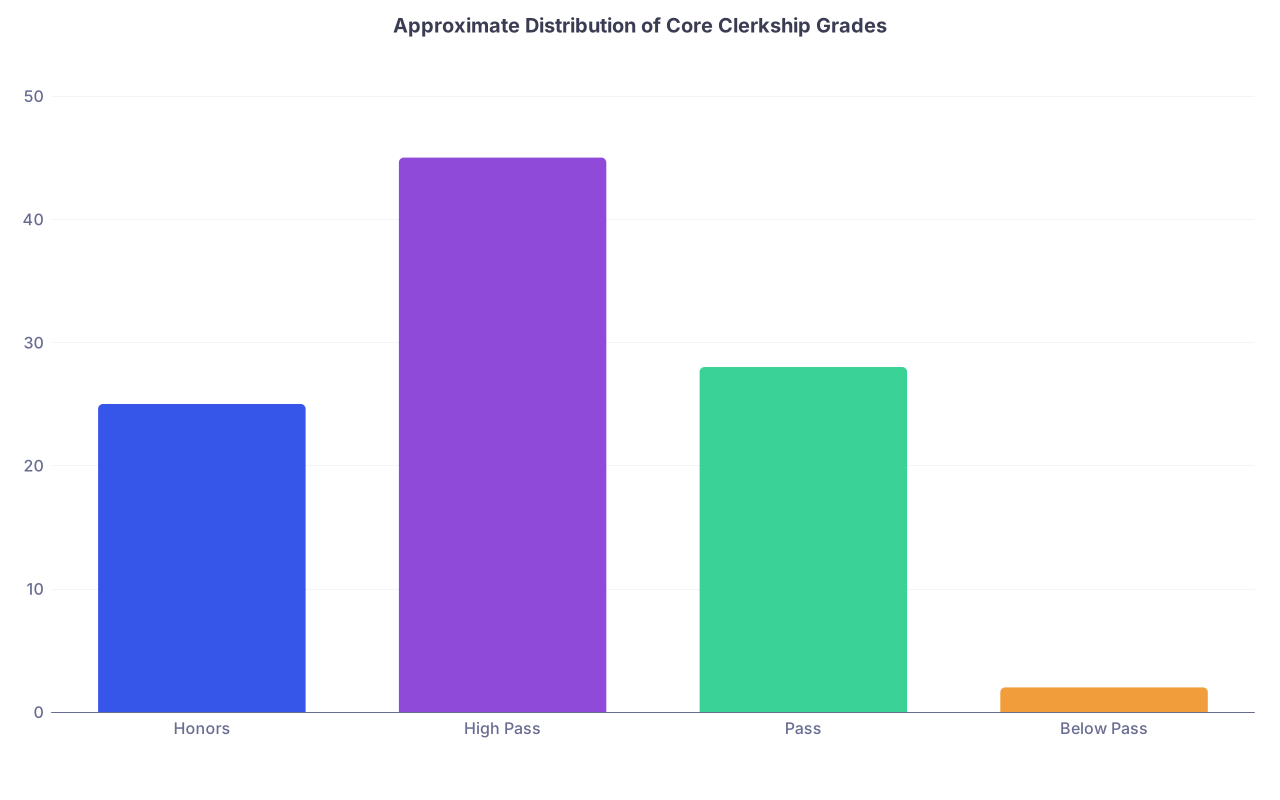
| Category | Value |
|---|---|
| Honors | 25 |
| High Pass | 45 |
| Pass | 28 |
| Below Pass | 2 |
If your school limits honors to ~20–30% of students on a given clerkship, “Honors on everything” literally means: you must consistently be in the top quarter of a group that’s already a filtered, high-achieving population. Across all rotations. In all conditions. With multiple attendings. Every time.
Is that possible? For a tiny minority, sure. Is it necessary? No. Is it the expectation? Also no.
Residency programs know how arbitrary clerkship grading is. Many of their own residents came from schools where you could barely get honors on surgery unless you cured cancer in between cases.
What Honors Actually Signals To Programs
Honors is not useless. It just does something more limited than students fantasize.
1. Honors in Key Rotations > Honors Everywhere
If you’re applying:
- Internal medicine: honors or high pass in IM, strong medicine comments.
- Surgery: strong performance in surgery and maybe anesthesia/surgical subspecialties.
- Pediatrics: good peds, decent medicine.
- EM: good EM rotation(s), strong SLOEs.
One or two non-honors in unrelated areas is usually a non-issue if the story lines up.
Example: A student with:
- Honors: Medicine, Surgery, EM Sub-I
- High Pass: OB/GYN, Psych, Family
- Step 2 CK: solid, not insane
- Strong EM letters
They’re fine for EM. The program director is not sitting there ranting, “But why not honors in OB?!”
2. Honors as a Tiebreaker, Not a Door
When competition is tight, a transcript full of honors can help in subtle ways:
- Looks consistent. Suggests you’re organized, prepared, and functional.
- Reduces concern about weak clinical performance.
- Helps you if other parts of the application are borderline.
But it’s a tiebreaker. The heavy hitters are still:
- Step 2 CK (especially in highly competitive fields now that Step 1 is pass/fail).
- Specialty-specific letters and narrative comments.
- Evidence of commitment and fit for that specialty.
The idea that a single “High Pass in Surgery” just ruined your shot at derm or ortho is fantasy. Derm programs care a lot more about research output, letters from derm faculty, and Step 2 CK.
The Real Problem: The Honors-Chasing Mindset
The real damage isn’t the grade itself. It’s the way chasing honors warps behavior and burns people out.
I’ve watched this play out:
Student A: Comes into rotations convinced they must honor everything. They:
- Volunteer for everything, even when they’re exhausted.
- Stay late just to be seen, but aren’t actually learning.
- Are terrified to say “I don’t know.”
- Constantly compare themselves to classmates.
Outcome: They do fine. Maybe 50/50 honors/high pass. But they feel like they failed, and they’re wrecked by the end of third year.
Student B: Aims to be excellent and useful, but not to game the system. They:
- Focus on understanding the patient, not impressing everyone.
- Ask real questions.
- Own their patients, follow through.
- Study steadily for shelves and Step 2.
Outcome: Also ends up with a mix of honors and high pass. But their comments are strong, they get good letters, and they actually still like medicine.
Student B matches just as well, often better, because they’re not hollow and burnt out.
When you build your entire identity around honors, you create two problems:
- You become fragile. One high pass feels like catastrophe.
- You become performative. You’re optimizing for optics, not clinical growth.
Residents and attendings can smell that.

Where Honors Actually Matters a Bit More
Let’s be honest. There are some contexts where clerkship honors matter more.
Competitive Specialties with Too Many Perfect Applicants
Think derm, plastics, ortho, neurosurgery, some radiology and ENT programs.
These specialties often see:
- Step 2 CK: 250+ is common.
- Research: Multiple pubs or significant scholarly work.
- Clinical record: Often heavily honored.
If you’re applying ortho with:
- Average Step 2
- No research
- And mostly Pass/High Pass in surgery/IM
You have a problem. But it’s not because you failed to honor every rotation. It’s because your overall application doesn’t stand out where that specialty cares: research, scores, advocacy from their own faculty.
In those fields, multiple honors in core rotations supports the narrative that you’re top-tier. But it’s still part of a package, not an isolated key.
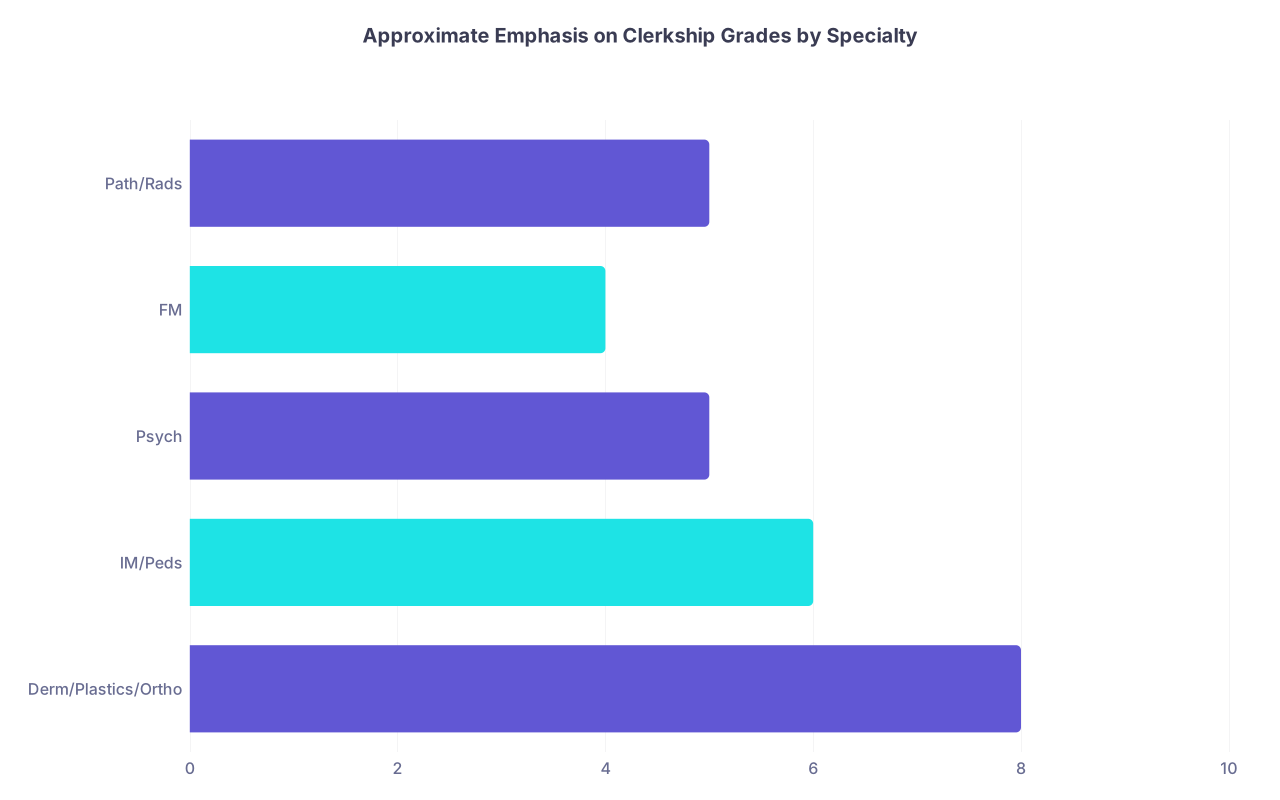
| Category | Value |
|---|---|
| Derm/Plastics/Ortho | 8 |
| IM/Peds | 6 |
| Psych | 5 |
| FM | 4 |
| Path/Rads | 5 |
(Scale 1–10: relative emphasis on clerkship grades vs other factors like research, scores, letters.)
In things like family med or psych, a mix of honors and high pass with good narratives is more than adequate. They’d rather see you likable, teachable, and not a disaster.
Your Own Institution’s Home Program
Some home programs look closely at their own students’ transcripts because they know exactly how their grading works. They know which rotations are stingy, which attendings are soft, etc.
If you’re trying to match at your home academic IM program and half your medicine rotations comment on:
- Poor follow-through
- Disorganization
- Marginal knowledge
That hurts. But again, the comments and pattern matter more than the letter grade on Neurology or OB.
What Actually Moves the Needle More Than Honors
If you want to spend energy on things that genuinely help your match odds, here’s where it’s much better invested than “honors at all costs.”
1. Shelf Exams and Step 2 CK
Shelf exams aren’t used universally in applications, but:
- Strong shelf performance → better prep for Step 2 CK.
- Step 2 CK is still heavily weighted by many programs, especially now that Step 1 is pass/fail.
You don’t need a 270. But falling asleep on Step 2 while obsessing over one honors vs high pass split? That’s how people shoot themselves in the foot.
2. Narrative Comments and Letters
Program directors read the MSPE and letters looking for:
- “Hardworking, reliable, excellent team member.”
- “Self-directed learner.”
- “One of the top students I’ve worked with in years.”
They also notice:
- “Sometimes disorganized.”
- “Needed frequent prompting.”
- “Struggled to manage time.”
Those comments often track loosely with honors, but not always. You can get High Pass with excellent comments that say way more about your match potential than a single grade label.

| Step | Description |
|---|---|
| Step 1 | Clinical Rotations |
| Step 2 | Daily Work Habits |
| Step 3 | Strong Evaluations & Comments |
| Step 4 | Excellent Letters of Recommendation |
| Step 5 | Solid Shelf Scores |
| Step 6 | Step 2 CK Performance |
| Step 7 | Stronger Residency Application |
3. Actually Being Good Clinically
Work that genuinely matters long term:
- Owning your patients: knowing their labs, plans, updates.
- Anticipating tasks instead of needing to be chased.
- Being calm and teachable under pressure.
- Not making the same mistake three times.
I’ve seen students with only a few honors walk into residency and immediately be trusted. And I’ve seen straight-honors students who crumble when there’s no script or rubric.
How Much Honors Is “Enough”?
Let’s be concrete.
For most non-ultra-competitive fields:
- Honors in some core rotations (especially your chosen field or IM)
- High Pass in the rest, maybe a Pass here or there
- Strong comments and decent Step 2 CK
That’s absolutely workable.
For more competitive fields:
- Honors or strong performance in your specialty, IM, and maybe surgery depending on the field
- Solid Step 2 CK
- Clear commitment: research, electives, away rotations, strong letters
Even there, a transcript with a mix of high pass and honors is normal. One Pass in OB or psych is not the end of the world if everything else is strong.
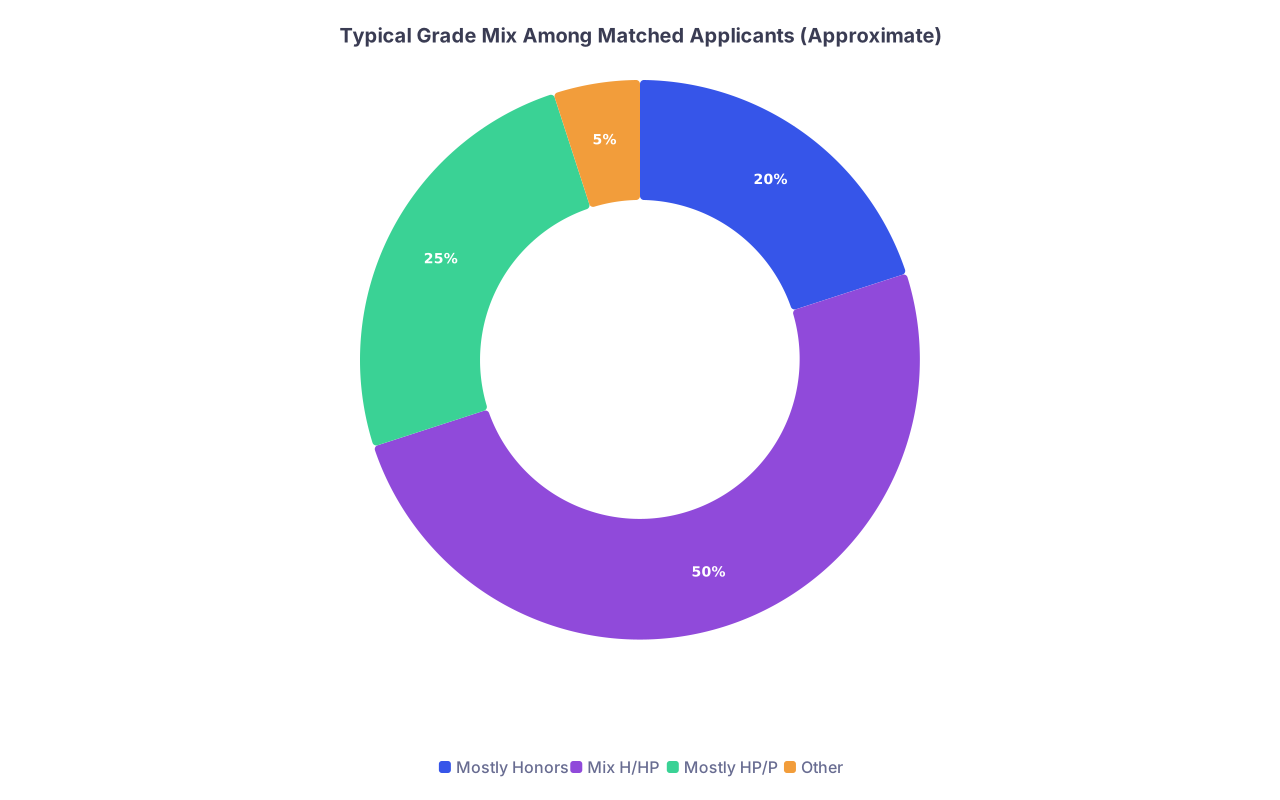
| Category | Value |
|---|---|
| Mostly Honors | 20 |
| Mix H/HP | 50 |
| Mostly HP/P | 25 |
| Other | 5 |
Are there programs where they quietly sort by “more honors is better”? Of course. But once you’re in the interview pile, your performance on interview day, letters, and fit usually matter more than the marginal difference between 5 vs 7 honors.
How To Stay Sane About Honors (Without Sandbagging)
I’m not telling you to shrug at grades and say, “Who cares.” That’s just lazy.
The rational approach is:
- Try to honor every rotation by being excellent.
- Fully expect that you will not.
- When you don’t, read the feedback carefully, fix what’s real, and move on.
If you want a practical mindset:
- Aim for consistent strong performance, not perfection.
- Protect your Step 2 CK prep like it’s sacred.
- Cultivate a small number of excellent relationships with attendings who can write powerful letters.
- Use each “non-honors” result as signal, not a verdict. Did multiple people mention the same weakness? Fix that.

The Myth You Should Actually Ditch
The dangerous myth isn’t “Honors matters.” It’s “If I don’t honor every rotation, I failed and my match is doomed.”
Here’s the reality:
- Honors broadly signals that you’re strong, but the system is noisy and unfair enough that not having a perfect run is normal.
- Program directors care far more about patterns and stories than individual grade labels.
- Your trajectory—how you grew, what you learned, how you show up by the time you’re a sub-I—is more predictive than whether you pulled off honors in OB as a terrified first clerkship.
Years from now, you will not remember the exact number of honors you got. You will remember whether you spent your clinical years performing for checkboxes—or actually becoming the kind of doctor you’d trust with your own family.