
Away rotations are wildly oversold.
They’re pitched as golden tickets to honors evaluations, glowing SLOEs/MSPE comments, and an automatic interview at your “dream” program. In reality, the data say something much less glamorous: they’re high-cost, high-stress, and only strategically useful for a minority of students and a minority of specialties.
Let’s strip the marketing from the reality.
What Away Rotations Actually Do (vs What Everyone Says)
Here’s the myth you’ve probably heard in the workroom:
“If you want a strong evaluation and a shot at X program, you have to rotate there.”
No, you don’t. And for many students, away rotations do not boost evaluations; they just compress a year’s worth of anxiety into four weeks.
What the evidence actually shows
The best-studied world here is emergency medicine (because of SLOEs), orthopedics, and a few other competitive fields.
Across these, a few patterns show up over and over:
Away rotations mainly function as extended interviews.
Programs use them to see:- Are you normal to work with at 2 a.m.?
- Do you show up, help, and not cause chaos?
- Do you fit the “vibe” of the residents?
That’s fit assessment, not “grade boosting.”
Evaluations plateau, they don’t skyrocket.
Most visiting students end up in a compressed band:- “Above average / strong”
- Rarely “truly exceptional”
- And yes, sometimes “do not rank”
You don’t usually go from “average on home rotations” to “superstar” just because you flew to another zip code.
Programs already discount visiting student evaluations.
Faculty know:- They’re seeing you at your absolute maximum effort.
- You’re self-selected, highly motivated, and often over-prepared.
- Of course you’ll stay late, read before rounds, and scrub all day.
So they treat those four weeks as a screen for red flags, not as proof that you’re a generational talent.
The real hidden function
Away rotations are more about avoiding harm than “boosting” anything.
- They can hurt you if you underperform, seem disinterested, or clash with residents.
- They can remove uncertainty if a program wasn’t sure about you and now sees you’re safe and solid.
- They rarely transform you from an unlikely match to a lock unless the program is already a realistic target and your app is in range.
That’s a very different story from “do an away, get an honors eval and secure a spot.”
Stress vs Benefit: What Students Actually Experience
Let’s be blunt: away rotations are stressful by design.
You’re dropped into an unfamiliar system, trying to impress strangers whose local norms you don’t yet understand, with your future riding on every interaction. That’s not a neutral environment for performance.
The stress cocktail
Away rotations reliably crank up:
- Performance anxiety – Every presentation feels like an audition. Because it is.
- Financial pressure – Flights, short-term housing, parking, food, lost income. VSLO doesn’t list that line item.
- Sleep disruption – New commute, new hospital, early starts, late ends.
- Cognitive overload – New EMR, new note styles, new order sets, new “this attending likes X, that attending hates X.”
I’ve watched plenty of students go from confident on their home services to stiff, quiet, and overthinking everything on away. And evaluators can sense it.
Now layer in this: most rotations do not curve upward just because you “worked harder.” Many faculty are reluctant to rank a visiting student above their own home students. There’s institutional loyalty and a bias toward people they know they’ll have to live with for years.
So you’re burning extra emotional and financial capital for a marginal shot at slightly nudging a program’s opinion of you.
Specialty-Specific Reality: When Aways Matter and When They Don’t
Here’s where the nuance lives. It’s not “aways are useless” vs “aways are essential.” It’s: in some specialties, they’re strategically valuable; in others, they’re overused trophies.
| Specialty Group | Typical Away Impact |
|---|---|
| Ortho, Derm, ENT, NSurg | Often strategically useful |
| EM, IR, Plastics | Sometimes helpful/targeted |
| IM, Peds, FM, Psych | Low utility for most |
| OB/GYN, Gen Surg | Mixed; case-dependent |
High-stakes fields: aways can matter, but not how you think
Orthopedics, neurosurgery, ENT, dermatology, plastics. These are the fields where PDs openly admit: away rotations can heavily influence interview offers and rank lists.
But here’s the myth: that means they “boost evaluations.”
What they really do is this:
- Confirm your ceiling if you already look competitive on paper (Step scores, research, home performance).
- Give programs a chance to see you not screw up on their turf.
- Help them justify to their committee, “We’ve worked with this person; they’ll fit here.”
The tricky part: these fields are flooded with visiting students who are all at 110% effort. That compresses the curve. You might be good. So is everyone else.
You typically walk away with something like “top 1/3” or “excellent” instead of “transformed my view of human potential.” That’s fine. That’s the expectation. But it’s not magical.
Moderate-stakes: sometimes helpful, often optional
Emergency medicine is the classic example. Historically, people did multiple aways to secure multiple SLOEs. That era is shifting:
- More programs are accepting home or regional letters.
- The weight of a single away SLOE is now balanced with your overall app, Step 2, and home performance.
Does an away SLOE help? Yes, especially at medium-competitive programs where they want to see you in action.
Does it automatically boost your evaluation vs home? Usually not. The language is standardized, and most students cluster in the same descriptive tiers.
Interventional radiology, some surgical subspecialties, and plastics sit in a similar “situationally helpful, not universally required” zone.
Low-stakes for aways: the core fields
Internal medicine, pediatrics, family medicine, psychiatry. These fields match vast numbers of applicants with:
- No aways
- Just home rotations and solid letters
- Normal, non-manic stress levels
Programs in these specialties care about:
- Consistent performance across multiple environments
- Professionalism, reliability, and growth
- Genuine interest (expressed through your app and interview, not necessarily spending $3,000 to show up in person)
An away in these fields can help in narrow cases—geographic reach, specific program interest, or if your home institution lacks that specialty—but they’re definitely not required to “boost” anything.
The uncomfortable truth
In a lot of scenarios, the “boost” from an away rotation is mostly psychological: you feel like you’re “doing something extra.” Programs see it as: “They rotated here. They were fine. Good to know.”
What Actually Drives Evaluations (Home vs Away)
If you want better clinical evaluations, most of the lever is local. Aways aren’t cheat codes; they’re just different arenas.
Here’s what consistently moves the needle, on any rotation:
- Showing up prepared and on time, every day, without drama.
- Owning your patients and following through without reminders.
- Communicating clearly, especially when you don’t know something.
- Not annoying the residents. Seriously. That’s half the game.
Away rotations don’t change those fundamentals. They just raise the stakes.
Why home rotations often produce stronger evals
At home:
- Residents know what your school expects.
- Attendings have a mental rubric of “honors-level performance” already built.
- You understand the EMR, the workflow, and the culture.
- You’ve already made some deposits in the “trust” bank.
So you’re free to perform at your best. Less cognitive load, less social uncertainty, more bandwidth for actual patient care and learning. Evaluations tend to track that.
On away rotations, you’re spending half your brain cycles on:
- “How does this team preround?”
- “Do they want SOAP? Problem-based? Something else?”
- “Is it weird if I stay this late? Or weird if I leave earlier?”
If you’re naturally adaptable and extraverted, you might thrive. If you’re independent but slower to warm up, your performance might actually look worse than at home, even though your underlying capability is the same.
So no, away rotations don’t reliably “boost” evaluations. For some people they even dilute their perceived performance.
The Money and Time Problem Everyone Handwaves
Let’s talk cost, because that’s not a side note. It’s central.
Between VSLO fees, institution application fees, housing, travel, and living expenses, a single away rotation can easily hit $2,000–3,000+. Two or three aways, and you’re in “small used car” territory.
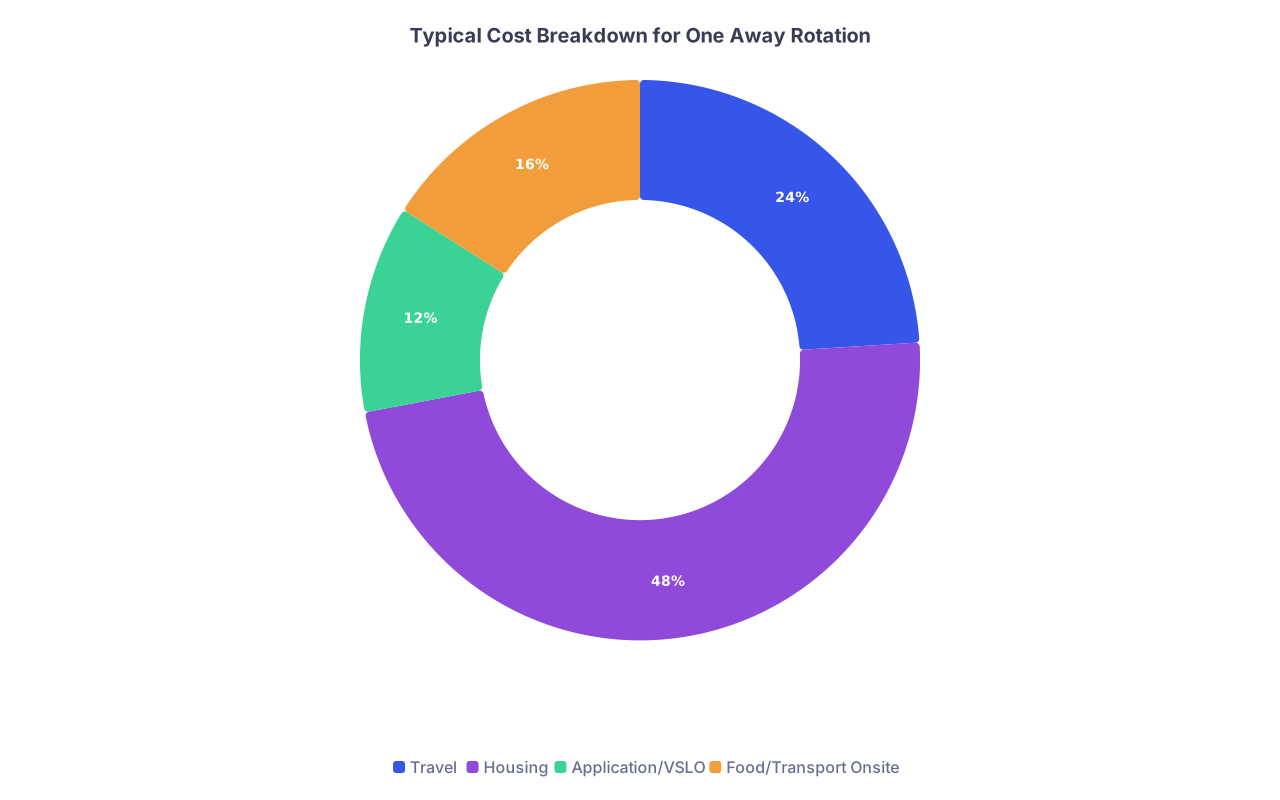
| Category | Value |
|---|---|
| Travel | 600 |
| Housing | 1200 |
| Application/VSLO | 300 |
| Food/Transport Onsite | 400 |
And this is before interviews.
Programs don’t usually factor that into how much they value your rotation. But you should.
Time cost is real too:
- 4 weeks on an away = 4 weeks not:
- Strengthening research output
- Improving Step 2 score
- Building depth at your home institution
- Actually resting before ERAS insanity
I've watched students sacrifice a potential Step 2 bump of 5–10 points to cram in “just one more away.” Then they were surprised when programs cared more about that score than which city they rounded in July.
If you were an objective decision-maker looking at your own life, you’d treat aways like a high-risk investment, not a default requirement.
When an Away Rotation Actually Makes Strategic Sense
Now, the part everyone actually needs: When should you actually do an away? There are legitimate cases.
Here’s my blunt checklist. An away rotation probably makes strategic sense if:
You’re applying to a very competitive specialty and
- You have at least a somewhat competitive Step 2 and transcript.
- Your home program is weak, small, or nonexistent in that field.
- You can target programs where you’re within range, not just your fantasy list.
You have geographic needs or constraints that matter:
- Dual-career couples needing specific cities.
- Strong family or visa-related constraints.
- You’re aiming to break into a region where your school has zero presence.
You’re using it to clarify true fit, not just to impress:
- You honestly want to know: Do I like a busy county hospital vs quaternary center?
- You’re deciding between coasts or lifestyle vs powerhouse programs.
Your performance is consistent and resilient under pressure:
- You tend not to choke in new settings.
- You can take feedback, adapt in real time, and not crumble from one bad day.
If you don’t hit at least one of those, you’re probably doing an away because everyone else is, or because it feels like “more is better.” That’s not strategy. That’s herd behavior.
How to Not Let an Away Rotation Backfire
If you do choose to do one, the main goal is not “be extraordinary.” It’s “be consistently solid and easy to work with.”

| Step | Description |
|---|---|
| Step 1 | Considering Away Rotation |
| Step 2 | Skip or Limit Aways |
| Step 3 | Select Targeted Programs |
| Step 4 | Prepare: EMR, Culture, Expectations |
| Step 5 | On Rotation: Show Up, Be Solid |
| Step 6 | Secure Neutral-to-Positive Eval |
| Step 7 | Potential Harm to Application |
| Step 8 | Competitive Specialty or Geo Need? |
| Step 9 | Red Flags? |
On the ground, that looks like:
- Learn the EMR and note templates fast. Ask interns, not attendings.
- Be visibly helpful but not clingy:
- Carry the list.
- Pre-chart.
- Volunteer for scut that actually frees residents (discharges, follow-up calls, paging consults).
- Read a bit each night, but don’t fake knowledge. “I’m not sure, but I read X and thought Y; can I check that?” beats bluffing.
- Do not try to re-engineer their system. You’re temporary staff, not a consultant.
- Watch the residents. Match their style, pace, and communication norms.
The ceiling on your eval will mostly be set by your baseline clinical skill. The floor is set by your professionalism, humility, and ability to not be annoying. Protect the floor.
The Bottom Line: Are Away Rotations Worth It?
If you’re looking for a universal rule, you’re going to be disappointed. But here’s the distilled version you actually need.
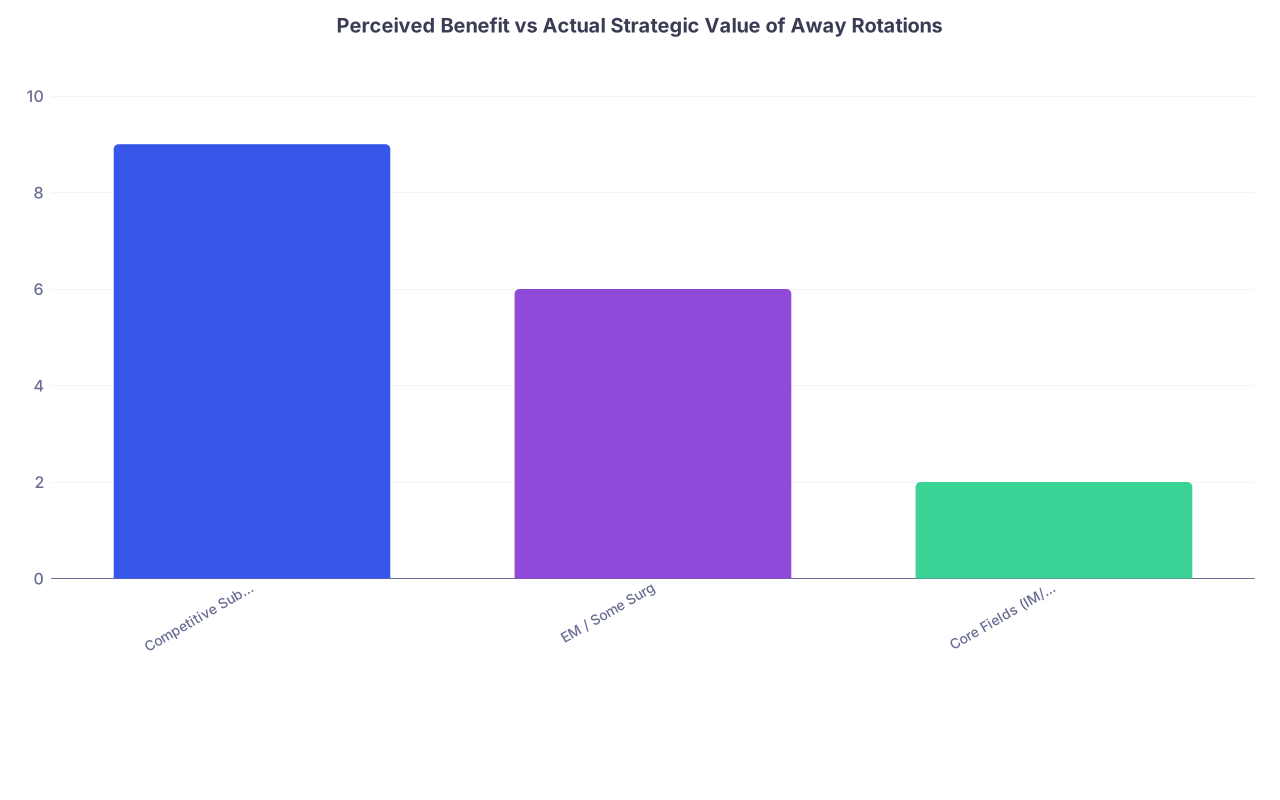
| Category | Value |
|---|---|
| Competitive Subspecialties | 9 |
| EM / Some Surg | 6 |
| Core Fields (IM/Peds/FM/Psych) | 2 |
(Think of those numbers as “how much an away rotation can matter,” not how often it will help you personally.)
Key Takeaways
- Away rotations rarely boost evaluations beyond what you’re already capable of; they mostly give programs a chance to confirm you’re safe and not a bad fit.
- The stress and cost are very real, and for many students—especially in core fields—the return on that investment is marginal at best.
- Aways make strategic sense only when they’re tightly aligned with specialty competitiveness, geographic constraints, or clear program targeting—not just because “everyone else is doing them.”